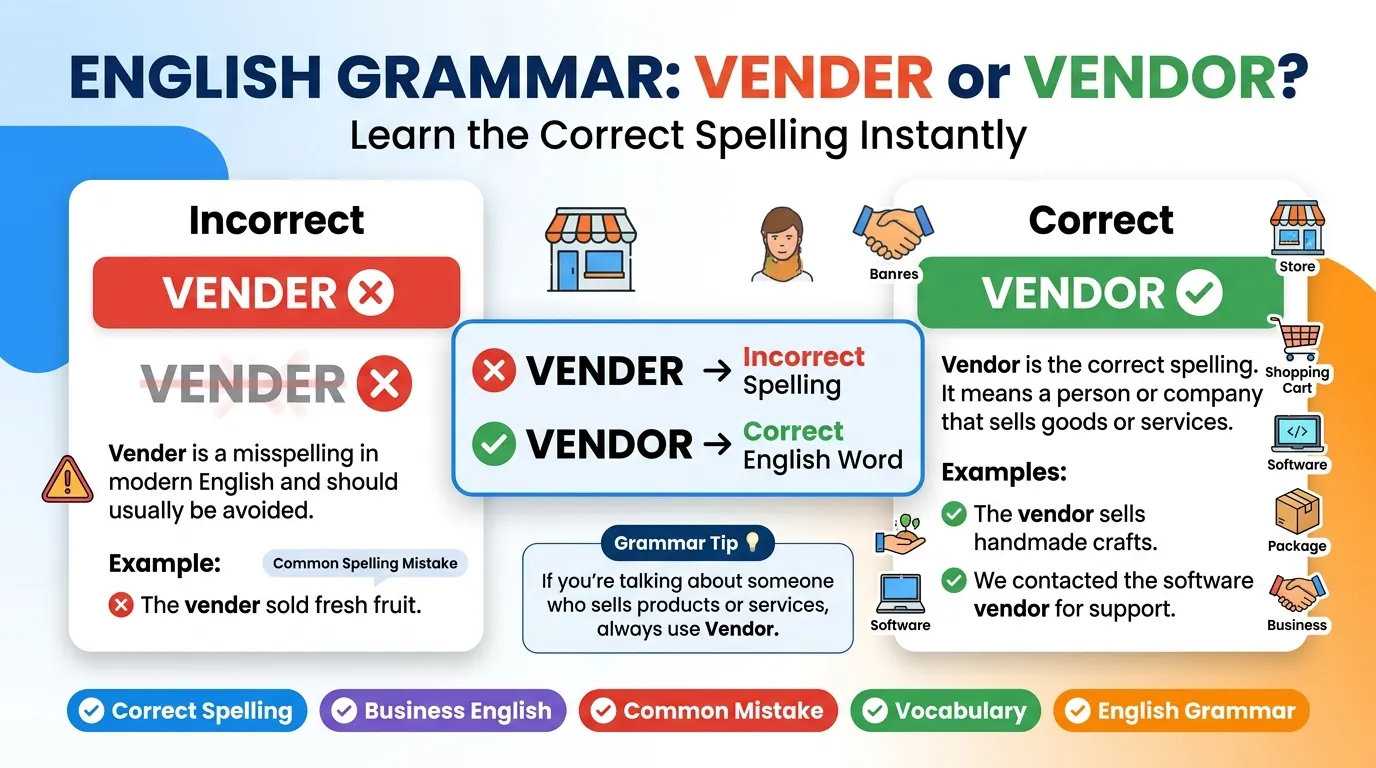
Quick Answer: If you’re wondering “vender vs vendor which is correct?”, the correct spelling for modern English is vendor.
While vender is a real but uncommon alternative found in some historical and legal references, vendor is the standard spelling used in business, technology, education, procurement, and everyday writing.
If you’re writing professionally, always choose vendor. If you’ve ever paused while typing vendor and wondered whether vender might also be correct, you’re not alone.
Thousands of people search for vender vs vendor, vendor or vender, and is vendor correct every month because the two words sound almost identical.
This confusion is common among students, professionals, business owners, and English learners alike.
The good news is that the answer is straightforward. In this complete grammar guide, you’ll learn the vendor meaning, vender meaning, the vendor vs vender difference, their history, pronunciation, real-world usage, and why one spelling dominates modern English.
You’ll also discover practical examples, business applications, and expert tips to help you avoid one of the most common English spelling mistakes.
Quick Answer
Here’s the simple answer most readers are looking for:
- ✅ Vendor is the correct and preferred spelling.
- ⚠️ Vender is an uncommon alternative spelling that survives mainly in older legal or historical texts.
- ✅ Use vendor in business documents, contracts, websites, resumes, emails, and academic writing.
So, if you’re asking “is vender or vendor correct?”, the answer is that vendor is the spelling almost everyone should use today.
What Does Vendor Mean?
The vendor meaning is a person, company, or organization that sells products or services to another person or business. The standard vendor definition applies across many industries, including retail, technology, healthcare, government, manufacturing, and e-commerce.
In modern business terminology, a vendor is often responsible for supplying goods, software, equipment, or professional services. Companies work with vendors every day to purchase everything from office furniture to cloud computing solutions.
Vendor Definition in Business
The vendor definition in business is more specific than simply “someone who sells.”
A business vendor typically:
- Supplies products or services
- Signs commercial agreements
- Issues invoices
- Receives purchase orders
- Works under vendor contracts
- Maintains long-term business relationships
For example, a company may purchase accounting software from a software vendor, medical equipment from a healthcare vendor, or construction materials from a commercial supplier.
Vendor Meaning with Examples
Understanding the vendor meaning with examples makes the concept much easier.
Examples:
- Our software vendor released a major security update.
- The company selected a trusted approved vendor after evaluating several suppliers.
- Every food vendor at the festival passed the health inspection.
- We compared prices from multiple commercial vendors before making a purchase.
- The purchasing department approved a new IT vendor for cybersecurity services.
- The online marketplace allows thousands of independent vendors to sell products.
- Our business receives monthly invoices from each registered vendor.
These vendor examples show how widely the word is used in professional and commercial settings.
What Does Vender Mean?
Many people search for the vender meaning because they occasionally encounter the spelling in older books, archived documents, or legal materials.
The vender definition is essentially the same as vendor—a person who sells goods or services. However, unlike vendor, vender is rarely used in modern English.
Today, you’ll almost always see vendor in:
- Business communication
- Professional writing
- Technology
- Procurement
- Retail
- Government documents
- Educational materials
If you’re wondering “is vender a word?”, the answer is yes. It exists, but it is considered a rare or historical spelling rather than the standard form.
Vender vs Vendor: What Is the Difference?
One of the most common questions is “what is the difference between vender and vendor?”
Interestingly, the difference isn’t about meaning—it’s about usage and acceptance.
Both words describe someone who sells products or services, but only vendor has become the standard spelling in modern English.
| Feature | Vendor | Vender |
| Modern English | ✅ Standard | ❌ Rare |
| Business writing | ✅ Recommended | ❌ Avoid |
| Academic writing | ✅ Preferred | ❌ Rare |
| Technology industry | ✅ Common | ❌ Uncommon |
| Procurement documents | ✅ Standard | ❌ Rare |
| Everyday communication | ✅ Yes | ❌ No |
When discussing the vendor vs vender difference, remember that the spelling vendor is universally recognized by businesses, educational institutions, publishers, and professional organizations.
Why Do People Confuse Vender and Vendor?
The confusion surrounding vendor or vender has several causes.
They Sound Almost Identical
Both words have nearly the same pronunciation. Because English speakers often spell unfamiliar words based on sound, many people naturally type vender instead of vendor.
This makes the pair one of the most frequently discussed commonly confused words in English.
The Verb “Vend”
Many learners assume that because the verb is vend, the noun should logically become vender.
However, English vocabulary doesn’t always follow predictable spelling patterns. Over time, vendor became the accepted noun in legal and commercial English, while vender gradually fell out of everyday use.
Older Dictionaries
Some historical dictionaries and legal publications still list vender, which leads people to believe both spellings are equally common.
In reality, modern dictionaries consistently present vendor as the standard spelling for contemporary writing.
The History and Origin of Vendor
Understanding the history of the word helps explain why vendor became the preferred spelling.
The noun vendor comes from Anglo-French and Latin roots related to the act of selling. It entered English centuries ago through legal and commercial language, where it referred to someone transferring ownership of property or goods.
Although the verb vend means “to sell,” the noun evolved as vendor, not vender. Over time, publishers, businesses, educators, and dictionaries adopted vendor as the standard spelling.
Today, vender survives mainly in historical records, older legal documents, and archived texts, while vendor dominates modern English.
American vs British English
Many people assume this is another case like color vs colour or organize vs organise, but that’s not true.
When comparing American vs British English, there is virtually no spelling difference.
| English Variety | Preferred Spelling |
| American English | Vendor |
| British English | Vendor |
| Canadian English | Vendor |
| Australian English | Vendor |
Whether you’re writing for readers in New York, London, Toronto, or Sydney, vendor is the accepted spelling.
When Should You Use Vendor?
If you’re unsure whether vendor fits your situation, this quick guide can help.
| Situation | Recommended Spelling |
| Business email | ✅ Vendor |
| Resume or CV | ✅ Vendor |
| Company website | ✅ Vendor |
| Procurement documents | ✅ Vendor |
| Vendor agreement | ✅ Vendor |
| Purchase order | ✅ Vendor |
| Academic assignment | ✅ Vendor |
| Historical quotation | ⚠️ Vender may appear if quoting the original source |
Following this simple rule ensures you’re using the correct English spelling in both professional writing and everyday communication.
Why Correct Spelling Matters
Choosing the correct spelling isn’t only about grammar—it also influences credibility.
Imagine sending a proposal to a client that repeatedly uses vender instead of vendor. Even though readers may understand your meaning, the unusual spelling can make your writing appear less polished.
Using the standard vendor spelling helps:
- Build trust with readers
- Improve business communication
- Strengthen professional writing
- Demonstrate attention to detail
- Support clear contracts and vendor agreements
- Improve readability for global audiences
It also aligns with Google’s E-E-A-T principles by showing expertise and accuracy in educational content.
Real-Life Examples of Vendor
Learning how to use vendor in a sentence is one of the easiest ways to remember the correct spelling.
Here are examples from different industries.
Technology
- Our software vendor provides cloud security solutions.
- The IT department compared three vendors before purchasing new software.
Procurement
- The purchasing team added the supplier to the approved vendor list.
- Every procurement vendor must complete the registration process before receiving a purchase order.
Retail
- The shopping mall welcomed several new retail vendors this month.
- Every marketplace seller must verify their business information.
Events
- Each food vendor received a designated booth before the festival opened.
- Wedding vendors coordinated closely with the event planner to ensure everything ran smoothly.
Seller vs Vendor: Understanding the Difference
Many people use seller and vendor interchangeably, but they are not always the same. Understanding the seller vs vendor difference can improve your business communication and help you use the right term in professional writing.
A seller is anyone who sells a product or service. This could be an individual selling a used phone online, a local shop owner, or a large corporation.
A vendor, on the other hand, usually refers to a person or company that regularly supplies goods or services to customers or other businesses under a commercial relationship. Vendors often work through contracts, issue invoices, and receive purchase orders.
| Seller | Vendor |
| General term for anyone who sells | Business-specific term |
| Can sell occasionally | Usually sells professionally |
| May not have a formal agreement | Often works under vendor agreements or contracts |
| Common in everyday conversations | Common in business and procurement |
For example:
- A person selling a bicycle online is a seller.
- A company providing office equipment to multiple businesses is a vendor.
Supplier vs Vendor: Are They the Same?
Another common comparison is supplier vs vendor. While the terms are closely related, they describe different roles within the procurement process and supply chain.
A supplier provides raw materials, inventory, or components that help another business produce or deliver products. A vendor generally sells finished products or services directly to a business or customer.
For example:
- A steel manufacturer supplying metal to a car factory is a supplier.
- A company selling accounting software to that factory is a software vendor.
In many industries, a business may work with dozens of suppliers but maintain an approved vendor list for purchasing products and services.
Where Is the Word “Vendor” Commonly Used?
The word vendor appears in many professional industries, making it an essential part of modern business terminology.
Technology
Technology companies frequently work with:
- Software vendor
- Cloud vendor
- Hardware vendor
- IT vendor
Organizations compare different vendors before purchasing software, cybersecurity solutions, or cloud services.
Procurement and Purchasing
In procurement, businesses carefully manage relationships with vendors through:
- Vendor registration
- Vendor management
- Vendor agreement
- Purchase order
- Invoice processing
- Vendor payment
- Approved vendor lists
These processes help organizations maintain quality, reduce risk, and build long-term supplier relationships.
Retail and E-commerce
Retail businesses rely on:
- Retail vendor
- Commercial vendor
- Marketplace seller
- Online vendor
For example, online marketplaces connect customers with thousands of vendors selling products across different categories.
Events and Hospitality
You’ll also hear the word vendor when discussing:
- Food vendors
- Wedding vendors
- Event vendors
- Exhibition vendors
- Trade show vendors
These businesses provide products or services during events and exhibitions.
Common Mistakes to Avoid
Even native English speakers make mistakes with vender vs vendor. Here are the most common ones.
Mistake 1: Using “Vender” in Professional Writing
❌ Our software vender provides excellent customer support.
✅ Our software vendor provides excellent customer support.
Mistake 2: Assuming Both Spellings Are Equally Common
Although vender exists, it is not commonly used today. Modern businesses, universities, publishers, and government organizations overwhelmingly use vendor.
Mistake 3: Ignoring Business Context
If you’re writing contracts, invoices, purchase orders, procurement documents, or business reports, always choose vendor.
Mistake 4: Relying Only on Pronunciation
Since both words sound almost the same, many people spell them based on pronunciation instead of checking the accepted spelling.
Easy Memory Trick
Need a quick way to remember the correct spelling?
Think of the letter O in vendor as representing Organization.
Organizations work with vendors.
Businesses hire vendors.
Companies pay vendors.
Whenever you write about commerce, procurement, or professional services, choose vendor.
Why Correct Spelling Matters
Using the correct spelling does more than improve grammar—it builds trust and professionalism.
Whether you’re writing a resume, business proposal, website article, procurement document, or email, using vendor instead of vender demonstrates attention to detail.
Correct spelling also:
- Improves writing accuracy
- Enhances professional credibility
- Strengthens business communication
- Helps readers understand your message instantly
- Supports search engine optimization by matching common search terms
- Aligns with Google’s E-E-A-T principles through accurate, trustworthy content
For businesses, consistent terminology also creates clearer contracts, purchase orders, invoices, and vendor agreements.
Key Takeaways
Before finishing, remember these important points:
- Vendor is the correct and standard spelling in modern English.
- Vender is a rare historical or legal variant.
- Both words have the same basic meaning, but vendor is preferred worldwide.
- There is no meaningful difference between American and British English for this word.
- Use vendor in business communication, contracts, academic writing, websites, and everyday English.
If you’re ever unsure about vendor or vender, choosing vendor is the safest and most professional decision.
FAQs
1. Vender vs vendor: Which is correct?
When comparing vender vs vendor, vendor is the accepted spelling in modern English. It is the version used in business, education, technology, and professional communication.
2. Is vender a word?
Yes. Vender is a real word, but it is uncommon and mainly appears in historical writings or certain legal references. Modern writers should use vendor.
3. What is the difference between vender and vendor?
The vendor vs vender difference is one of usage, not meaning. Both refer to someone who sells goods or services, but vendor is the standard spelling today.
4. Why is vendor spelled with “o”?
Many people ask, “why is vendor spelled with o?” Although the verb is vend, the noun developed historically as vendor, and that spelling became standardized through legal and commercial English.
5. How do you use vendor in a sentence?
Here are two examples:
- The software vendor released a new update.
- We chose an approved vendor after reviewing several proposals.
These examples show how to use vendor in a sentence naturally.
6. Is vendor used in business English?
Yes. Vendor is widely used in procurement, finance, healthcare, retail, manufacturing, government contracts, and technology.
7. Can I use vender in business documents?
It’s not recommended. Modern style guides and professional writing standards strongly favor vendor.
8. Is there a difference between American and British English?
No. Both American and British English use vendor as the standard spelling.
Final Thoughts
The debate over vender vs vendor often confuses writers because both words exist, but modern usage leaves little room for doubt.
While vender survives as a historical or legal variant, vendor is the standard spelling recognized by businesses, publishers, educational institutions, and dictionaries around the world.
If you’re discussing a software vendor, a retail vendor, a commercial vendor, or an approved vendor, using the accepted spelling improves clarity and professionalism.
Understanding the vendor meaning, the vendor definition in business, and the subtle distinctions between seller vs vendor and supplier vs vendor helps you communicate more accurately.
By choosing vendor consistently, you’ll avoid one of the most common English spelling mistakes, strengthen your professional writing, and ensure your content meets the expectations of both readers and search engines.
Actionable Takeaway
Before publishing any email, report, contract, blog post, or business document, search for the word “vender.” If it isn’t part of a historical quotation or legal source, replace it with vendor.
This simple proofreading habit will improve your writing accuracy, reinforce your credibility, and ensure you’re using the correct spelling every time.

Aaron Adam is the Administrator of SpellExact, dedicated to helping readers improve their spelling and writing accuracy. He oversees content quality, ensures reliable language resources, and works to make spelling guidance simple, practical, and accessible for everyone.