If you have searched for 300 Blackout vs 5.56, you may wonder whether these terms describe the same ammunition or two different cartridges. They describe two different rifle cartridges, each with its own dimensions, projectile diameter, and ballistic characteristics. You may also see names such as “.300 Blackout,” “300 BLK,” “5.56 NATO,” and “5.56×45mm NATO” when researching them.
The main difference comes down to projectile size and cartridge design. 300 Blackout uses a larger .30-caliber projectile, while 5.56×45mm NATO uses a smaller 5.56 mm projectile. Both cartridges can appear in discussions about similar firearm platforms, which can create confusion for beginners. This guide explains the terminology and key differences in straightforward English so students, ESL learners, beginners, and general readers can understand the comparison more easily.
Quick Answer
300 Blackout and 5.56 are different rifle cartridges. People commonly call 300 Blackout 300 BLK or .300 AAC Blackout, and it uses a larger .30-caliber projectile. People commonly use 5.56 to mean 5.56×45mm NATO, which uses a smaller 5.56 mm projectile. You should not treat these cartridges as interchangeable.
Why Do People Confuse 300 Blackout and 5.56?
People often compare 300 Blackout vs 5.56 because both cartridges appear in discussions about modern sporting rifles and similar firearm platforms.
Their names can also confuse beginners because the abbreviations do not immediately explain what each cartridge represents.
For example:
- People commonly abbreviate 300 Blackout as 300 BLK.
- People often shorten 5.56×45mm NATO to 5.56 NATO or simply 5.56.
- Manufacturers and technical sources may use .300 AAC Blackout for 300 Blackout.
- Writers may use 5.56 NATO when referring to 5.56×45mm NATO.
Although these cartridges can appear with related firearm platforms, they remain different cartridges. You should never assume that similar platforms make their ammunition interchangeable.
What Is 300 Blackout?
300 Blackout refers to a rifle cartridge that uses a .30-caliber projectile. Its formal designation commonly appears as .300 AAC Blackout, while many people simply call it 300 BLK. For technical cartridge and chamber specifications, you can refer to the SAAMI cartridge and ammunition standards.
The cartridge gives shooters a different combination of projectile size and ballistic characteristics from cartridges such as 5.56×45mm NATO.
The “300” in the name refers approximately to the projectile’s diameter in inches: .300 inch, or about 7.62 mm.
The word Blackout forms part of the cartridge’s name. It does not represent another name for 5.56.
What Does 300 BLK Mean?
300 BLK serves as a common abbreviation for 300 Blackout.
You may therefore see the following names referring to the same cartridge:
- 300 Blackout
- 300 BLK
- .300 BLK
- .300 AAC Blackout
What Is 5.56?
5.56 commonly refers to the 5.56×45mm NATO cartridge.
The name gives two important measurements. The 5.56 refers approximately to the projectile diameter in millimeters, while 45mm refers to the nominal case length.
People around the world have used this cartridge extensively in military and civilian contexts.
You should also distinguish 5.56×45mm NATO from .223 Remington. These cartridges share closely related dimensions, but their chamber and pressure specifications can differ. Always follow the exact chamber designation and ammunition guidance from the firearm manufacturer.
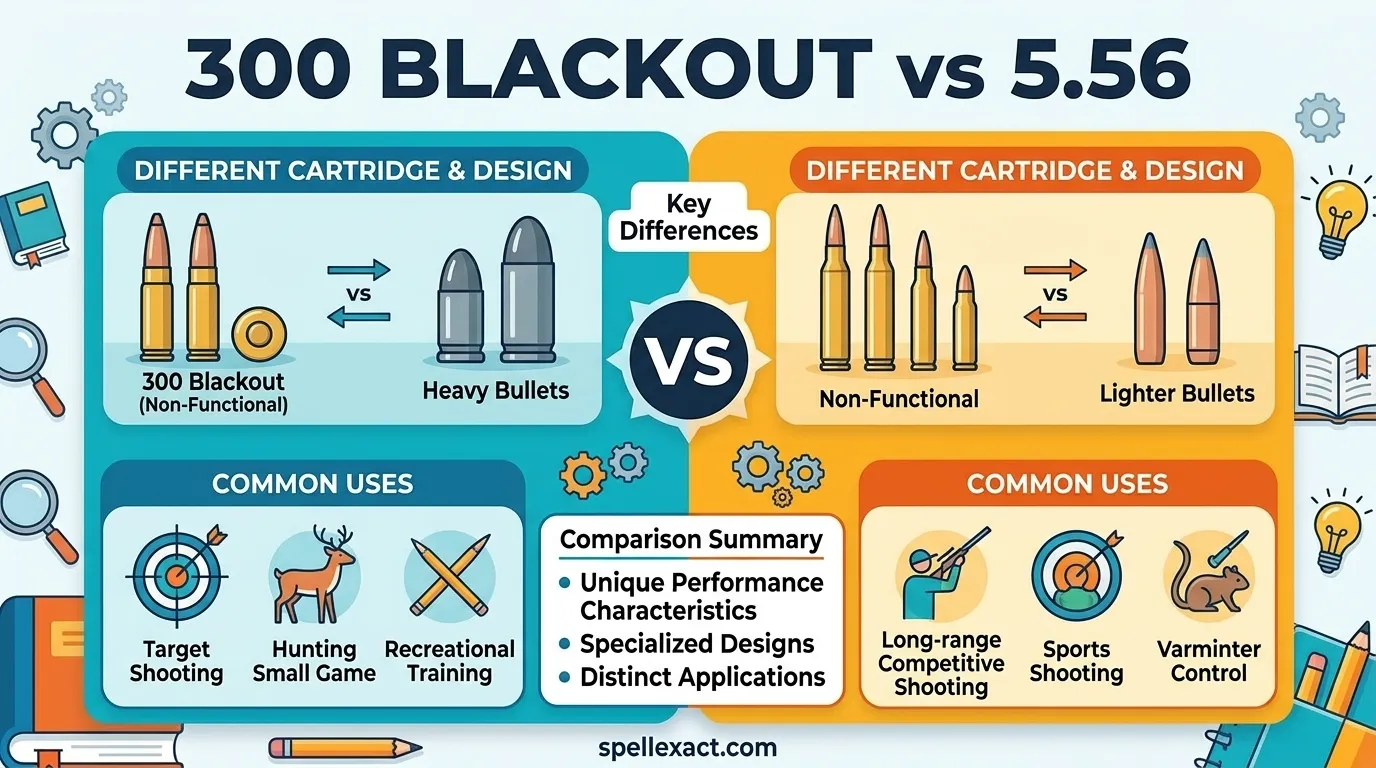
300 Blackout vs 5.56: Comparison Table
| Feature | 300 Blackout | 5.56×45mm NATO |
| Common abbreviation | 300 BLK | 5.56 NATO |
| Projectile diameter | About .30 inch / 7.62 mm | About .22 inch / 5.56 mm |
| Cartridge type | Rifle cartridge | Rifle cartridge |
| Common formal name | .300 AAC Blackout | 5.56×45mm NATO |
| Projectile size | Larger | Smaller |
| General design | Uses a larger projectile and offers different ballistic characteristics | Uses a smaller projectile and offers different ballistic characteristics |
| Common platform association | Often appears with AR-pattern rifles | Widely appears with AR-pattern rifles |
| Interchangeability | Not interchangeable with 5.56 | Not interchangeable with 300 Blackout |
| Common terminology | 300 Blackout, 300 BLK, .300 AAC Blackout | 5.56, 5.56 NATO, 5.56×45mm NATO |
When Do People Use 300 Blackout?
People discuss 300 Blackout in several firearm-related contexts because the cartridge provides a different combination of projectile diameter and ballistic characteristics from 5.56.
You may encounter 300 Blackout in:
- Firearm and ammunition specifications
- Cartridge comparisons
- Shooting-sports discussions
- Hunting discussions where local laws permit
- Military and firearm history
- Technical firearm literature
- Ammunition identification
The appropriate cartridge depends on the firearm, its chambering, applicable laws, and the manufacturer’s specifications.
When Do People Use 5.56?
People widely discuss 5.56×45mm NATO in military, law-enforcement, sporting, and civilian firearm contexts, depending on the jurisdiction and applicable regulations.
You may encounter 5.56 in:
- Firearm specifications
- Ammunition packaging
- Military history
- Shooting-sports discussions
- Technical manuals
- Cartridge comparisons
- Firearm education materials
For any specific firearm, always check the manufacturer’s markings and documentation to identify the correct cartridge.
10+ Examples of 300 Blackout and 5.56 in Context
Here are simple examples that show how writers use these terms:
- This article compares 300 Blackout and 5.56 cartridges.
- People commonly use 300 BLK as another name for 300 Blackout.
- The firearm manufacturer lists the chambering as 5.56×45mm NATO.
- The specifications identify the cartridge as 300 AAC Blackout.
- The article explains the difference between 300 BLK and 5.56.
- Many writers use 5.56 as a shortened reference to 5.56×45mm NATO.
- 300 Blackout and 5.56 use different projectile diameters.
- The firearm manual identifies the chambering as 5.56×45mm NATO.
- The product description distinguishes 300 BLK from 5.56.
- Beginners may confuse 300 Blackout with 5.56 because both cartridges appear with similar rifle platforms.
- The comparison explains why 300 BLK and 5.56 are not interchangeable cartridges.
- Technical sources may use both 300 Blackout and 300 BLK to describe the same cartridge.
Common Mistakes
Mistake 1: Thinking 300 Blackout and 5.56 Mean the Same Cartridge
They do not. Each cartridge has different specifications and a different projectile diameter.
Mistake 2: Assuming Similar Platforms Make Ammunition Interchangeable
A firearm platform can support different chamberings. The platform name alone cannot tell you which cartridge a particular firearm uses.
Mistake 3: Treating 300 BLK as a Separate Cartridge
300 BLK simply abbreviates 300 Blackout. The two names refer to the same cartridge.
Mistake 4: Assuming 5.56 and .223 Remington Have Identical Specifications
The two cartridges have closely related dimensions, but their standardized specifications can differ. Always follow the firearm manufacturer’s chamber designation and ammunition instructions.
Mistake 5: Identifying Ammunition by Appearance
Do not rely on visual similarity when identifying ammunition. Check the markings and specifications instead.
Memory Trick
Use this simple memory trick:
300 Blackout = bigger .30-caliber projectile
5.56 = smaller 5.56 mm projectile
You can also remember the names like this:
300 BLK → .30 caliber
5.56 → 5.56 mm
Keep in mind that the naming systems use different measurement conventions. Therefore, you should not compare the numbers as though they represent exactly the same type of measurement.
American vs British English
American and British English generally use the same cartridge names when discussing these terms.
You may see:
- 300 Blackout
- 300 BLK
- .300 AAC Blackout
- 5.56 NATO
- 5.56×45mm NATO
Technical writers may prefer formal cartridge designations, while casual writers often use shorter names.
The main spelling difference appears in the general word caliber:
- American English: caliber
- British English: calibre
For example:
- American English: .30-caliber cartridge
- British English: .30-calibre cartridge
The cartridge name itself does not change between these forms of English.
Similar Words and Terms
If you research 300 Blackout vs 5.56, you may encounter these related terms:
- 300 BLK
- .300 AAC Blackout
- 5.56 NATO
- 5.56×45mm NATO
- .223 Remington
- 7.62 mm
- .30 caliber
- rifle cartridge
- ammunition
- cartridge
- projectile
- bullet
- chambering
- caliber
- calibre
These words relate to firearms and ammunition, but they do not all mean the same thing. For example, cartridge, bullet, ammunition, and caliber describe different concepts.
Final Verdict
The basic difference is straightforward: 300 Blackout and 5.56 are two different rifle cartridges. 300 Blackout uses a projectile of approximately .30 inch, while 5.56×45mm NATO uses a projectile of approximately 5.56 mm.
Both cartridges can appear in discussions involving similar firearm platforms, but their specifications differ. You should always match ammunition to the exact chambering specified by the firearm manufacturer rather than relying on the platform’s appearance or general similarities.
FAQs
Is 300 Blackout the same as 5.56?
No. 300 Blackout and 5.56×45mm NATO are different cartridges with different specifications and projectile diameters.
What does 300 BLK stand for?
300 BLK commonly stands for 300 Blackout, also known as .300 AAC Blackout.
Is 300 Blackout bigger than 5.56?
Yes, when comparing projectile diameter, 300 Blackout uses a larger projectile. It measures approximately .30 inch, while 5.56×45mm NATO uses a projectile measuring approximately 5.56 mm.
Is 5.56 the same as .223 Remington?
No, not exactly. The cartridges have closely related dimensions, but their standardized chamber and pressure specifications can differ. Check the firearm manufacturer’s designation before selecting ammunition.
Can you use 300 Blackout and 5.56 interchangeably?
No. They are different cartridges, so you should not treat them as interchangeable. Always match ammunition to the firearm’s specified chambering.
Why do people compare 300 Blackout and 5.56?
People frequently compare them because both cartridges appear in discussions about similar modern rifle platforms and firearm applications.
What does the 5.56 in 5.56×45mm mean?
The 5.56 refers approximately to the projectile diameter in millimeters, while 45mm refers to the nominal case length.
What does caliber mean?
Caliber generally describes the approximate internal diameter of a firearm bore or the approximate diameter of a projectile, depending on the context. Cartridge naming systems can make this terminology more complicated for beginners.
Remember This
300 Blackout = 300 BLK = .300 AAC Blackout
5.56 = commonly 5.56×45mm NATO
These names describe different cartridges, not different names for the same ammunition.
The easiest distinction to remember is that 300 Blackout uses a larger .30-caliber projectile, while 5.56 uses a smaller 5.56 mm projectile.
Understanding these terms can help you read firearm specifications, technical articles, ammunition labels, and educational resources more accurately. If you need to identify the correct cartridge for a particular firearm, rely on the manufacturer’s documentation and markings rather than appearance or assumptions.
300 Blackout and 5.56 may share some platform associations, but that similarity does not make their cartridges interchangeable. Learning the terminology helps prevent one of the most common sources of confusion when beginners research these two cartridge names.

Aaron Adam is the Administrator of SpellExact, dedicated to helping readers improve their spelling and writing accuracy. He oversees content quality, ensures reliable language resources, and works to make spelling guidance simple, practical, and accessible for everyone.