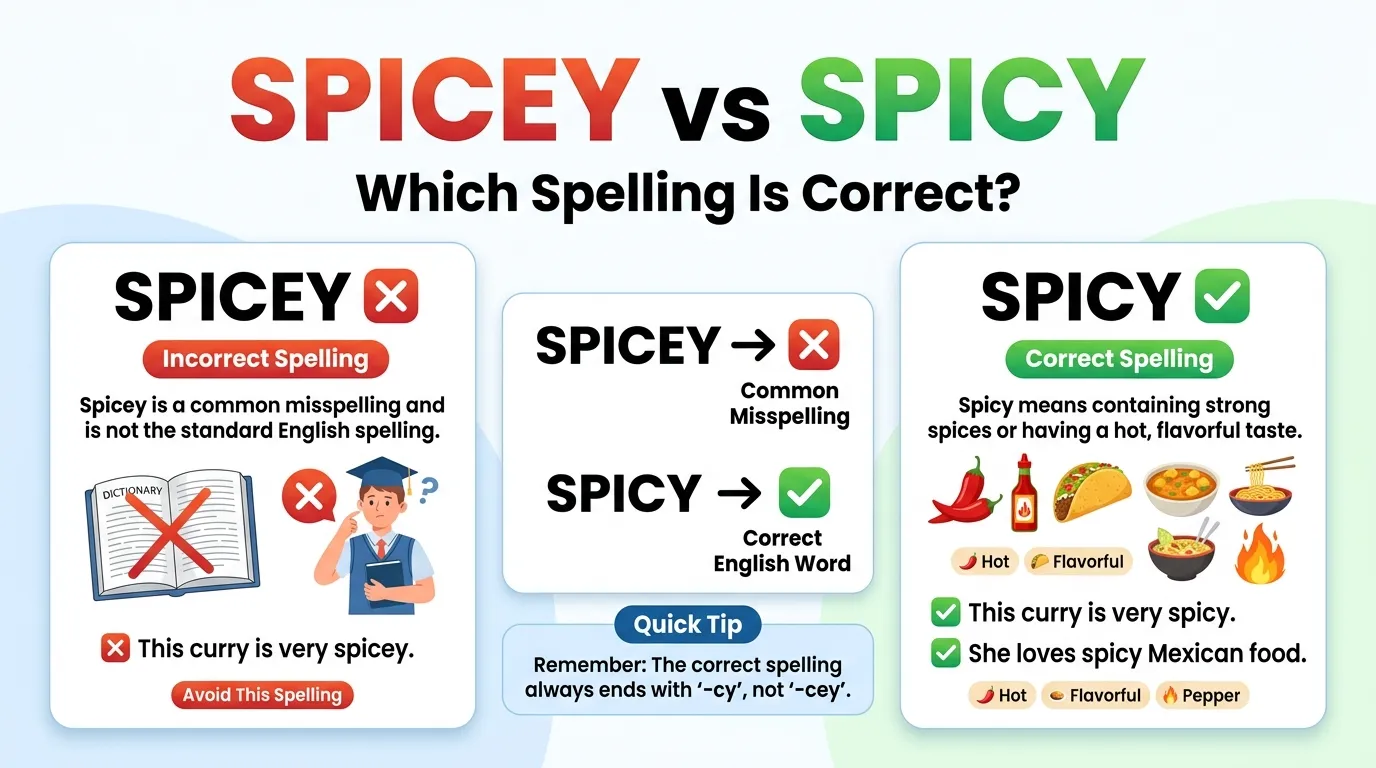
Spicy is the correct spelling; spicey is a common misspelling in standard English. Use spicy to describe food with a strong, warm, peppery, or hot flavor. If you are wondering whether to write spicey or spicy, always choose spicy in essays, recipes, menus, blog posts, emails, and professional writing.
The confusion between spicey vs spicy occurs because the noun spice ends in e, making spicey look logical. However, the correct adjective is formed by dropping the final e and adding y: spice → spicy. In this guide, you will learn the correct spelling of spicy, its meaning, pronunciation, grammatical forms, synonyms, common mistakes, and examples of how to use it naturally.
Quick Answer: Is It Spicey or Spicy?
The correct spelling is spicy, not spicey. Spicy is an adjective that describes food containing spices or having a warm, sharp, or hot flavor. It can also describe bold, exciting, or controversial conversations and situations in informal English.
- Correct: This chicken curry is spicy.
- Incorrect: This chicken curry is spicey.
- Correct: I enjoy spicy noodles.
- Incorrect: I enjoy spicey noodles.
- Correct: The sauce has a spicy flavor.
Remember: Spice becomes spicy, not spicey.
Spicey vs Spicy: What’s the Difference?
The main difference between spicey and spicy is spelling. Spicy is the standard English adjective, while spicey is generally considered a misspelling.
| Word | Correct or Incorrect? | Meaning | Recommended Usage |
| Spicy | Correct | Having a flavor associated with spices, warmth, or heat | Standard English writing |
| Spicey | Incorrect | A nonstandard spelling of spicy | Avoid in ordinary writing |
If you are searching for spicey vs spicy, which is correct, spicey or spicy, or is spicy correct, the answer is the same: use spicy in standard English.
The spelling spicey may occasionally appear in usernames, product names, branding, or informal online content. Such uses do not make it the standard spelling of the adjective.
What Does Spicy Mean?
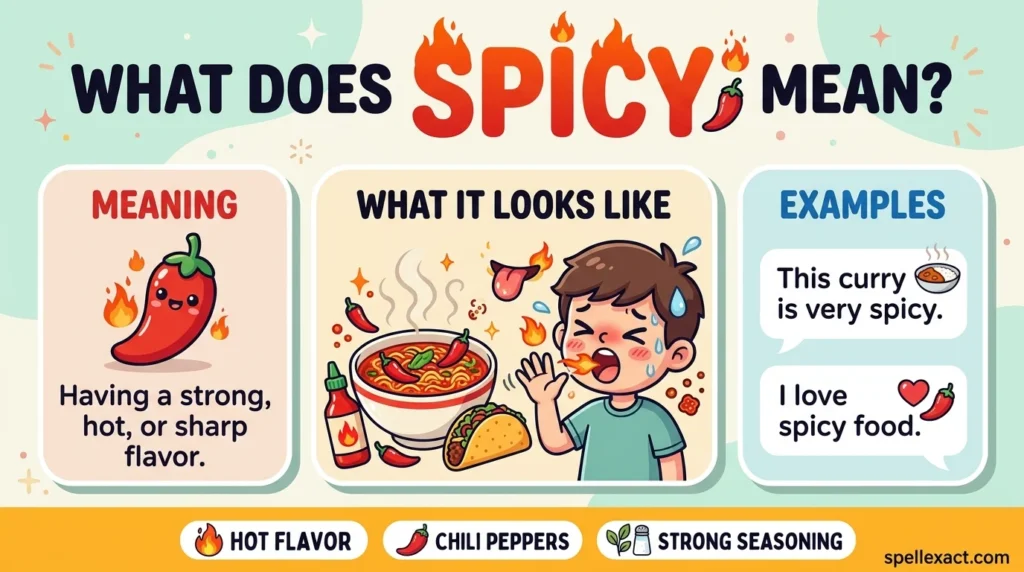
The meaning of spicy is having a noticeable flavor, warmth, or heat associated with spices and seasonings. It is most commonly used when describing food, but it can also describe certain smells, comments, jokes, and situations.
1. Spicy Meaning in Food
In cooking, spicy describes food that has a strong, warm, peppery, or hot flavor. Common ingredients that make food spicy include chili peppers, black pepper, ginger, mustard, cayenne, and hot sauce.
Examples:
- The soup is spicy because it contains red chili.
- She ordered a spicy chicken sandwich.
- This curry has a rich, spicy flavor.
- The restaurant serves spicy Thai noodles.
- I prefer mildly spicy food rather than extremely hot dishes.
Spicy does not always mean extremely hot. A dish can be mildly spicy, moderately spicy, or intensely hot depending on its ingredients and preparation.
2. Spicy Meaning Beyond Food
In informal English, spicy can describe something bold, exciting, provocative, or controversial. This figurative meaning is common in conversations, entertainment, social media, and casual writing.
Examples:
- The debate became spicy when the speakers disagreed.
- She shared some spicy opinions during the interview.
- His latest post contains a spicy joke.
- The conversation took a spicy turn after the unexpected question.
In these examples, spicy describes the tone or content rather than the physical heat of food.
Is Spicey a Word?
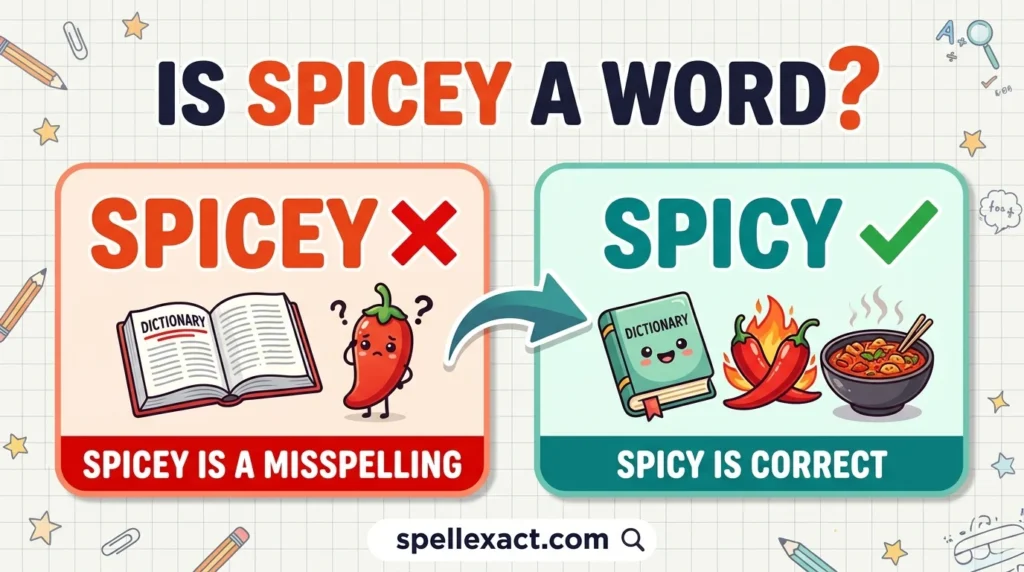
Spicey is not the standard spelling of spicy. Although you may encounter it online or in a name, it is not the accepted spelling for ordinary English writing.
If you are asking is spicey a word, the practical answer is that you should treat it as a misspelling when you mean food with spices or heat. Use spicy in school assignments, articles, restaurant menus, recipes, and professional communication.
Examples:
- Incorrect: This spicey sauce tastes delicious.
- Correct: This spicy sauce tastes delicious.
- Incorrect: We ordered spicey chicken wings.
- Correct: We ordered spicy chicken wings.
Why Is Spicy Not Spelled Spicey?
The spelling difference comes from how the adjective is formed from the noun spice. English sometimes drops a final silent e before adding a suffix beginning with a vowel or a letter combination that follows this pattern.
For this word, the standard spelling is:
Spice − e + y = Spicy
Compare these examples:
| Base Word | Correct Adjective | Common Misspelling |
| Spice | Spicy | Spicey |
| Ice | Icy | Icey |
| Juice | Juicy | Juicey |
| Grease | Greasy | Greasey |
These examples illustrate a useful spelling pattern, although English spelling has exceptions. Learning the established forms is the best way to avoid similar errors.
How to Remember the Correct Spelling
Use this simple memory trick:
- Start with the word spice.
- Remove the final e.
- Add y.
- Write spicy.
Think of the phrase: “Spice loses its e to become spicy.”
This reminder can help you avoid the common spicey spelling mistake when writing recipes, food reviews, articles, or everyday messages.
Spice vs Spicy: Understanding the Difference
Although spice and spicy are related, they have different grammatical roles.
| Word | Part of Speech | Meaning | Example |
| Spice | Noun | An ingredient used to add flavor to food | Cinnamon is a popular spice. |
| Spices | Plural noun | More than one spice | The recipe uses several spices. |
| Spicy | Adjective | Having a flavor associated with spices or heat | The curry is spicy. |
The easiest way to understand spice vs spicy is to remember that a spice is an ingredient, while spicy describes the flavor of something.
For example, chili powder is a spice, but a dish containing chili powder may be spicy.
How Do You Spell Spicy Correctly?
If you want to know how to spell spicy, remember that it contains five letters: S-P-I-C-Y.
The correct spelling is:
- S — first letter
- P — second letter
- I — third letter
- C — fourth letter
- Y — fifth letter
The incorrect form spicey contains an extra e. Do not add that letter when writing the adjective.
Correct examples include:
- Spicy food
- Spicy chicken
- Spicy sauce
- Spicy noodles
- Spicy curry
- Spicy snacks
- Spicy flavor
- Spicy aroma
Spicy Examples in Sentences
Learning spicy in a sentence helps you understand how the adjective works in everyday English.
Food-Related Examples
- This curry is too spicy for me.
- I enjoy spicy tacos with fresh salsa.
- The chef prepared spicy chicken with garlic and chili.
- These noodles taste spicy because of the chili oil.
- The restaurant offers mild and spicy versions of its soup.
- She added black pepper to give the sauce a spicy flavor.
- The spicy marinade works well with grilled vegetables.
- We ordered spicy wings for dinner.
Everyday and Figurative Examples
- The interview included some spicy questions.
- Their discussion became spicy after the disagreement.
- He made a spicy comment that surprised everyone.
- The comedian is known for spicy jokes.
- The online debate turned into a spicy exchange of opinions.
These examples demonstrate that the word can describe both literal flavor and figurative situations.
Common Spicey vs Spicy Mistakes
The spicey vs spicy confusion often appears in food descriptions, restaurant menus, online searches, and casual writing.
| Incorrect Phrase | Correct Phrase |
| Spicey food | Spicy food |
| Spicey chicken | Spicy chicken |
| Spicey sauce | Spicy sauce |
| Spicey noodles | Spicy noodles |
| Spicey curry | Spicy curry |
| Spicey chips | Spicy chips |
| Spicey wings | Spicy wings |
| Spicey flavor | Spicy flavor |
| Spiceyer than this | Spicier than this |
| Spiceyest dish | Spiciest dish |
When editing your writing, search for spicey and replace it with spicy wherever you mean the standard adjective. Check comparative and superlative forms separately.
Is Spicy Correct in American and British English?
Yes. Spicy is the correct spelling in both American and British English. It is also the standard spelling in Canadian and Australian English.
Unlike words such as color/colour and favorite/favourite, spicy vs spicey is not a regional spelling difference.
| English Variety | Correct Spelling |
| American English | Spicy |
| British English | Spicy |
| Canadian English | Spicy |
| Australian English | Spicy |
Whether you are writing for a US audience, a UK audience, or an international readership, choose spicy.
Is Spicy Only Used for Hot Food?
No. Spicy does not always mean food is extremely hot. It can describe a noticeable seasoning flavor, a warm sensation, or a sharp taste.
For example, ginger, black pepper, cinnamon, cloves, and mustard can create a spicy sensation without the intense chili heat associated with hot peppers.
Common descriptions include:
- Mildly spicy: A gentle warmth with little heat.
- Moderately spicy: A noticeable but manageable level of heat.
- Very spicy: Strong heat, often from chili peppers.
- Extremely spicy: Intense heat from particularly hot peppers or sauces.
These descriptions are useful in menus and recipes because people’s tolerance for heat varies.
Can Spicy Describe Flavor Without Chili?
Yes. Spicy can describe a warm or sharp flavor even when chili peppers are absent. The exact meaning depends on the ingredient and context.
Examples:
- Ginger tea has a warm, spicy taste.
- Black pepper gives the eggs a spicy bite.
- Mustard adds a sharp, spicy flavor to the sandwich.
- Cinnamon and cloves create a warm, spicy aroma.
- Horseradish and wasabi produce a sharp sensation that may be described as spicy.
In food writing, use more specific words such as peppery, sharp, warm, or pungent when they communicate the flavor more precisely.
Common Spicy Foods
Many cuisines use spices and peppers to create distinctive flavors. Common examples of spicy food include:
- Spicy chicken curry
- Spicy beef tacos
- Spicy ramen noodles
- Spicy buffalo wings
- Spicy biryani
- Spicy tomato salsa
- Spicy kimchi
- Spicy Sichuan hotpot
- Spicy grilled fish
- Spicy lentil soup
The word spicy can describe dishes from Indian, Pakistani, Mexican, Thai, Korean, Chinese, Caribbean, and Middle Eastern cuisines. However, not every dish in these cuisines is spicy; ingredients and preparation determine the flavor.
Synonyms of Spicy
The best synonyms for spicy depend on whether you mean heat, seasoning, sharpness, or a figurative tone. These words are related but are not always interchangeable.
| Synonym | Simple Meaning | Example Sentence |
| Hot | Having strong heat, often from chili | This sauce is hot. |
| Fiery | Extremely hot or intense | The wings have a fiery flavor. |
| Peppery | Tasting strongly of pepper | The salad has a peppery bite. |
| Piquant | Pleasantly sharp or stimulating in flavor | The sauce has a piquant taste. |
| Zesty | Fresh, lively, and sharp | The salsa tastes zesty. |
| Pungent | Having a strong smell or taste | Garlic has a pungent aroma. |
| Tangy | Having a sharp, often sour flavor | The chutney is tangy. |
| Well-seasoned | Flavored with an appropriate amount of seasoning | The rice is well-seasoned. |
| Bold | Having a strong, noticeable flavor or character | The stew has a bold flavor. |
| Flavorful | Having a rich or noticeable taste | The soup is flavorful. |
Use spicy when the main idea is a flavor associated with spices or heat. Choose tangy for sourness, peppery for pepper flavor, and fiery for intense heat.
For figurative meanings, words such as provocative, edgy, controversial, and bold may fit better, depending on the sentence.
What Are the Correct Word Forms of Spicy?
The standard word forms related to spicy include spice, spices, spicy, spicier, and spiciest.
| Word Form | Part of Speech | Meaning | Example |
| Spice | Noun | A flavoring ingredient | Cumin is a spice. |
| Spices | Plural noun | More than one spice | The recipe uses five spices. |
| Spicy | Adjective | Having a flavor associated with spices or heat | The curry is spicy. |
| Spicier | Comparative adjective | More spicy | This salsa is spicier than that one. |
| Spiciest | Superlative adjective | The most spicy | This is the spiciest dish on the menu. |
| Spicily | Adverb | In a spicy manner | The word is rarely needed in everyday writing. |
What Is the Comparative Form of Spicy?
The comparative form of spicy is spicier, and the superlative form is spiciest.
Examples:
- This curry is spicier than the soup.
- The red sauce is spicier than the green sauce.
- This is the spiciest ramen on the menu.
Although more spicy can occur in English, spicier is generally the more natural choice in ordinary comparisons.
Avoid spiceyer, spiceyest, and spicyest. The correct forms are spicier and spiciest.
What Is the Noun Form of Spicy?
The related noun is spice. It refers to an ingredient used to add flavor or aroma to food.
Examples include cinnamon, cumin, coriander, turmeric, paprika, cardamom, black pepper, and cloves.
- Noun: Black pepper is a spice.
- Adjective: The sauce is spicy.
What Is the Adverb Form of Spicy?
The adverb form is spicily, but it is uncommon in everyday English. Most writers can express the idea more naturally by using a phrase such as with a spicy flavor or in a spicy way.
For example:
- Natural: The dish has a spicy flavor.
- Less common: The dish was spicily prepared.
Is Spicy the Same as Hot?
Spicy and hot are related, but their meanings are not identical. Hot often refers to the burning sensation caused by chili peppers, while spicy can refer more broadly to flavors associated with spices and seasoning.
Examples:
- Spicy but not very hot: Ginger cookies with cinnamon.
- Hot and spicy: Chicken cooked with chili peppers.
- Spicy and aromatic: Lamb curry with cumin and cardamom.
- Hot sauce added: Plain noodles served with a strong chili sauce.
The distinction is helpful when describing food accurately or choosing a dish from a menu.
Can Spicy Describe a Smell?
Yes. Spicy can describe an aroma associated with spices, herbs, or strong seasonings.
Examples:
- The kitchen has a spicy smell from roasted cumin.
- The soup gives off a warm, spicy aroma.
- The bakery smells spicy because of cinnamon and cloves.
- The grilled meat has a smoky, spicy smell.
Words such as aromatic, peppery, and pungent may be more precise when describing a particular smell.
How to Fix Spicey in Your Writing
If you find spicey in an article, essay, recipe, or social media caption, use this simple editing process:
- Search your document for spicey.
- Replace it with spicy when you mean the standard adjective.
- Check comparative forms and change spiceyer to spicier.
- Change spiceyest or spicyest to spiciest.
- Read the complete sentence to confirm that the meaning remains clear.
- Use a reliable dictionary or spelling checker if you are uncertain.
For example:
- Incorrect: This spicey curry is too spicey for children.
- Correct: This spicy curry is too spicy for children.
A spelling checker can help identify errors, but checking the sentence in context is also important.
Commonly Misspelled Words Similar to Spicey
The confusion between spicey and spicy is one example of a broader challenge in English spelling. Reviewing other commonly confused words can improve writing accuracy.
| Incorrect Spelling | Correct Spelling |
| Spicey | Spicy |
| Shiney | Shiny |
| Tastey | Tasty |
| Icey | Icy |
| Reciept | Receipt |
| Occuring | Occurring |
| Thier | Their |
Some of these errors result from adding an unnecessary letter, while others involve letter order or consonant doubling. Learn each word’s accepted spelling rather than assuming that every word follows the same pattern.
Frequently Asked Questions
1. Is it spicey or spicy?
Spicy is correct. Spicey is a misspelling in standard English. Write spicy food, spicy sauce, spicy chicken, and spicy noodles.
2. Which is correct: spicey or spicy?
When comparing spicey vs spicy, choose spicy. It is the standard spelling in American, British, Canadian, and Australian English.
3. Is spicey a word?
Spicey may appear as an informal spelling or as part of a name, but it is not the standard spelling of the adjective. Use spicy in ordinary English writing.
4. How do you spell spicy correctly?
Spell it S-P-I-C-Y. Remember the pattern: spice → spicy. Remove the final e and add y.
5. What does spicy mean?
Spicy describes a flavor associated with spices, warmth, sharpness, or heat. It can also describe bold or provocative conversations and situations in informal English.
6. Why is spicy spelled without an e?
The accepted adjective is formed from spice by dropping the final e and adding y. Therefore, the correct form is spicy, not spicey.
7. Is spicy correct in American and British English?
Yes. Spicy is the standard spelling in both American and British English, as well as Canadian and Australian English.
8. Is spicy the same as hot?
Not exactly. Hot often refers to chili heat, whereas spicy can describe a broader range of flavors associated with spices and seasonings.
9. What is the difference between spice and spicy?
Spice is a noun referring to a flavoring ingredient. Spicy is an adjective describing something with a flavor associated with spices or heat.
10. What is the plural of spice?
The plural is spices. For example, the recipe uses several spices to give the curry a rich flavor.
11. What is the comparative form of spicy?
The comparative form is spicier. For example, this curry is spicier than the soup.
12. What is the superlative form of spicy?
The superlative form is spiciest. For example, this is the spiciest dish on the menu.
13. Can spicy describe something other than food?
Yes. In informal English, spicy can describe bold opinions, provocative jokes, lively debates, or exciting conversations.
14. What are some synonyms for spicy?
Common synonyms include hot, fiery, peppery, piquant, zesty, pungent, and bold. The best choice depends on the intended meaning.
15. How can I avoid the spicey spelling mistake?
Remember spice becomes spicy, not spicey. Read your writing carefully, use a dictionary when needed, and run a spelling check before publishing.
Final Answer:
The answer to spicey vs spicy is simple: spicy is the correct spelling, and spicey is a nonstandard misspelling when you mean the adjective describing flavor or heat.
Use spicy food, spicy sauce, spicy curry, spicy chicken, and spicy noodles in standard English writing. When comparing flavors, use spicier and spiciest.
Remember this spelling rule: spice → spicy. Applying this simple pattern will help you avoid a common spelling mistake and communicate more clearly in recipes, articles, school assignments, menus, and everyday writing.

Aaron Adam is the Administrator of SpellExact, dedicated to helping readers improve their spelling and writing accuracy. He oversees content quality, ensures reliable language resources, and works to make spelling guidance simple, practical, and accessible for everyone.