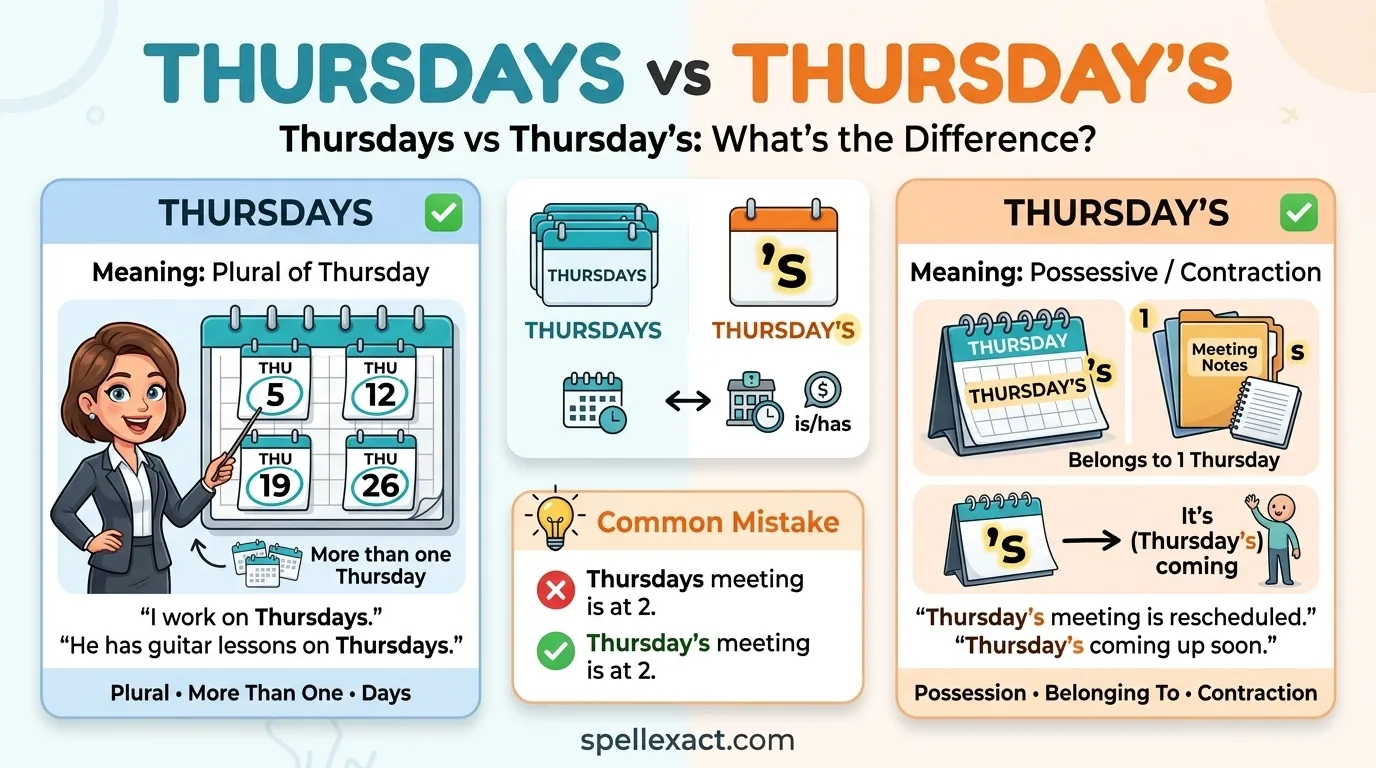
When learning Thursdays vs Thursday’s, the choice depends on whether you mean multiple Thursdays or something associated with one Thursday today. The meaning of the sentence tells you which form to use. Thursdays refers to multiple Thursdays when something happens regularly on that weekday.
For example, “I visit the library on Thursdays.” In contrast, Thursday’s is used when something is associated with one Thursday, such as “Thursday’s meeting starts at noon.” From my experience, this simple distinction makes everyday writing easier to understand.
There is also an informal use of Thursday’s when it can shorten “Thursday is” or “Thursday has.” For example, “Thursday’s going to be busy” can mean “Thursday is going to be busy.” The apostrophe does not make the word more formal. Instead, it signals a different grammatical function and helps readers understand how the word is being used.
Quick Answer
“Thursdays” is the plural form of Thursday and means more than one Thursday. “Thursday’s” is the possessive form and means something belongs to or is associated with Thursday. For example, I visit her on Thursdays uses the plural, while Thursday’s meeting was canceled uses the possessive.
Why Do People Confuse Thursdays and Thursday’s?
The confusion happens because both words are pronounced almost the same and both contain the word Thursday.
The difference is the apostrophe:
- Thursdays = plural, meaning more than one Thursday
- Thursday’s = possessive, showing that something belongs to or is connected with Thursday
Compare these sentences:
- We meet on Thursdays. → More than one Thursday
- Thursday’s meeting is important. → The meeting belongs to or is associated with Thursday
A simple rule can help: If you are making Thursday plural, do not use an apostrophe.
First Word: Thursdays
Thursdays is the plural form of Thursday.
It refers to more than one Thursday. You commonly use it when talking about repeated activities, schedules, routines, or events.
Examples of Thursdays
- I work from home on Thursdays.
- The library is closed on Thursdays.
- We have English class on Thursdays.
- She usually visits her grandparents on Thursdays.
- The restaurant offers live music on Thursdays.
Notice that there is no apostrophe in any of these examples.
Thursdays in a sentence
We usually go shopping on Thursdays.
Here, Thursdays means Thursday after Thursday, or multiple Thursdays.
Second Word: Thursday’s
Thursday’s is usually the possessive form of Thursday.
It shows that something is associated with, belongs to, or relates to Thursday.
For example:
- Thursday’s meeting = the meeting on Thursday
- Thursday’s weather = the weather on Thursday
- Thursday’s schedule = the schedule for Thursday
- Thursday’s newspaper = the newspaper associated with Thursday
Examples of Thursday’s
- Thursday’s meeting starts at 10 a.m.
- Thursday’s weather should be pleasant.
- I need to check Thursday’s schedule.
- Thursday’s game was postponed.
- We discussed Thursday’s assignment in class.
The apostrophe and s show possession or association.
Thursdays vs Thursday’s: Comparison Table
| Form | Meaning | Use | Example |
| Thursdays | More than one Thursday | Plural | I work on Thursdays. |
| Thursday’s | Something associated with Thursday | Possessive | Thursday’s meeting was canceled. |
| Thursdays | Repeated Thursdays | Regular events | Classes are held on Thursdays. |
| Thursday’s | Something belonging to or connected with Thursday | Possession/association | Thursday’s weather was rainy. |
When Should You Use Each?
Use “Thursdays” for More Than One Thursday
Use Thursdays when you are talking about Thursdays in general or a repeated event.
Examples:
- We play football on Thursdays.
- The store closes early on Thursdays.
- I have a meeting every Thursday, so my schedule is busy on Thursdays.
- She works late on Thursdays.
A useful test is to replace Thursdays with every Thursday or multiple Thursdays.
I exercise on Thursdays.
I exercise every Thursday.
Both sentences make sense, so Thursdays is correct.
Use “Thursday’s” for Possession or Association
Use Thursday’s when a noun comes after it and you mean something related to or associated with Thursday.
Examples:
- Thursday’s class was interesting.
- Thursday’s deadline is approaching.
- Thursday’s event starts at noon.
- Thursday’s announcement surprised everyone.
You can often think of Thursday’s as meaning “of Thursday” or “on Thursday.”
10+ Examples of Thursdays vs Thursday’s
Here are practical examples to make the difference clearer.
- I go to the gym on Thursdays.
- Thursday’s workout was difficult.
- We have meetings on Thursdays.
- Thursday’s meeting lasted two hours.
- The shop is busy on Thursdays.
- Thursday’s sales were higher than expected.
- She takes a cooking class on Thursdays.
- Thursday’s class begins at 6 p.m.
- They play basketball on Thursdays.
- Thursday’s game was canceled.
- I usually finish my work on Thursdays.
- Thursday’s deadline is important.
- The café offers discounts on Thursdays.
- Thursday’s discount is available to members.
The pattern is consistent: Thursdays refers to multiple Thursdays, while Thursday’s connects Thursday with another noun.
Common Mistakes
Mistake 1: Using an Apostrophe to Make a Plural
Incorrect:
I work on Thursday’s.
Correct:
I work on Thursdays.
An apostrophe is generally not used to make ordinary nouns plural.
An apostrophe is generally used to show possession rather than to form an ordinary plural. For more details, see this guide to apostrophe rules from Merriam-Webster.
Mistake 2: Removing the Apostrophe From a Possessive
Incorrect:
Thursday meeting was canceled.
Correct:
Thursday’s meeting was canceled.
The apostrophe helps show that the meeting is associated with Thursday.
Mistake 3: Confusing “Every Thursday” With Possession
Consider:
We meet on Thursdays.
This describes a repeated activity.
But:
Thursday’s meeting was canceled.
This refers to a particular meeting associated with Thursday.
Mistake 4: Writing “Thursday’s” When You Mean Several Thursdays
Incorrect:
I usually work on Thursday’s.
Correct:
I usually work on Thursdays.
If the word simply means more than one Thursday, leave out the apostrophe.
Memory Trick
Remember this simple rule:
Thursdays = many Thursdays
Thursday’s = something connected to Thursday
You can also remember:
No apostrophe = plural.
Apostrophe + s = possession or association.
For example:
- Thursdays → many Thursdays
- Thursday’s class → the class associated with Thursday
American vs British English
The distinction between Thursdays and Thursday’s is essentially the same in American and British English.
Both varieties use Thursdays as the plural form:
We have classes on Thursdays.
Both also use Thursday’s as a possessive form:
Thursday’s meeting starts at nine.
The main difference is not regional spelling. It is the grammatical function of the word.
Similar Words
The same pattern applies to other days of the week.
Monday
- Mondays = more than one Monday
- Monday’s meeting = the meeting associated with Monday
Tuesday
- Tuesdays = more than one Tuesday
- Tuesday’s schedule = the schedule associated with Tuesday
Wednesday
- Wednesdays = more than one Wednesday
- Wednesday’s event = the event associated with Wednesday
Friday
- Fridays = more than one Friday
- Friday’s deadline = the deadline associated with Friday
Saturday
- Saturdays = more than one Saturday
- Saturday’s game = the game associated with Saturday
The same grammatical principle applies throughout.
Final Verdict
Thursdays and Thursday’s are both correct, but they are used for different purposes.
Use Thursdays when you mean more than one Thursday or describe something that happens regularly on Thursday.
Use Thursday’s when you want to show that something is associated with, belongs to, or relates to Thursday.
So:
- I work on Thursdays. ✅
- Thursday’s meeting was canceled. ✅
- I work on Thursday’s. ❌
- Thursday meeting was canceled. ❌ when possession/association is intended
The key is simple: plural = Thursdays; possessive = Thursday’s.
FAQs
Is “Thursdays” correct?
Yes. Thursdays is the correct plural form of Thursday. Use it when referring to multiple Thursdays or something that happens regularly on Thursdays.
Is “Thursday’s” grammatically correct?
Yes. Thursday’s is commonly used as the possessive form of Thursday. For example, Thursday’s meeting means the meeting associated with Thursday.
Should I write “on Thursdays” or “on Thursday’s”?
Write “on Thursdays.” When you mean that something happens on multiple Thursdays or regularly every Thursday, no apostrophe is needed.
Is “Thursday’s” plural?
No. Thursday’s is not the normal plural form. The plural is Thursdays. The apostrophe in Thursday’s generally indicates possession or association.
What is the plural of Thursday?
The plural of Thursday is Thursdays.
Example:
We have meetings on Thursdays.
What is the possessive form of Thursday?
The possessive form is Thursday’s.
Example:
Thursday’s schedule has changed.
Why does “Thursday’s” have an apostrophe?
The apostrophe shows that something is associated with or belongs to Thursday.
For example:
Thursday’s meeting
means the meeting associated with Thursday.
Is “Thursdays” or “Thursday’s” correct in a schedule?
It depends on the meaning. Use Thursdays when listing a recurring day, such as “Open Thursdays.” Use Thursday’s when describing something associated with a particular Thursday, such as “Thursday’s schedule.”
Remember This
Thursdays = plural
Thursday’s = possessive
If you mean many Thursdays, use Thursdays.
If you mean something connected with Thursday, use Thursday’s.
I exercise on Thursdays.
Thursday’s workout was challenging.
That one distinction will help you choose the correct form in most situations.
Understanding the difference between Thursdays and Thursday’s is mainly about recognizing whether you need a plural noun or a possessive form. The absence or presence of the apostrophe changes the grammatical function of the word.
When you are describing a repeated activity, choose Thursdays without an apostrophe. When you are connecting Thursday to another noun, choose Thursday’s. Remembering “Thursdays = many” and “Thursday’s = connected to Thursday” makes this common spelling and grammar question much easier.

Andrew Anthony is a language enthusiast and content writer specializing in spelling mistakes, grammar, and English usage. He creates clear, practical, and well-researched guides that help readers improve their writing skills with confidence.