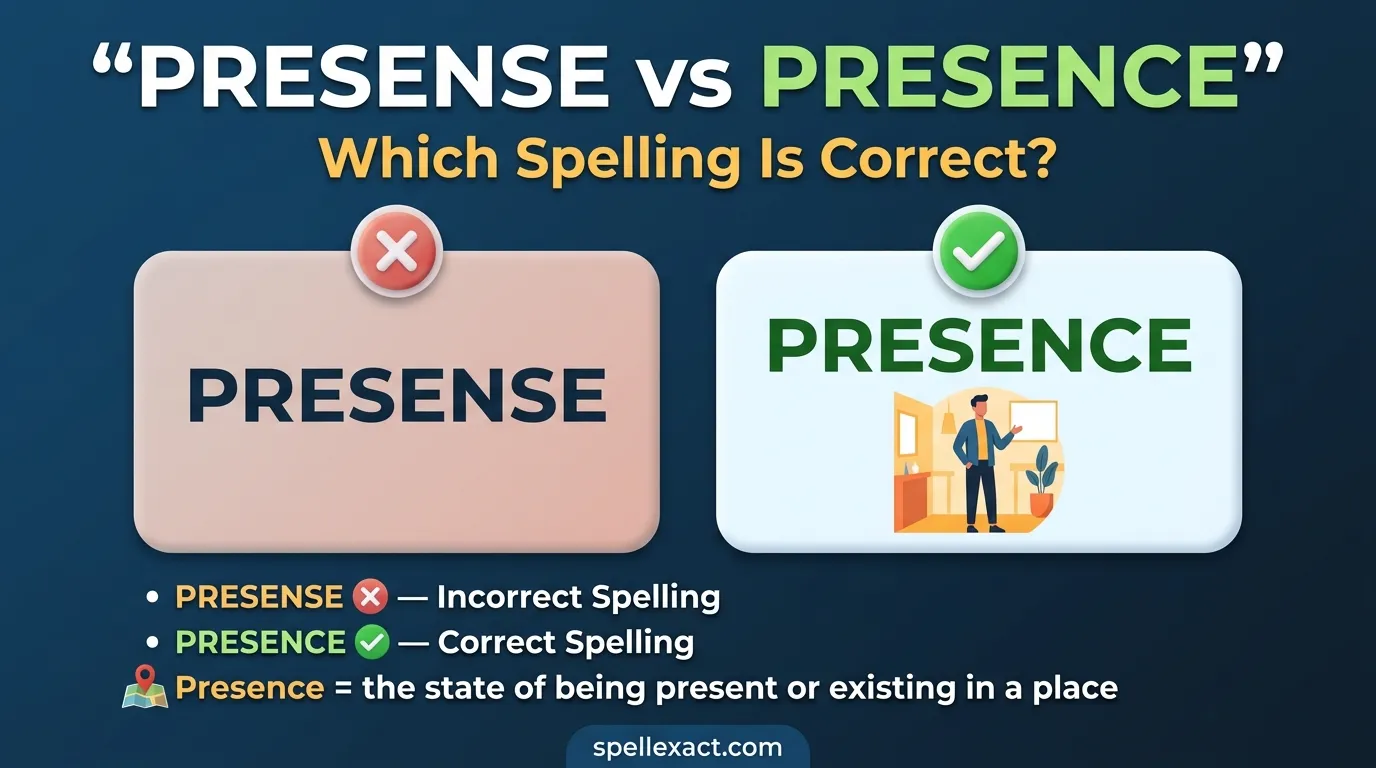
If you have ever wondered whether presense or presence is the correct spelling, you are not alone. This is a common spelling mistake because the word presence is pronounced in a way that can make the second-to-last sound easy to misremember.
The correct spelling is presence. Presense is a misspelling and should not be used in formal writing, academic work, professional emails, websites, or other polished communication.
In this guide, you will learn the meaning of presence, see clear examples, understand why presense is incorrect, and discover a simple trick to remember the right spelling.
Quick Answer:
Presence is the correct spelling.
Presense is incorrect.
- ✅ Presence — correct
- ❌ Presense — incorrect
The word presence generally refers to the state of being present or existing in a particular place. It can also describe someone’s manner, appearance, influence, or noticeable effect.
Example:
“Her presence made everyone feel comfortable.”
What Does Presence Mean?
Presence is a noun that comes from the adjective present. Its basic meaning is the state or fact of being present in a particular place.
For example:
- “The teacher noticed his presence in the classroom.”
- “Your presence is required at the meeting.”
- “The police increased their presence in the area.”
However, presence has several related meanings depending on the context.
It can describe someone’s appearance, manner, confidence, or influence, especially when that person naturally attracts attention.
For example:
“The speaker had a powerful presence on stage.”
Here, presence does not simply mean that the speaker was physically there. It suggests that the speaker appeared confident, impressive, and noticeable.
Why Is “Presense” Incorrect?
The spelling presense is a common misspelling of presence. The mistake usually happens because English pronunciation does not always make spelling obvious.
The correct word ends with -ence:
pres + ence = presence
It does not end with -ense.
A useful way to remember this is to connect presence with the word present:
present → presence
The spelling changes slightly when the noun is formed, but the c remains important.
Correct
Presence
Incorrect
Presense
If you are writing an essay, business email, report, article, application, or social media post, always use presence.
Presence vs Presense: Comparison Table
| Feature | Presence | Presense |
| Correct spelling | ✅ Yes | ❌ No |
| Part of speech | Noun | — |
| Meaning | State of being present; noticeable manner or influence | No standard English meaning |
| Standard English word | Yes | No |
| Example | “His presence was reassuring.” | “His presense was reassuring.” ❌ |
| Suitable for formal writing | Yes | No |
The difference is only one letter, but that letter changes whether the spelling is considered correct.
Examples of Presence in Sentences
Seeing the correct spelling in different situations can make it easier to remember.
Physical presence
When someone or something is physically in a particular place:
- “The presence of students made the classroom lively.”
- “Her presence at the event was greatly appreciated.”
- “The doctor confirmed the presence of an infection.”
- “We were surprised by his presence at the meeting.”
Personal presence
Presence can describe the way someone appears or behaves around others:
- “She has a calm and confident presence.”
- “The actor has a strong stage presence.”
- “His friendly presence made the conversation easier.”
Influence or effect
The word can also refer to an influence or noticeable existence:
- “The company has a growing presence in Asia.”
- “The brand has a strong online presence.”
- “The military maintained a presence near the border.”
Digital or online presence
In modern English, online presence is an especially common expression.
For example:
- “Every small business needs an online presence.”
- “The company improved its social media presence.”
- “Her professional online presence helped attract new clients.”
Here, presence means the way a person, organization, or brand exists and is represented online.
Common Mistakes With Presence
Because presence is frequently misspelled, it is useful to recognize the patterns behind the mistake.
1. Writing “presense”
This is the most direct spelling error.
❌ “The teacher appreciated her presense.”
✅ “The teacher appreciated her presence.”
2. Confusing presence with presents
Presence and presents sound similar in some contexts, but they have different meanings.
Presence means being present or having an influence.
Presents can mean gifts or the third-person form of present.
Examples:
- “Her presence was comforting.”
- “He bought birthday presents for his family.”
3. Confusing presence with present
Present and presence are related words, but they are not interchangeable.
- Present can be an adjective, noun, verb, or preposition depending on usage.
- Presence is a noun.
Examples:
- “She is present at the meeting.”
- “Her presence at the meeting was helpful.”
Presence vs Presents: A Quick Difference
This is another useful distinction for English learners.
| Word | Meaning | Example |
| Presence | Being present or having an influence | “His presence was reassuring.” |
| Presents | Gifts | “She received several presents.” |
If you mean someone’s being there, choose presence.
If you mean gifts, choose presents.
How to Remember the Correct Spelling
A simple memory trick can help you avoid the presense spelling permanently.
Think:
Present → Presence
The word presence contains a c, just like present contains the idea behind it.
You can also break the spelling into two parts:
PRE + SENCE = PRESENCE
Then remember:
Presence has a C, not an S, before the final E.
Another helpful technique is to associate common phrases with the correct spelling:
- physical presence
- strong presence
- stage presence
- online presence
- social media presence
- human presence
- presence of mind
The more often you see the correct spelling, the more natural it becomes.
Is Presence an American or British English Word?
Presence is standard in both American English and British English. There is no difference in spelling between the two varieties.
American English:
“She has a strong presence in the industry.”
British English:
“She has a strong presence in the industry.”
Both use presence.
The spelling presense is not an accepted alternative British spelling. If you are writing for a British, American, Canadian, Australian, or international audience, presence is the standard spelling.
Presence as a Noun
Grammatically, presence is a noun.
It is often used after words such as:
- his
- her
- their
- your
- physical
- strong
- powerful
- noticeable
- online
- social
- professional
Examples:
- “I enjoyed your presence at the event.”
- “She has a powerful presence.”
- “The company has a professional online presence.”
- “The doctor detected the presence of bacteria.”
Understanding its grammatical role can also help you recognize when presence is the word you need.
“Presence of Mind” Meaning
One particularly common expression is presence of mind.
It means the ability to remain calm and think clearly, especially during a difficult or unexpected situation.
For example:
“She had the presence of mind to call for help.”
This does not mean that she was merely physically present. It means she stayed mentally alert and acted sensibly under pressure.
Other common expressions include:
- stage presence
- physical presence
- online presence
- strong presence
- commanding presence
- professional presence
- presence of mind
Learning these phrases can help you understand and use the word naturally.
When Should You Use Presence?
Use presence when you are talking about:
- Someone being physically present.
- The existence of something in a particular place.
- A person’s noticeable character or manner.
- Someone’s influence or effect.
- A company’s or individual’s visibility online.
- The ability to remain calm and alert in a difficult situation.
For example:
Physical:
“His presence in the room was immediately noticed.”
Influence:
“The company has a strong presence in the market.”
Personality:
“She has an impressive stage presence.”
Digital:
“The business is building a stronger online presence.”
FAQs
Is “presense” a correct spelling?
No. Presense is a misspelling. The correct spelling is presence.
What is the correct spelling: presense or presence?
Presence is the correct spelling. It refers to the state of being present or to someone’s noticeable manner, influence, or effect.
Why do people spell presence as presense?
The mistake commonly occurs because of pronunciation. Writers may hear a sound that resembles an “s” and therefore spell the word as presense. However, the standard spelling uses c: presence.
How do you pronounce presence?
Presence is commonly pronounced approximately like “PREZ-uhns.” The pronunciation can contribute to spelling confusion because the written c does not sound like a hard “k.”
Is presence the same in British and American English?
Yes. Presence is spelled the same way in both British and American English.
What is the difference between presence and presents?
Presence means being present or having an influence, while presents can mean gifts.
Example:
“Her presence made me happy.”
“He gave me several birthday presents.”
Is “presence” a noun?
Yes. Presence is a noun. It can refer to someone’s physical attendance, existence, influence, appearance, or noticeable manner.
What is an easy way to remember “presence”?
Connect it with present: present → presence. Also remember that the correct spelling contains c: presence, not presense.
Final Summary
When comparing presense vs presence, there is only one correct standard spelling: presence. The spelling presense is a common error and should be avoided in professional, academic, and everyday writing.
Presence is a noun that can describe someone’s physical attendance, the existence of something, a person’s confidence or influence, or an organization’s visibility.
The easiest way to remember the word is to connect presence with present and remember the c. If you are writing about someone’s physical presence, stage presence, presence of mind, or online presence, the correct form is always presence in standard English.
Actionable Takeaway
Whenever you are unsure between presense vs presence, choose presence.
Remember:
✅ Presence = Correct
❌ Presense = Incorrect
Save the simple rule “Presence has C”, and you will be much less likely to make this common spelling mistake.

Aaron Adam is the Administrator of SpellExact, dedicated to helping readers improve their spelling and writing accuracy. He oversees content quality, ensures reliable language resources, and works to make spelling guidance simple, practical, and accessible for everyone.