When learning English or improving your English language skills, To Bad vs Too Bad is a common point of confusion because too bad is the most common phrase and expression for saying that something is unfortunate or disappointing in everyday usage.
People often say “Too bad” when someone does not get the job they wanted, such as, “Too bad, I hope you get the job next time.” Here, too can mean overly or extremely, which gives the phrase its familiar meaning.
Another example is an apple with a rotten part that you cannot use: “The apple was too bad. I couldn’t use it, so I had to throw away the fruit in the garbage.” In this usage, too bad is used to say that something is unsuitable or disappointing.
By contrast, to bad is generally not the correct form for this meaning. To is normally a preposition, while bad is an adjective. In a sentence, a preposition can have an object, and bad can be an adjective describing another noun rather than the object of a preposition.
For example, “Why do good things happen to bad people?” uses to correctly because bad describes people. This is an important part of English grammar, showing that to and too are not the same word.
From my experience explaining this common mistake, remembering “Too means overly” and “Too means extremely” makes the preposition use easier to understand.
Quick Answer
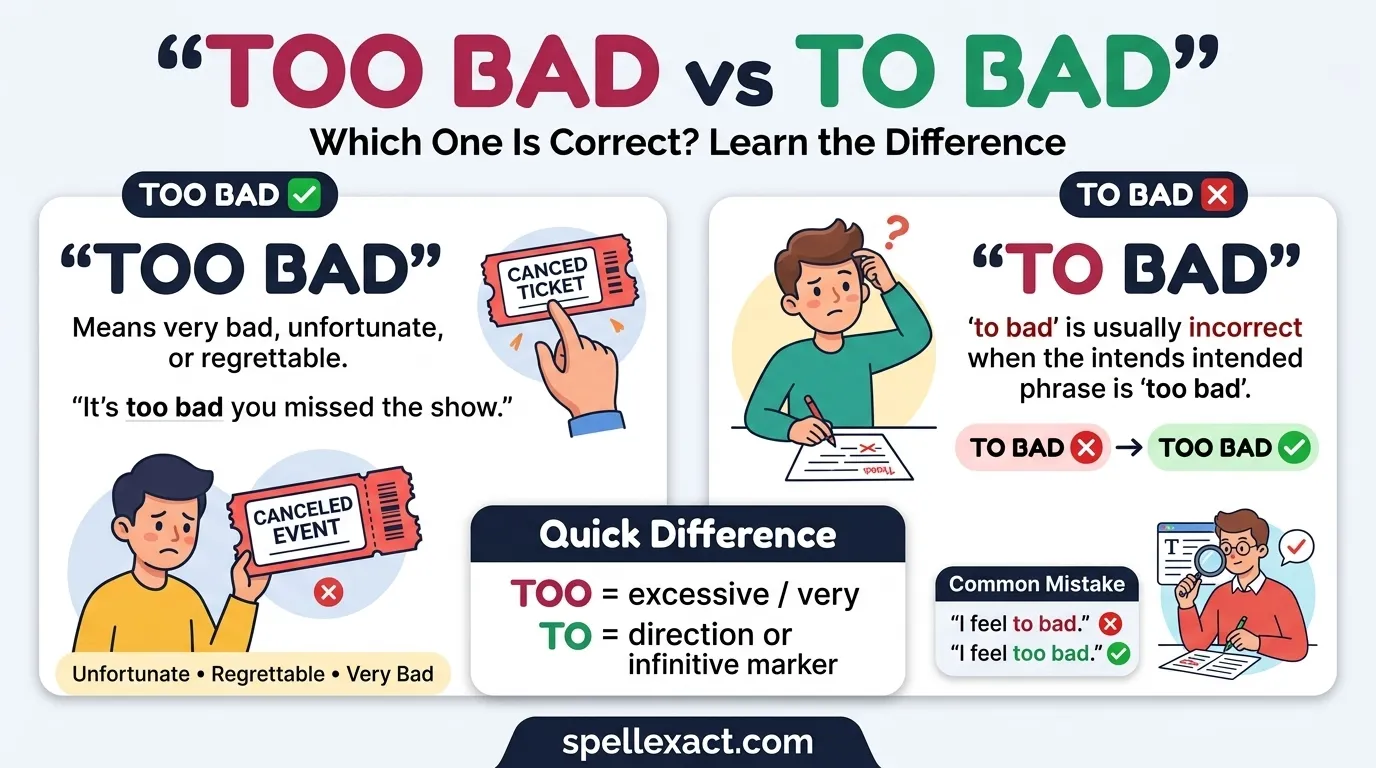
“Too bad” is correct when you mean unfortunate, disappointing, or excessively bad. For example, “It’s too bad you missed the concert.” “To bad” is generally incorrect when used with this meaning. Remember that too can mean “very/excessively” or “also,” while to usually shows direction, connection, or an infinitive verb.
Why Do People Confuse “To Bad” and “Too Bad”?
The main reason is pronunciation. To and too are commonly pronounced the same way, so it can be difficult to know which spelling to use when writing.
Their meanings, however, are different:
- To – commonly shows direction, relationship, or purpose.
- Too – means “also” or “more than necessary.”
- Bad – describes something unpleasant, poor, harmful, or unfortunate.
When expressing disappointment or regret, the correct phrase is “too bad.”
Example:
It’s too bad that you couldn’t come with us.
Here, too bad means that the situation is unfortunate.
What Does “To” Mean?
To is a very common English preposition. It can show movement toward a place or person, a relationship, or the purpose of an action. It is also used before the base form of a verb to create an infinitive.
Examples of “To”
- I went to school.
- She gave the book to me.
- We need to study.
- He wants to learn English.
- They traveled to London.
In these examples, to does not mean “excessively” or “also.”
Is “To Bad” Correct?
In the expression “to bad,” it is generally not correct if you are trying to say that something is unfortunate.
For example:
❌ It’s to bad that you missed the bus.
Correct:
✅ It’s too bad that you missed the bus.
What Does “Too” Mean?
Too has two main meanings in English.
First, it can mean “also” or “as well**:
- I want to come too.
- She likes coffee too.
- He is studying Spanish too.
Second, too can mean “more than is desirable, necessary, or acceptable.”
The word too can mean “also” or “more than necessary,” depending on the context. For a more detailed explanation of its uses, see the Cambridge Dictionary definition of “too”.
- The bag is too heavy.
- The water is too hot.
- This shirt is too expensive.
- It is too bad that we missed the train.
In “too bad,” the word too commonly expresses an unfortunate or disappointing situation.
To Bad vs Too Bad: Comparison Table
| Phrase | Correct? | Meaning | Example |
| to bad | ❌ Usually incorrect | Does not normally express disappointment | It’s to bad. |
| too bad | ✅ Correct | Unfortunate or disappointing | It’s too bad you missed it. |
| to | ✅ Correct | Direction, purpose, or infinitive marker | I went to work. |
| too | ✅ Correct | Also or excessively | It is too expensive. |
When Should You Use “Too Bad”?
Use too bad when you want to express that something is unfortunate, disappointing, or regrettable.
Examples
- It’s too bad you missed the party.
- That’s too bad about your broken phone.
- It’s too bad that the game was canceled.
- Too bad we arrived too late.
- It’s too bad she couldn’t join us.
Too bad can also be used as a short response:
“I forgot my umbrella.”
“Too bad. It’s raining.”
Depending on tone and context, “too bad” can sound sympathetic, neutral, or slightly dismissive.
10+ Examples of “Too Bad”
Here are some natural examples to help you understand the phrase:
- It’s too bad that you missed the train.
- That’s too bad about your canceled flight.
- It’s too bad we couldn’t stay longer.
- Too bad the restaurant was closed.
- It’s too bad she wasn’t feeling well.
- That’s too bad, but we can try again tomorrow.
- It’s too bad that the event was postponed.
- Too bad you didn’t bring your camera.
- It’s too bad they had to leave early.
- That’s too bad about the lost ticket.
- It’s too bad the weather changed.
- Too bad we missed the last bus.
Examples Using “Too” in Other Ways
Remember that too does not always mean “unfortunate.”
- I want some ice cream too.
- The coffee is too hot.
- She talks too quickly.
- This box is too heavy.
- He is coming too.
Common Mistakes
Mistake 1: Writing “to bad”
❌ It’s to bad that you missed the meeting.
✅ It’s too bad that you missed the meeting.
Mistake 2: Thinking “to” and “too” have the same meaning
Although they sound alike, they are different words.
- to → direction, purpose, or infinitive
- too → also or excessively
Mistake 3: Confusing “too bad” with “very bad”
Too bad can sometimes express that something is unfortunate, while very bad simply describes a high degree of badness.
Compare:
- The weather is very bad.
- It’s too bad that the weather ruined our picnic.
The first describes the weather. The second expresses regret about the situation.
Easy Memory Trick
A simple way to remember the difference is:
Too has an extra “o” because it means “more.”
Think:
Too = extra
Examples:
- too expensive = more expensive than acceptable
- too hot = more hot than comfortable
- too late = later than acceptable
And:
too bad = unfortunately
For to, remember common expressions such as:
- go to school
- give it to him
- want to eat
- travel to London
American vs British English
There is no standard American-versus-British spelling difference between “to” and “too.” Both varieties of English use the same words and the same basic rules.
The expression “too bad” is understood in both American and British English.
For example:
It’s too bad you couldn’t come.
is grammatically acceptable in both varieties.
Differences can sometimes occur in vocabulary, pronunciation, or conversational style, but the spelling distinction between to and too remains the same.
Similar Words
Several words are commonly confused because they sound alike or have related uses.
To vs Too
- to = direction, purpose, or infinitive
- too = also or excessively
Too vs Two
- too = also or excessively
- two = the number 2
Example:
I have two books too.
Bad vs Worse
- bad = unpleasant or poor
- worse = more bad or less good compared with something else
Example:
This situation is bad, but yesterday was worse.
Too Bad vs Very Bad
- too bad = unfortunate/disappointing, or excessively bad depending on context
- very bad = extremely poor or unpleasant
Final Verdict
When you want to say that something is unfortunate, disappointing, or regrettable, use “too bad.”
✅ It’s too bad you missed the train.
❌ It’s to bad you missed the train.
The word to is normally used for direction, purpose, or before a verb in an infinitive. The word too means “also” or “more than necessary,” and it is the correct spelling in the expression “too bad.”
Frequently Asked Questions
Is “to bad” grammatically correct?
Usually, no. If you mean that something is unfortunate or disappointing, the correct phrase is “too bad.”
Is it “too bad” or “to bad”?
It is “too bad” when expressing disappointment or saying that something is unfortunate.
What does “too bad” mean?
Too bad commonly means that something is unfortunate, disappointing, or regrettable. For example, “It’s too bad you missed the concert.”
Can I say “to bad”?
Not when you mean “unfortunate.” To bad is normally a spelling mistake in that context.
Is “too bad” rude?
Not necessarily. Too bad can express sympathy or disappointment, but its tone depends on context. In some situations, a short “Too bad” can sound dismissive or sarcastic.
What is the difference between “to” and “too”?
To commonly indicates direction, purpose, or an infinitive, while too means “also” or “more than necessary.”
Is “too bad” used in American English?
Yes. Too bad is standard and commonly understood in American English.
Is “too bad” used in British English?
Yes. British English also uses “too bad” with the same basic meaning and spelling.
Remember This
Too bad = unfortunate or disappointing.
To = direction, purpose, or infinitive.
A quick memory rule:
Too has two O’s → think “extra” or “also.”
So when you mean “unfortunate,” write:
✅ Too bad
not:
❌ To bad
Conclusion
The correct phrase is “too bad” when you want to express that something is unfortunate, disappointing, or regrettable. The extra o in too is important because too and to have different meanings, even though they sound alike.
Remember that to is commonly used for direction, purpose, and infinitives, while too means “also” or “more than necessary.” Once you connect too with the idea of “extra,” it becomes much easier to remember why “too bad” is the correct expression.

Aaron Adam is the Administrator of SpellExact, dedicated to helping readers improve their spelling and writing accuracy. He oversees content quality, ensures reliable language resources, and works to make spelling guidance simple, practical, and accessible for everyone.