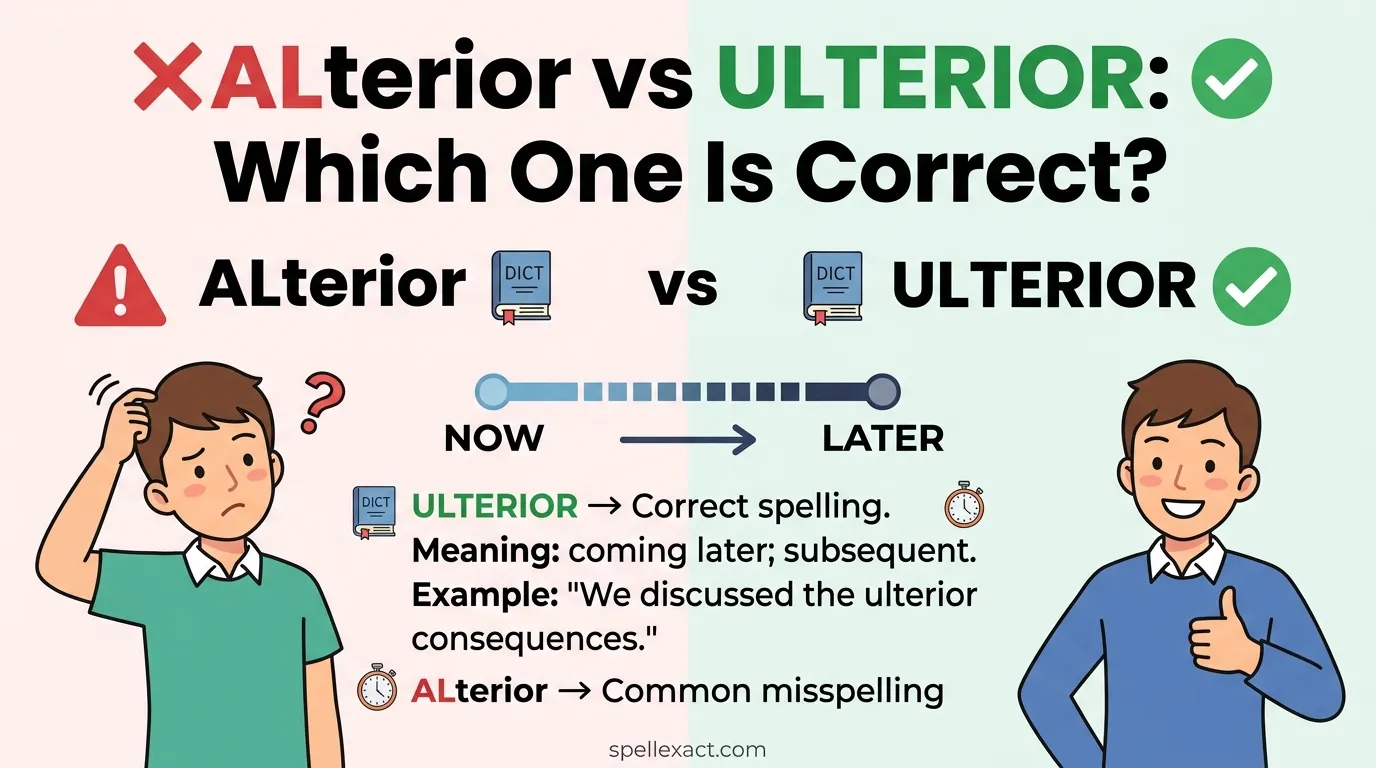
Alterior vs Ulterior explains the difference between the real word, correct spelling, and common mistake caused by confusion in standard English. Alterior is generally incorrect, while ulterior is the real word used in standard English.
When a word is spelled incorrectly, it can become a spelling mistake, especially when two words sound similar. This common mistake may happen through mishearing or uncertainty about pronunciation. For English language learners, this confusion is understandable because both forms can look and sound alike.
The correct word usage is ulterior, especially in the familiar phrase ulterior motive. The meaning of ulterior often refers to a hidden, less obvious motive, purpose, or reason. For example, someone may offer help while having an ulterior motive that is not immediately clear. To avoid this mistake in the future, remember that ulterior is the correct form, while alterior is incorrect in this standard usage.
Learning the correct spelling and pronunciation together makes the distinction more simple. When you see or hear ulterior, connect it with the idea of a hidden motive instead of changing its spelling to alterior. This small memory habit can help improve your English, reduce spelling mistake errors, and make your everyday word usage more accurate.
Quick Answer
Ulterior is the correct standard English word. Alterior is generally considered a misspelling or nonstandard form. Ulterior means something hidden, additional, or beyond what is immediately apparent, especially a secret motive or purpose. The common expression is “ulterior motive,” not “alterior motive.”
Why Do People Confuse Alterior vs Ulterior?
The confusion mainly comes from the similar appearance and pronunciation of the two words.
English has many words beginning with al-, such as alternative, alter, and alternate. Because of this, some people naturally assume that alterior is related to alter or means something different or additional.
However, the standard word is ulterior. It has been used in English for something farther away, later, hidden, or beyond the obvious meaning.
A particularly common phrase is:
ulterior motive
For example:
- “He offered to help, but I think he has an ulterior motive.”
- “She seemed friendly, but there may have been an ulterior purpose.”
What Does Ulterior Mean?
Ulterior is an adjective meaning something that is beyond what is immediately visible, known, or stated.
It is often used when someone has a hidden reason or intention.
Examples
- He had an ulterior motive for offering help.
- I suspect there was an ulterior purpose behind the decision.
- She seemed generous, but perhaps she had an ulterior intention.
The word can also refer to something farther away or beyond a particular point, although this use is less common in everyday conversation.
What About Alterior?
Alterior is not the standard word you should use in ordinary modern English when you mean a hidden or additional motive.
If you are writing an essay, email, article, application, or other formal English, use ulterior instead.
❌ He had an alterior motive.
✅ He had an ulterior motive.
Alterior vs Ulterior: Comparison Table
| Word | Standard English? | Meaning | Example |
| Alterior | Generally nonstandard/misspelled | Usually intended to mean ulterior | ❌ He had an alterior motive. |
| Ulterior | Yes | Hidden, additional, or beyond what is immediately apparent | ✅ He had an ulterior motive. |
When Should You Use Ulterior?
Use ulterior when you are describing a hidden reason, purpose, intention, or motive.
The most familiar expression is:
ulterior motive
You can also use ulterior with words such as:
- purpose
- intention
- reason
- objective
- plans
- interests
For example:
- “What is your ulterior motive?”
- “She may have an ulterior purpose.”
- “There could be an ulterior reason for his decision.”
10+ Examples of Ulterior
Here are practical examples to help you understand the correct usage.
- I think he has an ulterior motive.
- She offered to drive me home, but I wondered if she had an ulterior motive.
- The company may have an ulterior purpose for making the offer.
- He claimed he was helping without any ulterior motive.
- She suspected that his kindness had an ulterior reason.
- The politician denied having any ulterior motive.
- I agreed to the plan because I saw no ulterior purpose.
- His invitation made me wonder whether he had an ulterior intention.
- They questioned whether the proposal served an ulterior objective.
- She was friendly and appeared to have no ulterior motives.
- He gave me the information without any apparent ulterior motive.
- The manager insisted that the decision had no ulterior purpose.
Common Mistakes
The most common mistake is replacing the first u in ulterior with a.
Incorrect
- alterior motive
- alterior purpose
- alterior reason
Correct
- ulterior motive
- ulterior purpose
- ulterior reason
Another mistake is assuming that ulterior means simply “alternative.” It does not normally mean “another option.”
For example:
❌ “We need an ulterior plan because the first plan failed.”
Better:
✅ “We need an alternative plan because the first plan failed.”
Use alternative when you mean another choice or option. Use ulterior when you mean something hidden, additional, or beyond what is immediately apparent.
Memory Trick: How to Remember Ulterior
A simple way to remember ulterior is:
ULTERIOR = UNDER THE SURFACE
Think of an ulterior motive as a reason that is not immediately visible.
You can also remember the familiar phrase:
“ulterior motive”
If you remember this common expression, you are less likely to write alterior motive.
American vs British English
There is no important American-versus-British spelling difference for ulterior.
Both American English and British English use:
ulterior
For example:
- American English: “He had an ulterior motive.”
- British English: “He had an ulterior motive.”
The spelling remains the same in both varieties of standard English.
Similar Words
Understanding related words can make the difference easier to remember.
Alternative
Alternative means another choice or option.
- “We need an alternative solution.”
Hidden
Hidden means something that cannot easily be seen or discovered.
- “There was a hidden message in the letter.”
Secret
Secret describes something deliberately kept unknown.
- “They had a secret plan.”
Underlying
Underlying refers to something that exists beneath the surface or is not immediately obvious.
- “We need to understand the underlying reason.”
Ulterior
Ulterior often describes a hidden or additional motive, purpose, or intention.
- “He may have an ulterior motive.”
Final Verdict
When deciding between alterior vs ulterior, use ulterior in standard English.
Ulterior is the correct word for something hidden, additional, or beyond what is immediately apparent. The phrase “ulterior motive” is especially common.
If you see alterior, it is usually best to check whether the writer intended ulterior or possibly alternative, depending on the meaning.
FAQs
Is alterior a correct English word?
Alterior is generally not the standard word used in modern English for a hidden motive or purpose. In most cases, ulterior is the correct choice.
Is it ulterior motive or alterior motive?
The correct phrase is ulterior motive.
Example: “He offered to help, but I suspected he had an ulterior motive.”
What does ulterior mean?
Ulterior means hidden, additional, or beyond what is immediately apparent. It is frequently used to describe a hidden motive or purpose.
What is an ulterior motive?
An ulterior motive is a reason for doing something that is different from, or hidden behind, the reason openly given.
Is ulterior the same as alternative?
No. Ulterior usually relates to a hidden or additional motive, purpose, or intention. Alternative means another choice or option.
Is ulterior used in American English?
Yes. Ulterior is standard in both American and British English.
How do you spell ulterior?
The correct spelling is U-L-T-E-R-I-O-R: ulterior.
Why do people spell ulterior as alterior?
The mistake likely occurs because alterior looks plausible and resembles other common words beginning with al-. However, the standard spelling is ulterior.
Remember This
Ulterior = hidden or beyond the obvious.
Alterior = generally a misspelling when “ulterior” is intended.
The most useful phrase to remember is:
“ulterior motive”
If someone has an ulterior motive, they have a reason for doing something that may not be immediately obvious.
Conclusion
The correct choice in alterior vs ulterior is ulterior when you mean a hidden, additional, or less obvious motive or purpose. Although alterior may look natural because of other English words beginning with “al-,” it is not the standard spelling for this meaning.
To avoid the mistake, remember the common phrase “ulterior motive.” When you are talking about another option or choice, use alternative instead. Keeping these two words separate will make your English clearer and more accurate.

Aaron Adam is the Administrator of SpellExact, dedicated to helping readers improve their spelling and writing accuracy. He oversees content quality, ensures reliable language resources, and works to make spelling guidance simple, practical, and accessible for everyone.