Have you ever wanted to describe someone who absolutely loves food but stopped because you were unsure whether foody or foodie was the correct spelling? You are not alone. These two words look almost identical, but one is much more widely accepted and natural in modern English.
If you are writing a social media post, blog, restaurant review, message, or formal piece of content, choosing the right word matters. In this guide, we will explain foody vs foodie, their meanings, correct usage, examples, common mistakes, and the differences you may encounter in American and British English.
Quick Answer:
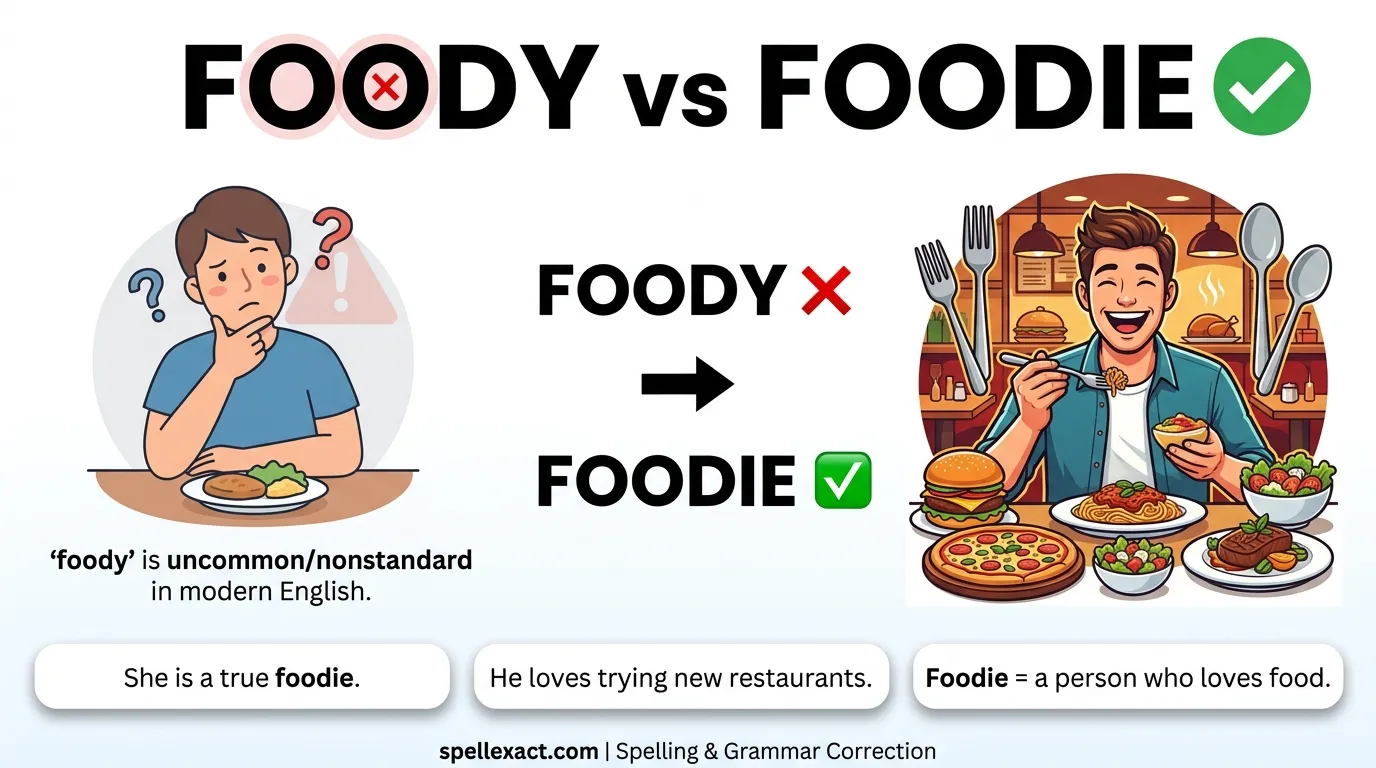
Foodie is the standard and widely accepted word for a person who loves food, enjoys trying different dishes, or has a strong interest in cooking and food culture.
Foody can appear occasionally, but it is much less common and is generally not the preferred spelling when you mean “a person who loves food.”
The simple rule:
- ✅ Foodie = a person who loves or is enthusiastic about food
- ⚠️ Foody = uncommon and usually not the preferred spelling for this meaning
Example:
My sister is a real foodie and loves discovering new restaurants.
If you are unsure which spelling to use, choose foodie.
What Does “Foodie” Mean?
The noun foodie refers to someone who has a particular enthusiasm for food. A foodie may enjoy eating at restaurants, discovering new cuisines, experimenting with recipes, reviewing dishes, or learning about ingredients and cooking techniques.
The word is informal and friendly, making it especially common in everyday conversation, food blogs, social media, restaurant descriptions, and lifestyle writing.
For example:
Sarah is a foodie who loves trying authentic Italian cuisine.
Here, foodie describes Sarah as someone who takes a special interest in food.
Being a foodie does not necessarily mean someone eats large amounts of food. It is more about interest, appreciation, curiosity, and enjoyment of food.
A foodie might be interested in:
- International cuisines
- Restaurant experiences
- Home cooking
- Baking
- Food photography
- Food reviews
- Specialty ingredients
- New recipes
- Culinary traditions
- Coffee and desserts
What Does “Foody” Mean?
Foody is sometimes used as an alternative spelling, but it is not the usual choice when referring to a person who loves food.
You may occasionally see “foody” in informal writing, brand names, usernames, advertisements, or creative contexts. However, its usage is much less established than foodie.
This is why writing:
He is a foody.
may look unusual to many English speakers.
The more natural version is:
He is a foodie.
There is another important point: foody may sometimes be used informally as an adjective to describe something related to food. However, even in this situation, alternatives such as food-related, culinary, or simply food are often clearer.
For standard English writing, foodie is the safer and more recognizable choice when talking about a food enthusiast.
Foody vs Foodie: Comparison Table
| Feature | Foody | Foodie |
| Common spelling | Less common | ✅ Very common |
| Meaning: food enthusiast | Occasionally used | ✅ Standard choice |
| Part of speech | Usually informal | Noun, sometimes informal adjective use |
| Natural in everyday English | Less natural | ✅ Very natural |
| Common in food blogs | Sometimes | ✅ Yes |
| Common on social media | Sometimes | ✅ Yes |
| Recommended for standard writing | Usually no | ✅ Yes |
| Refers to someone who loves food | Possible but uncommon | ✅ Yes |
When the intended meaning is “someone who loves food,” foodie is clearly the preferred word.
Why Is “Foodie” the Correct Choice?
The spelling foodie developed as an informal noun based on the word food, using the suffix -ie. English has many informal nouns formed in a similar way.
For example:
- groupie – someone who follows or strongly admires a particular group or celebrity
- techie – someone interested in technology
- movie buff – someone enthusiastic about movies
- foodie – someone enthusiastic about food
The spelling foodie has become firmly established in modern English and is easily understood by English speakers around the world.
This is why dictionaries, food publications, restaurants, bloggers, and everyday speakers overwhelmingly use foodie when referring to a food enthusiast.
Examples of “Foodie” in Sentences
Seeing the word in context makes the difference easier to remember.
Everyday examples
- I’m a huge foodie, so I always look for local restaurants when I travel.
- My brother became a foodie after learning how to cook.
- She is a serious foodie who enjoys experimenting with new recipes.
- If you’re a foodie, you’ll love this city’s food scene.
- He’s always searching for the best pizza, so everyone calls him a foodie.
Social media examples
- Calling all foodies!
- A foodie’s guide to the best weekend meals.
- Every foodie needs to try this dessert.
- Foodie adventures never disappoint.
Professional or content-writing examples
The city has become a popular destination for foodies interested in traditional cuisine.
Our guide is designed for foodies who want to discover authentic local dishes.
These examples show why foodie is especially useful in food-related content and lifestyle writing.
Foody vs Foodie: Common Mistakes
One of the most common mistakes is assuming that foody must be correct because it appears to follow a simple spelling pattern.
For example:
❌ She is a passionate foody.
A better version is:
✅ She is a passionate foodie.
Another mistake is thinking that “foodie” describes only someone who eats expensive restaurant meals. The term is much broader. A foodie can enjoy anything from homemade meals and street food to fine dining and international cuisine.
You should also avoid changing the spelling based on pronunciation. Foodie is pronounced approximately like FOO-dee, so some writers naturally spell it “foody.” However, pronunciation does not determine the standard spelling.
Common incorrect or less-preferred usage
- ❌ He is a professional foody.
- ✅ He is a professional foodie.
- ❌ She calls herself a foody.
- ✅ She calls herself a foodie.
- ❌ This blog is for every foody.
- ✅ This blog is for every foodie.
Is “Foodie” an Adjective or a Noun?
Foodie is primarily a noun.
It identifies a person who is enthusiastic about food.
Maria is a foodie.
Here, “foodie” is a noun because it identifies Maria.
You may also encounter informal expressions where “foodie” is used attributively before another noun:
foodie culture
foodie community
foodie destination
In these expressions, “foodie” helps describe something connected with food enthusiasts.
For formal writing, however, you should consider the context and choose the clearest expression available.
American vs British English: Foody vs Foodie
There is no major American-versus-British spelling difference here.
Both American English and British English commonly use foodie to describe a person who is enthusiastic about food.
You may encounter foody in informal writing in different English-speaking regions, but it is not comparable to spelling differences such as:
- color vs colour
- favorite vs favourite
- center vs centre
In other words, you should not choose foody simply because you are writing for a British audience or foodie because you are writing for an American audience.
Foodie works naturally in both varieties of English.
Foodie Synonyms and Related Words
If you want to avoid repeating “foodie,” several related expressions can work depending on the context.
Useful alternatives
- Food lover
- Food enthusiast
- Food fan
- Culinary enthusiast
- Gastronomy enthusiast
- Food aficionado
- Restaurant enthusiast
- Cooking enthusiast
For example:
She is a food enthusiast who enjoys exploring Asian cuisine.
This is slightly more formal than:
She is a foodie.
For casual writing, foodie is usually the most natural and concise option.
When Should You Use “Foodie”?
Use foodie when you want to describe someone with a strong interest in food, cooking, dining, or culinary experiences.
It works particularly well in:
- Blog posts
- Restaurant reviews
- Travel articles
- Social media captions
- Food websites
- Casual conversations
- Marketing copy
- Lifestyle content
For example:
New York is a dream destination for foodies.
This sentence sounds natural and immediately communicates that the city offers exciting experiences for people who love food.
Can “Foodie” Describe Someone Who Loves Cooking?
Yes. A foodie can be interested in both eating and preparing food.
However, if you specifically mean someone who enjoys cooking, terms such as cook, home cook, or cooking enthusiast may be more precise.
For example:
James is a foodie who spends his weekends experimenting with homemade pasta.
This tells us that James enjoys food and cooking without suggesting that “foodie” specifically means “cook.”
Frequently Asked Questions
Is “foody” a correct word?
“Foody” can be found in informal usage, but it is much less common than foodie. If you mean a person who loves or is enthusiastic about food, foodie is the recommended spelling.
Is foodie one word or two words?
Foodie is normally written as one word.
Correct:
She is a foodie.
Not:
She is a food ie.
Is foodie formal or informal?
Foodie is generally considered an informal or conversational word. It is extremely common in modern English, particularly in food, travel, lifestyle, and social media contexts.
Can I use foodie in a professional article?
Yes. Foodie is perfectly understandable in professional content, especially when the topic involves restaurants, travel, food culture, or culinary experiences. For highly formal writing, food enthusiast may sometimes be a more formal alternative.
What is the plural of foodie?
The plural is foodies.
Example:
Thousands of foodies visit the festival every year.
Is foodie used in American English?
Yes. Foodie is widely used in American English and is also common in British English and other varieties of English.
What is the difference between a foodie and a food lover?
The meanings are very similar. A food lover simply describes someone who loves food, while foodie often suggests a deeper interest in discovering, discussing, preparing, or appreciating food.
Why do people spell foodie as foody?
The mistake usually comes from pronunciation. Because foodie sounds like “foo-dee,” some people naturally assume it should be spelled foody. However, foodie is the conventional spelling for a food enthusiast.
Final Summary
When comparing foody vs foodie, the choice is straightforward in most situations. Foodie is the standard and much more widely recognized spelling for a person who loves food, enjoys trying different cuisines, or takes an active interest in cooking and culinary experiences. Although foody may appear in informal contexts, it is not the preferred spelling for this meaning.
Remember that there is no significant American English versus British English distinction between these spellings. If you are writing a restaurant review, travel article, social media caption, or everyday message, foodie is the natural choice. If you want a more formal alternative, use food enthusiast or culinary enthusiast.
Actionable Takeaway
Whenever you mean “a person who loves or is enthusiastic about food,” choose foodie.
Easy memory trick:
Food + ie = Foodie → a person who loves food.
So, if you are writing:
“I’m a ___ who loves trying new restaurants.”
The best answer is:
✅ I’m a foodie who loves trying new restaurants.

Caleb Carter is a passionate language enthusiast and content writer specializing in spelling mistakes, grammar, and vocabulary. He creates clear, practical guides that help readers improve their writing skills and communicate confidently every day.