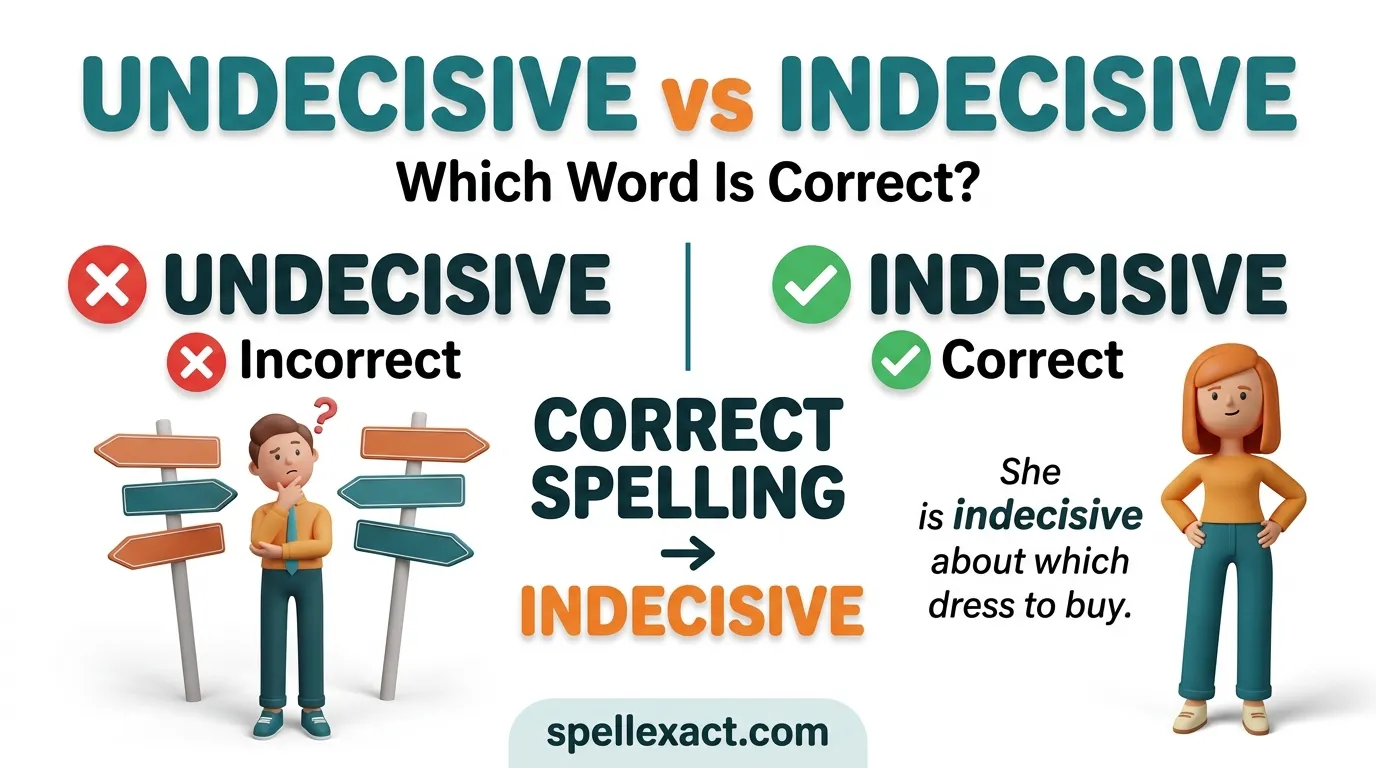
The confusion around undecisive vs indecisive is common because both words may sound logical, but only one is the correct choice in English. When people have typed undecisive, it may have sounded natural, creating confusion about which word to use.
This common mistake happens because both forms seem logical, but indecisive is the correct choice. In everyday writing, emails, academic work, and professional communication, using the right word helps keep a message clear and polished.
The easiest way to understand the difference is to focus on meaning, usage, and word choice. Indecisive describes someone who feels unsure or has difficulty making a decision or choosing between decisions. Undecisive is uncommon in standard English, so it is better to use indecisive in normal writing and speaking.
A person may second-guess a choice while choosing, but indecisive provides greater clarity and accuracy. This distinction also helps learners understand English language, spelling, and grammar more naturally.
For example, saying someone is indecisive communicates that the person struggles with a choice, whereas undecisive may sound unusual. Paying attention to communication, correct usage, and the right word makes writing easier to understand. When you connect indecisive with difficulty making a decision, the difference becomes easier to remember.
Quick Answer
Indecisive is the standard and commonly used word for someone who has difficulty making decisions. Undecisive is uncommon and is generally not the preferred choice in modern standard English. If you mean “unable or unwilling to make a decision,” use indecisive.
Why Do People Confuse It?
People often confuse undecisive and indecisive because both words appear to be formed from the word decisive.
The prefix in- commonly creates a negative meaning:
- decisive → indecisive
- dependent → independent
- complete → incomplete
- direct → indirect
Because undecisive also seems logically possible, some writers use it when they mean “not decisive.” However, indecisive is the normal word when describing someone or something that lacks decisiveness.
First Word: Indecisive
Indecisive is an adjective meaning unable to make a decision easily or unwilling to choose between different possibilities.
It is the standard word for a person who repeatedly struggles to make choices.
Examples:
- Tom is indecisive when choosing what to order.
- She became indecisive about which job to accept.
- His indecisive nature sometimes frustrates his friends.
- I was indecisive about which color to buy.
The noun form is indecision.
Example:
Her indecision delayed the project.
Second Word: Undecisive
Undecisive is an uncommon word and is not normally the best choice when you want to say that someone has difficulty making decisions.
In most everyday and formal English, indecisive is the natural choice.
If you are writing an essay, email, article, school assignment, or professional document, indecisive is generally the safer and more familiar word.
Indecisive vs Undecisive: Comparison Table
| Feature | Indecisive | Undecisive |
| Part of speech | Adjective | Adjective |
| Common in modern English | Yes | No, uncommon |
| Meaning | Unable or reluctant to make decisions | Rarely used to express a lack of decisiveness |
| Natural choice for people | Yes | Generally no |
| Suitable for formal writing | Yes | Usually avoid |
| Related noun | Indecision | — |
| Recommended choice | Yes | No |
When Should You Use Each?
Use “Indecisive” for a Person
Use indecisive when someone has difficulty choosing or making decisions.
Example:
- My brother is indecisive about what to study.
Use “Indecisive” for Behavior or Actions
The word can also describe behavior, thinking, or an approach that shows difficulty making a decision.
Example:
- Her indecisive behavior made the situation more complicated.
What About “Undecisive”?
Because undecisive is uncommon, it is usually better to replace it with indecisive.
Instead of:
- He is undecisive about the offer.
Write:
- He is indecisive about the offer.
10+ Examples of Indecisive
- Sarah is indecisive when shopping for clothes.
- I was indecisive about which restaurant to choose.
- His indecisive nature made the meeting longer.
- She became indecisive after hearing both sides of the argument.
- Mark is too indecisive to choose a vacation destination.
- The customer was indecisive about which laptop to buy.
- Being indecisive can make simple choices feel difficult.
- I felt indecisive because both options looked good.
- Her indecisive response left everyone waiting.
- He can be very indecisive when making important career choices.
- The manager seemed indecisive during the discussion.
- Don’t be indecisive if you already know what you want.
Common Mistakes
Mistake 1: Using “Undecisive” Instead of “Indecisive”
❌ He is undecisive about his future.
✅ He is indecisive about his future.
Mistake 2: Confusing “Indecisive” With “Undecided”
These words are related but are not exactly the same.
Indecisive describes a person or their tendency to have difficulty making decisions.
Undecided usually means that a decision has not yet been made.
Compare:
- She is indecisive.
- She is undecided about which university to attend.
Someone can be undecided about one particular choice without generally being an indecisive person.
Mistake 3: Using “Indecision” as an Adjective
❌ He is indecision.
✅ He is indecisive.
Indecision is a noun, while indecisive is an adjective.
Memory Trick
Remember:
Indecisive = In + decisive = having difficulty deciding.
Think of the sentence:
“I’m IN trouble because I can’t decide.”
The in- in indecisive can help you remember the correct word.
Another simple trick is:
Decision → indecision → indecisive
These three words belong together.
American vs British English
Indecisive is standard and widely understood in both American English and British English.
There is no major American-versus-British spelling difference for this word.
For example, both varieties naturally use:
- She is indecisive.
- His indecision caused a delay.
- I am undecided about the proposal.
If you are writing for an American or British audience, indecisive is the appropriate choice.
Similar Words
Several words are related to indecisive, but their meanings can differ slightly.
- Undecided — having not yet made a decision.
- Hesitant — uncertain or unwilling to act quickly.
- Uncertain — not sure about something.
- Doubtful — feeling that something may not be true or suitable.
- Irresolute — unable to make a firm decision, especially in a formal context.
- Vacillating — repeatedly changing between different choices or opinions.
For everyday English, indecisive and undecided are especially useful, but they should not always be used interchangeably.
Final Verdict
When you mean “unable or reluctant to make a decision,” the correct and natural choice is indecisive.
Undecisive is uncommon, so it is generally better to avoid it in standard English. If you are describing someone who struggles to choose, remember:
Indecisive = unable or reluctant to make decisions.
FAQs
Is “undecisive” a correct word?
“Undecisive” exists in some usage, but it is uncommon. Indecisive is the standard and much more natural choice for describing difficulty making decisions.
Is it “indecisive” or “undecisive”?
Use indecisive in normal English. It is the familiar word for someone who has trouble making decisions.
What does indecisive mean?
Indecisive means unable or reluctant to make a decision, especially when faced with several choices.
What is the noun of indecisive?
The noun is indecision.
Example: His indecision caused the team to wait.
Is “undecided” the same as “indecisive”?
Not exactly. Undecided usually means that a particular decision has not been made, while indecisive describes a tendency or difficulty in making decisions.
What is another word for indecisive?
Depending on the context, alternatives include hesitant, uncertain, irresolute, and vacillating.
Can I use “indecisive” for a person?
Yes. For example: “She is indecisive when making important decisions.”
Remember This
Indecisive is the word to remember.
- ✅ Indecisive = unable or reluctant to make decisions
- ⚠️ Undecisive = uncommon; generally avoid it
- ✅ Indecision = the noun form
- ✅ Undecided = a person or matter for which a decision has not yet been made
Conclusion
The difference between undecisive vs indecisive is mainly about standard usage. When you want to describe someone who struggles to make choices or decisions, indecisive is the natural and widely used word. Undecisive is uncommon and should generally be replaced with indecisive.
A useful way to remember the difference is to connect indecisive with indecision. If someone cannot easily decide, they are indecisive; if a particular choice has not yet been settled, they may be undecided. Using these words correctly will make your English clearer and more natural.

Maria Megan is a language enthusiast and content writer specializing in spelling, grammar, and English usage. She creates clear, practical articles that help readers identify common spelling mistakes, improve writing accuracy, and communicate with greater confidence.