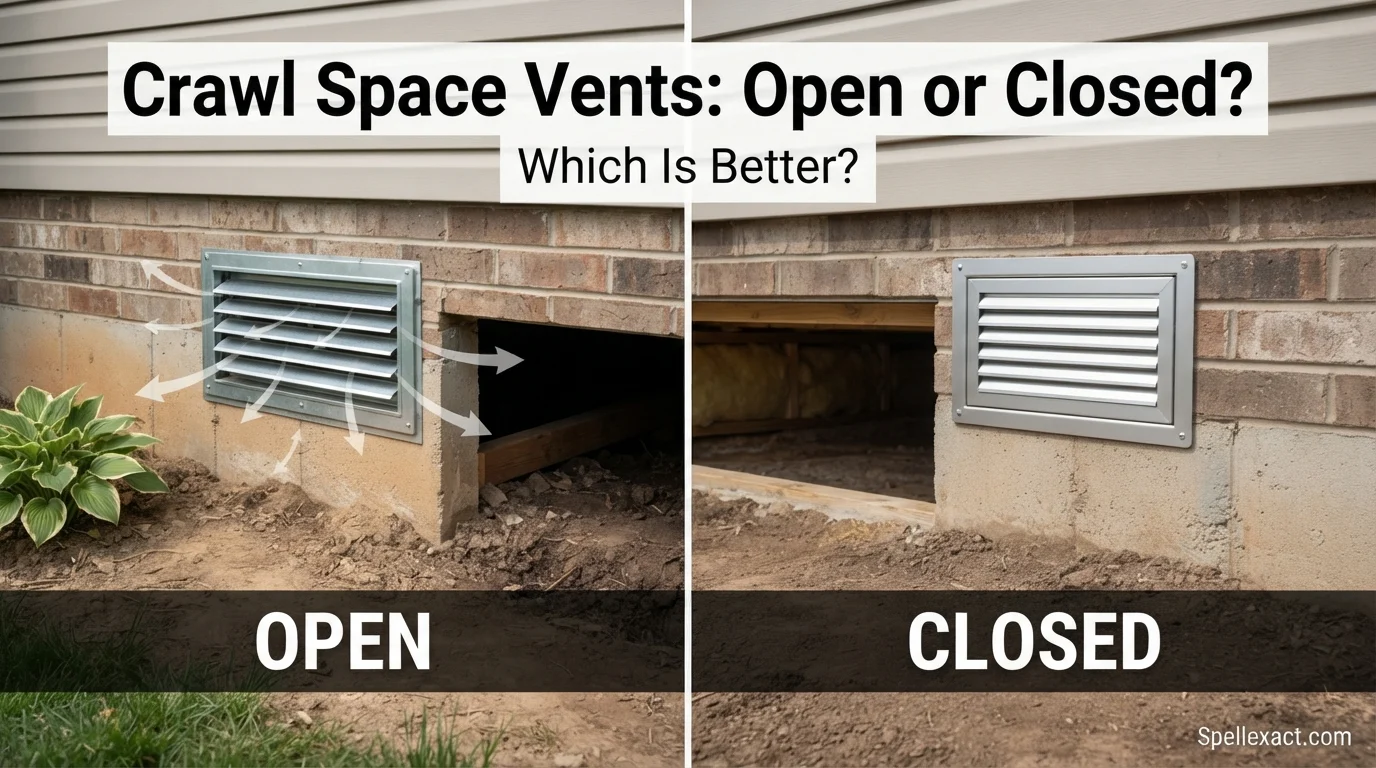
Should crawl space vents be open or closed? It depends on how your crawl space is built. If you have a traditional vented crawl space, keep the vents open in mild and warm weather and close them only during hard freezes if your pipes are at risk. If your crawl space is sealed (encapsulated), the vents should stay closed all year.
This question confuses many homeowners because the advice has changed over time. Older homes were built to “breathe” through foundation vents. Newer building research shows that outside air can carry moisture into the space, especially in humid areas. This guide explains both methods in plain English, so you can protect your home from mold, rot, and frozen pipes.
Quick Answer
Keep crawl space vents open if your crawl space is a traditional vented one, with no sealed vapor barrier, and the weather is mild or warm. Close them in freezing weather to protect pipes. If your crawl space is encapsulated with a sealed vapor barrier, keep the vents closed all year.
Why Do People Get Confused About Crawl Space Vents?
People get mixed advice because two different building methods exist, and both are common.
- Old method: Add vents so air can flow through and dry the space.
- New method: Seal the space, cover the ground, and control moisture directly.
- Seasonal advice: Some people say “open in summer, closed in winter,” which is only partly true.
- Climate differences: What works in a dry, cold area may fail in a hot, humid one.
Because both methods are used, one person’s good advice can be another person’s mistake.
What Does It Mean to Keep Crawl Space Vents Open?
A vented crawl space has small openings in the foundation walls. Open vents let outside air move through the space. The idea is that moving air carries away moisture that rises from the soil.
This works best when:
- The climate is dry or mild.
- The ground is covered with a plastic vapor barrier.
- The vents are not blocked by plants, dirt, or storage items.
The weakness is humidity. In warm, damp weather, outside air can be more humid than the air under your house. When that air hits cooler surfaces, water can condense on wood, pipes, and ductwork.
What Does It Mean to Keep Crawl Space Vents Closed?
Closed vents are used in two very different situations, and they are not equally safe.
Closed in a sealed crawl space (good): The ground and walls are covered with a thick vapor barrier, the vents are sealed, and the space is dried by a dehumidifier or conditioned air. This is often called encapsulation.
Closed in an unsealed crawl space (risky): The vents are shut, but the dirt floor is bare and nothing controls moisture. Water vapor from the soil gets trapped, and humidity can rise quickly.
The difference is simple: closing vents works only when you also control the moisture.
Open Vents vs Closed Vents: Comparison Table
| Feature | Open Vents (Vented Crawl Space) | Closed Vents (Sealed Crawl Space) |
| Air source | Outside air flows through | Air stays inside the sealed space |
| Best climate | Dry or mild areas | Humid, hot, or very cold areas |
| Vapor barrier on ground | Recommended | Required, covering ground and walls |
| Moisture control | Passive (natural airflow) | Active (dehumidifier or conditioned air) |
| Freezing pipe risk | Higher in winter | Lower |
| Upfront cost | Low | Higher |
| Ongoing care | Seasonal vent checks | Check humidity and equipment |
When Should You Open or Close Crawl Space Vents?
Use this guide for a traditional vented crawl space.
Keep vents open when:
- Spring, summer, and fall temperatures are mild.
- The air is dry or only slightly humid.
- A ground vapor barrier is already installed.
Close vents when:
- Temperatures stay below freezing for several days.
- Water pipes run through the crawl space and are not well insulated.
- A professional has told you your crawl space is sealed.
Keep vents open or check with a professional when:
- Outdoor humidity is very high. Closing the vents may trap moisture, but opening them may bring more in. A dehumidifier or encapsulation is often the real fix.
Real-Life Examples
- Dry mountain town, vented crawl space with vapor barrier: The owner keeps vents open in summer and closes them during winter cold snaps.
- Humid coastal home with open vents and a dirt floor: Damp summer air condenses under the floor, so the owner chooses encapsulation.
- Newly encapsulated crawl space: The contractor seals the vents permanently because the space is now managed with a dehumidifier.
- Older farmhouse with uninsulated pipes: The owner closes vents and adds pipe insulation before a freezing week.
- Rainy spring week: Standing water appears under the house. Closing vents will not fix this, so the owner fixes drainage and gutters first.
- Home with a gas furnace in the crawl space: The owner checks with a heating professional before closing vents, because the furnace may need fresh air.
- Vents blocked by bushes: Airflow is poor even though the vents are “open.” Trimming the plants helps.
- Winter closed vents, spring forgotten: The owner leaves them shut into summer, and musty smells appear. Setting a calendar reminder solves this.
- Rental property with bare soil: Closing vents makes the space damp, so the owner adds a vapor barrier first.
- Home in a flood-prone area: The owner uses flood vents that open automatically with rising water, as local rules require.
- Insulated floor above a vented space: Moist outside air can wet the insulation, so the owner has an inspector check for sagging or damp batts.
Common Mistakes to Avoid
- Closing vents on a bare dirt floor. This traps ground moisture.
- Leaving vents open all winter in a freezing climate. Pipes can freeze and burst.
- Forgetting to reopen vents in spring. Moisture can build up over summer.
- Blocking vents with soil, mulch, plants, or stored items.
- Sealing vents without a plan for moisture control, such as a dehumidifier.
- Ignoring signs of trouble like musty smells, sagging insulation, or mold spots.
- Skipping local rules. Building codes differ by region.
Memory Trick
Think “Seal first, then close.”
You can close the vents only after you have sealed the ground and controlled the moisture. If the space is not sealed, think “mild weather, open air; freezing weather, close with care.”
American vs British English
The topic is the same, but the words are different.
- American English: crawl space (or crawlspace), foundation vents, vapor barrier, encapsulation.
- British English: underfloor void or sub-floor void, air bricks, damp-proof membrane, ventilation.
In the UK, houses with suspended timber floors often have air bricks. These are fixed openings, and experts usually advise keeping them clear rather than closing them. In the US, both vented and sealed designs are common, so the open-or-closed question comes up more often. Spelling also differs: “vapor” (US) and “vapour” (UK).
Similar Terms You May Hear
- Vented crawl space: A crawl space with wall vents that let outside air in.
- Unvented or sealed crawl space: A crawl space with no wall vents and sealed walls.
- Encapsulated crawl space: A sealed crawl space lined with a heavy plastic barrier on the floor and walls.
- Conditioned crawl space: A sealed crawl space that gets some heated or cooled air or uses a dehumidifier.
- Vapor barrier (vapor retarder): A plastic sheet that blocks moisture from the soil.
- Foundation vent: The small opening in the foundation wall.
- Flood vent: A special vent that opens during flooding to reduce wall pressure.
Final Verdict
There is no single answer for every house. For a traditional vented crawl space, open vents are the usual choice, with seasonal closing only for freezing weather. For a sealed, encapsulated crawl space, closed vents are correct. The worst option is closed vents on bare soil, because it traps moisture with no way to remove it. If you are unsure, ask a licensed contractor or home inspector in your area.
Frequently Asked Questions
Should crawl space vents be open or closed in summer?
In a traditional vented crawl space with a ground vapor barrier, they are usually kept open. In very humid areas, summer air can add moisture, so a dehumidifier or encapsulation may be a better solution.
Should crawl space vents be open or closed in winter?
Close them during freezing weather if water pipes are in the space and are not insulated. Insulate the pipes too. In a sealed crawl space, they stay closed all year.
Can closed crawl space vents cause mold?
Yes, if the ground is bare or moisture is not controlled. Trapped humidity can lead to mold, wood rot, and musty smells. A sealed crawl space with moisture control avoids this.
Do crawl space vents prevent moisture problems?
Not always. Vents help in dry climates, but in humid weather they can bring in damp air. Gutters, drainage, and a ground vapor barrier matter just as much.
Is it better to seal or vent a crawl space?
In many humid regions, building experts prefer sealing because it controls moisture more reliably. In dry climates, venting can still work well. Local climate and building code should guide the choice.
How many vents does a crawl space need?
Many US codes ask for about 1 square foot of vent opening for every 150 square feet of floor area. This can be reduced when a ground vapor barrier is used. Check your local code for exact numbers.
How do I know if my crawl space is sealed or vented?
Look for open or screened vents in the foundation walls and bare soil or thin plastic on the ground. A sealed space has no open vents and thick liner covering the floor and walls.
Remember This
- Open vents work best in mild weather with a ground vapor barrier.
- Close vents in hard freezes to protect pipes.
- Sealed crawl spaces keep vents closed all year.
- Never close vents on bare soil without moisture control.
- Keep vents clear of plants, dirt, and stored items.
- Check your local building code and ask a professional if you are unsure.
Conclusion
Whether crawl space vents should be open or closed comes down to one question: how is your crawl space built? A vented space needs airflow in mild weather and some protection in freezing weather. A sealed space needs closed vents and steady moisture control. Matching your vent habits to your crawl space type is the best way to avoid damp air, mold, and frozen pipes.
Take a quick look at your crawl space this season. Check the vents, the ground covering, and any pipes. If you see standing water, mold, or a strong musty smell, call a licensed professional before you open or close anything. A small inspection now can save you from large repair bills later.

Andrew Anthony is a language enthusiast and content writer specializing in spelling mistakes, grammar, and English usage. He creates clear, practical, and well-researched guides that help readers improve their writing skills with confidence.