When describing a deep red color, should you say burgundy or wine? Both words can describe dark reddish shades, but they are not always interchangeable. Burgundy usually refers to a specific deep red color associated with the Burgundy region of France, while wine can describe a broader range of red, purple-red, or reddish-brown shades inspired by wine.
For English learners, the difference can be confusing because color names often overlap. In everyday English, both terms may describe clothing, paint, cars, hair, shoes, furniture, and other objects. However, burgundy is generally the more established and specific color name, while wine is more flexible and can vary depending on context.
Quick Answer
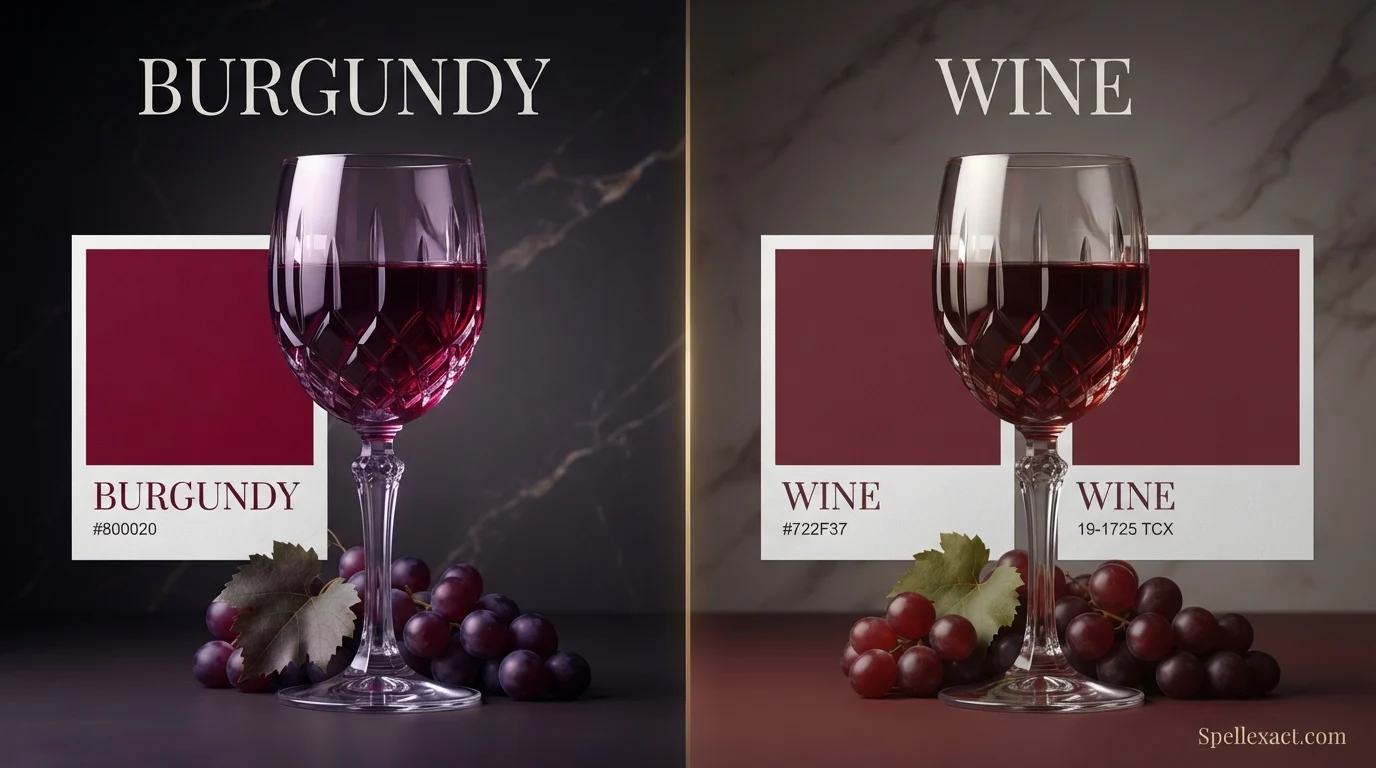
Burgundy and wine both describe dark red shades. Burgundy is usually a deep, rich red with purple or brown undertones, while wine is a broader color term inspired by red wine and may range from reddish-purple to dark red. In everyday English, burgundy is often the more precise choice.
Why People Confuse It
People confuse burgundy and wine because both words can refer to similar dark red colors.
There is no single universally fixed shade for either word in ordinary English. Different brands, designers, websites, and manufacturers may use the terms differently.
For example:
- A burgundy dress usually suggests a rich, dark red.
- A wine-colored dress can suggest a similar dark red but may have more purple, brown, or muted tones.
- A burgundy car and a wine-colored car may look almost identical.
The surrounding context often matters more than a precise color boundary.
First Word: Burgundy
Burgundy is a noun and an adjective.
As a color, it means a deep, rich red, often with purple or brown undertones.
Examples:
- She bought a burgundy handbag.
- He wore a burgundy jacket.
- The walls were painted burgundy.
- Burgundy is a popular color for winter clothing.
The word comes from Burgundy, a historical region of France famous for its wine production.
Second Word: Wine
Wine can also be used as a color word.
As a color, wine generally means a dark red shade resembling the color of red wine.
Examples:
- She chose a wine-colored scarf.
- The sofa is available in wine.
- He bought a wine shirt for the party.
- The curtains have a deep wine color.
Unlike burgundy, the word wine can refer to a wider range of shades because different wines have different colors.
Burgundy vs Wine: Comparison Table
| Feature | Burgundy | Wine |
| Basic meaning | Deep, rich red | Dark red inspired by wine |
| Typical appearance | Red with purple/brown undertones | Can range from red to reddish-purple or brown |
| Specificity | Usually more specific | Usually broader |
| Common use | Fashion, interiors, branding, cars | Fashion, interiors, descriptions |
| Origin | Burgundy region of France | Wine as a beverage |
| Example | Burgundy dress | Wine-colored dress |
| Can they look similar? | Yes | Yes |
When to Use Each
Use “burgundy” when you want a specific color name
Choose burgundy when you are describing a rich, dark red shade and want a familiar, established color term.
Examples:
- a burgundy sweater
- burgundy boots
- a burgundy sofa
- burgundy lipstick
- a burgundy tie
Use “wine” when describing a wine-like shade
Use wine when the color is being described generally as resembling red wine.
Examples:
- a wine-colored shirt
- wine curtains
- a wine handbag
- wine-colored walls
In many everyday situations, either word may be understood.
10+ Examples of Burgundy and Wine
Examples with “burgundy”
- She wore a burgundy dress to the wedding.
- I bought a burgundy jacket for winter.
- The bedroom has burgundy curtains.
- He chose a burgundy tie.
- Her shoes are burgundy.
- They painted the door burgundy.
Examples with “wine”
- She bought a wine-colored scarf.
- The restaurant has wine-colored chairs.
- He was wearing a wine shirt.
- I like this wine-colored handbag.
- The room has wine-colored curtains.
- She chose a wine-colored dress.
Comparing both
- The two dresses are similar, but one is burgundy and the other is wine-colored.
- Burgundy is often used as a specific color name, while wine can describe a broader dark-red shade.
Common Mistakes
Mistake 1: Thinking they are completely different colors
They are not necessarily completely different. Their shades can overlap considerably.
Mistake 2: Assuming “wine” always means purple
Wine can have purple undertones, but it does not always look purple. The exact shade depends on the context.
Mistake 3: Treating color names as scientifically fixed
Everyday color names do not always have strict boundaries. A manufacturer may label a particular shade burgundy, while another may call a very similar shade wine.
Mistake 4: Writing “a burgundy color”
This is understandable, but burgundy can work directly as a color adjective.
More natural:
- a burgundy dress
- a burgundy car
You can also say:
- a burgundy color
- a burgundy shade
but these are often less concise.
Memory Trick
Think:
Burgundy = a named deep-red shade.
Wine = a broader wine-inspired color.
A simple memory sentence is:
Burgundy is a type of dark red; wine describes a wine-like shade.
American vs British English
There is no major American-versus-British English difference that makes burgundy and wine mean completely different colors.
Both varieties of English use burgundy as a color term.
Wine is also understandable in both varieties when it is used to describe a color.
However, individual retailers, designers, and brands may use these labels differently.
Similar Words
Several other color terms are related to burgundy and wine:
- Maroon — usually a dark reddish-brown shade.
- Bordeaux — a dark red associated with the wine-producing region of Bordeaux.
- Merlot — sometimes used as a wine-inspired dark red color.
- Claret — a dark red, especially in British English.
- Oxblood — a very dark red, often with brown or burgundy tones.
- Crimson — a strong, deep red that is generally brighter than burgundy.
- Plum — a dark purple shade with less emphasis on red.
- Mauve — a softer, lighter purple-pink shade.
These words overlap, but they should not automatically be treated as exact synonyms.
Final Verdict
Burgundy and wine can both describe a deep red color, and in many everyday situations they are used for very similar shades.
If you want the more specific and widely recognized color name, choose burgundy. If you are simply describing a color that resembles red wine, wine-colored is also natural.
The exact shade can vary by context, so the two terms may sometimes describe nearly identical colors.
FAQs:
Is burgundy the same as wine color?
Not always. Burgundy is generally a specific deep red shade, while wine is a broader description for colors inspired by red wine. The two can look very similar.
Which is darker, burgundy or wine?
There is no universal rule. Both can refer to dark colors, and the actual shade depends on how the color is defined by a person, designer, or manufacturer.
Is burgundy red or purple?
Burgundy is primarily a deep red, but it can have noticeable purple or brown undertones.
Is wine color red or purple?
Wine color is generally based on dark red wine, so it is usually a dark red. Some wine-colored shades can have strong purple or brown undertones.
Can I use burgundy and wine interchangeably?
Often, yes, when describing clothing or other everyday objects. However, if a particular product has a specified color name, it is better to use the manufacturer’s stated term.
What is another word for burgundy?
Depending on the exact shade, related terms include maroon, Bordeaux, claret, oxblood, and dark red. They are not always exact equivalents.
Which is more common: burgundy or wine?
Burgundy is a well-established color name in English. Wine is also commonly used as a descriptive color term, particularly for fashion and interior colors.
Conclusion:
Burgundy = a deep, rich red color.
Wine = a broader wine-inspired dark red shade.
They can describe very similar colors, but burgundy is usually the clearer choice when you want to name a specific dark-red color.
In simple English, you can remember: burgundy is a color name, while wine is a color description based on wine.
The two terms are close enough that context matters. If you are naming a color for clothing, design, or everyday conversation, either may work when the intended shade is clear. When precision matters, check the actual color or the manufacturer’s color label rather than relying only on the word.

Aaron Adam is the Administrator of SpellExact, dedicated to helping readers improve their spelling and writing accuracy. He oversees content quality, ensures reliable language resources, and works to make spelling guidance simple, practical, and accessible for everyone.