If you’ve ever wondered whether to write flys or flies, you’re asking one of the most common English spelling questions. Thousands of people search for flys vs flies, flies or flys, and is flys a word because both spellings look believable. However, only one is correct in standard English.
If you’re a student, writer, blogger, ESL learner, or professional, using the correct spelling matters. A small spelling mistake can reduce the credibility of your writing, especially in academic papers, business emails, or SEO content.
In this complete guide, you’ll learn the difference between flys vs flies, the grammar rules for fly, when to use flies, why people mistakenly write flys, and how to remember the correct spelling forever.
Quick Answer
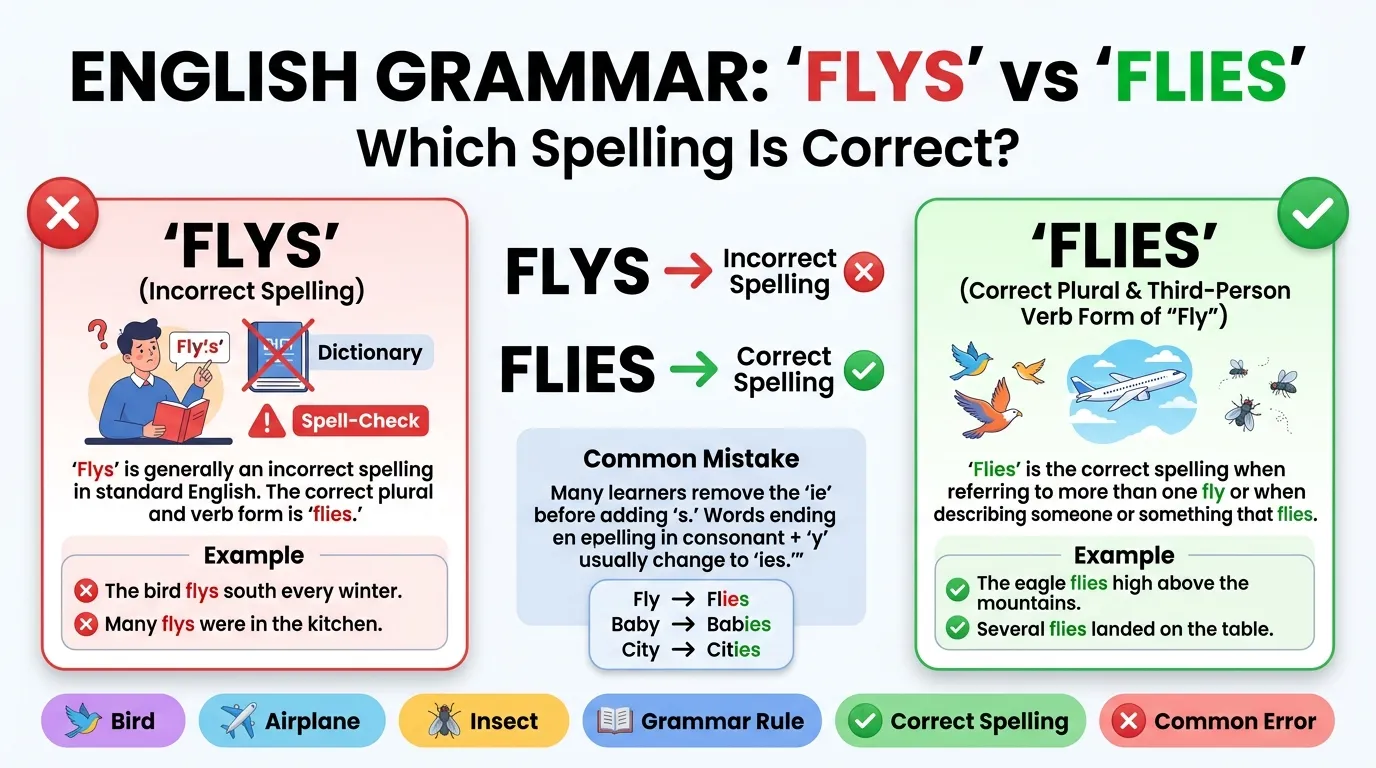
Flies is the correct spelling in standard English.
Use flies when referring to:
- The plural of fly (the insect).
- The third-person singular form of the verb fly.
Flys is not grammatically correct in standard English unless it is used as a proper noun, such as a surname or brand name.
Quick Examples
✅ The flies are buzzing around the fruit.
✅ She flies to New York every month.
❌ There are many flys in the kitchen.
If you’re asking how to spell flies correctly, the answer is simple: flies is always the correct choice in everyday English.
At a Glance: Flys vs Flies
| Word | Correct? | Part of Speech | Meaning |
| Fly | ✅ | Noun / Verb | A flying insect or to move through the air |
| Flies | ✅ | Plural noun / Verb | More than one fly or the third-person singular verb |
| Flys | ❌ | — | Incorrect spelling in standard English (except proper names) |
This simple comparison answers the most common question about flys vs flies spelling and helps you avoid one of the most common English spelling mistakes.
What Does “Flies” Mean?
Understanding the flies meaning is the first step toward using the word correctly.
The word flies has two main meanings in English.
1. Flies as the Plural of Fly
A fly is a small winged insect commonly found around food, gardens, farms, and outdoor spaces.
When there is more than one, the correct plural of fly is flies.
Examples:
- Flies are attracted to sweet foods.
- We kept the windows closed to stop flies from coming inside.
- Farmers often protect animals from biting flies.
- Houseflies can carry harmful bacteria.
In each sentence, flies functions as a plural noun.
2. Flies as a Verb
The word flies is also the third-person singular verb of fly.
Examples:
- She flies to London every month.
- The eagle flies above the mountains.
- The airplane flies at nearly 35,000 feet.
- Time flies when you’re having fun.
Here, flies describes an action and is the correct fly verb form in the present tense.
When to Use “Flies”
One of the biggest search intents behind flys vs flies is knowing when to use flies.
Use flies whenever you’re talking about:
Multiple Insects
Examples:
- The picnic attracted dozens of flies.
- Flies become more active during warm weather.
- We used a net to keep flies away from the fruit.
Someone or Something Flying
Examples:
- He flies to Dubai every week for work.
- The bird flies across the river every morning.
- This airline flies to over 80 countries.
- The drone flies smoothly even in strong wind.
A simple rule to remember is:
If you mean more than one fly or someone flies, always write flies.
Is “Flys” a Word?
Many people search:
- Is flys a word?
- Is flys grammatically correct?
The answer is no.
In standard English dictionaries and grammar references, flys is not accepted as the correct plural noun or verb form.
However, you might occasionally see Flys used as:
- A surname
- A company name
- A product name
- A username
- A fictional character’s name
These are proper nouns, not examples of standard grammar.
So, unless you’re referring to a specific name, always use flies.
Why Do People Write “Flys”?
If flies is correct, why do so many people type flys?
There are several reasons.
1. They Apply the Wrong Plural Rule
Most English nouns simply add -s.
Examples:
- Car → Cars
- Book → Books
- Dog → Dogs
People naturally assume:
Fly → Flys
But fly follows a different spelling rule.
2. The Pronunciation Doesn’t Change Much
Both spellings sound almost identical.
Because pronunciation doesn’t clearly indicate the spelling, many writers choose the wrong version.
3. Typing Habits
Fast typing often leads to spelling errors.
Since flys requires fewer keystrokes than flies, it’s a common typo.
4. Lack of Grammar Knowledge
Many learners memorize vocabulary instead of learning English spelling rules.
Understanding the rule is much more effective than memorizing individual words.
The Grammar Rule Explained
The answer to why is it flies instead of flys comes from one simple grammar rule.
Rule: Consonant + Y → IES
When a word ends in a consonant followed by Y, replace the Y with I before adding ES.
Visual Rule
Fly
↓
Remove Y
↓
Add IES
↓
Flies
This is one of the most important plural spelling rules in English.
More Examples
| Singular | Plural |
| Fly | Flies |
| Baby | Babies |
| City | Cities |
| Story | Stories |
| Lady | Ladies |
| Puppy | Puppies |
| Spy | Spies |
| Reply | Replies |
Learning this consonant + y spelling rule helps you spell dozens of English words correctly.
Exception: When You Simply Add “-S”
Not every word ending in Y changes to IES.
If the Y follows a vowel, simply add S.
Examples:
| Singular | Plural |
| Boy | Boys |
| Toy | Toys |
| Key | Keys |
| Monkey | Monkeys |
| Journey | Journeys |
Compare these examples:
- Fly → Flies ✅
- Boy → Boys ✅
This comparison is one of the easiest ways to understand English grammar rules.
Pronunciation
Many learners also search for the pronunciation of these words.
| Word | Pronunciation |
| Fly | /flaɪ/ |
| Flies | /flaɪz/ |
Notice that the pronunciation changes slightly by adding the /z/ sound at the end of flies.
Flies in a Sentence
Reading examples is one of the fastest ways to improve your English vocabulary and understand correct English usage.
Everyday Conversation
- Flies keep landing on the fruit bowl.
- The bird flies back to its nest every evening.
- My father flies to Singapore several times each year.
- Time flies when you’re enjoying yourself.
School Examples
- The science teacher explained why flies are important to ecosystems.
- Students observed flies through a microscope.
- The paper airplane flies farther with a stronger throw.
Business Examples
- Our CEO flies internationally every month.
- The company flies employees to conferences.
- She flies to client meetings every week.
Nature Examples
- The butterfly flies from flower to flower.
- Flies help break down organic matter.
- An eagle flies high above the valley.
- Some flies are harmless, while others spread disease.
Travel Examples
- The airline flies to more than 100 destinations.
- He flies business class whenever possible.
- She flies home every holiday season.
These examples show both flies in a sentence as a noun and as a verb, making the difference much easier to remember.
Common Mistakes to Avoid
Even experienced writers occasionally confuse flys vs flies, especially when writing quickly. Understanding these mistakes will help you improve your spelling and write with greater confidence.
Mistake #1: Writing Flys as the Plural of Fly
❌ There were several flys on the window.
✅ There were several flies on the window.
Remember, flies is always the correct plural of fly.
Mistake #2: Using Flys as a Verb
❌ She flys to Chicago every Monday.
✅ She flies to Chicago every Monday.
The correct fly verb form in the third-person singular is flies.
Mistake #3: Forgetting the Consonant + Y Rule
Many learners forget one of the most important English spelling rules:
- Fly → Flies
- Cry → Cries
- Try → Tries
- Study → Studies
Once you learn this pattern, you’ll avoid many common English spelling mistakes.
Mistake #4: Assuming Every Plural Ends in “-S”
Not all English nouns simply add -s.
Compare these examples:
| Singular | Correct Plural |
| Book | Books |
| Chair | Chairs |
| Boy | Boys |
| Fly | Flies |
| City | Cities |
This is why understanding plural words ending in y is so important.
Easy Memory Trick
If you ever hesitate between flies or flys, remember this simple formula:
Consonant + Y = Replace Y with I and Add ES
Visual reminder:
Fly
↓
Remove Y
↓
Add IES
↓
Flies ✅
Think of another familiar example:
Baby → Babies
If you can remember baby → babies, you’ll also remember fly → flies.
Commonly Confused Words
People searching for flys vs flies often struggle with similar spelling patterns. Here are a few commonly confused words that follow the same grammar rule.
| Incorrect | Correct |
| Flys | Flies |
| Babys | Babies |
| Citys | Cities |
| Storys | Stories |
| Ladys | Ladies |
| Studys | Studies |
| Replys | Replies |
| Worrys | Worries |
Learning these patterns improves your English vocabulary, strengthens your grammar, and reduces spelling errors.
Why “Boy” Becomes “Boys” but “Fly” Becomes “Flies”
This is another question many learners ask.
The difference depends on the letter before Y.
Add -S After a Vowel + Y
Examples:
- Boy → Boys
- Toy → Toys
- Key → Keys
- Monkey → Monkeys
Change Y to IES After a Consonant + Y
Examples:
- Fly → Flies
- Lady → Ladies
- City → Cities
- Story → Stories
- Puppy → Puppies
This simple comparison makes the spelling rule for words ending in y much easier to understand.
American vs British English
Many readers wonder whether American English and British English use different spellings for flys vs flies.
The answer is no.
Both varieties of English use:
- ✅ Fly
- ✅ Flies
Neither American nor British English accepts flys as the correct spelling in standard writing.
Whether you’re writing for readers in the United States, the United Kingdom, Canada, Australia, or elsewhere, flies is always the correct choice.
Key Takeaways
Before moving on, here’s a quick recap.
- ✅ Flies is the correct spelling.
- ❌ Flys is incorrect in standard English.
- Flies is the plural of fly.
- Flies is also the third-person singular form of the verb fly.
- Use the consonant + y → ies rule.
- Both American and British English use flies.
- Learning the spelling rule is easier than memorizing individual words.
Practice Quiz
Test your understanding.
1. Which sentence is correct?
A. The bird flys south every winter.
B. The bird flies south every winter.
✅ Answer: B
2. What is the correct plural of fly?
A. Flys
B. Flies
✅ Answer: B
3. Which spelling follows English grammar rules?
A. Flys
B. Flies
✅ Answer: B
4. Complete the sentence.
She ______ to Boston every month.
A. flys
B. flies
✅ Answer: B
5. Which rule applies to the word fly?
A. Add -s
B. Change y to i and add -es
✅ Answer: B
If you answered all five correctly, you’ve mastered one of the most common English spelling patterns.
Frequently Asked Questions
Is flys a word?
In standard English, flys is not the correct spelling. It may appear as a surname, company name, or brand, but it should not be used as the plural of fly or as a verb.
Which is correct: flys or flies?
Flies is the correct spelling for both the plural noun and the third-person singular verb.
Why is it flies instead of flys?
Because fly ends in a consonant followed by y. According to English grammar rules, the y changes to i before adding -es.
What is the plural of fly?
The correct plural of fly is flies.
Example:
- One fly
- Two flies
How do you spell flies correctly?
Start with fly, remove the y, and add ies:
Fly → Flies
Is flies a verb?
Yes. Flies is the third-person singular form of the verb fly.
Example:
- She flies to work every Monday.
Can flys ever be correct?
Only when it’s part of a proper noun, such as a surname, company name, or product name. In everyday writing, flies is the correct spelling.
What is the difference between flys and flies?
The difference is straightforward:
- Flies is the grammatically correct spelling used in standard English.
- Flys is generally an incorrect spelling unless it is used as a proper name.
Final Summary
The confusion between flys vs flies is easy to resolve once you understand the underlying spelling rule. In standard English, flies is always the correct spelling when referring to the plural of fly or the third-person singular verb.
The form flys is considered incorrect in everyday writing and should only appear as part of a proper noun, such as a surname or brand name. By learning the consonant + y → ies rule, you’ll not only spell flies correctly but also improve your understanding of many other English words with similar patterns.
Instead of memorizing individual spellings, focus on the rule behind them. The same principle applies to words like baby → babies, city → cities, and story → stories. This approach strengthens your grammar, expands your vocabulary, and helps you write more accurately in academic, professional, and everyday situations.
If you’re an ESL learner, a student, or a content writer, mastering these English spelling rules will make your writing clearer and more polished.
Actionable Takeaway
Whenever you find yourself deciding between flys vs flies, remember this simple rule:
If a word ends with a consonant + y, change the y to i and add es.
So:
- ✅ Fly → Flies
- ❌ Fly → Flys
Keep this rule in mind, proofread your work, and practice using flies in real sentences. With consistent practice, choosing the correct spelling will become automatic.

Andrew Anthony is a language enthusiast and content writer specializing in spelling mistakes, grammar, and English usage. He creates clear, practical, and well-researched guides that help readers improve their writing skills with confidence.