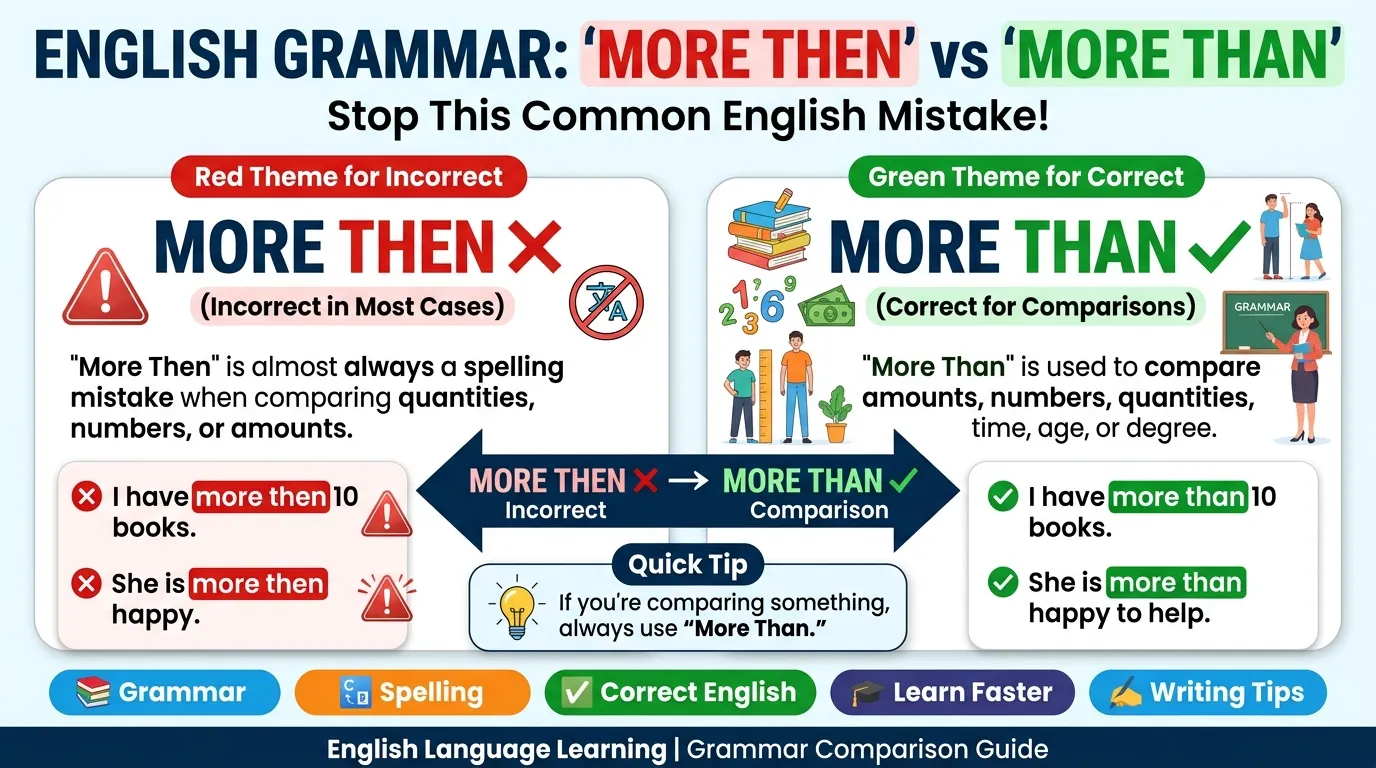
If you’re wondering whether more then or more than is correct, here’s the short answer:
✅ “More than” is correct.
❌ “More then” is almost always incorrect.
The reason is simple: than is used for comparisons, while then refers to time, order, or what happens next. So, if you’re comparing numbers, amounts, people, or ideas, always use more than.
Many English learners and even native speakers confuse these words because they sound alike. If you’ve searched for more then vs more than, more than or more then, than vs then, or is more then correct, you’re in the right place.
This guide explains the grammar rule in plain English, includes plenty of more than examples, highlights common mistakes, and shares practical tips to help you write confidently.
Quick Answer
| Question | Answer |
| Which is correct? | ✅ More than |
| Is more then correct? | ❌ No, in standard English |
| Why? | Than is used for comparisons, while then refers to time or sequence. |
| Example | ✅ More than 100 people attended. |
Featured Snippet Answer
Use “more than” whenever you’re comparing quantities, numbers, amounts, or people. “More then” is a grammar mistake because “then” relates to time, not comparison.
Examples:
- ✅ She has more than 20 books.
- ✅ The project cost more than expected.
- ❌ She has more then 20 books.
Why Do People Search “More Then vs More Than”?
This is one of the most searched common English grammar mistakes because the words than and then are pronounced similarly. In fast speech, they often sound almost identical, making it easy to choose the wrong spelling while writing.
People usually search this topic because they want to know:
- Is more then grammatically correct?
- What is the difference between more then and more than?
- When to use than and when to use then?
- Why does Grammarly correct more then?
- How can I remember the correct phrase?
This article answers all of these questions with clear explanations and real-world examples.
What Does “More Than” Mean?
The more than meaning is simple. It means a greater amount, quantity, number, degree, or level than something else. In other words, it is used whenever you’re making a comparison.
Examples of “More Than”
- More than 500 students applied for the scholarship.
- She earns more than her brother.
- The meeting lasted more than two hours.
- This laptop costs more than $1,000.
- We received more than enough support.
Notice that each sentence compares one amount, number, or idea with another. This is why than is the correct word.
Real-Life Examples
Business
- Our sales increased by more than 30% this year.
- The company hired more than 100 new employees.
Academic Writing
- More than half of the participants completed the survey.
- The study collected more than 5,000 responses.
- We received more than 200 customer inquiries this week.
- More than 50 people confirmed their attendance.
Everyday Conversation
- I have more than enough food.
- She’s more than happy to help.
- We walked more than five miles yesterday.
These examples show how naturally more than fits into professional, academic, and everyday English.
What Does “More Then” Mean?
Many people search for the more then meaning, expecting it to be another correct expression.
The truth is that more then is not a standard English phrase when used for comparison.
The word then refers to:
- Time
- Sequence
- Order of events
- What happens next
Examples:
- Finish your homework, then watch TV.
- We ate dinner, then went home.
- Back then, smartphones didn’t exist.
Here, then tells us when something happens—not how much or how many.
That’s why more then is considered a grammar mistake in almost every comparison.
More Then vs More Than: What’s the Difference?
Understanding the than and then difference is easier once you know the job each word performs.
| Feature | Than | Then |
| Main Purpose | Comparison | Time or sequence |
| Part of Speech | Conjunction (and sometimes preposition) | Adverb |
| Used after “more” | ✅ Yes | ❌ No |
| Used after “better” | ✅ Yes | ❌ No |
| Used after “less” | ✅ Yes | ❌ No |
| Refers to time | ❌ No | ✅ Yes |
| Example | More than 10 people | Then we left |
Whenever you’re making a comparison, than is the correct choice.
Whenever you’re talking about time or the next event, use then.
Decision Tree: Should You Use Than or Then?
Use this simple guide whenever you’re unsure.
Are you comparing two things?
│
YES
│
Use THAN
│
Example:
More than 100 people
▼
Are you talking about time or what happens next?
│
YES
│
Use THEN
│
Example:
We finished dinner, then watched a movie.
If you’re still asking “more than or more then?”, this decision tree gives you the answer in seconds.
Why Do People Make This Mistake?
Knowing why the error happens makes it easier to avoid.
1. Similar Pronunciation
The words than and then sound almost identical in many English accents.
2. Typing Too Quickly
Fast typing often leads writers to choose the wrong word without noticing.
3. Autocorrect Isn’t Perfect
Spell-check tools sometimes miss the mistake because then is a correctly spelled English word.
4. English Learners Memorize Sounds First
Many learners hear the words before studying the grammar rules, which leads to confusion later.
5. Lack of Proofreading
A quick proofreading check usually catches this mistake before publishing.
Understanding these causes helps you avoid one of the most confusing English words in everyday writing.
Common Mistakes Writers Make
Here are some examples that appear frequently in emails, blogs, essays, and social media.
| ❌ Incorrect | ✅ Correct |
| More then 100 people attended. | More than 100 people attended. |
| She earns more then me. | She earns more than me. |
| It costs more then expected. | It costs more than expected. |
| We waited more then two hours. | We waited more than two hours. |
| He knows more then anyone else. | He knows more than anyone else. |
Each incorrect sentence uses then where a comparison is needed. Replacing it with than immediately fixes the grammar.
Easy Memory Tricks to Remember the Difference
If you still hesitate between more then vs more than, don’t worry. These simple memory tricks can help you choose the correct word every time.
Trick 1: Than = Comparison
Think of the letter A in than as standing for comparison.
Whenever you compare people, things, numbers, or amounts, use than.
Examples:
- More than 50 students attended.
- Better than before.
- Less than expected.
- Faster than the old model.
- More than enough food.
If you’re wondering when to use than, remember this simple rule:
Comparison = Than
Trick 2: Then = Time
Think of then as meaning next, afterward, or at that time.
Examples:
- Finish your homework, then play games.
- We had dinner, then watched a movie.
- Back then, life was very different.
If your sentence is about time or sequence, then is the correct choice.
Is “More Then” Ever Correct?
One of the most common Google searches is “Is more then correct?”
The answer is almost always no.
When you’re comparing quantities, people, or ideas, more than is the only grammatically correct phrase.
Rare Exception
Occasionally, the words more and then may appear next to each other by coincidence because they belong to different parts of a sentence.
For example:
We needed more, then everyone volunteered to help.
In this sentence:
- More describes the amount needed.
- Then introduces the next event.
This is not the phrase more then used as a comparison. It is simply two separate words appearing together.
For everyday writing, you should treat more then as incorrect.
Related Grammar Mistakes You Should Avoid
Once you understand the difference between more then and more than, you’ll notice the same rule applies to many other comparison phrases.
| ❌ Incorrect | ✅ Correct | Reason |
| Better then | Better than | Comparison |
| Less then | Less than | Comparison |
| Rather then | Rather than | Comparison |
| Other then | Other than | Comparison |
| Bigger then | Bigger than | Comparison |
| Smaller then | Smaller than | Comparison |
| Higher then | Higher than | Comparison |
| Older then | Older than | Comparison |
These are all examples of English grammar comparison words where than is required.
Learning these patterns will improve your grammar and reduce common writing mistakes.
American vs. British English
Many readers wonder whether American English and British English have different rules for more than.
The answer is no.
Both varieties of English follow exactly the same rule:
- ✅ More than
- ❌ More then
Whether you’re writing for readers in the United States, the United Kingdom, Canada, Australia, or New Zealand, more than is always the correct expression.
One small difference worth noting is that American English sometimes accepts different than, while British English usually prefers different from. However, this variation does not affect more than, which remains the standard form everywhere.
Grammar Rule You Should Always Remember
Here’s the easiest grammar rule to remember:
| If Your Sentence… | Use |
| Compares two things | Than |
| Talks about time | Then |
| Shows a greater amount | More than |
| Describes the next event | Then |
If you memorize just these four rules, you’ll avoid one of the most common English grammar mistakes.
Writing Tips to Avoid This Mistake
Professional writers, editors, and teachers often use these proofreading habits:
- Ask yourself whether you’re making a comparison.
- Replace more then with more than whenever comparing quantities.
- Read the sentence aloud before publishing.
- Use grammar-checking software, but don’t rely on it completely.
- Proofread emails, essays, and blog posts carefully.
- Practice with real sentences until the rule becomes automatic.
These habits improve your writing accuracy and help you avoid many confusing English words.
FAQs
1. Which is correct: more then or more than?
More than is correct. Use it whenever you’re comparing numbers, amounts, people, or ideas. More then is considered incorrect in standard English.
2. Why is “more then” incorrect?
Because then refers to time or sequence, not comparison. Since more introduces a comparison, it must be followed by than.
3. What is the difference between than and then?
The than and then difference is simple:
- Than = comparison
- Then = time or sequence
4. When should I use “than”?
Use than after comparative words such as:
- More
- Less
- Better
- Worse
- Bigger
- Smaller
- Higher
- Lower
Example:
This phone is better than my old one.
5. When should I use “then”?
Use then when discussing time or the next step.
Example:
Finish your work, then take a break.
6. Is “more then” ever acceptable?
Only in extremely rare situations where more and then happen to appear together as separate parts of a sentence. As a comparison, it is incorrect.
7. Why do so many people confuse than and then?
They sound very similar, which makes them one of the most commonly confused words in English. Fast typing and autocorrect also contribute to the mistake.
8. Can grammar checkers detect this mistake?
Most modern grammar tools can identify more then as an error and suggest more than, but proofreading manually is still a good habit because no tool catches every mistake.
Final Summary
The difference between more then vs more than comes down to one simple grammar rule. More than is used for comparisons involving numbers, quantities, amounts, people, or ideas, while then is used to describe time, sequence, or what happens next. Although these words sound alike, they serve completely different purposes in English grammar.
If you remember that comparison uses than and time uses then, you’ll avoid one of the most common writing mistakes. Whether you’re writing an email, blog post, business report, academic paper, or social media caption, using more than correctly will make your writing clearer, more professional, and grammatically accurate.
Actionable Takeaway
Before you publish or send any piece of writing, do a quick “than vs. then” check. If your sentence compares two things, choose than. If it describes time or the next event, choose then. This five-second proofreading habit can eliminate one of the most common grammar mistakes and improve the quality of your English writing.
Related Articles
To strengthen your grammar skills, you may also find these topics helpful:
- Than vs. Then: Complete Grammar Guide
- Less Than vs. Less Then
- Better Than vs. Better Then
- Their vs. There vs. They’re
- Your vs. You’re
- Affect vs. Effect
- Accept vs. Except
- Who vs. Whom
Exploring these related grammar guides will help you master other commonly confused English words and become a more confident writer.

Caleb Carter is a passionate language enthusiast and content writer specializing in spelling mistakes, grammar, and vocabulary. He creates clear, practical guides that help readers improve their writing skills and communicate confidently every day.