Have you ever paused while writing because you weren’t sure whether to use minuscule or miniscule? If so, you’re in good company. Thousands of people search for minuscule vs miniscule every month because the two spellings look almost identical. Whether you’re writing an essay, email, blog post, or professional report, using the correct spelling can make your writing more polished and credible.
This complete grammar guide explains which is correct: minuscule or miniscule, why the confusion exists, how dictionaries treat both spellings, and how to remember the correct one forever. You’ll also find clear examples, pronunciation tips, common mistakes, comparison tables, and expert writing advice to help you improve your English spelling skills.
Quick Answer
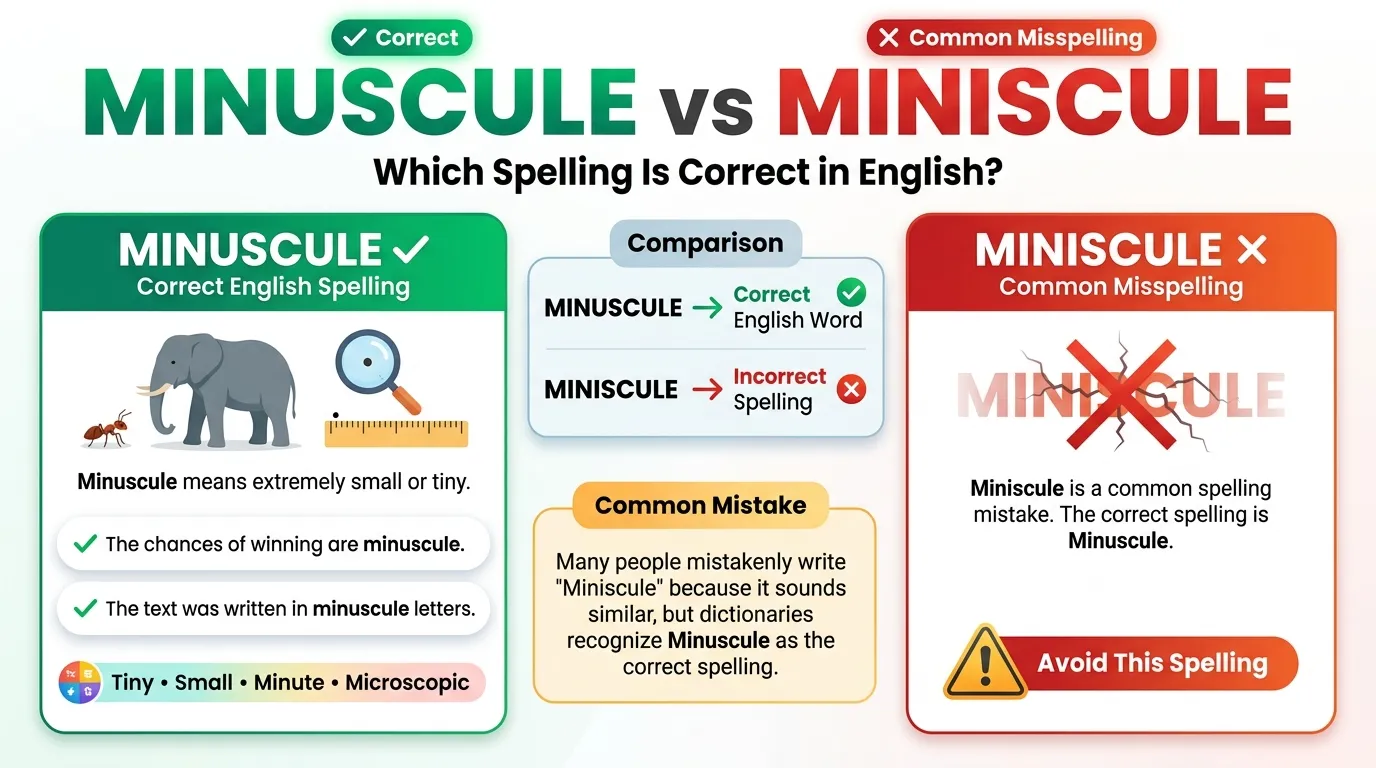
Minuscule is the correct spelling, while miniscule is a common misspelling. The word minuscule means extremely small, tiny, or insignificant and is the accepted spelling in American English, British English, and other major varieties of English. For academic, professional, and everyday writing, always use minuscule.
Which Is Correct: Minuscule or Miniscule?
The correct spelling is minuscule.
Although miniscule appears in online searches, social media posts, and even some published content, it is considered a common spelling error rather than the standard form. Major dictionaries and grammar references recommend using minuscule in all formal and professional writing.
If you’re ever unsure, remember this simple rule:
- ✅ Minuscule = Correct English spelling
- ❌ Miniscule = Common typo or misspelling
Learning the difference between minuscule and miniscule will help you avoid one of the most common English spelling mistakes.
Comparison Table: Minuscule vs Miniscule
| Feature | Minuscule | Miniscule |
| Correct spelling | ✅ Yes | ❌ No |
| Standard dictionary spelling | ✅ Yes | Usually listed as a misspelling |
| Professional writing | ✅ Recommended | ❌ Avoid |
| Academic writing | ✅ Yes | ❌ No |
| Grammar checkers | ✅ Accepted | ❌ Usually flagged |
| American English | ✅ Yes | ❌ No |
| British English | ✅ Yes | ❌ No |
| SEO and website content | ✅ Recommended | ❌ Not recommended |
Quick Tip
✔ Correct: Minuscule
✘ Incorrect: Miniscule
What Does Minuscule Mean?
The minuscule meaning is extremely small, tiny, minute, microscopic, or insignificant.
The word is an adjective used to describe something that is very small in size, amount, importance, or degree.
You can use minuscule to describe:
- Physical objects
- Tiny measurements
- Small quantities
- Slight differences
- Low probabilities
- Minor mistakes
- Insignificant changes
Dictionary-Style Definition
Leading English dictionaries describe minuscule as something very small or extremely tiny. In modern English, it can refer to both physical size and figurative importance.
For example:
- A minuscule crack in a wall.
- A minuscule chance of success.
- A minuscule increase in sales.
- A minuscule amount of sugar.
Although dictionary wording varies slightly, they all agree that minuscule is the correct spelling.
Why Do People Spell It “Miniscule”?
One of the biggest reasons people search for is miniscule a word is because the incorrect spelling seems logical.
Many familiar English words begin with mini, including:
- Mini
- Miniature
- Minimal
- Minimize
- Minibus
- Minivan
Because these words all relate to something small, many writers naturally assume that miniscule follows the same spelling pattern.
However, that’s not how the word developed.
The correct spelling comes from Latin, not from the English prefix mini-.
This is why minuscule contains a “u” instead of another “i.”
Word Origin (Etymology)
Understanding the history of the word makes the spelling much easier to remember.
Minuscule comes from the Medieval Latin word minusculus, which means “somewhat smaller.”
Originally, the word referred to small lowercase handwriting used by medieval scribes. Over time, its meaning expanded to describe anything extremely small or insignificant.
Because of its Latin origin, the spelling remained minuscule, even though many modern English words beginning with mini- have a different structure.
Knowing the word’s history is one of the easiest ways to remember the correct spelling of minuscule.
Is Miniscule a Word?
This is one of the most searched questions online.
The short answer is:
Not in standard English.
Some dictionaries include miniscule only because it is such a common typo. They list it to help readers find the correct spelling, not because it is considered acceptable in formal writing.
If you’re writing:
- Essays
- Business reports
- Professional emails
- Website articles
- Academic papers
- Job applications
always choose minuscule.
Using the correct spelling improves your credibility and demonstrates strong writing skills.
Why Does Google Show Results for “Miniscule”?
Many people wonder why Google displays results for miniscule if it is incorrect.
The reason is simple.
Google understands search intent, not just exact spelling.
When someone searches miniscule, Google’s algorithm recognizes that they most likely mean minuscule. Instead of showing no results, it returns pages about the correct spelling.
This is why you may see both spellings in search results even though only minuscule is considered standard English.
Why Correct Spelling Matters
Correct spelling does much more than prevent grammar mistakes.
It helps you:
- Build trust with readers.
- Improve your professional image.
- Strengthen your academic writing.
- Increase confidence in your communication.
- Create more polished website content.
- Demonstrate attention to detail.
Even a minuscule spelling mistake can affect how readers perceive your work. Whether you’re writing for school, work, or your website, accurate spelling makes your message clearer and more credible.
How to Spell Minuscule Correctly
If you often forget how to spell minuscule, you’re not alone.
Try this simple memory trick.
Think of:
MINUS + CULE
The beginning resembles the word minus, reminding you that something is less, smaller, or reduced.
Remember:
✅ minUscule
Not:
❌ minIscule
Another easy tip is to think of the phrase:
“Small things have less (minus), so remember the U.”
This simple trick can help you remember the spelling without relying on a grammar checker.
Minuscule Pronunciation
Many learners search for minuscule pronunciation because the spelling is unusual.
The standard pronunciation is:
min-UH-skyool
Phonetic pronunciation:
/mɪˈnʌs.kjuːl/
Practice saying it slowly:
min → UH → skyool
Speaking the word correctly alongside writing it correctly will help reinforce it in your memory.
Common Mistakes to Avoid
Here are the mistakes writers make most often.
❌ Writing “Miniscule”
Incorrect:
The difference between the two phones is miniscule.
Correct:
The difference between the two phones is minuscule.
❌ Assuming It Comes from “Mini”
Although the meaning relates to something tiny, the spelling does not come from the English word mini.
❌ Ignoring Spell Check Suggestions
Modern grammar tools and spelling checkers almost always identify miniscule as a spelling error.
Grammar Expert Tip
If your spell checker suggests replacing miniscule with minuscule, always accept the correction. Trusted dictionaries, professional editors, and style guides all recommend minuscule as the standard spelling.
Minuscule Examples in Sentences
Learning through examples is one of the fastest ways to remember new vocabulary.
Everyday Examples
- There was only a minuscule amount of coffee left.
- She spotted a minuscule tear in her jacket.
- The baby held the toy with its minuscule hands.
- Our team made only a minuscule improvement this week.
- The difference between the two prices was minuscule.
Business Examples
- The startup reported a minuscule profit during its first quarter.
- Customer complaints represented a minuscule percentage of total orders.
- A minuscule pricing change increased conversions.
Academic and Scientific Examples
- Scientists measured minuscule particles using advanced equipment.
- Researchers detected a minuscule variation in temperature.
- Even a minuscule calculation error changed the experiment’s outcome.
American vs British English
Many English learners wonder whether American vs British spelling changes this word.
The answer is simple.
There is no spelling difference.
| English Variety | Correct Spelling |
| American English | ✅ Minuscule |
| British English | ✅ Minuscule |
| Canadian English | ✅ Minuscule |
| Australian English | ✅ Minuscule |
Unlike words such as color/colour or center/centre, minuscule is spelled exactly the same in every major variety of English.
When Should You Use Minuscule?
Use minuscule whenever you want to describe something that is extremely small, tiny, minute, microscopic, or insignificant. The word fits naturally in both formal and informal writing, making it useful for students, professionals, bloggers, and anyone looking to improve their English writing skills.
Here are some common situations where minuscule is the right choice:
- Academic essays and research papers
- Business reports and presentations
- Professional emails
- News articles
- Website and SEO content
- Books and magazines
- Everyday conversations
Whether you’re describing a physical object, a small amount, or an insignificant difference, minuscule is the correct word to use.
More Examples of Minuscule in Sentences
Seeing minuscule in a sentence helps reinforce the correct spelling and usage.
Everyday Examples
- The child found a minuscule shell on the beach.
- There was a minuscule hole in the fabric.
- I noticed only a minuscule difference between the two designs.
- She added a minuscule pinch of salt.
- The insect was so minuscule that I almost missed it.
Workplace Examples
- The company achieved a minuscule increase in revenue.
- A minuscule typo changed the meaning of the report.
- The budget was adjusted by only a minuscule amount.
- Our marketing campaign showed a minuscule improvement in conversions.
- The error affected only a minuscule percentage of customers.
School and Academic Examples
- The microscope revealed minuscule organisms.
- Researchers observed minuscule changes during the experiment.
- A minuscule mistake in the equation changed the final answer.
- The professor pointed out a minuscule formatting error.
- Students measured minuscule particles during the science lab.
Daily Conversation Examples
- The chances of rain are minuscule today.
- His contribution was minuscule compared to the entire project.
- The price difference is minuscule, so either option is fine.
- We have only a minuscule amount of time left.
- Her handwriting became almost minuscule near the bottom of the page.
Minuscule Synonyms
If you want to improve your vocabulary and avoid repetition, these minuscule synonyms can help.
- Tiny
- Minute
- Microscopic
- Infinitesimal
- Negligible
- Diminutive
- Miniature
- Slight
- Small
- Compact
- Trivial
- Insignificant
- Petite
- Little
Each synonym has a slightly different nuance, so choose the one that best fits your sentence.
Minuscule Antonyms
The opposite of minuscule includes words that describe something much larger or more important.
Common antonyms include:
- Huge
- Massive
- Enormous
- Giant
- Immense
- Significant
- Considerable
- Substantial
- Large
- Gigantic
Learning both synonyms and antonyms is an excellent way to build a stronger English vocabulary.
Related Commonly Misspelled Words
If you often confuse minuscule vs miniscule, you may also find these spelling guides helpful.
- Definitely vs Definately
- Separate vs Seperate
- Receive vs Recieve
- Occurred vs Occured
- Embarrass vs Embarass
- Principal vs Principle
- Affect vs Effect
- Ensure vs Insure
- Than vs Then
- Lose vs Loose
These are among the most commonly misspelled words in English. Learning them together can improve your spelling accuracy and writing confidence.
Proofreading Tips to Avoid Spelling Errors
Strong writers know that proofreading is just as important as writing. These simple habits can help you avoid spelling mistakes like miniscule.
- Read your work slowly before publishing.
- Use a trusted grammar checker or spell checker.
- Double-check words that often cause confusion.
- Keep a list of difficult spellings for future reference.
- Verify the dictionary spelling if you’re uncertain.
- Read important documents aloud.
- Proofread once for grammar and a second time for spelling.
These techniques will strengthen your English grammar, improve your writing skills, and reduce common spelling errors.
Why Accurate Spelling Builds Trust
Correct spelling is more than a grammar rule it reflects professionalism and attention to detail.
Whether you’re writing for school, work, or your own website, readers expect accurate language. Small spelling mistakes can distract from your message and reduce confidence in your content.
Using minuscule correctly shows that you value clear communication. It also helps your writing appear more polished, especially in academic, professional, and online settings.
Frequently Asked Questions
1. Which is correct: minuscule or miniscule?
Minuscule is the correct spelling. Miniscule is a common misspelling and should not be used in formal or professional writing.
2. Is miniscule a real word?
Some dictionaries mention miniscule only because it is a frequent typo. The accepted and standard spelling is minuscule.
3. What does minuscule mean?
The minuscule meaning is extremely small, tiny, minute, or insignificant. It can describe size, amount, importance, or probability.
4. Why do people spell it miniscule?
Many people mistakenly associate the word with the prefix mini-. However, minuscule comes from the Latin word minusculus, which is why the spelling includes a u instead of an extra i.
5. Is there a difference between American and British English?
No. Both American English and British English use minuscule as the correct spelling.
6. Can I use minuscule in formal writing?
Yes. Minuscule is appropriate for academic papers, professional emails, business reports, journalism, and everyday writing.
7. What part of speech is minuscule?
Minuscule is an adjective. It describes a noun by indicating that it is extremely small or insignificant.
8. What is the opposite of minuscule?
Common antonyms include huge, massive, enormous, immense, significant, and substantial.
Final Thoughts
The comparison of minuscule vs miniscule has one clear answer: minuscule is the correct spelling, while miniscule is a common misspelling that should be avoided in standard English. Although the incorrect version appears in online searches and informal writing, trusted dictionaries, grammar guides, and style manuals consistently recommend minuscule for academic, professional, and everyday use.
Remember that good spelling improves more than grammar it strengthens your credibility as a writer. By understanding the word’s meaning, origin, pronunciation, and correct usage, you’ll be able to use minuscule with confidence in any situation. Small improvements like this can have a significant impact on the clarity and professionalism of your writing.
Actionable Takeaway
Before submitting an essay, sending an email, or publishing a blog post, search your document for “miniscule.” If it appears, replace it with “minuscule.” This quick proofreading habit takes only a few seconds but helps eliminate a common spelling mistake, improves your writing quality, and ensures you’re using the correct English spelling every time.

Aaron Adam is the Administrator of SpellExact, dedicated to helping readers improve their spelling and writing accuracy. He oversees content quality, ensures reliable language resources, and works to make spelling guidance simple, practical, and accessible for everyone.