Have you ever typed “scarry” when you meant to describe something frightening? You’re not alone. Scarry vs scary is a common spelling confusion, especially because words such as “carry” and “marry” use a double “r.” However, when you want to describe something that causes fear, the correct spelling is scary.
In this guide, we’ll explain the difference between scarry and scary, show you which spelling is correct, and provide simple examples you can remember. Whether you’re writing an email, school assignment, social media post, or everyday message, this guide will help you use the right word confidently.
Quick Answer:
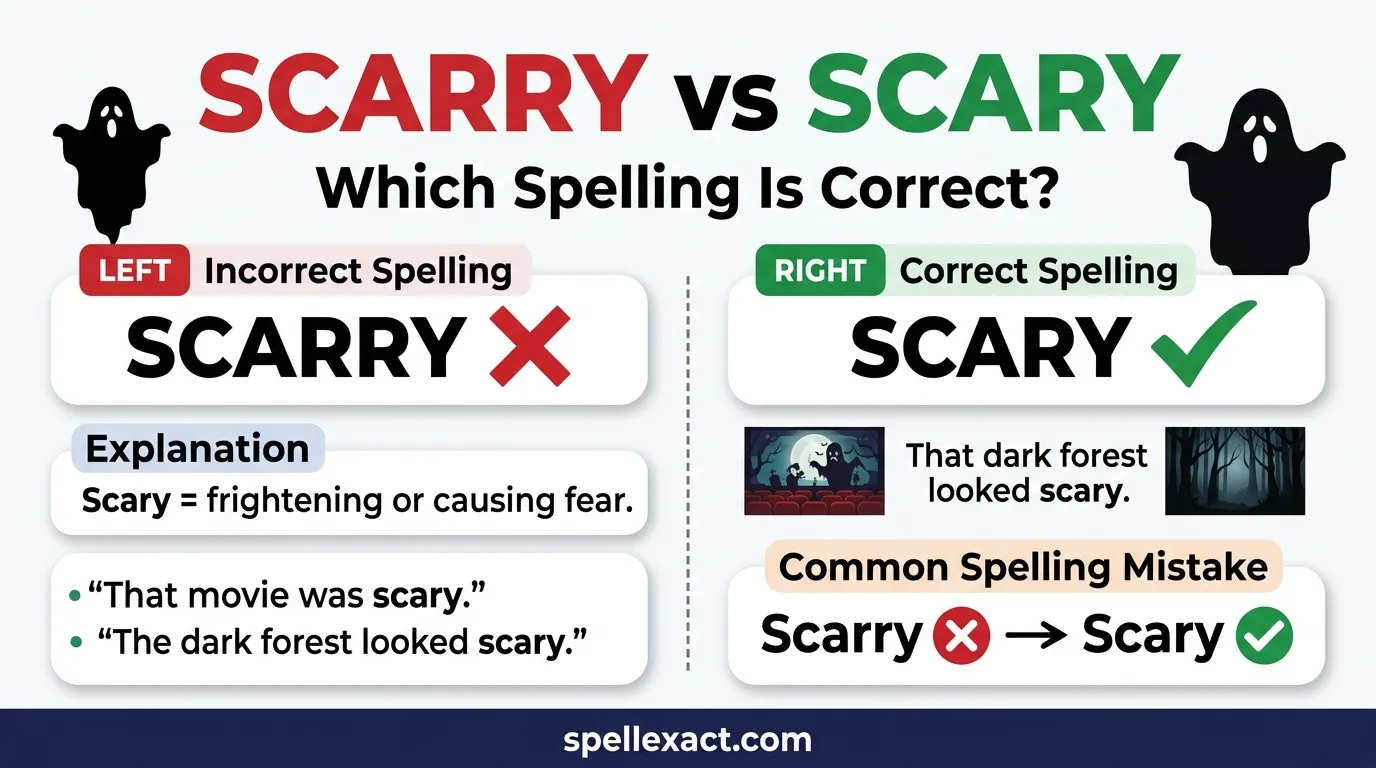
Scary is the correct spelling when you mean “frightening,” “causing fear,” or “making someone feel afraid.”
Scarry is generally a misspelling of scary in standard English. If you want to describe a frightening movie, person, situation, sound, or experience, always use scary.
- ✅ Scary = frightening or causing fear
- ❌ Scarry = usually an incorrect spelling of scary
- Correct example: That movie was really scary.
- Incorrect example: That movie was really scarry.
A quick way to remember it is: scary has only one “r.”
What Does Scary Mean?
The word scary is an adjective. It describes something that makes you feel afraid, nervous, frightened, or uncomfortable.
It can describe many different things, including:
- A frightening movie
- A dangerous situation
- A strange noise
- A frightening person
- A nightmare
- A horror story
- A sudden accident
- An uncertain or worrying experience
For example:
The abandoned house looked scary at night.
Here, “scary” tells us that the house creates a feeling of fear.
The word comes from scare, which means to frighten someone or make them feel afraid. When we add -y to “scare,” we get scary, meaning something that causes fear.
Is Scarry a Correct Word?
In ordinary modern English, scarry is not the standard spelling of the adjective meaning frightening. If you are writing about something frightening, scary is the word you should use.
The confusion often comes from English spelling patterns. Many words contain doubled consonants, so it can feel natural to write “scarry.” However, scary follows a different spelling pattern.
Compare:
- Scare → scary
- Carry → carrying
- Marry → married
- Worry → worrying
The spelling of a word cannot always be predicted simply by looking at similar-looking words. That is why memorizing the correct spelling of scary is useful.
Scary Meaning in Simple English
In simple terms, scary means something that makes you afraid.
For example:
- A horror movie can be scary.
- A loud noise at midnight can be scary.
- Walking alone in a dark place may feel scary.
- A dangerous storm can be scary.
You can think of it this way:
Scary = something that scares you.
This simple connection makes the correct spelling easier to remember.
Scarry vs Scary: Comparison Table
| Word | Correct? | Meaning | Example |
| Scary | ✅ Yes | Frightening or causing fear | That was a scary story. |
| Scarry | ❌ Usually no | Common misspelling of scary | That was a scarry story. |
| Scare | ✅ Yes | To frighten someone | You scared me! |
| Scared | ✅ Yes | Feeling frightened | I was scared by the noise. |
| Scariest | ✅ Yes | Most frightening | That was the scariest movie I’ve seen. |
| Scarier | ✅ Yes | More frightening | This movie is scarier than the first one. |
The important distinction is that scary describes something that causes fear, while scared describes the person or creature experiencing the fear.
Scary vs Scared: What’s the Difference?
Another common mistake is confusing scary with scared.
The easiest rule is:
Scary describes the thing causing fear.
Scared describes the person feeling fear.
For example:
- The horror movie was scary.
- I was scared while watching it.
Here, the movie causes fear, so it is scary. The person experiences fear, so the person is scared.
More examples:
- The dog looked scary.
- The child was scared of the dog.
- The thunderstorm was scary.
- We were scared during the storm.
This distinction is useful because even people who spell “scary” correctly sometimes use scary and scared incorrectly.
Examples of Scary in Sentences
Seeing the word in context is one of the best ways to understand and remember it.
Everyday Examples
- That noise outside sounds scary.
- I watched a scary movie last night.
- The dark forest looked scary.
- It was a scary experience.
- The sudden accident was extremely scary.
- That old photograph is a little scary.
- The storm became scary after midnight.
- He told us a scary story around the campfire.
More Natural Examples
The word “scary” does not always describe supernatural or horror-related things. It can also describe real-life situations involving danger or uncertainty.
For example:
Losing your job unexpectedly can be a scary experience.
Driving through heavy fog was scary.
It was scary to hear someone knocking on the door at 2 a.m.
In each example, “scary” describes something that produces fear or anxiety.
Scary, Scarier, and Scariest
The adjective scary also has comparative and superlative forms.
Scary
Use scary when describing something frightening.
That movie is scary.
Scarier
Use scarier when comparing two things.
The second movie was scarier than the first.
Scariest
Use scariest when something is the most frightening among several things.
That was the scariest scene in the entire movie.
Notice that the spelling changes naturally:
scary → scarier → scariest
The y changes to i before the comparative and superlative endings.
Why Do People Spell Scary as Scarry?
There are several reasons people write scarry instead of scary.
First, English has many words with doubled consonants. Words such as carry, marry, and hurry may influence how people spell similar-looking words.
Second, people often spell words based on pronunciation. Since the “r” sound is clear in “scary,” it may seem reasonable to write two r’s.
Third, fast typing can produce accidental extra letters. A person who already knows the correct spelling may still type “scarry” as a simple typo.
Regardless of the reason, if your intended meaning is “frightening,” the standard spelling is scary.
Common Mistakes to Avoid
1. Writing Scarry Instead of Scary
Incorrect:
That was a scarry movie.
Correct:
That was a scary movie.
2. Confusing Scary With Scared
Incorrect:
I was very scary during the storm.
Correct:
I was very scared during the storm.
The storm was scary, while you were scared.
3. Adding an Extra R
Incorrect:
The haunted house was scarry.
Correct:
The haunted house was scary.
Remember: one r in “scary.”
4. Using Scary When You Mean Scarier
When comparing two things, use scarier.
This horror movie is scarier than the last one.
Not:
This horror movie is scary than the last one.
American vs British English: Scarry vs Scary
There is no standard American vs British spelling difference between “scary” and “scarry.”
Both American English and British English use:
scary
For example:
- American English: That movie was scary.
- British English: That film was scary.
The vocabulary used around the word may sometimes differ. For instance, American English commonly uses movie, while British English often uses film. But the adjective itself remains scary in both varieties.
So, whether you are writing for an American, British, Canadian, Australian, or international audience, scary is the standard choice.
How to Remember the Correct Spelling
If you frequently confuse scarry vs scary, try this simple memory trick:
Scare + y = scary.
Start with the verb:
scare
Then add y:
scare + y → scary
You do not need to add another “r.”
Another useful reminder is:
Something is scary; someone is scared.
This helps you remember both the spelling and the meaning.
Is Scarry Ever Used as a Name?
Although scarry is generally not the standard spelling of the adjective “scary,” similar forms can appear as names, surnames, usernames, or other proper nouns.
That does not make scarry the correct spelling when you are trying to say that something is frightening.
For normal English writing, use scary.
For example:
The story was scary.
That is the standard form.
Scary Synonyms and Related Words
If you want to avoid repeating “scary,” several related words can express similar ideas. The best choice depends on the intensity and context.
Common synonyms for scary
- Frightening
- Frightful
- Terrifying
- Alarming
- Chilling
- Creepy
- Spooky
- Horrifying
- Disturbing
- Intimidating
- Menacing
- Threatening
These words are not always exact substitutes.
For example, creepy often describes something that makes you uncomfortable or uneasy, while terrifying suggests a much stronger feeling of fear.
Scary in Different Contexts
The word scary is flexible and appears in many types of writing.
Movies and Entertainment
That was one of the scariest horror movies I’ve ever watched.
Real-Life Experiences
The accident was a scary experience, but everyone was safe.
Nature
The thunder sounded scary during the storm.
People and Behavior
His threatening behavior was scary.
Stories
My grandmother used to tell me scary stories before bed.
Using context makes the meaning of “scary” easy to understand.
Frequently Asked Questions
Is “scarry” or “scary” correct?
Scary is correct when you mean frightening or causing fear. “Scarry” is generally a misspelling in this context.
Why is scary spelled with one r?
The adjective comes from scare, with the suffix -y, producing scary. The standard spelling does not require a second “r.”
Is scarry a word?
“Scarry” can appear in specialized contexts or as a proper name or surname, but it is not the standard spelling of the adjective meaning frightening. For that meaning, use scary.
What is the difference between scary and scared?
Scary describes something that causes fear, while scared describes someone who feels fear.
Example: The movie was scary, and I was scared.
What is the comparative form of scary?
The comparative form is scarier.
Example:
This book is scarier than the first one.
What is the superlative form of scary?
The superlative form is scariest.
Example:
That was the scariest moment of my life.
Is “scary” the same in American and British English?
Yes. Both American and British English use scary with the same spelling and meaning.
How can I remember the spelling of scary?
Remember the phrase “scare + y = scary.” You can also remember that the correct spelling has only one r.
Summary
When deciding between scarry vs scary, the answer is simple: scary is the standard spelling when you mean frightening, alarming, or causing fear. Scarry is generally an incorrect spelling in this context. Although the extra “r” may seem natural because of words such as “carry” and “marry,” it does not belong in the standard spelling of “scary.”
Remember the useful distinction: something can be scary, but a person can be scared. If you are writing a sentence about a frightening movie, dangerous situation, creepy sound, or unsettling experience, choose scary. And when comparing frightening things, use scarier and scariest.
Actionable Takeaway
Whenever you are unsure about scarry vs scary, use this quick rule:
Scary = frightening ✅
Scarry = usually a spelling mistake ❌
Memory trick: scare + y = scary.

Liam Noah is a passionate language writer at SpellExact, specializing in spelling mistakes, grammar, word confusion, and American vs. British English. He creates clear, practical content that helps readers write and communicate with confidence.