If you have ever typed “foward” and wondered whether it is a real word, you are not alone. This is one of those common spelling mistakes that can easily slip through because foward looks and sounds very close to the correct spelling.
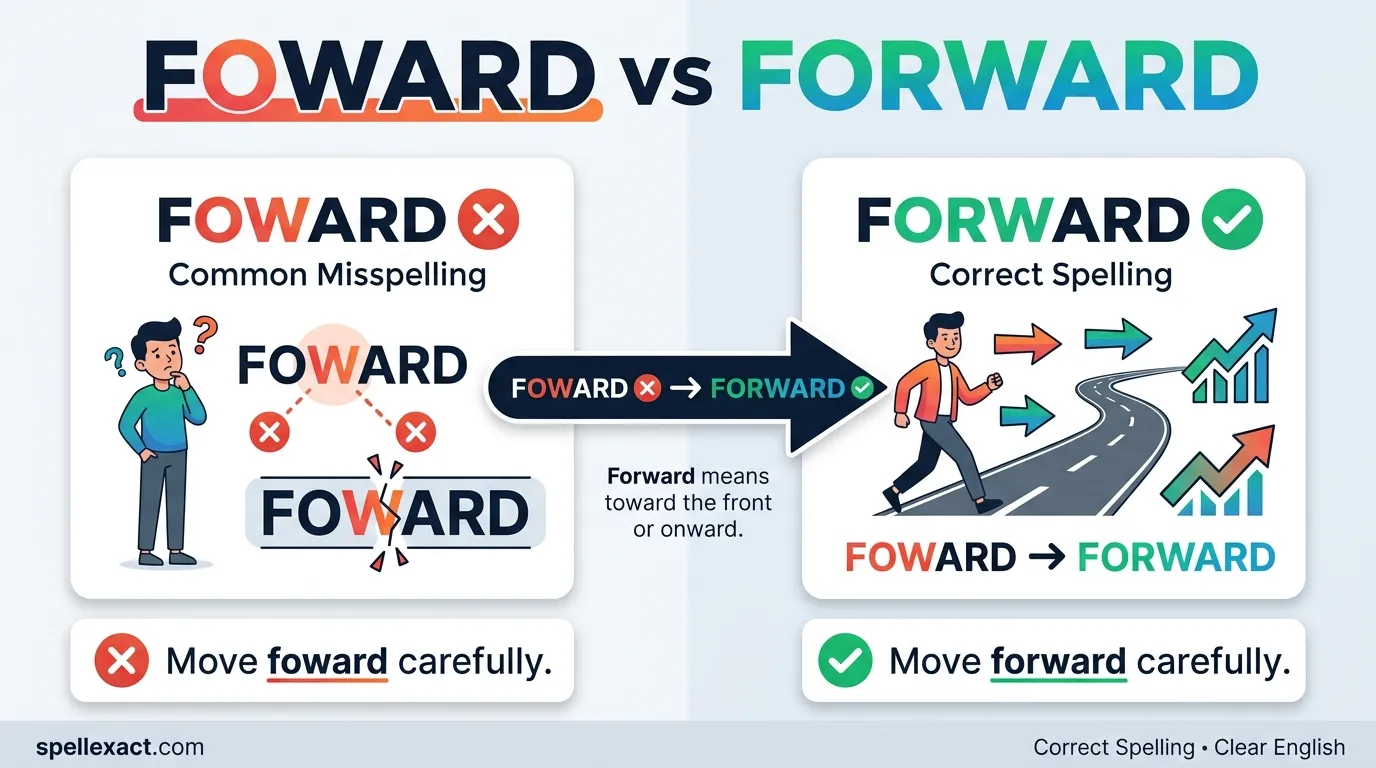
The correct spelling is forward. Whether you are writing an email, school assignment, social media post, or professional document, learning the difference between foward vs forward can help you write with greater confidence and accuracy.
Quick Answer
Forward is the correct spelling.
Foward is a misspelling of forward and should generally be avoided in standard English writing.
- Correct: Please move forward with the project.
- Incorrect: Please move foward with the project.
The easiest way to remember the spelling is that forward contains the word “for” before “ward.”
Foward vs Forward: Comparison Table
| Word | Correct Spelling? | Meaning | Example |
| Forward | Yes | Toward the front, ahead, or progressing | We need to move forward. |
| Foward | No | Common misspelling of forward | ❌ We need to move foward. |
In standard American and British English, forward is the accepted spelling.
What Does Forward Mean?
Forward is a versatile English word that can function as an adverb, adjective, verb, or noun depending on the context. Its general meaning relates to movement, direction, progress, or sending something onward.
Here are the main meanings of forward.
1. Moving Toward the Front
Forward can describe physical movement in the direction ahead.
Examples:
- Take one step forward.
- The car moved forward slowly.
- Please look forward, not backward.
In these examples, the word refers to movement toward the front.
2. Making Progress
Forward can also describe progress or advancement.
Examples:
- We need to move forward after this setback.
- The company is looking forward to future growth.
- She continued moving forward with her plans.
This meaning is common in business, personal development, and everyday conversation.
3. Sending Something to Another Person
As a verb, forward means to send something to another person or destination.
Examples:
- Please forward this email to the manager.
- I will forward the documents tomorrow.
- Could you forward me the message?
This usage is especially common in email communication and professional settings.
4. Located Toward the Front
As an adjective, forward can describe something positioned closer to the front.
Example:
- The passengers sat in the forward section of the aircraft.
Is Foward a Word?
No. Foward is not the standard spelling of the English word forward.
The confusion usually happens because people accidentally leave out the letter “r” after “fo.” Since the words look visually similar, the mistake can be easy to miss when proofreading.
For example:
- ❌ foward
- ✅ forward
This is particularly common when typing quickly on a keyboard or mobile device.
Why Do People Misspell Forward as Foward?
The foward vs forward confusion is usually caused by spelling patterns and fast typing rather than a misunderstanding of meaning.
Here are some common reasons.
The Missing “R” Problem
The correct spelling contains two r letters:
F-O-R-W-A-R-D
When people type quickly, the first r is sometimes omitted:
F-O-W-A-R-D
That produces foward, which is incorrect.
Pronunciation Can Be Misleading
In natural speech, the first r sound in forward may not always be strongly emphasized. As a result, some writers spell the word according to how they think it sounds.
This is a common issue in English spelling, where pronunciation and written form do not always match perfectly.
Typing Habits and Autocorrect Errors
Fast typing can create accidental omissions. In some cases, users may repeatedly type foward and overlook the error if their spell-check settings do not catch it.
A quick review before publishing or sending important writing can prevent this mistake.
How to Spell Forward Correctly
The correct spelling is:
F-O-R-W-A-R-D
A useful memory trick is:
FOR + WARD = FORWARD
Think of the word for followed by ward. This can help you remember that an r comes after the letters fo.
Another simple way to remember it is to focus on the beginning:
- Forward
- Not Foward
If you remember that the word begins with for, you are much less likely to write foward.
Forward in Sentences
Seeing the correct spelling in context can make it easier to remember.
Examples of Forward as an Adverb
- The horse moved forward.
- She leaned forward to hear better.
- Please step forward when your name is called.
- The team continued forward despite the challenges.
Examples of Forward as an Adjective
- The forward door is closed.
- We sat in the forward part of the bus.
- The aircraft experienced an issue in the forward compartment.
Examples of Forward as a Verb
- Please forward the invoice to the accounting department.
- Can you forward this message to Sarah?
- I will forward the information as soon as I receive it.
Examples of Forward in Expressions
Looking forward to
- I am looking forward to the weekend.
- We are looking forward to meeting you.
- She is looking forward to starting her new job.
Notice that looking forward to is a common English expression used to show anticipation or excitement about something in the future.
Common Mistakes Related to Forward
Besides writing foward, several other mistakes can appear when using forward.
Mistake 1: Writing “Foward”
This is the main spelling error.
- ❌ I am looking foward to your reply.
- ✅ I am looking forward to your reply.
Mistake 2: Confusing Forward and Foreword
These words sound similar in some contexts but have completely different meanings.
Forward means ahead, onward, or toward the front.
Foreword means a short introductory section at the beginning of a book, often written by someone other than the author.
Examples:
- We must move forward with the plan.
- The author wrote a brief foreword for the new edition.
Remember:
- Forward = direction or progress
- Foreword = introductory words in a book
Mistake 3: Confusing “Looking Forward To” With the Wrong Grammar
The expression looking forward to is followed by a noun or a verb ending in -ing.
- ✅ I am looking forward to meeting you.
- ❌ I am looking forward to meet you.
This happens because to in this expression functions as a preposition rather than the beginning of an infinitive.
Mistake 4: Using Forward When Backward Is Intended
Forward means toward the front or ahead, while backward means toward the back or in reverse.
- Move forward, not backward.
- The vehicle rolled backward.
Checking the context can help you choose the correct directional word.
Foward vs Forward in American and British English
There is no difference between American English and British English when it comes to the standard spelling of forward.
Both varieties use:
Forward
And both consider foward a misspelling.
However, British and American English sometimes differ in other spelling choices, such as:
- color vs colour
- organize vs organise
- center vs centre
- traveling vs travelling
But forward remains the standard spelling on both sides of the Atlantic.
Forward or Forwards?
Although foward vs forward is primarily a spelling question, some writers also wonder about forward vs forwards.
Both forward and forwards can be used as adverbs.
Examples:
- Move forward.
- Move forwards.
However, usage can vary slightly by region and style.
Forward is widely used in both American and British English and is often preferred in formal or concise writing.
Forwards is also common, particularly in British English and conversational contexts.
Examples:
- The company is moving forward with the proposal.
- He took two steps forwards.
If you are unsure which version to choose, forward is generally a safe and widely accepted option.
Practical Tips to Avoid the Foward Spelling Mistake
Correct spelling becomes easier with repetition. Here are a few practical strategies.
Remember the First Three Letters: “FOR”
The word begins with for:
FOR + WARD
If you see foward, immediately check whether the r after fo is missing.
Use Spell Check
Modern word processors and browsers usually identify foward as a spelling error. However, spell check should not replace careful proofreading, especially in professional or published content.
Read Important Writing Slowly
When proofreading, slow down and pay attention to commonly misspelled words. Errors are often easier to spot when you read the sentence aloud.
Learn the Word in Context
Memorizing a word inside a natural sentence can be more effective than repeatedly memorizing individual letters.
Try remembering:
“I am looking forward to hearing from you.”
This sentence helps reinforce both the correct spelling and a common grammatical expression.
Frequently Asked Questions
Is foward or forward correct?
Forward is correct. Foward is a misspelling and should not be used in standard English.
How do you spell forward correctly?
The correct spelling is F-O-R-W-A-R-D.
Why do I keep spelling forward as foward?
The most common reason is accidentally omitting the first r. Remember that the word begins with for, not fo.
Is foward in the dictionary?
Standard English dictionaries recognize forward, not foward, as the correct word for movement, progress, or sending something onward.
What is the difference between forward and foreword?
Forward refers to direction, progress, or sending something onward. A foreword is an introductory section at the beginning of a book.
Is forward spelled differently in British English?
No. Forward is the standard spelling in both American English and British English.
Is “looking foward to” correct?
No. The correct expression is “looking forward to.”
For example:
- ✅ I am looking forward to seeing you.
- ❌ I am looking foward to seeing you.
Can forward be used as a verb?
Yes. Forward can mean to send something to another person or destination.
For example:
Please forward the email to me.
Summary:
The difference between foward vs forward is simple: forward is the correct spelling, while foward is a common misspelling. Forward can describe movement toward the front, progress into the future, or the act of sending something onward.
The best way to avoid the mistake is to remember that forward begins with “for.” Before sending an important email or publishing content, quickly check for the missing r in words such as looking forward, move forward, and forward this message.
Actionable takeaway:
Whenever you are unsure, pause and spell the word as FOR + WARD = FORWARD. This simple memory trick can help you eliminate the foward spelling mistake for good.

Liam Noah is a passionate language writer at SpellExact, specializing in spelling mistakes, grammar, word confusion, and American vs. British English. He creates clear, practical content that helps readers write and communicate with confidence.