Have you ever typed “goodmorning” in a text, email, or social media post and wondered whether it should actually be written as “good morning”? You are not alone. This is a common spelling and spacing question because the two versions look almost identical, but only one is considered standard English.
The correct form is “good morning” two separate words. It is a common greeting used when you meet someone or communicate with them during the morning. In this guide, we will explain goodmorning vs good morning, show you how to use the phrase naturally, and help you avoid this common writing mistake.
Quick Answer
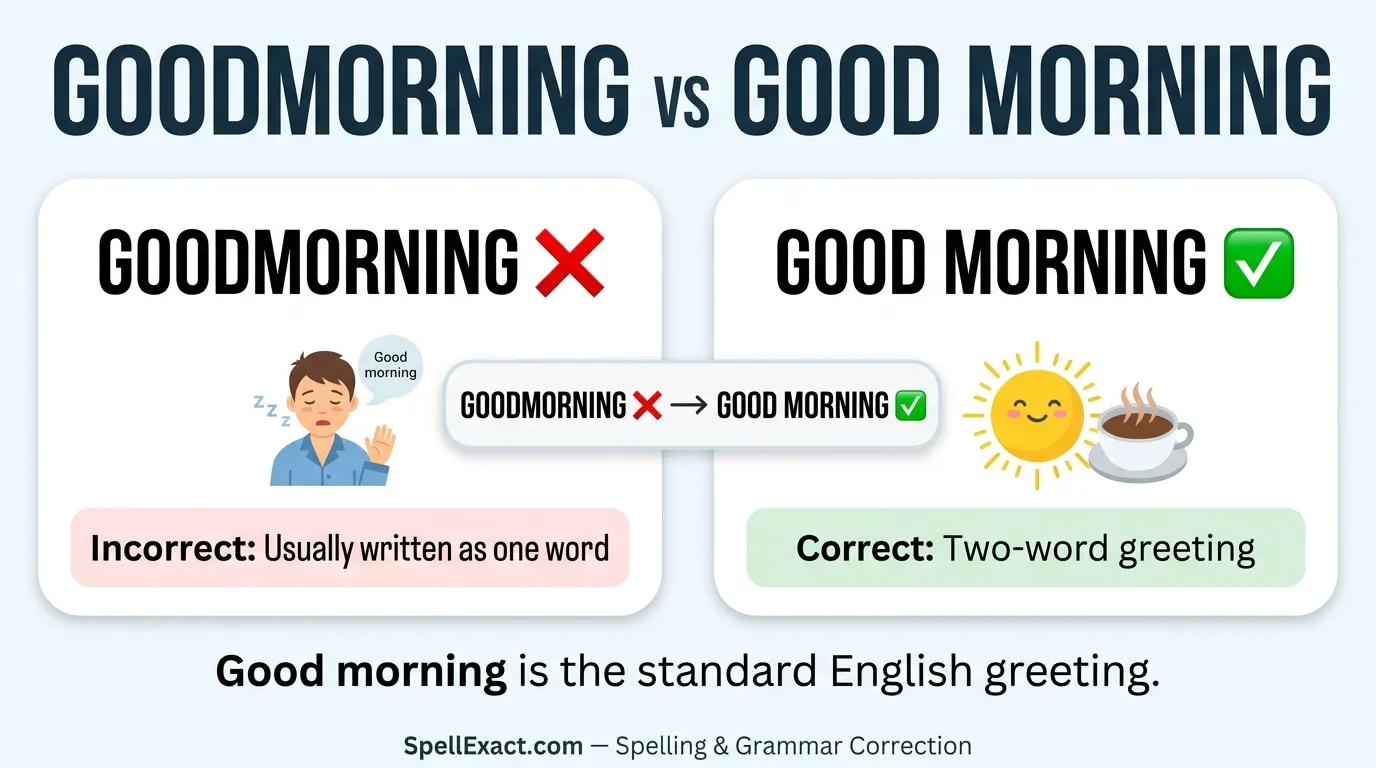
Good morning is the correct standard spelling.
Goodmorning is generally considered incorrect because “good” and “morning” should be written as two separate words when used as a greeting.
- ✅ Good morning!
- ❌ Goodmorning!
For formal writing, professional emails, school assignments, and polished online content, always use “good morning.”
Goodmorning vs Good Morning: What Is the Difference?
The main difference is spacing.
Good morning consists of two words:
- Good — an adjective expressing something positive.
- Morning — the part of the day between night and afternoon.
Together, “good morning” is a greeting or expression of goodwill used during the morning.
For example:
Good morning, Sarah! How are you today?
The spelling “goodmorning” combines the two words into one. Although people sometimes type it this way in casual messages, it is not the standard spelling of the greeting in English.
This is similar to other common word-spacing mistakes where two familiar words are incorrectly joined together.
Is “Goodmorning” a Word?
No. “Goodmorning” is not the standard English form of the greeting.
When you want to greet someone in the morning, write:
Good morning.
The phrase is normally treated as two separate words. Dictionaries and standard English usage recognize good morning as the conventional form.
You may occasionally see “goodmorning” used online, in usernames, hashtags, informal posts, or stylized brand names. That does not make it the standard spelling.
So, if you are writing an email, article, message, letter, assignment, or professional communication, choose good morning.
What Does “Good Morning” Mean?
Good morning is a polite greeting used during the morning.
It can be used with friends, family members, coworkers, teachers, customers, or strangers. The expression can sound formal, friendly, cheerful, or respectful depending on the situation and tone.
For example:
- Good morning, everyone.
- Good morning, Mr. Smith.
- Good morning! Did you sleep well?
- Good morning, team. Let’s get started.
- Good morning! I hope you have a wonderful day.
The phrase does not necessarily mean that the morning itself is literally “good.” Instead, it functions as a conventional greeting.
Why Do People Write “Goodmorning”?
There are several reasons people make this mistake.
First, English contains many compound words, so it can be tempting to combine familiar words into one. Words such as goodbye, bedroom, and sunlight are written as single words, but that does not mean every frequently used combination should be joined.
Second, texting and social media often encourage quick, informal writing. People may type “goodmorning” because it feels faster or because they have seen other people use it.
Another reason is influence from usernames, hashtags, and online captions. For example, someone might use #goodmorning as a hashtag. Hashtags cannot contain spaces, so the words may appear joined. That does not change the standard spelling when the phrase is used in ordinary writing.
Examples of “Good Morning” in Sentences
Here are some natural examples to help you understand how to use good morning correctly.
Example 1: Casual Conversation
Good morning! How are you feeling today?
This is a friendly greeting between people who know each other.
Example 2: Workplace
Good morning, everyone. Let’s begin the meeting.
This is appropriate for professional communication.
Example 3: Email
Good morning, John,
I am writing to follow up on our conversation from yesterday.
Here, “Good morning” works as a polite email opening.
Example 4: Classroom
Good morning, students. Please take your seats.
A teacher might use this greeting when addressing a class.
Example 5: Family
Good morning, Mom! What’s for breakfast?
The phrase can also sound warm and informal.
Example 6: Customer Service
Good morning. How may I help you?
This is a polite and professional use of the expression.
Goodmorning vs Good Morning Comparison Table
| Feature | Goodmorning | Good Morning |
| Spelling | Incorrect in standard usage | Correct |
| Number of words | One | Two |
| Standard English | ❌ No | ✅ Yes |
| Used as a greeting | Informally seen online | Standard and natural |
| Professional writing | Avoid | Recommended |
| Formal emails | Avoid | Correct |
| School writing | Avoid | Correct |
| Casual texting | Sometimes used | Preferred |
The key point is simple: use “good morning” as two words.
Is “Good Morning” Capitalized?
Capitalization depends on where the phrase appears in a sentence.
At the beginning of a sentence, Good is capitalized:
Good morning! How are you?
When addressing someone directly, you can write:
Good morning, Alex.
In an email greeting or salutation, capitalization can vary slightly depending on the style you use:
Good morning, Sarah,
Both the greeting and the person’s name are normally capitalized in this type of opening.
In the middle of a sentence, lowercase may be appropriate:
I wished my coworkers a good morning before starting work.
The important thing is to keep the two words separate.
Is “Good Morning” Formal or Informal?
Good morning can be either formal or informal.
It is appropriate in professional environments:
Good morning, everyone. Thank you for joining the meeting.
It is also completely natural in everyday conversation:
Good morning! Did you have a good night?
The level of formality depends more on the situation and the rest of your wording than on the phrase itself.
If you want to sound especially professional, you can combine it with a person’s name or title:
Good morning, Dr. Williams.
Good Morning in American vs British English
There is essentially no spelling difference between American and British English for this greeting.
Both varieties use:
Good morning
The same two-word form is standard in American English and British English.
There can be differences between American and British English in vocabulary, pronunciation, punctuation, and some spelling conventions, but “good morning” remains the same.
So whether you are writing for readers in the United States, the United Kingdom, Canada, Australia, or another English-speaking region, good morning is the safe standard form.
Common Mistakes With “Good Morning”
Understanding the common errors can make it easier to remember the correct form.
1. Writing “Goodmorning”
Incorrect:
Goodmorning, everyone!
Correct:
Good morning, everyone!
The most common mistake is simply forgetting the space.
2. Using “Good Morning” as One Word in Formal Writing
Even if you see “goodmorning” frequently on social media, avoid it in formal writing.
Use:
Good morning, Professor.
rather than:
Goodmorning, Professor.
3. Confusing a Hashtag With Normal Spelling
You might see:
#goodmorning
That is normal for a hashtag because spaces cannot be used within hashtags. However, the ordinary phrase is still:
Good morning.
4. Overcapitalizing the Phrase
You generally do not need to write:
GOOD MORNING
unless you deliberately want to emphasize the greeting.
Normal writing usually looks better as:
Good morning!
How to Remember the Correct Spelling
A simple trick is to think of good morning as a short phrase rather than a single word.
Compare it with:
- Good afternoon
- Good evening
- Good night
These expressions are normally written as separate words.
You would write:
Good afternoon, everyone.
So when you move from afternoon to morning, use the same basic pattern:
Good morning, everyone.
Remember: good + space + morning.
Can “Goodmorning” Be Used in Texting?
You may encounter goodmorning in informal texts, captions, usernames, or online communities. People often ignore standard spacing rules when communicating casually.
However, if you want your English to look correct and polished, good morning is still the better choice.
This is especially important if your message is going to a teacher, employer, client, customer, manager, or professional audience.
Casual communication may tolerate many shortcuts, but standard spelling is always the safer option when you are unsure.
Frequently Asked Questions
Is “goodmorning” correct spelling?
No. Goodmorning is not the standard spelling of the English greeting. The correct form is good morning, written as two separate words.
Should I write “good morning” or “goodmorning”?
Always choose good morning in standard English. It is the accepted two-word form used in conversations, emails, professional writing, and other normal contexts.
Is “good morning” one word or two?
Good morning is two words. The adjective “good” and the noun “morning” remain separate when used together as a greeting.
Can I use “goodmorning” in a text message?
You may see people use it informally, but good morning is the correct and more polished choice. If you want your message to follow standard English, keep the space.
Is “Good Morning” capitalized?
At the beginning of a sentence or greeting, write Good morning. For example: “Good morning, everyone.” The capitalization can change when the phrase appears elsewhere in a sentence.
Is “good morning” the same in American and British English?
Yes. Both American and British English use good morning as the standard spelling. There is no American-versus-British spelling difference for this expression.
Why is “goodmorning” so common online?
Informal writing, fast typing, usernames, captions, and hashtags can make the joined version appear frequently. A hashtag such as #goodmorning is different from normal written English because hashtags cannot contain spaces.
Is “good morning” appropriate for a professional email?
Yes. Good morning is a polite and widely accepted way to begin a professional email, especially when followed by the recipient’s name.
Summary
When comparing goodmorning vs good morning, the answer is straightforward: good morning is the correct standard form. It should be written as two separate words when used as a greeting. “Goodmorning” may appear in informal online communication, usernames, or hashtags, but it is not the standard spelling you should use in polished English.
If you are writing a friendly text, a school assignment, a business email, or a professional message, keeping the space between good and morning will make your writing clear and correct. American and British English use the same form, so you do not need to worry about regional spelling differences.
Actionable Takeaway
Remember this simple rule:
✅ Good morning = correct
❌ Goodmorning = incorrect in standard English
The next time you greet someone before noon, write “Good morning!” with a space. It is a small detail, but using the correct form makes your writing look more polished and professional.

Maria Megan is a language enthusiast and content writer specializing in spelling, grammar, and English usage. She creates clear, practical articles that help readers identify common spelling mistakes, improve writing accuracy, and communicate with greater confidence.