The difference between Take Effect vs Take Affect often confuses English learners because both phrases sound similar, but only one is correct. These commonly confused phrases in the English language can be understood more easily by looking at the words, their meanings, and their corresponding phrases.
Effect and Affect may sound alike, but they do not serve the same purpose. Take Effect with an E is the right phrase, while Take Affect with an A is almost always a typo. In my experience explaining English word choices, focusing on the meaning first makes this distinction much easier to remember.
Quick Answer
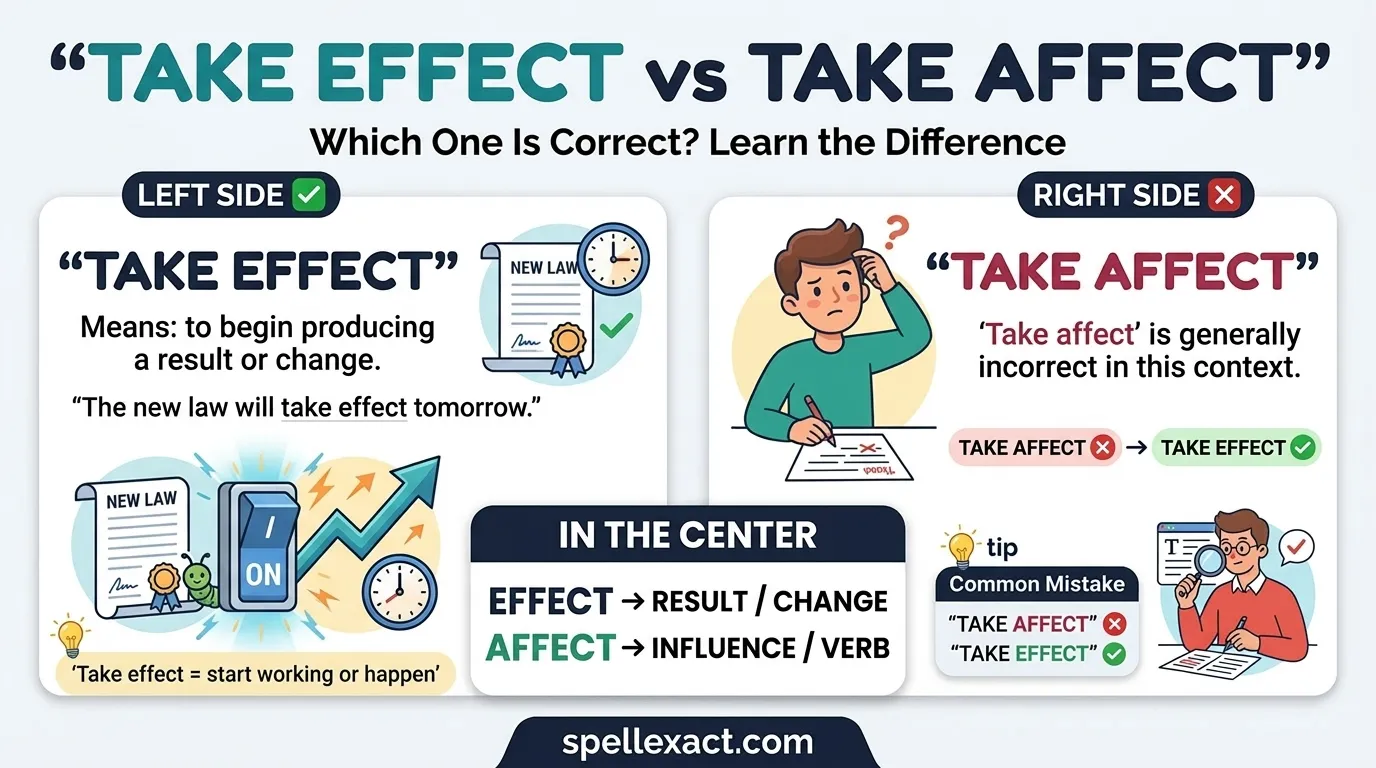
“Take effect” is the correct phrase. It means that a rule, law, medicine, decision, or change begins to work or produce a result. “Take affect” is not the standard expression. Use affect when you mean “influence,” such as “The weather may affect our plans.”
Why Do People Confuse “Take Effect” and “Take Affect”?
People often confuse take effect and take affect because the words effect and affect sound similar and are connected in meaning.
Both words can relate to change or influence, but they usually work differently in a sentence:
- Effect is usually a noun meaning a result or consequence.
- Affect is usually a verb meaning to influence or change something.
- Take effect is a fixed phrase meaning “begin to work” or “begin to produce a result.”
- Take affect is generally a spelling or word-choice mistake.
For example:
The new policy will take effect on Monday.
But:
The new policy may affect employees.
The first sentence says the policy will begin operating. The second says the policy will influence employees.
What Does “Effect” Mean?
Effect is most commonly a noun that means a result, consequence, or outcome caused by something.
Examples:
- The medicine had a positive effect.
- The storm had a serious effect on the town.
- The new rule will take effect tomorrow.
- Lack of sleep can have a negative effect on concentration.
The phrase take effect has a special meaning: to begin to work, operate, or produce a result.
Examples of “Take Effect”
- The new law will take effect next year.
- The medicine should take effect within an hour.
- The changes will take effect immediately.
- The new schedule takes effect on Monday.
What Does “Affect” Mean?
Affect is most commonly a verb meaning to influence or have an impact on something. For a detailed explanation of the distinction between affect and effect, see the Merriam-Webster dictionary guide.
Affect is most commonly a verb meaning to influence or have an impact on something.
Examples:
- Rain can affect traffic.
- Stress can affect your sleep.
- The decision will affect many people.
- Higher prices may affect consumer behavior.
A useful way to remember it is:
Affect = influence
If something influences another thing, you can often use affect.
Take Effect vs Take Affect: Comparison Table
| Phrase/Word | Correct? | Part of Speech | Meaning | Example |
| Take effect | Yes | Fixed phrase | Begin to work or produce a result | The new rule will take effect tomorrow. |
| Take affect | No, in standard usage | — | Not the standard phrase | ❌ The rule will take affect tomorrow. |
| Effect | Yes | Usually noun | Result or consequence | The medicine had a strong effect. |
| Affect | Yes | Usually verb | Influence or change | The medicine may affect your sleep. |
When Should You Use “Take Effect”?
Use take effect when something starts working, operating, or producing a result.
It is commonly used with:
- laws
- rules
- policies
- regulations
- agreements
- decisions
- changes
- medicines
- treatments
- contracts
- schedules
Examples
- The new law will take effect in January.
- The medication should take effect within 30 minutes.
- The policy will take effect immediately.
- The new timetable will take effect next week.
- The agreement will take effect after both parties sign it.
- The changes will take effect on Monday.
- The discount will take effect at midnight.
- The new regulations have already taken effect.
- The treatment began to take effect after several days.
- The updated rules will take effect next month.
- The company’s new policy will take effect tomorrow.
- The emergency measures took effect immediately.
Common Mistakes With “Take Effect” and “Affect”
Mistake 1: Using “Take Affect”
❌ The new rules will take affect tomorrow.
✅ The new rules will take effect tomorrow.
Take effect is the standard expression.
Mistake 2: Confusing “Affect” With “Effect”
❌ The weather may effect our plans.
✅ The weather may affect our plans.
Here, affect is a verb meaning “influence.”
Mistake 3: Using “Effect” When You Need a Verb
❌ The noise effected my concentration.
For the ordinary meaning “influenced,” use:
✅ The noise affected my concentration.
Mistake 4: Assuming “Affect” Is Always Wrong
Affect is a perfectly correct word. The problem is using it in the fixed expression take effect.
Compare:
- The medicine will take effect soon.
- The medicine may affect your appetite.
Both are correct, but they express different ideas.
What Is an Easy Memory Trick?
Remember:
Take EFFECT = a change takes place.
Think of effect as the result.
The new rule takes effect → the new rule starts working.
For affect, remember:
Affect = influence.
The new rule affects workers → the rule influences workers.
A simple formula is:
Take effect = begin to work
Affect = influence
American vs British English
There is no meaningful American-versus-British spelling difference in the phrase take effect.
Both American English and British English use:
The new rules will take effect next month.
Similarly, affect is used as a verb meaning “influence” in both varieties of English.
The main issue is therefore not regional spelling. It is choosing the correct word based on its meaning and grammatical function.
Similar Words and Phrases
Several expressions are related to take effect and affect.
Come into effect
Come into effect means to begin operating or becoming applicable.
The new regulations will come into effect next month.
Go into effect
Go into effect has a similar meaning, especially in American English.
The new policy will go into effect tomorrow.
Become effective
This means to start producing the intended result or to become officially applicable.
The new system will become effective next week.
Have an effect
This means to produce a result or influence something.
Exercise can have a positive effect on your health.
Affect
Affect means to influence something.
Lack of sleep can affect your concentration.
Final Verdict:
The correct phrase is take effect.
Use take effect when you mean that something begins to work, operate, or produce a result.
Use affect when you mean influence or change something.
So:
✅ The new rules will take effect tomorrow.
❌ The new rules will take affect tomorrow.
And:
✅ The new rules may affect employees.
Once you remember “take effect = begin to work” and “affect = influence,” the difference becomes much easier to understand.
Frequently Asked Questions
Is “take affect” correct?
No. Take effect is the standard phrase. It means that something begins to work, operate, or produce a result.
What does “take effect” mean?
Take effect means to begin working or to start producing a result. For example, “The new policy will take effect tomorrow.”
Should I say “take effect” or “take affect”?
Use take effect. “Take affect” is not the standard expression in English.
Is “affect” a noun or a verb?
Affect is most commonly a verb meaning “to influence.” For example, “Stress can affect your concentration.”
Is “effect” a noun or a verb?
Effect is most commonly a noun meaning “result” or “consequence.” It can also be used as a verb in certain contexts, meaning to bring about or cause something.
What is the difference between affect and effect?
Affect usually means “influence,” while effect usually means “result.” For example, “Noise can affect your sleep” and “Noise can have an effect on your sleep.”
Can I say “the medicine took effect”?
Yes. The medicine took effect is correct. It means that the medicine began to work or produce its intended result.
What is another way to say “take effect”?
Depending on the context, you can use come into effect, go into effect, or become effective.
Remember This
Take effect = begin to work.
Affect = influence.
If you are talking about a law, rule, medicine, policy, agreement, or change starting to work, use take effect.
The new policy will take effect on Monday.
If you are talking about something influencing another thing, use affect.
The new policy may affect employees.
Conclusion
The difference between take effect and take affect is straightforward once you understand the roles of effect and affect. Take effect is the correct fixed phrase and means that something begins to work, operate, or produce a result. Take affect is not the standard expression.
The word affect, however, is still important and commonly used when you mean “influence.” Remember the simple distinction: take effect = begin to work, while affect = influence. This rule will help you avoid one of the most common effect-versus-affect mistakes in everyday English.

Aaron Adam is the Administrator of SpellExact, dedicated to helping readers improve their spelling and writing accuracy. He oversees content quality, ensures reliable language resources, and works to make spelling guidance simple, practical, and accessible for everyone.