Have you ever typed incourage and wondered if it was correct? You’re not alone. Thousands of people search for incourage vs encourage, encourage or incourage, and is incourage a word because the two spellings sound almost identical. If you’re writing an email, an essay, a social media post, or a professional document, using the correct spelling is important for clear and credible communication.
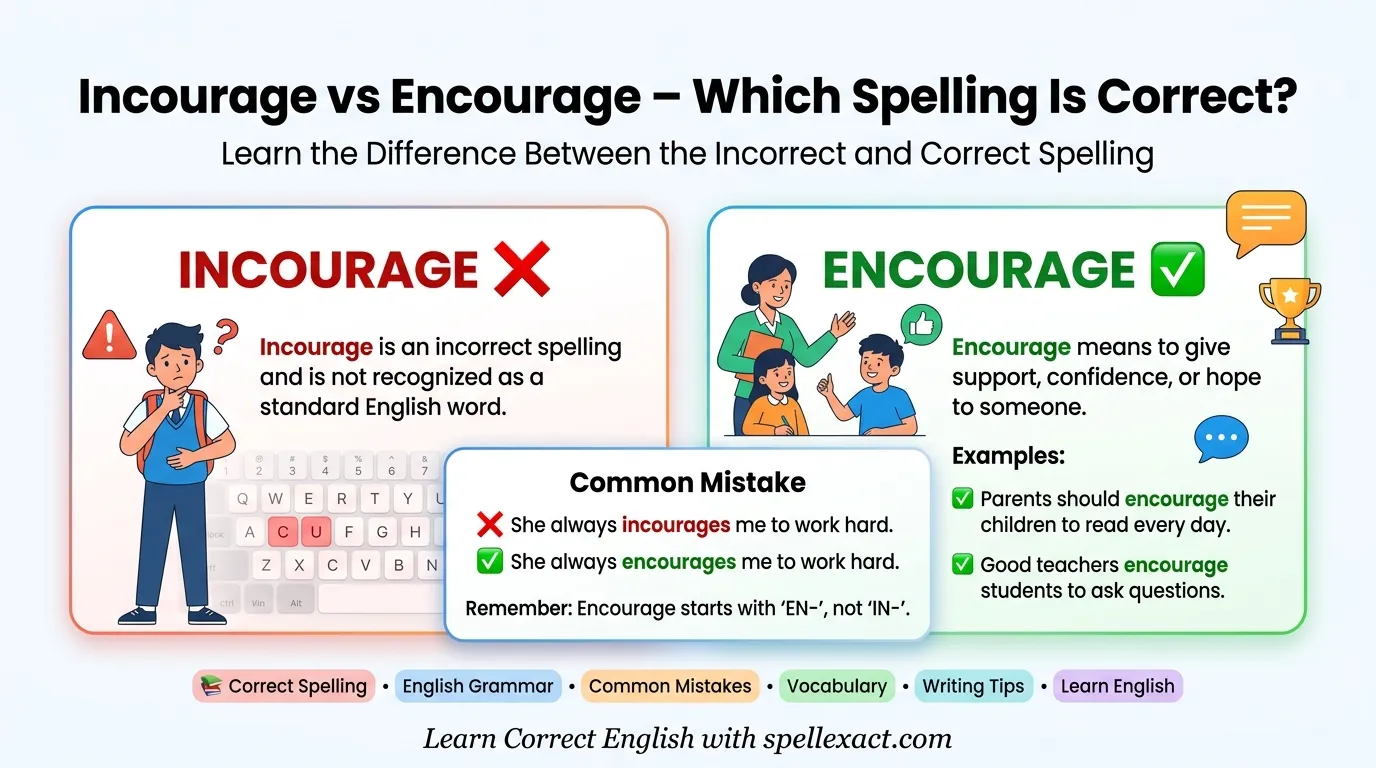
The answer is simple: encourage is the only correct spelling. Incourage is a common spelling mistake caused by pronunciation and typing habits. In this complete guide, you’ll learn the correct spelling of encourage, its meaning, pronunciation, grammar, word origin, real-life examples, and practical memory tricks so you’ll never make this mistake again.
Quick Answer
✅ Correct: Encourage
❌ Incorrect: Incourage
Why? “Incourage” is not an English word. It is a common misspelling of encourage, which means to give someone confidence, support, or motivation.
Example
- ✅ My parents encourage me to follow my dreams.
- ❌ My parents incourage me to follow my dreams.
If you’re choosing between incourage vs encourage, always use encourage.
What Does “Encourage” Mean?
According to standard English dictionaries, encourage means to give someone confidence, hope, support, or motivation to do something. It can also mean helping someone believe in themselves or inspiring them to continue despite difficulties.
Simple Encourage Definition
Encourage (verb):
To inspire, support, motivate, or give confidence to another person.
Whether you’re helping a child learn, motivating a colleague, or supporting a friend during a difficult time, you are encouraging them.
Encourage Synonyms
These words have similar meanings:
- Motivate
- Inspire
- Support
- Cheer on
- Empower
- Boost confidence
- Promote
- Strengthen
- Uplift
- Guide
Using these related words naturally improves your English vocabulary and makes your writing more engaging.
Is “Incourage” a Word?
One of the most common questions people ask is:
“Is incourage a word?”
The answer is no.
Incourage is not listed in reputable English dictionaries because it isn’t a real English word. Instead, it is one of the most common misspelled English words.
Whenever you write incourage, replace it with encourage.
Remember:
❌ Incourage
✅ Encourage
Modern spelling checkers usually recognize incourage spelling as incorrect and suggest encourage instead.
Word Origin (Why Is It Spelled “Encourage”?)
Understanding where the word comes from makes it much easier to remember.
The word encourage comes from the Old French word encoragier, which means “to give courage.” It is built from:
- en- = to make or put into
- courage = bravery or confidence
Together, encourage literally means to give someone courage.
This explains why the word begins with en, not in.
A simple memory trick is:
Encourage = En + Courage
If you remember the word courage, you’ll always remember the correct spelling of encourage.
Incourage vs Encourage: What’s the Difference?
Many people search for encourage vs incourage difference, but there isn’t actually a comparison between two correct words.
Here’s the truth.
| Feature | Incourage | Encourage |
| Correct spelling | ❌ No | ✅ Yes |
| Real English word | ❌ No | ✅ Yes |
| Dictionary entry | ❌ No | ✅ Yes |
| Used in formal writing | ❌ Never | ✅ Always |
| Accepted in American English | ❌ No | ✅ Yes |
| Accepted in British English | ❌ No | ✅ Yes |
The comparison clearly shows that encourage is the only spelling you should ever use.
Why Do People Misspell “Encourage”?
Many learners wonder why this spelling confusion happens.
There are several reasons.
1. Pronunciation Confusion
One of the biggest causes of this spelling confusion is pronunciation.
The first syllable of encourage is often pronounced softly, making it sound similar to “in.”
As a result, many people mistakenly write:
❌ Incourage
instead of
✅ Encourage
2. Phonetic Spelling
Many English learners spell words exactly as they hear them.
Unfortunately, English pronunciation doesn’t always match spelling.
This is why common spelling errors in English include words like:
- Recieve
- Definately
- Occured
- Untill
- Incourage
Learning common spelling patterns helps reduce these mistakes.
3. Fast Typing
Typing quickly without proofreading often leads to accidental spelling mistakes.
Even experienced writers sometimes type incourage by mistake.
Fortunately, proofreading and using a spelling checker usually catch the error.
4. Similar English Prefixes
English contains many words beginning with in-, such as:
- Include
- Increase
- Inspire
Because these words are familiar, many writers assume encourage also begins with in, even though it doesn’t.
How to Remember the Correct Spelling
If you’re wondering how to spell encourage, try these simple memory tricks.
Trick #1: Remember “Courage”
The easiest method is to focus on the word inside it.
Encourage = En + Courage
If you’re giving someone courage, you’re encouraging them.
Trick #2: Read It Slowly
Break it into parts.
En – Cour – Age
Reading it slowly helps your brain recognize the correct spelling.
Trick #3: Practice in Sentences
The more often you use the word correctly, the easier it becomes to remember.
When Should You Use “Encourage”?
Use encourage whenever you mean:
- motivating someone
- inspiring action
- giving confidence
- offering support
- promoting positive behavior
- helping someone achieve a goal
- boosting morale
- strengthening confidence
For example:
- Teachers encourage students to ask questions.
- Parents encourage children to read.
- Coaches encourage athletes before competitions.
- Managers encourage teamwork.
- Friends encourage each other during difficult times.
Encourage Examples in Sentences
Learning through examples is one of the best ways to improve proper word usage.
Everyday Conversation
- I encourage you to keep learning English.
- Good friends encourage one another.
School
- Teachers encourage students to participate in class.
- Reading every day encourages better vocabulary.
Workplace
- Our manager encourages creative thinking.
- Positive feedback encourages employees to improve.
Business
- Successful companies encourage innovation.
- Good leaders encourage collaboration.
Healthcare
- Doctors encourage patients to exercise regularly.
- Nurses encourage healthy lifestyle choices.
Sports
- Coaches encourage players to stay focused.
- Fans encourage their favorite teams throughout the match.
Personal Development
- Books can encourage lifelong learning.
- Small successes encourage greater confidence.
Notice that every correct example uses encourage, never incourage.
Incorrect vs Correct Examples
Here are some common mistakes people make.
| Incorrect | Correct |
| ❌ Please incourage your child. | ✅ Please encourage your child. |
| ❌ Teachers incourage learning. | ✅ Teachers encourage learning. |
| ❌ We should incourage teamwork. | ✅ We should encourage teamwork. |
| ❌ She incouraged me yesterday. | ✅ She encouraged me yesterday. |
| ❌ Parents should incourage honesty. | ✅ Parents should encourage honesty. |
If you see incourage in your writing, replace it with encourage before publishing.
Common Phrases with Encourage
You’ll often find encourage used in these expressions:
- Encourage learning
- Encourage participation
- Encourage discussion
- Encourage creativity
- Encourage teamwork
- Encourage healthy habits
- Encourage confidence
- Encourage innovation
- Encourage positive behavior
- Encourage growth
- Encourage communication
- Encourage success
These phrases are commonly used in education, business, healthcare, leadership, and everyday English, making them useful additions to your vocabulary.
Common Misspellings of Encourage
Besides incourage, there are several other incorrect spellings that people commonly type.
Incorrect Spellings
- ❌ Incourage
- ❌ Encorage
- ❌ Encurage
- ❌ Encourge
- ❌ Encouradge
- ❌ Encorage
- ❌ Incourage
Correct Spelling
- ✅ Encourage
If you’re unsure, remember that the word contains courage, making encourage the only correct spelling.
Encourage Pronunciation
Many people search for encourage pronunciation because they hear the beginning of the word as “in.”
Simple Pronunciation
en-KUR-ij
IPA Pronunciation
- American English: /ɪnˈkɝː.ɪdʒ/
- British English: /ɪnˈkʌr.ɪdʒ/
Although the first syllable sounds similar to “in,” the spelling still begins with en. This pronunciation difference is one reason why incourage spelling is such a common mistake.
Grammar: How to Use “Encourage” Correctly
Understanding grammar helps you use encourage naturally in both spoken and written English.
Pattern 1: Encourage + Object
Use encourage directly before a person or group.
Examples
- I encourage my children every day.
- Teachers encourage students to ask questions.
- Parents encourage healthy habits.
Pattern 2: Encourage + Someone + To + Verb
This is the most common sentence pattern.
Examples
- She encouraged me to apply for the job.
- My coach encouraged us to keep practicing.
- Our manager encouraged everyone to share ideas.
- Doctors encourage patients to exercise regularly.
Pattern 3: Passive Voice
Examples
- We were encouraged to continue.
- Students were encouraged to participate.
- Employees were encouraged to attend the workshop.
Using these grammar patterns correctly will improve your writing and help you avoid common grammar mistakes.
Encourage vs Encouragement
Many learners also confuse encourage with encouragement.
Although they’re related, they have different grammatical roles.
| Word | Part of Speech | Meaning | Example |
| Encourage | Verb | To give support or confidence | I encourage my friends every day. |
| Encouragement | Noun | Support, confidence, or motivation | Your encouragement helped me succeed. |
Remember:
- Encourage = Action (verb)
- Encouragement = Thing (noun)
American vs British English
A common question is whether encourage has different spellings in American and British English.
The answer is no.
| American English | British English |
| Encourage | Encourage |
Both varieties use exactly the same spelling, pronunciation, and meaning.
So whether you’re writing for readers in the United States, the United Kingdom, Canada, Australia, or elsewhere, encourage is always correct.
Why Correct Spelling Matters
Using the correct English spelling isn’t just about grammar—it also improves communication and builds trust with your readers.
Correct spelling helps you:
- Create a professional impression.
- Improve readability.
- Avoid misunderstandings.
- Build credibility with employers, teachers, and clients.
- Write stronger academic papers.
- Publish higher-quality blog posts.
- Improve SEO by matching the words users actually search.
- Demonstrate careful proofreading and attention to detail.
If you’re creating content online, correct spelling can also improve user experience and reduce bounce rates because readers trust polished writing.
Writing Tip
Professional Writing Tip
If you’re ever unsure whether a word is correct, don’t rely only on memory. Use your spell checker, proofread your work carefully, or consult a trusted dictionary. Small spelling mistakes like incourage can distract readers and reduce the credibility of otherwise excellent writing.
Developing this habit will make you a more confident and accurate writer over time.
Frequently Asked Questions
1. Which is correct: incourage or encourage?
Encourage is the correct spelling. Incourage is a misspelling and should not be used in any type of writing.
2. Is incourage a real English word?
No. If you’re asking “Is incourage a word?”, the answer is no. It isn’t recognized in standard English dictionaries.
3. Why is encourage spelled with “en” instead of “in”?
The word comes from the Old French encoragier, meaning to give courage. Its historical origin is why the correct spelling begins with en.
4. How do you spell encourage correctly?
The correct spelling is:
E-N-C-O-U-R-A-G-E
Remember the word courage inside encourage to make it easier to remember.
5. Can spell-check detect “incourage”?
Yes. Most modern spell-check tools recognize incourage as an incorrect spelling and suggest encourage as the correct replacement.
6. Is encourage a noun or a verb?
Encourage is a verb. The noun form is encouragement.
7. What are some synonyms for encourage?
Common synonyms include:
- Inspire
- Motivate
- Support
- Empower
- Cheer on
- Boost confidence
- Strengthen
- Promote
These words are similar but may be used in slightly different contexts.
8. How can I avoid spelling mistakes like incourage?
You can reduce spelling mistakes by:
- Reading regularly.
- Proofreading your writing.
- Using spell-check software.
- Learning common misspelled English words.
- Practicing difficult words in sentences.
- Remembering that encourage contains the word courage.
Related Spelling Guides
If you’re improving your English spelling, you may also find these comparisons helpful:
- Havnt vs Haven’t
- Vender vs Vendor
- Reciept vs Receipt
- Presense vs Presence
- Villian vs Villain
- Hazzard vs Hazard
Exploring similar spelling guides can strengthen your vocabulary and help you avoid other common English writing mistakes.
Final Thoughts
If you’ve been searching for incourage vs encourage, the answer is clear: encourage is the only correct spelling. The word means to inspire, motivate, support, or give confidence to someone, while incourage is simply a common misspelling caused by pronunciation and typing habits. Understanding the word’s origin, grammar, and real-world usage makes it much easier to remember and use correctly.
The next time you’re unsure whether to write encourage or incourage, think of the word courage hidden inside encourage. That simple memory trick can help you avoid the mistake every time.
By proofreading your work, practicing common spelling patterns, and using reliable writing tools, you’ll improve your English writing skills and communicate with greater confidence. Whether you’re writing for school, work, or your website, using the correct spelling shows professionalism and attention to detail.

Aaron Adam is the Administrator of SpellExact, dedicated to helping readers improve their spelling and writing accuracy. He oversees content quality, ensures reliable language resources, and works to make spelling guidance simple, practical, and accessible for everyone.