Have you ever found yourself stopping in the middle of writing because you weren’t sure whether to use who’s or whose? If so, you’re not alone. The confusion around who’s vs whose is one of the most common grammar mistakes in English because both words sound exactly the same.
If you’re writing an email, an essay, a blog post, or a social media caption, choosing the correct word helps your writing look more polished and professional.
The good news is that understanding the difference between who’s and whose is much easier than it seems. Once you learn one simple rule, you’ll know when to use who’s and whose with confidence.
In this guide, you’ll learn the meaning of each word, grammar rules, practical examples, common mistakes, memory tricks, and expert writing tips to improve your English writing skills and use correct English grammar every time.
Quick Answer
If you need a fast answer, here’s the simple rule:
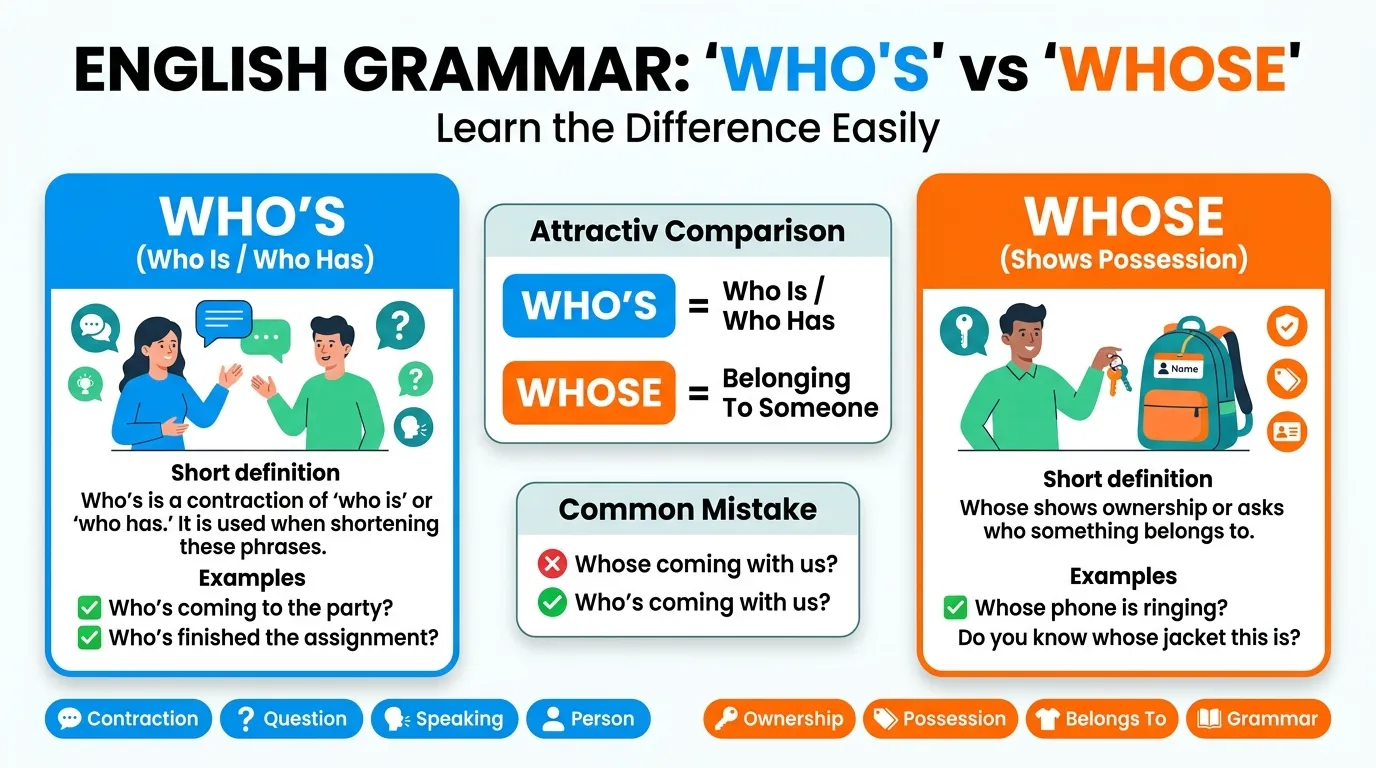
- Who’s = Who is or Who has (a contraction)
- Whose = Shows ownership or possession
Examples
- ✅ Who’s coming to the meeting?
- ✅ Who’s already finished the assignment?
- ✅ Whose backpack is on the chair?
- ✅ I know the student whose project won first place.
Easy Memory Trick
Ask yourself one question:
Can I replace the word with “who is” or “who has”?
- If yes, use who’s.
- If no, use whose.
This simple trick is the easy way to remember who’s and whose, and it’s also the best answer for anyone wondering how to remember who’s vs whose.
Why Do People Confuse Who’s and Whose?
Many English learners—and even native speakers—struggle with who’s vs whose because the words are homophones in English. Homophones are words that sound the same but have different meanings and spellings.
There are several reasons people confuse them:
- Both words are pronounced exactly the same.
- Apostrophes often confuse writers.
- Many people memorize spelling instead of understanding grammar.
- Grammar checkers don’t always recognize context.
- Fast typing leads to accidental mistakes.
Understanding English grammar who’s vs whose helps you avoid these errors and write more naturally.
What Is the Difference Between Who’s and Whose?
The difference between who’s and whose is based on grammar rather than pronunciation.
- Who’s is an English contraction that means who is or who has.
- Whose is a possessive determiner and possessive pronoun used to show ownership.
Although they sound identical, they have completely different purposes.
| Feature | Who’s | Whose |
| Meaning | Who is / Who has | Shows ownership |
| Part of Speech | Contraction | Possessive determiner / possessive pronoun |
| Apostrophe | Yes | No |
| Indicates Ownership | No | Yes |
| Example | Who’s calling? | Whose keys are these? |
This simple grammar comparison makes remembering the correct word much easier.
What Does “Who’s” Mean?
The who’s definition is straightforward.
Who’s is a contraction formed by combining:
- Who is
- Who has
The apostrophe replaces the missing letters, following standard apostrophe rules used in English contractions.
Who’s Meaning
The who’s meaning always refers to someone who is doing something or someone who has done something.
Who’s Examples
Here are several who’s examples showing who’s in a sentence:
- Who’s waiting outside?
- Who’s coming with us?
- Who’s been using my laptop?
- Who’s responsible for today’s presentation?
- Who’s interested in joining the discussion?
- Who’s already submitted the report?
- Who’s calling this late at night?
Every example follows the who’s grammar rules because you can replace who’s with who is or who has.
For example:
Who’s leading today’s meeting?
becomes
Who is leading today’s meeting?
Since the sentence still makes sense, who’s is correct.
This replacement test is one of the easiest ways to improve your English writing skills.
What Does “Whose” Mean?
The whose definition is completely different.
Whose is a possessive word that shows ownership, possession, or relationship.
It answers questions like:
- Who owns it?
- To whom does it belong?
Whose Meaning
The whose meaning always relates to ownership rather than action.
Whose Examples
These whose examples show whose in a sentence correctly.
- Whose notebook is on the desk?
- Whose phone keeps ringing?
- Whose idea was selected?
- Do you know whose jacket this is?
- I met a teacher whose lessons inspired thousands of students.
- We visited a museum whose history dates back hundreds of years.
- The athlete whose record was broken congratulated the winner.
Unlike who’s, whose never includes an apostrophe.
When to Use Who’s and Whose
One of the most common grammar questions is:
When should I use who’s or whose?
Fortunately, the answer is simple.
Use “Who’s” When
Use who’s whenever you mean:
- Who is
- Who has
Examples:
- Who’s speaking first?
- Who’s available tomorrow?
- Who’s been working on this project?
- Who’s ready to begin?
- Who’s attending today’s workshop?
These sentences follow the grammar rules for who’s because each one can be expanded naturally.
Use “Whose” When
Use whose whenever you’re talking about ownership or possession.
Examples:
- Whose bicycle is parked outside?
- Whose wallet is on the table?
- Whose responsibility is this task?
- I know the employee whose computer stopped working.
- She adopted a puppy whose owner had moved away.
These examples follow the grammar rules for whose because every sentence refers to ownership.
Learning when to use who’s and whose is one of the easiest ways to improve your correct English grammar.
Who’s vs Whose in Everyday Writing
Knowing the correct word is useful in many real-life situations.
Emails
- Who’s attending tomorrow’s meeting?
- Whose report needs revision before submission?
Text Messages
- Who’s coming tonight?
- Whose turn is it to order dinner?
Social Media
- Who’s watching the game?
- Whose vacation photos are these?
Online Chats
- Who’s joining the video call?
- Whose microphone isn’t working?
Using the correct word helps you communicate clearly and professionally in everyday conversations.
Who’s vs Whose in Academic and Business Writing
Whether you’re writing for school or work, using who’s vs whose correctly strengthens your credibility.
Academic Writing
- The researcher whose study changed the field received an international award.
- The student whose essay earned the highest score received a scholarship.
Business Writing
- Who’s responsible for approving the proposal?
- Whose signature is required before processing the contract?
- Please identify whose department will manage this project.
Using correct English grammar in academic essays, business reports, and professional emails leaves a positive impression and demonstrates attention to detail.
Common Grammar Mistakes
Because these words sound exactly alike, they’re among the most common grammar mistakes in English.
Mistake 1
❌ Who’s backpack is this?
✅ Whose backpack is this?
Ownership requires whose.
Mistake 2
❌ Whose coming to dinner?
✅ Who’s coming to dinner?
The sentence expands to Who is coming to dinner?, so who’s is correct.
Mistake 3
❌ Who’s opinion matters most?
✅ Whose opinion matters most?
Since the opinion belongs to someone, whose is the correct choice.
Mistake 4
Many writers believe apostrophes always show possession.
In reality, who’s contains an apostrophe because it’s a contraction, not because it indicates ownership. Understanding these apostrophe rules helps eliminate one of the most frequent spelling mistakes in English.
Featured Snippet Summary
If you’re looking for a quick explanation of who’s vs whose, remember this:
- Who’s means who is or who has.
- Whose shows ownership or possession.
- Replace who’s with who is to test whether it’s correct.
- If you’re talking about something that belongs to someone, always use whose.
Mastering this simple rule will help you write more accurately, avoid common grammar mistakes, and build stronger English writing skills.
Decision Tree: Should You Use “Who’s” or “Whose”?
Whenever you’re unsure which word to use, follow this simple decision tree.
Step 1: Can you replace the word with who is or who has?
- If yes, use who’s.
- If no, move to Step 2.
Step 2: Are you talking about ownership or asking who something belongs to?
- If yes, use whose.
- If no, read the sentence again to identify whether you need a contraction or a possessive word.
This quick proofreading technique is one of the easiest ways to improve your correct English grammar and avoid common writing errors.
Who’s vs Whose with Examples
Learning through examples is the fastest way to master who’s vs whose.
Everyday Conversations
- Who’s making breakfast today?
- Whose coffee mug is on the kitchen counter?
- Who’s calling your phone?
- Whose jacket did you borrow?
- Who’s ready to leave?
- Whose dog is playing in the park?
At School
- Who’s presenting the science project?
- Whose homework is missing?
- Who’s absent today?
- Whose textbook is on the teacher’s desk?
- Who’s answering the first question?
- Whose calculator did you use?
At Work
- Who’s leading today’s meeting?
- Whose report needs approval?
- Who’s handling the client presentation?
- Whose department manages customer support?
- Who’s responsible for the final review?
- Whose proposal was selected?
In Emails
- Who’s available for a quick meeting tomorrow?
- Whose feedback should I include in the final report?
- Who’s joining the conference call?
- Whose signature is required before we submit the document?
These examples demonstrate who’s vs whose with examples in situations you may encounter every day.
Who’s vs Whose in Relative Clauses
Many learners know that whose shows ownership in questions, but it also appears in relative clauses.
Examples include:
- I met a professor whose research changed modern medicine.
- We visited a village whose history dates back over 500 years.
- She adopted a puppy whose owner had moved overseas.
- The athlete whose determination inspired everyone won the championship.
In each sentence, whose connects a noun with something that belongs to it. This is an important part of English grammar who’s vs whose that many learners overlook.
Commonly Confused Grammar Words
If you’re learning who’s vs whose, you’ll probably encounter these confusing word pairs as well.
Your vs You’re
- Your shows possession.
- You’re means you are.
Examples:
- Your presentation was excellent.
- You’re doing a fantastic job.
Its vs It’s
- Its shows ownership.
- It’s means it is or it has.
Examples:
- The company updated its website.
- It’s time to start the meeting.
Their vs There vs They’re
- Their shows possession.
- There refers to a place.
- They’re means they are.
Examples:
- Their house is beautiful.
- The restaurant is over there.
- They’re planning a vacation.
Learning these commonly confused words alongside who’s vs whose will strengthen your grammar and improve your writing accuracy.
American vs British English
Many writers wonder whether American English and British English treat who’s and whose differently.
The answer is no.
Whether you’re writing in:
- American English
- British English
- Canadian English
- Australian English
the spelling, punctuation, and grammar rules remain exactly the same.
Both varieties of English use who’s as a contraction and whose as a possessive word.
Practice Quiz
Test your understanding before moving on.
Choose the Correct Word
- ______ coming to the birthday party?
- ______ backpack is on the floor?
- I know the teacher ______ class won the competition.
- ______ been using my computer?
- ______ responsibility is it to lock the office?
- Do you know ______ phone keeps ringing?
- ______ organizing tomorrow’s workshop?
- The author ______ novel became a bestseller received an award.
Answers
- Who’s
- Whose
- Whose
- Who’s
- Whose
- Whose
- Who’s
- Whose
If you answered all eight correctly, you’ve developed a solid understanding of when to use who’s and whose.
Expert Writing Tips
Professional editors and English teachers recommend these habits to avoid mistakes.
- Replace who’s with who is or who has before submitting your writing.
- Ask whether the sentence refers to ownership. If it does, use whose.
- Read important documents aloud during proofreading.
- Practice using both words in everyday writing.
- Don’t rely entirely on a grammar checker because context matters.
- Review other grammar topics, such as English contractions, possessive pronouns, and apostrophe rules, to build a stronger foundation.
These simple habits will improve your English writing skills and help you write with confidence.
Frequently Asked Questions
1. What is the difference between who’s and whose?
The difference between who’s and whose is simple. Who’s is a contraction of who is or who has, while whose shows ownership or possession.
2. Is who’s a contraction?
Yes. Who’s is an English contraction that combines who is or who has into one shorter word.
3. Is whose possessive?
Yes. Whose is a possessive determiner and can also function as a possessive pronoun to indicate ownership.
4. When should I use who’s or whose?
Use who’s whenever you mean who is or who has. Use whose whenever you’re referring to ownership.
5. Why do people confuse who’s and whose?
People confuse them because they are homophones in English. They sound the same but have different meanings and grammar functions.
6. Can whose refer to things as well as people?
Yes. Although whose commonly refers to people, it can also refer to animals, organizations, and things in modern English.
7. Are the grammar rules the same in American and British English?
Yes. American and British English follow exactly the same rules for who’s and whose.
8. What’s the easiest way to remember who’s vs whose?
The easiest method is the “who is” test. If replacing the word with who is or who has makes sense, use who’s. Otherwise, use whose.
Summary
Understanding who’s vs whose is easier once you remember their different roles in English grammar. Who’s is always a contraction of who is or who has, while whose is a possessive word used to show ownership. Although they sound alike, they perform completely different functions in a sentence, and choosing the correct one makes your writing clearer and more professional.
If you’re writing an essay, business email, blog post, or social media update, applying the simple “who is” test will help you avoid one of the most common grammar mistakes. By practicing with real-life examples and understanding the grammar rules, you’ll improve your English writing skills, build confidence, and communicate more effectively in every situation.
Actionable Takeaway
Before you send an email, publish a blog post, or submit an assignment, take a few seconds to check who’s vs whose. Replace who’s with who is or who has. If the sentence still makes sense, you’ve chosen the correct word.
If you’re talking about ownership or possession, use whose instead. This simple proofreading habit will strengthen your grammar, reduce writing mistakes, and help you produce clear, professional, and accurate English every time.

Andrew Anthony is a language enthusiast and content writer specializing in spelling mistakes, grammar, and English usage. He creates clear, practical, and well-researched guides that help readers improve their writing skills with confidence.