If you are confused about havnt vs havent, you are not alone. Many English learners and writers search for havnt or haven’t or havent or haven’t because these spellings look similar when typed quickly. However, only one form is accepted in standard English.
The correct spelling is haven’t. Both havnt and havent are incorrect because they are missing the proper apostrophe and letter structure required for English contractions. In this guide, you will learn the correct spelling of haven’t, its meaning, examples, common mistakes, and simple grammar rules to avoid this error in the future.
Quick Answer:
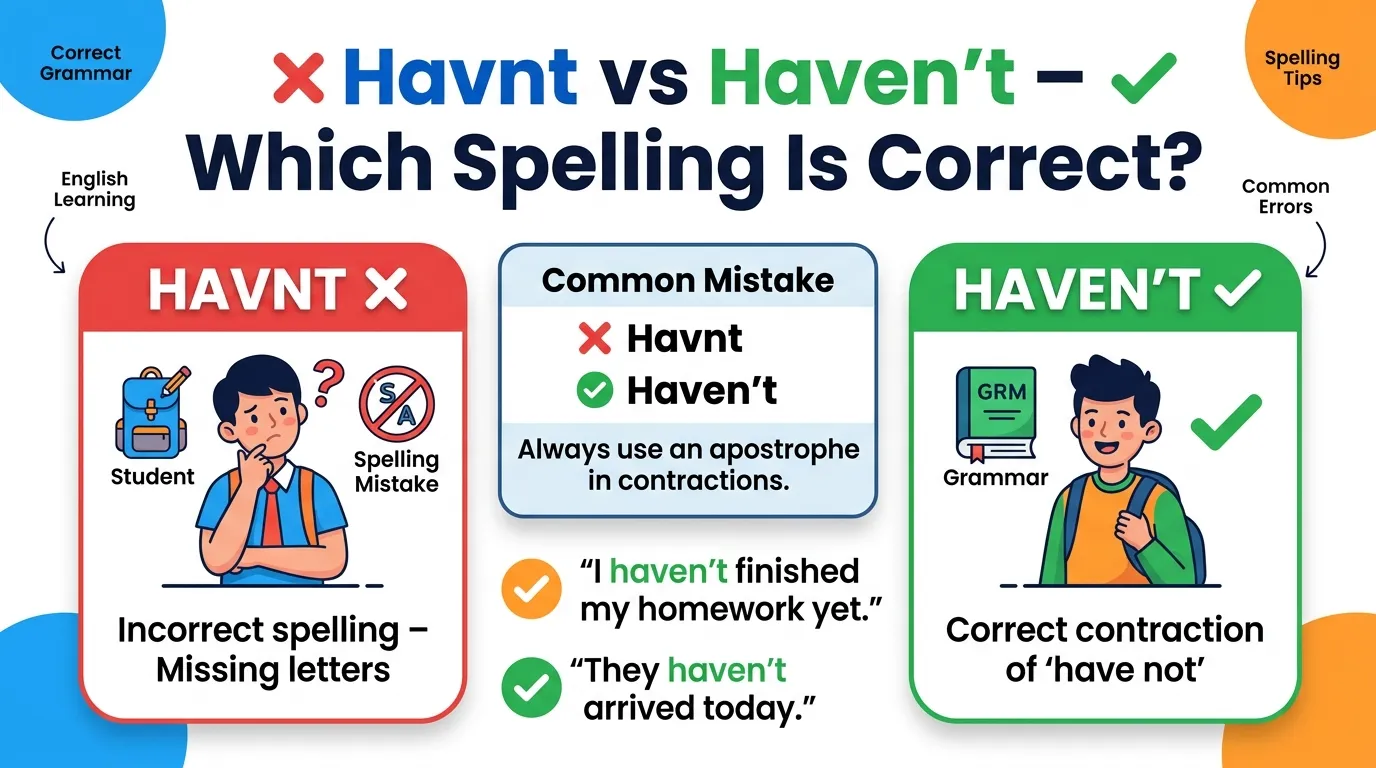
Havnt vs Havent: The correct spelling is haven’t.
- ❌ Havnt = Incorrect spelling
- ❌ Havent = Incorrect spelling
- ✅ Haven’t = Correct spelling
Haven’t is the contraction of have not.
Example:
- I haven’t finished my work.
- We haven’t received your message.
- They haven’t arrived yet.
If you are searching “is havnt a word” or “is havent correct”, the answer is no. Neither spelling is considered correct in standard English writing.
What Does Haven’t Mean?
The word haven’t means “have not.” It is a shortened form used when speaking or writing naturally.
The grammar structure is:
Have not → Haven’t
The apostrophe replaces the missing letter “o” from the word not.
This type of shortened word is called a contraction. English contractions make sentences shorter and more natural.
Examples:
- I haven’t seen that movie.
- You haven’t answered my question.
- We haven’t completed the project.
- They haven’t visited the new office.
Understanding the haven’t meaning makes it easier to recognize why havnt and havent are spelling mistakes.
Havnt vs Havent: What Is the Difference?
When comparing havnt vs havent, the important thing to remember is that neither spelling follows correct English grammar rules.
| Spelling | Correct? | Reason |
| Havnt | ❌ No | Missing letters and apostrophe |
| Havent | ❌ No | Missing apostrophe |
| Haven’t | ✅ Yes | Correct contraction of “have not” |
Many people think havent might be acceptable because it contains almost all the letters. However, contractions cannot simply remove punctuation. The apostrophe has a specific grammatical purpose.
For example:
- Do not → Don’t (not Dont)
- Cannot → Can’t (not Cant)
- Have not → Haven’t (not Havent)
The same rule applies every time.
Is Havnt a Word?
A common search question is: “Is havnt a word?“
No, havnt is not a word in English dictionaries. It is simply a typing mistake or spelling error caused by removing important letters from haven’t.
People usually write havnt because:
- They type too quickly.
- They forget the apostrophe.
- They shorten words while texting.
- They are unfamiliar with English contractions.
Example:
Incorrect:
I havnt finished my homework.
Correct:
I haven’t finished my homework.
The second sentence follows proper English spelling rules.
Is Havent Correct Without an Apostrophe?
Another common question is: “Is havent correct?”
No, havent is not correct in standard English.
The apostrophe is necessary because it shows that letters have been removed.
Original phrase:
Have not
↓
Remove the letter “o”
↓
Add apostrophe
↓
Haven’t
Without the apostrophe, the word becomes a spelling error.
Incorrect:
We havent received your email.
Correct:
We haven’t received your email.
This small punctuation mark changes the word from incorrect to correct.
Why Do People Confuse Havnt and Havent?
The confusion between havnt vs havent happens for several reasons.
1. Fast Typing and Texting Habits
Many people ignore punctuation when writing casual messages. Over time, these shortcuts become habits.
Examples:
- havent instead of haven’t
- dont instead of don’t
- cant instead of can’t
Although these forms may appear in informal chats, they are not correct for professional or academic writing.
2. Apostrophe Confusion
Many learners understand the meaning of contractions but forget where the apostrophe belongs.
Apostrophes show missing letters:
- I am → I’m
- You are → You’re
- Have not → Haven’t
Without the apostrophe, the contraction is incomplete.
3. English Contractions Can Be Tricky
English has many contractions, and each one follows a pattern.
Examples:
| Full Form | Correct Contraction |
| Have not | Haven’t |
| Do not | Don’t |
| Does not | Doesn’t |
| Did not | Didn’t |
| Will not | Won’t |
Learning these patterns helps prevent common English spelling mistakes.
Grammar Rule Behind Haven’t
The main grammar rule is simple:
When letters are removed from two words to create a contraction, an apostrophe replaces the missing letters.
For haven’t:
Full phrase:
Have not
Missing letter:
“o”
Correct contraction:
Haven’t
This is why the apostrophe in haven’t is important.
The same punctuation rule applies to many other English contractions.
Examples:
- Is not → Isn’t
- Are not → Aren’t
- Could not → Couldn’t
- Should not → Shouldn’t
Following these grammar rules for contractions will improve your overall writing accuracy.
Correct Examples Using Haven’t
Here are examples showing the proper use of haven’t in everyday English.
Daily Conversation Examples
- I haven’t eaten lunch yet.
- We haven’t talked recently.
- She hasn’t finished her book.
- They haven’t arrived at the station.
Work and Professional Examples
- I haven’t received your email.
- We haven’t completed the final report.
- The team hasn’t approved the changes.
Learning English Examples
- I haven’t learned this grammar rule before.
- Students haven’t practiced enough.
- They haven’t understood the difference yet.
These examples show how commonly haven’t is used in natural English communication.
Common Mistakes Related to Haven’t
The havnt vs havent mistake is part of a larger group of spelling errors in English.
Common examples:
| Incorrect | Correct |
| Havent | Haven’t |
| Havnt | Haven’t |
| Dont | Don’t |
| Cant | Can’t |
| Wont | Won’t |
| Didnt | Didn’t |
These mistakes usually happen because writers forget apostrophes in contractions.
Improving your understanding of punctuation rules will help you avoid many similar grammar mistakes.
Real-Life Examples: Incorrect vs Correct Usage
Text Message Example
❌ Incorrect:
I havent seen your message.
✅ Correct:
I haven’t seen your message.
Email Example
❌ Incorrect:
We havnt received your payment details.
✅ Correct:
We haven’t received your payment details.
Social Media Example
❌ Incorrect:
I havnt watched this movie yet.
✅ Correct:
I haven’t watched this movie yet.
Using the correct form makes your writing clearer and more professional.
American and British English Differences
When learning about havnt vs havent, many people wonder whether American English and British English use different spellings. This is a common question because some English words change depending on the country.
However, in this case, there is no difference between American English and British English.
Both varieties use:
✅ Haven’t
Both varieties reject:
❌ Havnt
❌ Havent
The spelling, meaning, and grammar rules are exactly the same.
Examples:
American English:
I haven’t completed my assignment yet.
British English:
I haven’t completed my assignment yet.
The word does not change because haven’t is a standard English contraction used worldwide.
Haven’t vs Have Not: Which One Should You Use?
Both haven’t and have not are correct, but the choice depends on the situation.
Using Haven’t in Everyday English
The contraction haven’t is common in:
- Conversations
- Emails
- Messages
- Blogs
- Informal writing
Examples:
- I haven’t finished the report.
- We haven’t decided yet.
- They haven’t called me.
It sounds natural and friendly.
Using Have Not in Formal Writing
The full phrase have not is often used when you want a more formal or stronger tone.
Examples:
- We have not received the required information.
- I have not approved this request.
- The company has not completed the process.
Academic writing, legal documents, and official statements often prefer the complete form.
Understanding have not vs haven’t helps you choose the right expression based on your audience.
Why Apostrophe in Haven’t Is Important
The apostrophe in haven’t is the most important detail that separates the correct spelling from mistakes like havent.
The apostrophe shows missing letters.
The process is:
Have not
↓
Remove the letter “o”
↓
Replace it with an apostrophe
↓
Haven’t
Without the apostrophe, the contraction is incomplete.
Compare:
❌ I havent finished my work.
✅ I haven’t finished my work.
The first sentence contains a spelling mistake, while the second follows correct English grammar.
How to Remember the Correct Spelling of Haven’t
If you often forget the correct spelling, use this simple memory trick:
Remember: “Have Not Always Needs an Apostrophe”
The word haven’t comes from:
Have + Not = Haven’t
The apostrophe is always placed before the final t.
Correct:
✅ Haven’t
Incorrect:
❌ Havent
❌ Havnt
This simple rule can help you avoid one of the most common English spelling mistakes.
Tips to Improve Your English Writing
Improving your spelling and grammar requires consistent practice. Here are some helpful writing tips:
1. Read More English Content
Reading articles, books, and quality websites helps you recognize correct word patterns naturally.
2. Practice Common Contractions
Learn frequently used contractions:
- Have not → Haven’t
- Do not → Don’t
- Cannot → Can’t
- Will not → Won’t
- Should not → Shouldn’t
3. Proofread Before Publishing
Before sending an email or publishing content, check:
- Apostrophes
- Spelling
- Grammar
- Sentence structure
A quick review can remove small errors that affect professionalism.
4. Use Grammar Tools Carefully
Grammar-checking tools can help find spelling errors, but understanding the grammar rule is more valuable.
Knowing why haven’t is correct helps you avoid similar mistakes in the future.
Related English Grammar Mistakes
The confusion between havnt vs havent is similar to many other contraction mistakes.
Here are common examples:
| Incorrect | Correct |
| Dont | Don’t |
| Doesnt | Doesn’t |
| Isnt | Isn’t |
| Arent | Aren’t |
| Wont | Won’t |
| Couldnt | Couldn’t |
All these examples follow the same apostrophe rule.
Learning these patterns improves your overall English writing skills and helps you communicate more clearly.
Why Correct Spelling Matters
Some people think small spelling mistakes do not matter, especially online. However, correct spelling improves trust and readability.
Using haven’t correctly helps your writing appear:
- More professional
- More trustworthy
- Easier to understand
- Grammatically accurate
Whether you are writing a blog article, school assignment, business email, or social media post, proper grammar creates a better impression.
Frequently Asked Questions
1. What is the correct spelling: havnt or havent?
The correct spelling is neither havnt nor havent. The correct form is haven’t, which means have not.
2. Is havnt a word?
No. Havnt is not an English word. It is a spelling mistake created by removing letters and the apostrophe from haven’t.
3. Is havent correct spelling?
No. Havent is incorrect because contractions require apostrophes. The correct spelling is haven’t.
4. What is the difference between havnt and havent?
There is no correct difference because both are wrong spellings. Havnt removes too many letters, while havent removes the necessary apostrophe.
5. How do you spell haven’t correctly?
The correct spelling is:
✅ Haven’t
It is formed from:
Have not → Haven’t
6. Why does haven’t have an apostrophe?
The apostrophe replaces the missing letter o from the original phrase have not. It shows that the word is a contraction.
7. Can I use haven’t in formal writing?
Yes, but some formal documents may prefer have not because it sounds more official and emphasizes the negative meaning.
8. Is haven’t the same in American and British English?
Yes. Both American English and British English use haven’t with the same spelling and meaning.
Final Summary
The confusion between havnt vs havent is very common, but the correct answer is simple: neither spelling is correct. The only accepted form is haven’t, which is the contraction of have not. The apostrophe is required because it represents missing letters and follows standard English punctuation rules.
If you are searching for havnt or haven’t, havent or haven’t, or wondering is havnt a word, remember that only haven’t is correct. Using the right spelling improves your grammar, communication, and writing quality.
Actionable Takeaway
Whenever you are unsure about havnt vs havent, use this quick rule:
Have not = Haven’t
Before submitting an assignment, sending a professional email, or publishing online content, check your contractions and apostrophes. Small grammar improvements can make your writing clearer, more professional, and easier for readers to trust.

Maria Megan is a language enthusiast and content writer specializing in spelling, grammar, and English usage. She creates clear, practical articles that help readers identify common spelling mistakes, improve writing accuracy, and communicate with greater confidence.