Have you ever typed “villian” and wondered whether it was actually correct? You are not alone. This is a common spelling mistake because the word villain looks and sounds as though it might contain two “i” letters in the middle. However, only one spelling is correct.
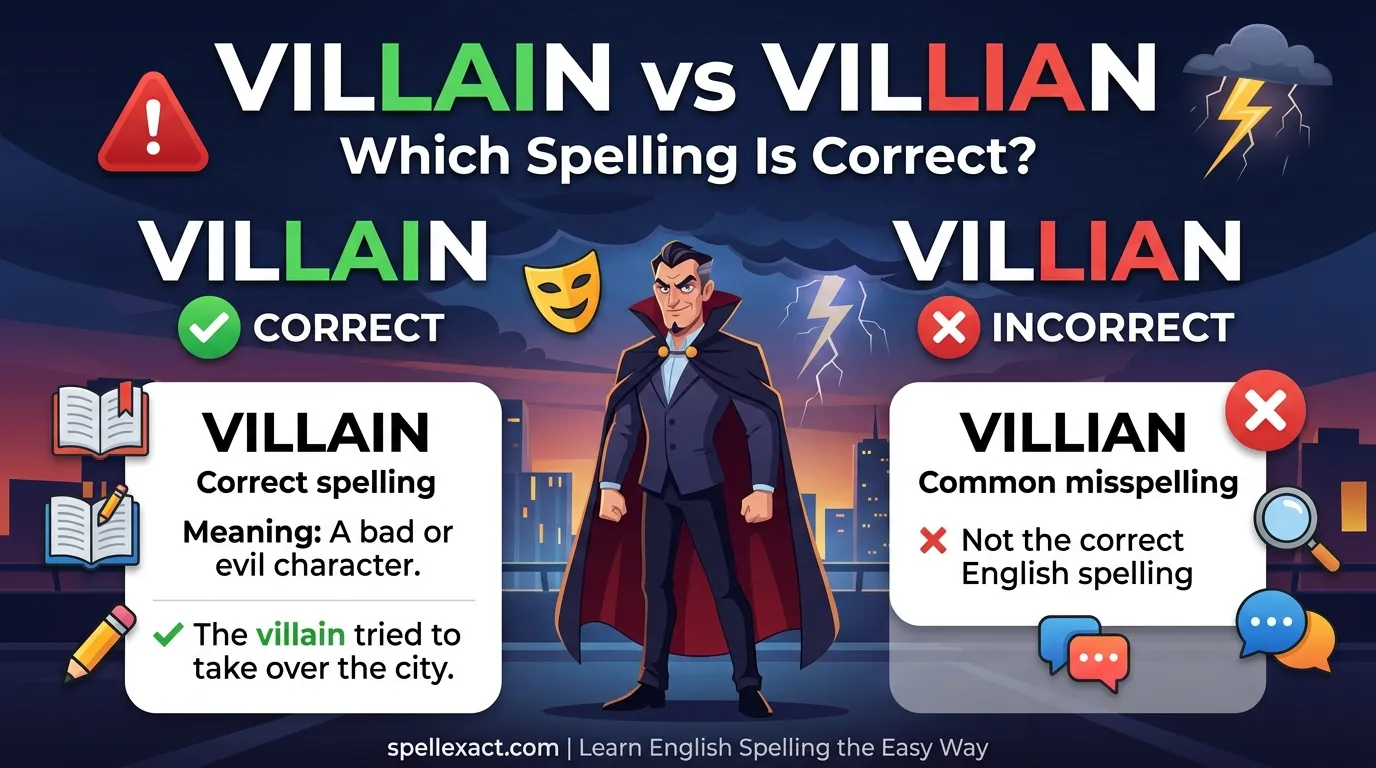
In the villain vs villian debate, the answer is simple: villain is the correct English spelling, while villian is a misspelling. This guide explains the difference, meaning, pronunciation, examples, common mistakes, and an easy trick to remember the correct spelling.
Quick Answer:
Villain is the correct spelling.
Villian is incorrect and should not be used in standard English writing.
- Correct: The villain was finally defeated.
- Incorrect: The villian was finally defeated.
The correct spelling is V-I-L-L-A-I-N.
A helpful way to remember it is that villain ends with “ain,” not “ian.”
What Does Villain Mean?
A villain is traditionally a person in a story, film, play, or other work of fiction who acts as the main opponent of the hero. The villain is often responsible for creating conflict and may be cruel, dishonest, dangerous, or morally corrupt.
For example:
- The villain tried to destroy the city.
- Every superhero needs a memorable villain.
- The detective finally discovered who the villain was.
However, the meaning of villain can be broader than simply “the bad guy.” In modern storytelling, villains can have complex motivations, tragic backgrounds, or understandable reasons for their actions. A character may therefore be a villain from one person’s perspective while believing they are doing the right thing.
Related words and phrases include:
- Antagonist
- Bad guy
- Evil character
- Enemy
- Opponent
- Criminal
- Evil-doer
- Archvillain
Although antagonist and villain are sometimes used interchangeably, they do not always mean exactly the same thing. An antagonist is a character who opposes the protagonist, but that character does not necessarily have to be evil.
Villain vs Villian: What Is the Difference?
There is no difference in meaning because “villian” is simply a misspelling of “villain.”
The confusion usually happens because English contains many words ending in -ian, such as:
- Guardian
- Historian
- Musician
- Politician
- Comedian
Because of these familiar spelling patterns, writers may accidentally change villain into villian. However, villain does not follow the -ian ending pattern.
Villain vs Villian Comparison Table
| Word | Correct? | Meaning |
| Villain | Yes | An evil or opposing character, especially in a story |
| Villian | No | A common misspelling of villain |
When writing an essay, story, social media post, email, article, or professional document, always use villain.
How Do You Spell Villain Correctly?
The correct spelling is:
V-I-L-L-A-I-N
Notice the final four letters:
A-I-N
This is where many spelling mistakes occur. People sometimes write villian because they switch the a and i.
Correct spelling:
Villain
Incorrect spelling:
Villian
A simple spelling breakdown is:
vill + ain = villain
Try saying the ending slowly: “ain.” This can help you remember that the word ends in -ain, not -ian.
Examples of Villain in Sentences
Seeing a word used naturally in sentences is one of the best ways to remember its spelling and meaning.
Here are some examples:
- The villain escaped before the police arrived.
- She played the villain in the school drama.
- Darth Vader is one of cinema’s most famous villains.
- The novel’s villain had a surprisingly complicated backstory.
- The hero and villain faced each other for the final time.
- Sometimes, the villain is the most interesting character in the story.
- He was unfairly portrayed as the villain of the situation.
- The company became the villain in the public debate.
The last example demonstrates another important use. Villain can also describe someone who is viewed as the person responsible for a problem, even outside fictional stories.
For example:
The politician was presented as the villain of the controversy.
In this sentence, the person is not a fictional character. The word is being used figuratively.
Why Is “Villian” a Common Misspelling?
The spelling villian is easy to understand because English has many words that contain the letter sequence -ian. Writers may unconsciously apply that familiar pattern to villain.
Another reason is pronunciation. When spoken quickly, the ending of villain may not clearly reveal its spelling. English spelling and pronunciation do not always follow predictable rules, so relying only on how a word sounds can lead to mistakes.
Common incorrect forms include:
- Villian
- Vilan
- Villan
- Villian character
Among these, villian is by far the most common error.
The safest approach is to remember that the correct word contains “ai” near the end:
vill + ai + n
Common Mistakes When Using Villain
1. Writing “villian” instead of “villain”
This is the main spelling error.
- Incorrect: The villian attacked the hero.
- Correct: The villain attacked the hero.
2. Confusing villain with antagonist
A villain is generally a morally bad or harmful character. An antagonist is simply someone or something that opposes the main character.
For example, a strict but fair teacher could be an antagonist in a story without being a villain.
3. Using “villain” for every opposing character
Not every opponent is evil. In a story with two characters who disagree, one may be the protagonist and the other the antagonist, but neither necessarily needs to be a villain.
4. Forgetting the plural form
The singular form is villain.
The plural form is villains.
- One villain
- Two villains
- Several villains
Do not write villians. The correct plural is villains.
Villain Pronunciation
The word villain is generally pronounced like:
VIL-in
The pronunciation may be represented approximately as /ˈvɪlən/.
The word has two syllables:
vil + lain/in
Depending on accent and natural speech patterns, the ending may sound slightly different, but the spelling remains the same: villain.
Villain in American vs British English
There is no spelling difference between American and British English for this word.
Both varieties use:
Villain
American English: villain
British English: villain
The meaning is also essentially the same in both forms of English. Whether you are writing for an American, British, Canadian, Australian, or international audience, villian remains incorrect in standard English.
This makes villain easier to remember than words with regional spelling variations such as color/colour, organize/organise, or center/centre.
Villain as a Noun and Figurative Expression
The primary grammatical role of villain is a noun.
As a character:
- The villain captured the hero.
As a description of a person blamed for something:
- The media made him the villain of the story.
In a figurative sense:
- Sugar is often treated as the villain in unhealthy diets.
In figurative use, villain does not necessarily mean that someone or something is genuinely evil. It may simply refer to the person, group, or thing viewed as the cause of a problem.
This distinction can make your writing more precise and natural.
An Easy Trick to Remember Villain vs Villian
Here is a simple memory trick:
A villain is a bad guy, and “bad” contains an A—so villain contains “AI.”
Therefore:
Vill + AIN = Villain
You can also remember this phrase:
The villain remains in the villain’s “lair,” not the villian’s lair.
The key visual pattern is AI.
When you are unsure, look at the final three letters:
- Correct: ain
- Incorrect: ian
Because villain ends in -ain, you can quickly identify the correct spelling.
Villain vs Antagonist: Are They the Same?
Although these words are closely related, they are not exact synonyms.
A villain is usually a bad, harmful, or morally corrupt character.
An antagonist is the person, force, or character that opposes the protagonist.
Consider this example:
A story follows a lawyer trying to stop a company from building on protected land. The company’s owner may be the antagonist because they oppose the protagonist. Whether the owner is also a villain depends on their actions and motivations.
Therefore:
- Every villain may function as an antagonist.
- Not every antagonist is a villain.
Understanding this difference can improve both your vocabulary and your writing.
Frequently Asked Questions
Is villian a correct spelling?
No. Villian is a misspelling. The correct spelling is villain.
How do you spell villain?
The correct spelling is V-I-L-L-A-I-N.
Why do people spell villain as villian?
People often confuse the ending with the common English pattern -ian, found in words such as musician and politician. However, villain ends in -ain.
Is villain spelled differently in British English?
No. Both American and British English use the spelling villain.
What is the plural of villain?
The plural is villains.
- Correct: villains
- Incorrect: villians
Does villain always mean an evil person?
Not always in a literal sense. A villain usually refers to an evil character in fiction, but it can also describe someone portrayed as responsible for a problem.
Is an antagonist always a villain?
No. An antagonist opposes the protagonist, but they do not have to be evil or morally bad.
What is another word for villain?
Depending on the context, alternatives include antagonist, bad guy, enemy, evildoer, criminal, adversary, and archvillain.
Summary:
The correct spelling is villain, while villian is incorrect. A villain is typically the evil or opposing character in a story, although the word can also be used figuratively to describe someone blamed for a problem. The most common mistake is reversing the “ai” sequence and writing “ian” instead.
There is no American vs British English spelling difference: both use villain. Remember that the word ends in -ain, not -ian, and you can avoid this common spelling error in your everyday writing.
Actionable Takeaway
Before publishing or sending your writing, quickly check the word: V-I-L-L-A-I-N. If you see villian or villians, replace them with villain or villains. A simple spelling check like this helps your writing look more polished, professional, and trustworthy.

Andrew Anthony is a language enthusiast and content writer specializing in spelling mistakes, grammar, and English usage. He creates clear, practical, and well-researched guides that help readers improve their writing skills with confidence.