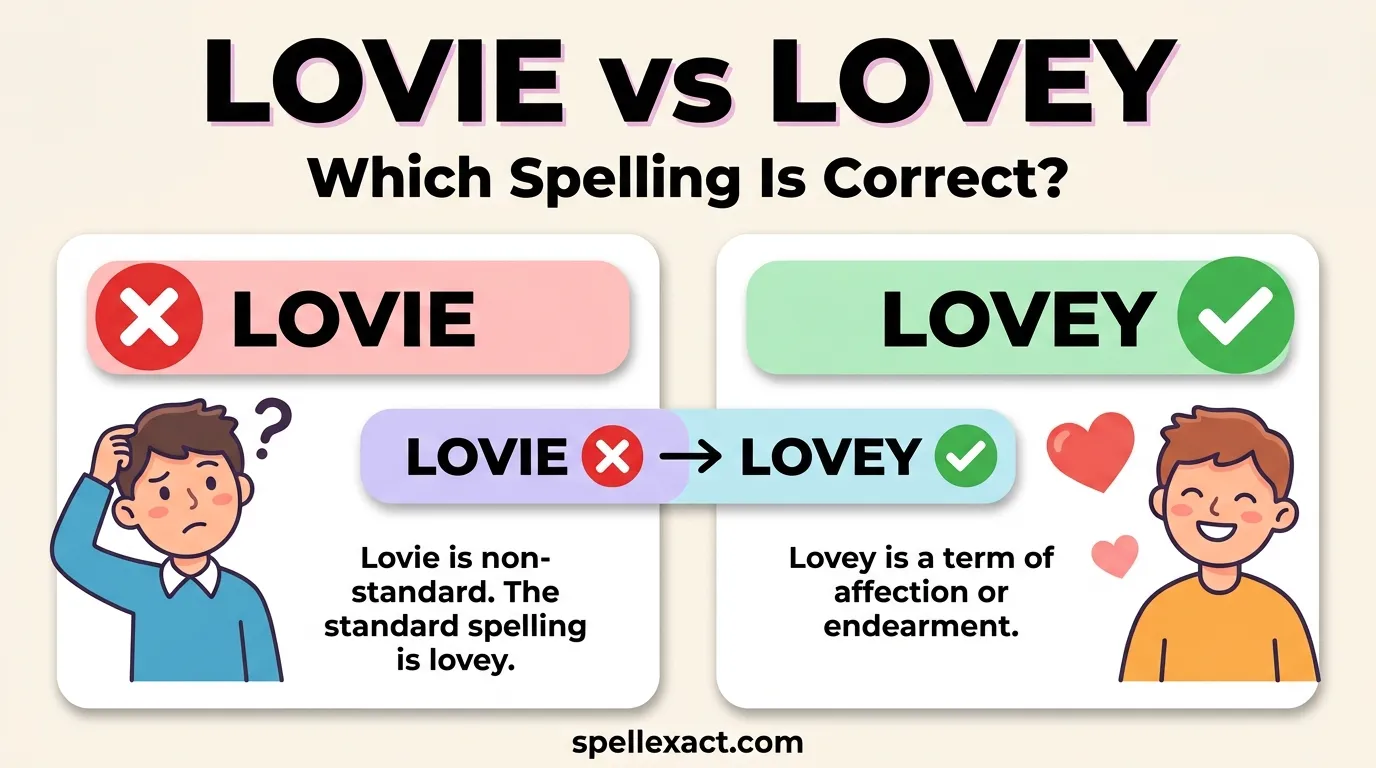
When you compare lovie vs lovey, the right choice depends on context, meaning, and how the word is used in everyday English communication today. If you have typed a message and paused because you were unsure which spelling is right, the confusion is understandable.
Both forms exist, but they are used differently depending on the context. In everyday English, lovey is the more familiar spelling for an affectionate term, while Lovie can work as a personal nickname or pet name. These words commonly appear in texts, social media, and casual conversations, where informal spellings are common.
In everyday communication, knowing the meaning and usage can help you choose the best form and avoid common mistakes. This guide looks at how these terms and expressions work in real conversation, as well as written communication and digital communication.
From practical experience, lovey naturally works as an affectionate expression connected with love, while Lovie may be appropriate when it is someone’s chosen name. Still, the intended meaning and personal preference should always be considered when choosing between the two forms.
Quick Answer
“Lovey” is the standard spelling when you mean an affectionate or loving term. For example, “Come here, lovey.” “Lovie” can appear as a personal nickname or creative spelling, but it is not normally the standard choice when referring to someone affectionately.
Why Do People Confuse “Lovie” and “Lovey”?
People often confuse lovie and lovey because both spellings represent similar sounds and are associated with affection.
The confusion is especially common in informal communication, where people create personalized spellings for nicknames. A person might write “Lovie” because it looks cute or because it is the preferred spelling of a particular nickname.
However, when you are looking for the generally accepted English word meaning someone who is loved or a term of affection, lovey is the safer choice.
First Word: Lovie
Lovie is generally used as an informal, personal, or creative spelling.
It may appear as:
- A nickname
- A pet name
- A personal name
- A deliberately cute spelling in texts or social media
For example:
“Good morning, Lovie!”
Here, Lovie may be someone’s chosen nickname. In this context, the spelling is personal rather than a standard grammatical form.
Because names and nicknames can have individual spellings, Lovie can be correct when someone specifically chooses to spell their nickname that way.
Second Word: Lovey
Lovey is the more established English spelling for an affectionate form of address.
It can be used to address someone warmly or affectionately:
“Are you feeling better, lovey?”
It is also seen in the expression lovey-dovey, which describes overly affectionate behavior.
For general English writing, lovey is normally the appropriate spelling when you mean an affectionate term.
Lovie vs Lovey: Comparison Table
| Word | Common Use | Standard English? | Example |
| Lovie | Personal nickname or creative spelling | Informal/personal | “Hi, Lovie!” |
| Lovey | Affectionate term or pet name | Yes, in this use | “Come here, lovey.” |
When Should You Use Each?
When to Use Lovie
Use Lovie when it is someone’s chosen nickname or when you intentionally want a personalized spelling.
For example:
“Lovie is her nickname.”
If a person’s name or nickname is officially spelled Lovie, you should preserve that spelling.
When to Use Lovey
Use lovey when you are using the word as a general affectionate expression.
For example:
“Thank you, lovey.”
It can also appear in lovey-dovey:
“They were acting very lovey-dovey.”
For ordinary English writing, lovey is usually the better choice when you mean an affectionate term.
10+ Examples of Lovie and Lovey
Here are examples showing the difference:
- Come here, lovey.
- Are you okay, lovey?
- Good night, lovey.
- Don’t worry, lovey; everything will be fine.
- She called her daughter “lovey.”
- They were being very lovey-dovey.
- Lovie is the nickname she uses online.
- Everyone knows him as Lovie.
- Her nickname is spelled Lovie.
- “Lovie” is a personal nickname in this context.
- He sent a sweet message to his lovey.
- She prefers to be called Lovie.
Notice that lovey works naturally as a general affectionate expression, while Lovie can function as an individual’s chosen nickname.
Common Mistakes
One common mistake is assuming that lovie and lovey are simply two standard spellings of the same English word.
They can overlap in informal communication, but their typical uses are different.
Mistake 1: Using “Lovie” as the standard spelling
If you are simply addressing someone affectionately, lovey is generally the appropriate spelling.
❌ “Good morning, lovie.”
✅ “Good morning, lovey.”
Mistake 2: Changing Someone’s Nickname
If someone’s preferred nickname is Lovie, do not automatically change it to Lovey.
For example:
“Her name is Lovie.”
In this case, Lovie is a personal spelling and should be retained.
Mistake 3: Confusing It With “Lovely”
Lovely is a different word.
“You look lovely today.”
Here, lovely is an adjective meaning beautiful, pleasant, or delightful. It is not simply another spelling of lovey.
Memory Trick
Think of lovey as the spelling connected directly to love.
LOVE → LOVEY
So when you want an affectionate word, remember:
Love → lovey
Use Lovie mainly when it is someone’s chosen name or nickname.
American vs British English
There is no major American-versus-British spelling difference that changes the basic distinction between lovie and lovey.
In both varieties of English, lovey can be used as an affectionate term. Lovie may appear as a personal nickname or informal creative spelling.
The exact frequency and tone can vary depending on the speaker, region, and context, but the basic spelling distinction remains useful in standard writing.
Similar Words
Several words are related to lovey but have different meanings or uses:
- Love — a strong feeling of affection or deep care.
- Lovely — beautiful, pleasant, or delightful.
- Loving — showing or feeling affection.
- Beloved — dearly loved.
- Darling — an affectionate name for someone.
- Sweetie — an affectionate term for someone.
- Honey — a common term of affection.
- Lovey-dovey — excessively or openly affectionate.
Understanding these related words can make it easier to choose the correct expression.
Final Verdict
Lovey is generally the correct spelling when you are using the word as an affectionate term or pet name in ordinary English.
Lovie can still be correct when it is someone’s personal nickname or intentionally chosen spelling. Therefore, the context matters.
For general writing: choose “lovey.” For a person’s established nickname: use the spelling that person uses.
Frequently Asked Questions
Is “lovie” a correct word?
Lovie can be used as a personal nickname or informal spelling, but it is not normally the standard spelling of the general affectionate term. In that context, lovey is the usual choice.
Is “lovey” a real word?
Yes. Lovey is an established informal English term used affectionately for someone who is loved or as a warm form of address.
Is it “lovie” or “lovey”?
For a general affectionate term, lovey is the preferred spelling. Lovie can be appropriate when it is someone’s chosen nickname.
Can I call someone “lovey”?
Yes. Lovey can be used as an affectionate form of address, especially in informal conversation.
Is “lovie” short for lovely?
Not normally. Lovie may be a nickname or creative spelling, while lovely is a separate standard English word meaning beautiful, pleasant, or delightful.
What does “lovey-dovey” mean?
Lovey-dovey describes people who are very openly affectionate or romantic with each other.
Which spelling should I use in formal writing?
If you mean an affectionate form of address, lovey is the more recognizable choice. However, if Lovie is someone’s actual name or nickname, preserve their spelling.
Remember This
Lovey = the usual affectionate English word.
Lovie = usually a personal or creative nickname spelling.
So, when you’re unsure, remember:
Love → Lovey
Conclusion
The difference between lovie and lovey is mainly about standard usage and personal spelling. Lovey is the more established English form when you are using an affectionate term for someone, while Lovie commonly appears as a chosen nickname or informal spelling.
If you are writing a normal sentence and want to express affection, lovey is generally the better choice. If you are referring to someone’s specific nickname, however, use the spelling they prefer. This simple distinction will help you avoid unnecessary spelling confusion.

Liam Noah is a passionate language writer at SpellExact, specializing in spelling mistakes, grammar, word confusion, and American vs. British English. He creates clear, practical content that helps readers write and communicate with confidence.