If you’ve searched for offerred vs offered, you’re probably wondering which spelling is correct before sending an email, writing an assignment, updating your resume, or publishing content online. It’s a common question because English spelling rules aren’t always straightforward, and words with double consonants often create confusion.
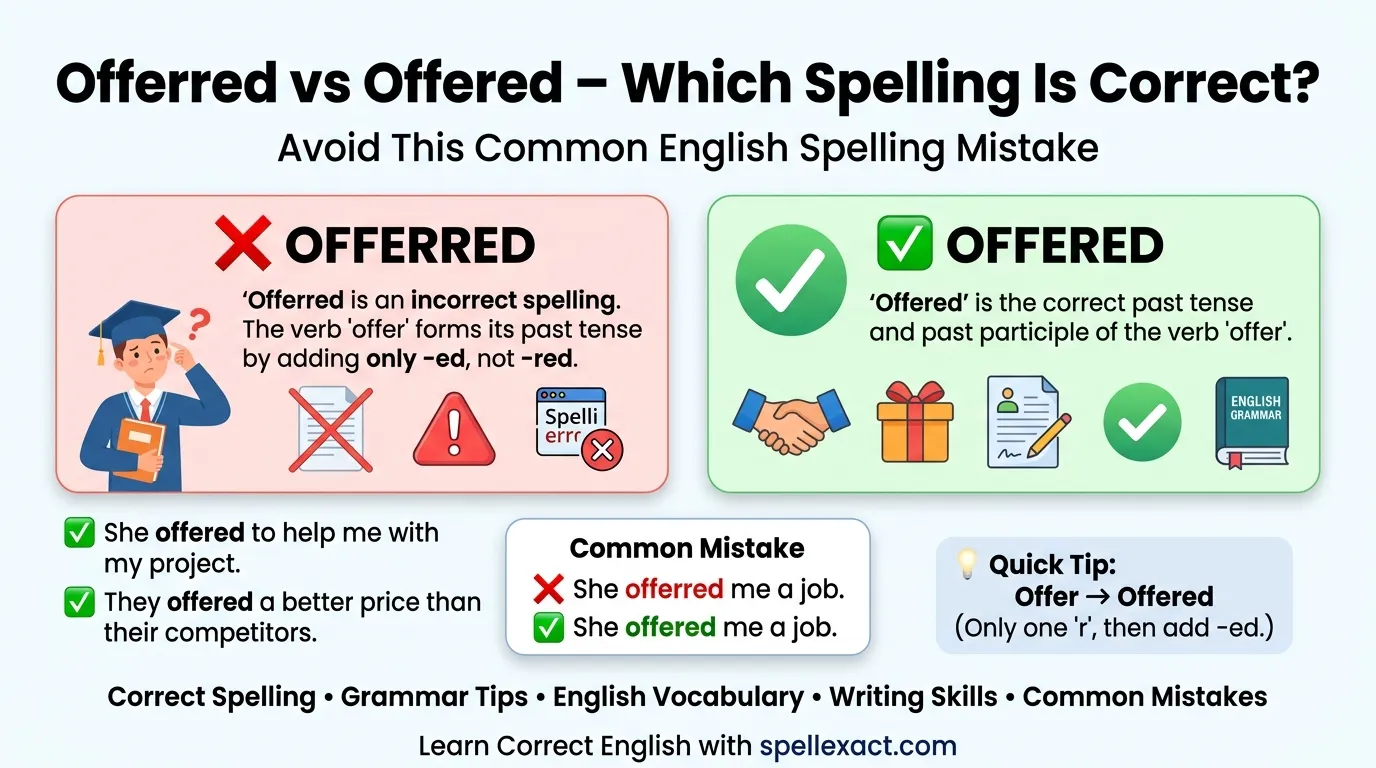
The good news is that the answer is simple. Offered is the only correct spelling, while offerred is a misspelling. In this guide, you’ll learn why the mistake happens, the grammar rule behind it, how dictionaries treat the word, practical examples, and easy memory tricks to help you avoid this error forever.
Quick Answer
Offered ✅ is the correct spelling.
Offerred ❌ is incorrect and is not recognized in standard English dictionaries.
The word offered is the past tense and past participle of the verb offer. Whether you’re writing in American, British, Canadian, or Australian English, offered is always the correct form.
Key Takeaways
- ✅ Offered is the correct spelling.
- ❌ Offerred is a spelling mistake.
- Offered is the past tense and past participle of offer.
- Both American and British English use offered.
- Simply add -ed to offer—never add an extra r.
Is “Offerred” a Real Word?
No. Offerred is not a real English word.
If you search trusted dictionaries such as Merriam-Webster, Cambridge Dictionary, Oxford Learner’s Dictionary, or Collins Dictionary, you’ll find offered, but you won’t find offerred as an accepted spelling.
Modern grammar checkers like Microsoft Editor, Grammarly, and Google Docs also flag offerred as a spelling error and recommend offered instead.
This makes offered the only correct choice for academic, professional, and everyday writing.
What Does “Offered” Mean?
The word offered comes from the verb offer, which means to present, give, provide, suggest, or make something available to someone.
When something has already been presented or proposed, we use offered.
Offered Definition
Offered (verb): The past tense and past participle of offer, meaning someone gave, proposed, presented, or made something available.
Examples
- She offered me a ride home.
- The company offered a competitive salary.
- Our teacher offered additional practice exercises.
- They offered excellent customer support.
- The hotel offered complimentary breakfast.
Every sentence above uses the correct spelling.
Offerred vs Offered: What’s the Difference?
Although the two spellings look nearly identical, only one is grammatically correct.
| Word | Correct? | Meaning |
| Offered | ✅ Yes | Correct past tense and past participle of offer |
| Offerred | ❌ No | Incorrect spelling; not accepted in English |
If you’re writing emails, resumes, reports, blog posts, assignments, or business documents, always choose offered.
Verb Forms of “Offer”
Understanding the complete verb forms makes it easier to remember the correct spelling.
| Verb Form | Word |
| Base Form | Offer |
| Third-Person Singular | Offers |
| Present Participle | Offering |
| Past Tense | Offered |
| Past Participle | Offered |
Notice that none of these forms contain a double r.
Why Do People Write “Offerred”?
The misspelling offerred usually comes from misunderstanding English spelling rules.
Many English verbs double their final consonant before adding -ed, including:
- stop → stopped
- plan → planned
- admit → admitted
- refer → referred
- prefer → preferred
After seeing these examples, many writers assume offer follows the same rule.
However, offer behaves differently.
Because the stress falls on the first syllable, the final r is not doubled.
Correct:
offer → offered
Incorrect:
offer → offerred
This is one of the most common spelling mistakes made by English learners and even native speakers when typing quickly.
The Grammar Rule Explained
Understanding one simple grammar rule can help you avoid not only offerred, but many similar spelling mistakes.
A final consonant is usually doubled before adding -ed only when:
- the verb ends with one vowel followed by one consonant, and
- the final syllable is stressed.
Examples:
- prefer → preferred
- refer → referred
- admit → admitted
Now look at the word offer.
Its pronunciation is:
OF-fer
The stress falls on the first syllable, not the second.
Because the last syllable is unstressed, the r is not doubled.
Therefore, the correct spelling is simply:
Offer + ed = Offered
This rule is accepted across modern English grammar guides.
Pronunciation
The pronunciation of offered is:
/ˈɔː.fərd/ (British English)
/ˈɔː.fɚd/ (American English)
Although the pronunciation may make some learners think another r belongs in the spelling, it does not.
The written form always remains offered.
Why This Mistake Happens
There are several reasons people accidentally write offerred.
1. Confusing Similar Words
Words like:
- referred
- preferred
- transferred
all contain double r, so writers naturally expect offer to follow the same pattern.
2. Fast Typing
Typing quickly often leads to accidental extra letters.
3. Pronunciation
Some learners spell words based on how they sound rather than following grammar rules.
4. Non-Native English Learning
English contains many exceptions, making consonant doubling one of the trickiest spelling rules to master.
5. Autocorrect Isn’t Perfect
While many writing tools catch the mistake, some browsers or older software may not flag it immediately, especially if proofreading is skipped.
Real-Life Examples of “Offered”
Seeing the word in context makes it easier to remember.
Everyday Conversation
- My neighbor offered to water my plants while I was away.
- She offered me a slice of homemade cake.
- They offered to help carry the heavy boxes.
Workplace
- My employer offered flexible working hours.
- The client offered positive feedback after the presentation.
- The manager offered me a leadership role.
Education
- The university offered new online courses this semester.
- Our professor offered extra revision sessions before the final exam.
- The school offered scholarships to outstanding students.
Business
- The supplier offered free shipping on bulk orders.
- The bank offered a lower interest rate.
- The retailer offered seasonal discounts to loyal customers.
Using offered correctly in different situations helps reinforce the proper spelling naturally.
Common Mistakes to Avoid
Here are some of the most frequent errors writers make.
❌ She offerred me a better opportunity.
✅ She offered me a better opportunity.
❌ The company offerred free training.
✅ The company offered free training.
❌ We offerred our support.
✅ We offered our support.
A quick proofreading check can prevent these mistakes and make your writing appear more polished and professional.
American vs British English
A common question is whether American English and British English use different spellings for this word.
The answer is no.
No matter which variety of English you use, the correct spelling is always offered.
| English Variant | Correct Spelling |
| American English (US) | Offered ✅ |
| British English (UK) | Offered ✅ |
| Canadian English | Offered ✅ |
| Australian English | Offered ✅ |
Unlike words such as canceled/cancelled, traveled/travelled, or modeled/modelled, there is no regional spelling variation for offered.
Commonly Confused Words
The mistake offerred belongs to a larger group of English spelling errors involving doubled consonants. Learning these patterns can improve your overall spelling accuracy.
| Incorrect | Correct |
| Offerred | Offered |
| Occured | Occurred |
| Refered | Referred |
| Prefered | Preferred |
| Transfered | Transferred |
| Stoped | Stopped |
| Planed | Planned |
| Admiting | Admitting |
Notice that some verbs require a doubled consonant, while others do not. Understanding the spelling rule is far more reliable than guessing.
Memory Trick to Remember “Offered”
Need a simple way to remember the correct spelling?
Use this formula:
Offer + ed = Offered
There is never an extra r.
Another easy reminder is:
If the word starts with “OF-fer,” don’t double the final letter. Just add “-ed.”
Repeating this trick a few times can help make the correct spelling automatic.
How to Avoid This Mistake
Good writers develop habits that reduce spelling errors before they happen.
Here are a few practical tips:
- Learn the base form of the verb before adding endings.
- Read your writing aloud during proofreading.
- Use trusted spell-check tools, but don’t rely on them completely.
- Practice commonly confused words together.
- Remember that offer is stressed on the first syllable, so the r is not doubled.
These habits not only help with offered but also improve your overall grammar and writing confidence.
Related Words and Synonyms
Expanding your vocabulary can make your writing more natural and engaging.
Related Forms
- Offer
- Offers
- Offering
- Offered
- Offeree
- Offeror
Synonyms of “Offered”
Depending on the context, offered can be replaced with:
- Presented
- Gave
- Proposed
- Suggested
- Extended
- Supplied
- Provided
- Introduced
- Submitted
Using synonyms appropriately can improve readability without changing the intended meaning.
What Do Grammar Experts Say?
English spelling guides agree that offered is the standard form because it follows the accepted rule for verbs with stress on the first syllable.
Trusted dictionaries and grammar references consistently list:
- Offer
- Offers
- Offering
- Offered
They do not recognize offerred as a correct spelling.
If you’re writing for school, work, business, or publication, using offered ensures your writing meets standard English conventions.
FAQs
1. Is “offerred” a real English word?
No. Offerred is not recognized by standard English dictionaries. It is considered a spelling mistake.
2. Which spelling is correct: offerred or offered?
Offered is the only correct spelling. It is the past tense and past participle of offer.
3. Why isn’t the “r” doubled in “offered”?
The verb offer is stressed on the first syllable (OF-fer), so it does not follow the consonant-doubling pattern used in words like preferred or referred.
4. Is “offered” the past tense of “offer”?
Yes. Offered functions as both the past tense and past participle of the verb offer.
5. Is there a difference between American and British English?
No. Both American and British English use offered. There is no spelling variation.
6. Why do spell-check tools flag “offerred”?
Because offerred is not a recognized English word. Most grammar and spelling tools recommend replacing it with offered.
7. Is “offered” used in formal writing?
Absolutely. Offered is the standard spelling used in academic papers, business reports, legal documents, resumes, professional emails, and published writing.
8. How can I remember the correct spelling?
Think of the rule:
Offer + ed = Offered
If you’re tempted to type offerred, stop and remember that offer never adds an extra r.
Similar Spelling Mistakes to Learn Next
If you found this guide helpful, you may also want to learn about other commonly confused spellings, such as:
- Occurred vs Occured
- Preferred vs Prefered
- Transferred vs Transfered
- Referred vs Refered
- Cancelled vs Canceled
- Separate vs Seperate
- Definitely vs Definately
- Embarrass vs Embarass
Learning these related spelling rules builds stronger grammar skills and helps you write with greater confidence.
Summary
The debate over offerred vs offered has a simple answer: offered is the only correct spelling. It is the accepted past tense and past participle of the verb offer, while offerred is a common misspelling that does not appear in reputable dictionaries or grammar references. This rule remains the same in American, British, Canadian, and Australian English, making offered the correct choice in every context.
The confusion usually arises because writers compare offer with verbs like prefer and refer, which do double the final r. However, since offer is stressed on the first syllable, it follows a different spelling rule. By understanding this pattern, practicing with real-life examples, and remembering the simple formula “Offer + ed = Offered,” you can avoid this mistake and write with greater confidence.
Actionable Takeaway
Before submitting an assignment, sending an important email, or publishing online content, take a moment to proofread your work. If you spot offerred, replace it with offered immediately. Building this small proofreading habit will improve your spelling accuracy, strengthen your professional writing, and help you avoid one of the most common English spelling mistakes.

Aaron Adam is the Administrator of SpellExact, dedicated to helping readers improve their spelling and writing accuracy. He oversees content quality, ensures reliable language resources, and works to make spelling guidance simple, practical, and accessible for everyone.