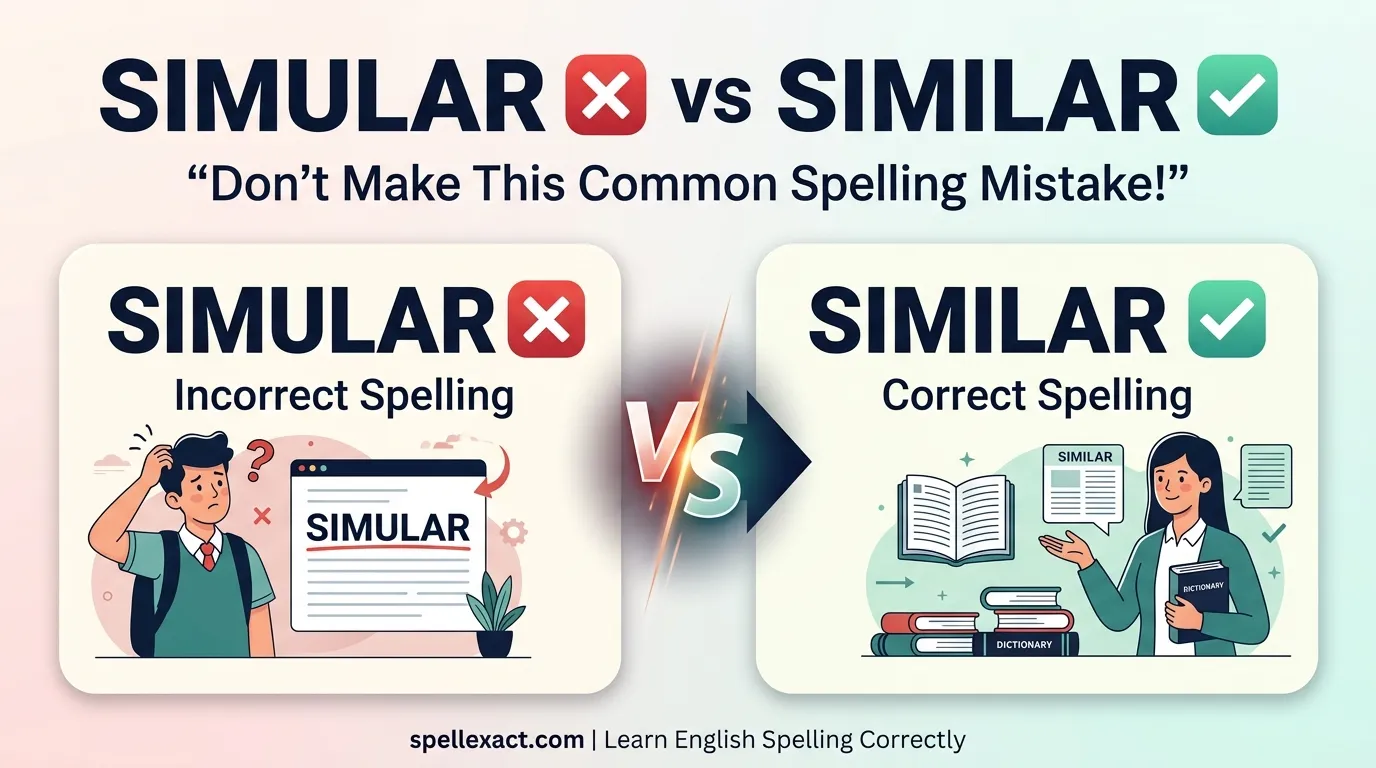
If you are wondering whether “simular” or “similar” is the correct spelling, you are not alone. This is a common spelling confusion because the two words look and sound very close. However, in standard modern English, only similar is correct.
If you are writing an email, school assignment, blog post, social media caption, or professional document, using the correct spelling helps your writing look clear and credible.
This guide explains the difference between simular vs similar, their meaning, pronunciation, examples, common mistakes, and simple ways to remember the correct spelling.
Quick Answer
Similar is the correct English spelling.
Simular is generally considered a misspelling of similar and should not be used in standard English writing.
- Correct: The two designs are very similar.
- Incorrect: The two designs are very simular.
The word similar means almost the same, alike, or having characteristics in common.
Simular vs Similar: What Is the Difference?
The main difference is simple: similar is a standard English word, while simular is usually a spelling mistake.
| Word | Correct? | Meaning | Example |
| Similar | Yes | Almost the same; alike | These two cars look similar. |
| Simular | No | Usually a misspelling of “similar” | Avoid using it in standard writing. |
| Although simular may occasionally appear in historical texts, names, or specialized contexts, it is not the accepted modern spelling when you mean “alike” or “nearly the same.” | |||
| For everyday, academic, and professional writing, choose similar. |
What Does Similar Mean?
The word similar is an adjective. It describes two or more people, objects, ideas, situations, or things that share important characteristics.
Something does not need to be exactly identical to be similar. For example, two phones may have different brands and features but still be similar in size, shape, or function.
Examples of Similar in Sentences
Here are some natural examples:
- The twins have similar personalities.
- Your handwriting is similar to your father’s.
- These two recipes use similar ingredients.
- The new model has a similar design to the previous one.
- We had similar experiences during our first year at work.
- The colors are different, but the overall patterns are similar.
In each sentence, similar means alike, comparable, or having shared characteristics.
Why Do People Write “Simular” Instead of “Similar”?
The misspelling simular is understandable because English spelling does not always match pronunciation perfectly.
People may accidentally replace the i in similar with a u, especially when typing quickly or relying on how the word sounds.
There are several possible reasons for this mistake:
- The pronunciation may make the middle vowel unclear.
- The writer may confuse similar with words containing -ular, such as regular or particular.
- Autocorrect may not always catch the mistake.
- The word may simply be typed incorrectly.
This is why learning the correct spelling pattern can help prevent the error.
How Do You Spell Similar Correctly?
The correct spelling is:
S-I-M-I-L-A-R
A useful way to remember it is:
SIM + ILAR = SIMILAR
Another simple memory trick is to focus on the repeated “i” sound and spelling:
sim-i-lar
There is no u after the m. So remember:
Similar has “i,” not “u.”
Is “Simular” Ever a Correct Word?
In modern standard English, simular is not the correct spelling for the adjective meaning “alike.”
You may occasionally encounter simular in older writings, unusual proper names, historical documents, or nonstandard text. However, that does not make it appropriate as a replacement for similar in contemporary English.
If you mean:
- alike
- nearly the same
- comparable
- having common characteristics
- resembling something else
the correct word is similar.
Similar Meaning and Related Words
Understanding related vocabulary can make it easier to use similar naturally in your writing.
Depending on the context, synonyms and closely related words include:
- alike
- comparable
- corresponding
- resembling
- related
- equivalent
- matching
- parallel
- near-identical
These words are not always interchangeable, however.
For example: - Similar means having shared characteristics.
- Identical means exactly the same.
- Comparable means similar enough to be compared.
- Alike often means similar in appearance or nature.
Similar vs Identical
This distinction is especially important.
Similar means two things are alike but not necessarily exactly the same:
The sisters have similar voices.
Identical means completely the same:
The two copies are identical.
Therefore, two things can be similar without being identical.
How to Use Similar in a Sentence
The word similar can appear in several sentence structures.
Similar to
The most common structure is similar to.
- This dress is similar to the one I bought last year.
- His approach is similar to mine.
- The symptoms can be similar to those of a common cold.
Similar in
Use similar in when describing a particular quality or characteristic.
- The two products are similar in price.
- The brothers are similar in appearance.
- Their opinions are similar in many ways.
Similar + Noun
You can also place similar before a noun.
- They have similar interests.
- We experienced similar problems.
- Several similar cases have been reported.
These patterns are useful for making your writing sound natural and grammatically correct.
Common Mistakes with Similar
The confusion between simular vs similar is not the only mistake writers make. Here are several common errors.
Mistake 1: Writing “Simular”
Incorrect:
The results were simular.
Correct:
The results were similar.
Always use similar in standard English.
Mistake 2: Confusing Similar with Identical
Incorrect use:
The two files are similar because they are exactly the same.
Better:
The two files are identical because they are exactly the same.
Use similar for things that are alike but not necessarily exact copies.
Mistake 3: Using “Similar With”
Although usage can vary in informal communication, similar to is generally the most natural and widely accepted construction.
Less natural:
This product is similar with the original version.
Better:
This product is similar to the original version.
Mistake 4: Misspelling Similar in Compound Forms
Be careful with related expressions such as:
- similarly
- similarity
- similarities
- dissimilar
- dissimilarity
Examples: - The two methods work similarly.
- There is a noticeable similarity between them.
- We discussed the similarities and differences.
Learning these related forms can reinforce the correct spelling of similar.
Similar vs Similarly vs Similarity
These words are connected but have different grammatical functions.
| Word | Word Type | Meaning | Example |
| Similar | Adjective | Alike or nearly the same | The buildings are similar. |
| Similarly | Adverb | In a similar way | Similarly, the second test showed improvement. |
| Similarity | Noun | The quality of being similar | There is a similarity between the two images. |
| Knowing the difference helps you choose the correct form for your sentence. | |||
| For example: |
The ideas are similar. ✓- The ideas are similarly. ✗
- There is a strong similarity between the ideas. ✓
Pronunciation of Similar
Similar is commonly pronounced approximately as:
SIM-uh-ler
The exact pronunciation can vary slightly depending on accent and region. However, the spelling remains the same.
The pronunciation should not lead you to spell the word as simular. English often contains vowel sounds that are reduced or pronounced differently from their written form.
American vs British English: Is There Any Difference?
There is no spelling difference between American English and British English for this word.
Both varieties use:
similar
Not:
simular
This makes the word easy to remember for international writing. Whether you are writing for readers in the United States, United Kingdom, Canada, Australia, or elsewhere, similar is the standard spelling.
There may be slight differences in pronunciation depending on the speaker’s accent, but the written form remains unchanged.
Real-Life Examples of Similar vs Simular
Consider these everyday situations.
Example 1: Shopping
You want to describe two products that look almost the same.
Correct:
I found a similar product at a lower price.
Incorrect:
I found a simular product at a lower price.
Example 2: School Writing
You are comparing two historical events.
Correct:
The two events had similar causes.
Example 3: Workplace Communication
You are discussing a previous project.
Correct:
We faced similar challenges on the last project.
Example 4: Social Conversation
You are talking about shared interests.
Correct:
We have similar tastes in music.
In all of these situations, similar is the word you need.
A Simple Trick to Remember “Similar”
If you regularly confuse simular and similar, try connecting the word to similarity.
The word similarity clearly begins with:
simil-
Therefore:
- similar
- similarly
- similarity
Notice that these related words all contain the same simil base.
Thinking about the word family can make the correct spelling easier to remember.
You can also remember this sentence:
Similar things are alike, and both “similar” and “alike” contain an “i” sound.
The mnemonic does not explain every letter, but it can help you pause and remember that simular is not the standard spelling.
Frequently Asked Questions
Is simular a correct spelling?
No. In standard modern English, simular is generally a misspelling of similar when referring to things that are alike or nearly the same.
Which is correct: simular or similar?
Similar is correct. Use similar in formal, academic, professional, and everyday writing.
What does similar mean?
Similar means alike, comparable, or having characteristics in common. It does not necessarily mean exactly the same.
How do you spell similar?
The correct spelling is S-I-M-I-L-A-R.
Why do people misspell similar as simular?
The mistake often happens because of pronunciation, typing errors, or confusion with words containing the -ular spelling pattern.
Is there a British spelling of similar?
No. Both American English and British English use similar.
What is the difference between similar and identical?
Similar means nearly the same or alike, while identical means exactly the same.
What are some synonyms for similar?
Common synonyms include alike, comparable, corresponding, resembling, related, matching, and equivalent, depending on the context.
Final Summary:
When choosing between simular vs similar, the answer is clear: similar is the correct spelling in standard modern English. It is an adjective used to describe things that are alike, comparable, or share important characteristics. Simular is generally a misspelling and should be avoided in everyday, academic, and professional writing.
The easiest way to remember the correct form is to connect similar with related words such as similarly and similarity. Before publishing or sending your writing, take a moment to check for this common spelling error.
A quick correction from simular to similar can make your writing clearer, more polished, and more trustworthy.
Actionable takeaway:
Whenever you mean alike or nearly the same, write similar—never simular.

Aaron Adam is the Administrator of SpellExact, dedicated to helping readers improve their spelling and writing accuracy. He oversees content quality, ensures reliable language resources, and works to make spelling guidance simple, practical, and accessible for everyone.