The handiwork vs handywork question becomes clearer when spelling history, Google Books, and historical examples are considered. Both forms have appeared in written English, and handywork has even been used modernly.
M-W describes it as an archaic variant, while handiwork is the correct spelling for standard modern English. This historical variant therefore has a real record of use rather than being a completely random spelling.
Historical records show a broad range of usage. There are limited examples from the 16th century, while the 18th century and 19th century contain many more examples of both forms. In some periods, the numbers may be a similar number, which can surprise learners researching English spelling questions.
From my experience, this is a useful reminder that a word can be wrong for modern standard usage while still appearing as an older form in historical writing. Its archaic status helps explain why handywork can still be found in older texts and occasional modern writing.
For present-day writers, the settled spelling is handiwork. Historical sources may show handywork, but that does not necessarily make it the preferred modern form. Some misspellers may not be completely regular wrong from a historical sense, because the alternative has documented usage, but modern writers should still choose the standard form. In normal modern spelling, handiwork is used for skilled work or something produced by someone’s hands.
Quick Answer
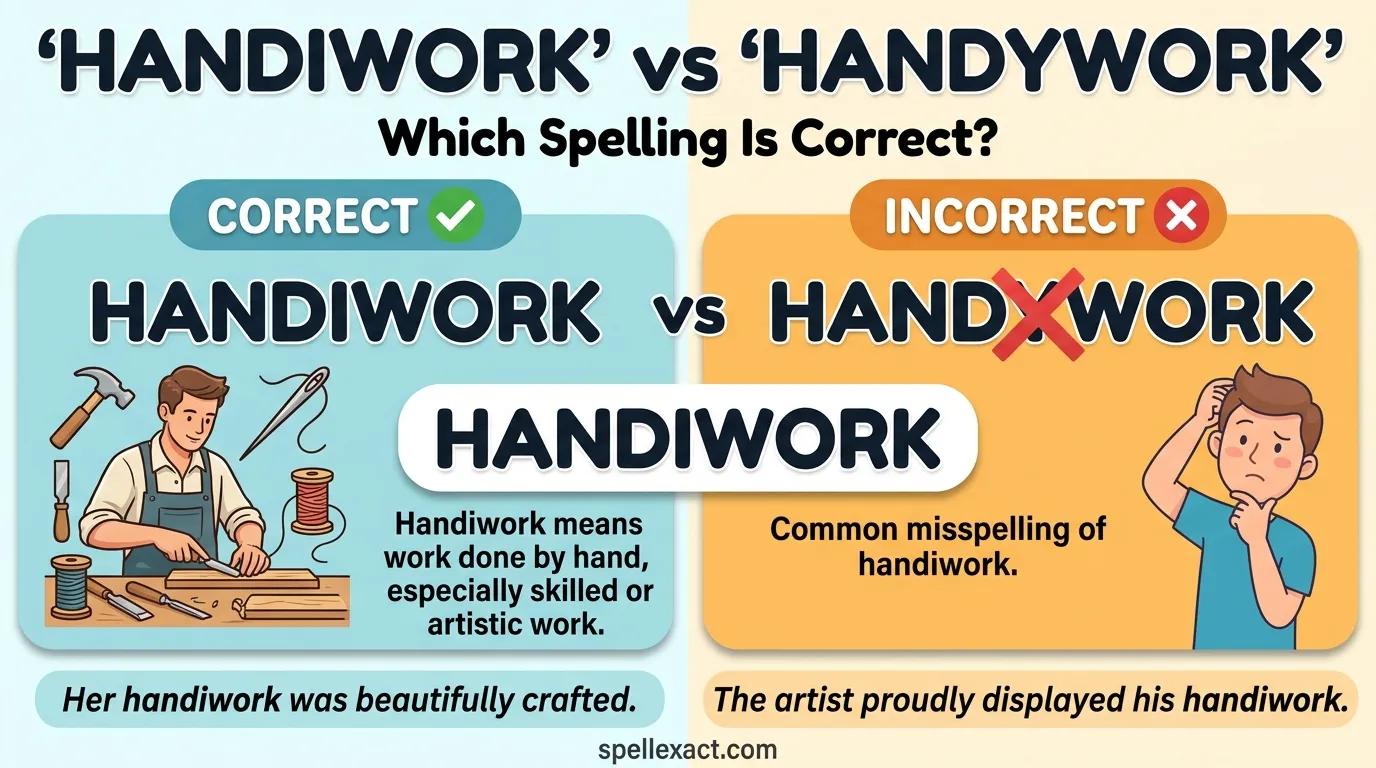
Handiwork is the correct and standard spelling. It means work done by hand, especially skilled or carefully crafted work. Handywork is not the standard spelling for this meaning and should generally be avoided. For example: “The beautiful cabinet is a fine example of his handiwork.”
Why Do People Confuse It?
People often confuse handiwork and handywork because both forms look natural at first glance.
The confusion comes partly from the familiar adjective handy, which means useful, convenient, or skilled with one’s hands. Someone may therefore assume that handywork means work done skillfully by hand.
However, handiwork is the established noun. Its spelling needs to be learned as a whole rather than formed by simply adding work to handy.
Another reason for confusion is pronunciation. In normal speech, the difference between the two spellings is not obvious, so writers may choose the form that looks more familiar.
First Word: Handiwork
Handiwork is the correct spelling.
It is a noun that refers to work made or completed by hand, particularly work that demonstrates skill, effort, or craftsmanship.
Meaning of Handiwork
Handiwork can describe:
- Something carefully made by hand
- A person’s skilled work
- A finished product showing someone’s craftsmanship
- The result of someone’s effort or skill
For example:
The wooden chair was clearly the handiwork of an experienced craftsman.
The word can also be used more broadly to describe the visible result of someone’s actions.
The broken window was the handiwork of the children playing nearby.
In this example, handiwork is used somewhat humorously to mean the result of someone’s actions.
Second Word: Handywork
Handywork is generally not the standard spelling of the noun handiwork.
If you want to refer to skilled work or something made by hand, use handiwork.
For example:
❌ The beautiful quilt is her handywork.
✅ The beautiful quilt is her handiwork.
The adjective handy is a legitimate English word, but that does not make handywork the standard spelling of this particular noun.
Handiwork vs Handywork: Comparison Table
| Feature | Handiwork | Handywork |
| Standard spelling | ✅ Yes | ❌ No, for this meaning |
| Part of speech | Noun | Not the standard noun |
| Meaning | Work done skillfully by hand | Usually a misspelling of handiwork |
| Example | “This painting is her handiwork.” | “This painting is her handywork.” ❌ |
| Recommended in formal writing | Yes | No |
When Should You Use Each?
Use “handiwork” when talking about skilled work
Use handiwork when something has been made, repaired, created, or completed through someone’s skill and effort.
The detailed embroidery is her handiwork.
Use “handiwork” for handmade creations
The word is especially useful when discussing crafts, artwork, furniture, clothing, decorations, and similar creations.
We admired the artist’s handiwork.
Avoid “handywork” for this meaning
If your intended meaning is work done by hand, skilled craftsmanship, or the result of someone’s work, choose handiwork.
10+ Examples of Handiwork
Here are some natural examples showing how handiwork is used:
- The beautiful painting is the handiwork of a talented local artist.
- We were impressed by the carpenter’s handiwork.
- This handmade basket is a fine example of traditional handiwork.
- The intricate embroidery shows the artist’s careful handiwork.
- She proudly displayed her handiwork at the craft fair.
- The wooden table is the handiwork of my grandfather.
- We could see the craftsman’s handiwork throughout the old building.
- The detailed decoration was clearly the handiwork of an experienced designer.
- Her handiwork included several beautifully knitted scarves.
- The restored furniture shows the expert handiwork of the craftsman.
- Everyone admired the child’s creative handiwork.
- The intricate design is a remarkable piece of handiwork.
Common Mistakes
The most common mistake is writing handywork instead of handiwork.
Incorrect:
His handiwork was impressive. ✅
Actually, this sentence is correct.
Incorrect spelling:
His handywork was impressive. ❌
Correct spelling:
His handiwork was impressive. ✅
Another mistake is assuming that every compound word follows an obvious spelling pattern. English contains many words whose spelling has developed historically and cannot always be predicted simply by combining two familiar words.
So, instead of trying to construct handiwork from handy + work, remember the established spelling: handiwork.
Memory Trick
A simple way to remember the spelling is:
Hand + I + work = handiwork
Think of the “I” as the person putting skill and effort into the work:
HAND + I + WORK → HANDIWORK
So when you mean skilled work done by hand, remember:
Handiwork has an “I.”
American vs British English
There is no major American-versus-British spelling difference for handiwork.
Both American English and British English use handiwork as the standard spelling.
So whether you are writing for an American or British audience, use:
handiwork ✅
The alternative handywork should not be used as the standard spelling simply because of regional English differences.
Similar Words
Several words have meanings related to handiwork:
- Craftsmanship — skill involved in making something well
- Workmanship — the quality or skill shown in someone’s work
- Craft — an activity involving skill in making things
- Handmade — made by hand rather than by machine
- Creation — something produced or made
- Artistry — creative or artistic skill
- Skill — the ability to do something well
- Labor — physical or mental work
For example, craftsmanship and handiwork can overlap in meaning, but they are not always interchangeable.
The cabinet demonstrates excellent craftsmanship.
Here, craftsmanship emphasizes the quality and skill of the work.
The cabinet is a beautiful example of his handiwork.
Here, handiwork emphasizes the actual work or creation produced by the person.
Final Verdict
Handiwork is the correct spelling when you mean skilled work done by hand or the result of someone’s effort and craftsmanship.
Handywork is generally a misspelling in this context. Although handy is a real English word, it does not change the established spelling of handiwork.
If you are writing an essay, article, email, school assignment, or professional document, choose handiwork.
Frequently Asked Questions
Is “handiwork” or “handywork” correct?
Handiwork is the correct standard spelling. It refers to work made or done skillfully by hand or the result of someone’s effort.
What does handiwork mean?
Handiwork means work made or completed by hand, especially work that demonstrates skill, care, or craftsmanship.
Is handywork a word?
Handywork is not the standard spelling of the noun meaning skilled work done by hand. In most writing, use handiwork instead.
How do you spell handiwork?
The correct spelling is H-A-N-D-I-W-O-R-K: handiwork.
Can I say “her handiwork”?
Yes. “Her handiwork” is a natural and correct expression when referring to something she made or completed skillfully.
Is handiwork one word or two?
Handiwork is written as one word.
Is handiwork used in American English?
Yes. Handiwork is standard in American English and is also used in British English.
What is another word for handiwork?
Depending on the context, alternatives include craftsmanship, workmanship, craft, creation, and artistry.
Remember This
- ✅ Handiwork = correct
- ❌ Handywork = generally incorrect for this meaning
- Handiwork is a noun.
- It commonly refers to skilled work done by hand.
- Remember: HAND + I + WORK = HANDIWORK.
Conclusion
When choosing between handiwork vs handywork, use handiwork. It is the standard English spelling for work made or completed by hand, particularly when the work demonstrates someone’s skill, care, or craftsmanship.
The spelling handywork can look logical because handy is a familiar English word, but it is not the standard form of this noun. Remember the simple pattern “hand + I + work”, and you will be much less likely to make this spelling mistake.

Caleb Carter is a passionate language enthusiast and content writer specializing in spelling mistakes, grammar, and vocabulary. He creates clear, practical guides that help readers improve their writing skills and communicate confidently every day.