Studing vs Studying often confuses English learners and fast typers who rely on intuition instead of checking English spelling rules before writing.
The confusion happens because people sometimes remove a letter when they form verbs with -ing. This creates spelling confusion around word endings, especially for language learners developing their language skills.
Although studing may look right, it is one of the common errors in written English. Understanding verb formation makes spelling correction easier. The correct spelling is studying, formed by adding -ing to study without removing the final y. In English grammar, this is an example of how spelling patterns affect verb forms.
For better spelling accuracy, remember that verb endings do not always follow the same pattern. This small learning step can improve your writing accuracy and help you use the word with correct usage when typing or writing about studying English.
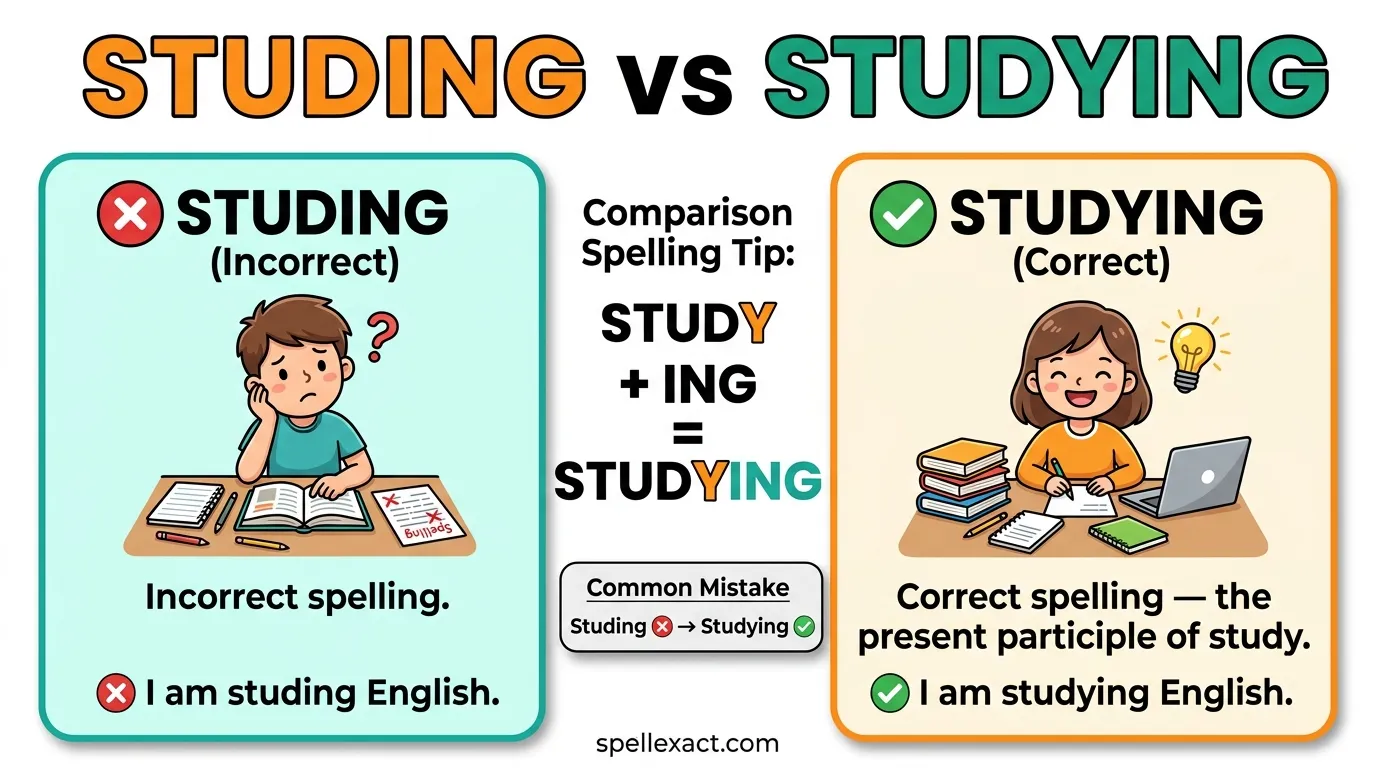
When you study English, paying attention to these details builds a stronger understanding. For example, write “I am studying English” rather than “I am studing English.” With practice, recognizing these spelling rules becomes easier, helping you avoid the same spelling mistake in your everyday writing.
Quick Answer
Studying is the correct spelling, while studing is incorrect in standard English. The word studying comes from the verb study and means learning about a subject or preparing for something. When adding -ing to study, keep the letter y and add ing: study + ing = studying.
Why Do People Confuse Studing and Studying?
People often confuse studing and studying because they are trying to apply English spelling rules to a verb ending in y.
In English, some verbs ending in y change their spelling when a suffix is added. For example, try becomes trying, while study becomes studying.
The mistake happens when someone removes the letter y before adding -ing. This produces studing, which is not the standard spelling.
Another reason is pronunciation. In everyday speech, the middle sounds in studying may blend together, making the spelling less obvious to learners.
The easiest way to avoid this error is to remember that the verb study keeps its final y when you add -ing.
What Does Studing Mean?
Studing is a misspelling of studying. It is not accepted as the standard English spelling of the verb form.
If you see studing in a message, assignment, or online post, the writer almost certainly means studying.
Incorrect: She is studing for her mathematics exam.
Correct: She is studying for her mathematics exam.
In formal writing, schoolwork, professional emails, and examinations, always use studying.
What Does Studying Mean?
Studying is the present participle or gerund form of the verb study. It refers to the activity of learning, reading, researching, or preparing to understand a subject.
It can describe an action happening now or an activity in general.
Studying as a Present Participle
When used with a helping verb, studying describes an ongoing action.
Examples:
- I am studying English.
- She is studying for her final exam.
- They were studying in the library.
Studying as a Gerund
When used as a noun, studying refers to the activity of learning.
Examples:
- Studying requires patience.
- I enjoy studying history.
- Studying regularly can improve your understanding.
In both cases, studying is the correct spelling.
Studing vs Studying: Comparison Table
| Feature | Studing | Studying |
| Spelling | Incorrect | Correct |
| Meaning | No standard meaning in this context | Learning or preparing |
| Base verb | Intended to be study | Study |
| Grammar | Nonstandard spelling | Gerund or present participle |
| Example | She is studing. | She is studying. |
| Suitable for formal writing | No | Yes |
When Should You Use Studying?
Use studying whenever you want to describe learning, preparing for an examination, or examining something carefully.
1. Talking About an Action Happening Now
Use studying with forms of the verb be to describe an ongoing activity.
Example: I am studying for my science test.
2. Describing a Habit or Routine
Use studying when talking about regular learning activities.
Example: He spends two hours studying every evening.
3. Talking About a Past Ongoing Action
Use studying with was or were to describe an activity that was happening in the past.
Example: We were studying when the electricity went out.
4. Using the Word as a Noun
Use studying when referring to the activity of learning itself.
Example: Studying in a quiet room helps me concentrate.
12 Examples of Studying in Sentences
Here are 12 practical examples showing how to use studying correctly in everyday English.
- I am studying English to improve my communication skills.
- Sarah is studying for her final examination.
- They are studying together at the university library.
- My brother enjoys studying mathematics.
- We were studying when our teacher arrived.
- Studying regularly helps students understand difficult topics.
- She has been studying for three hours.
- Are you studying for tomorrow’s test?
- He is studying biology at college.
- I prefer studying in the morning.
- The students were studying quietly in the classroom.
- Studying a new language takes time and practice.
Notice that the spelling remains studying in every sentence, regardless of the tense or grammatical role.
Common Mistakes When Using Studying
Even experienced English learners sometimes make spelling mistakes with verbs ending in y. Here are some errors to avoid.
Mistake 1: Removing the Letter Y
Incorrect: I am studing for my exam.
Correct: I am studying for my exam.
The letter y stays in the word when you add -ing.
Mistake 2: Confusing Studying With Studied
Incorrect: I am studied English right now.
Correct: I am studying English right now.
Use studying for an action in progress. Use studied for the past tense or past participle.
Mistake 3: Using Studying Without a Helping Verb
Incorrect: She studying for the test.
Correct: She is studying for the test.
When studying describes an ongoing action, it normally needs a form of be, such as am, is, or are.
However, it can stand alone in other grammatical structures, such as “Studying is important.”
Mistake 4: Assuming Every Verb Ending in Y Changes the Same Way
Incorrect: Study becomes studing.
Correct: Study becomes studying.
English spelling depends on the suffix being added. The rules for -ing are not always the same as the rules for -ed.
Memory Trick: How to Remember Studying
A simple way to remember the correct spelling is:
Study + ing = Studying
Keep the original word study intact and add ing to the end.
You can also remember this sentence:
“I keep the Y when I am studying.”
Another helpful trick is to connect the word to other similar verbs:
- Cry → Crying
- Try → Trying
- Carry → Carrying
- Study → Studying
These examples show that the final y remains when adding -ing.
American vs British English: Is There a Difference?
There is no spelling difference between American and British English for this word.
Both varieties use studying as the correct spelling.
| American English | British English |
| Studying | Studying |
| Studied | Studied |
| Studies | Studies |
For example:
- American English: I am studying for my final exam.
- British English: I am studying for my final exam.
The spelling is identical in both varieties. Differences in pronunciation may occur between speakers, but they do not change the standard spelling.
Similar Words to Studying
Understanding other verbs that follow the same spelling pattern can help you improve your English spelling.
| Base Verb | Correct -ing Form | Incorrect Form |
| Try | Trying | Tring |
| Cry | Crying | Cring |
| Carry | Carrying | Carring |
| Apply | Applying | Appling |
| Copy | Copying | Coping |
| Study | Studying | Studing |
Remember that these examples focus on adding -ing. Some of these verbs follow different rules when other suffixes are added.
For instance, study becomes studied in the simple past tense, but studying in the present participle.
Frequently Asked Questions
1. Is it studing or studying?
Studying is correct. Studing is a misspelling. Always keep the final y when adding -ing to study.
2. Why is studying spelled with a Y?
The base verb is study. When you add -ing, the final y remains unchanged, producing studying. The spelling rule does not require removing the y.
3. Is studing a real English word?
Studing is not the standard spelling of the verb form. It may appear as a typing or spelling error, but the correct word is studying.
4. What is the difference between study and studying?
Study is the base form of the verb, while studying is its present participle and gerund form.
Example: “I study every day” describes a habit. “I am studying now” describes an ongoing action.
5. What is the past tense of studying?
The simple past tense of study is studied.
Example: I studied English yesterday.
The past participle is also studied, as in “I have studied English for two years.”
6. Is studying a noun or a verb?
Studying can function as both a verb form and a noun-like gerund.
Example as a verb form: She is studying English.
Example as a gerund: Studying improves your knowledge.
7. Does American English use studing?
No. American English uses studying, just like British English and other standard varieties of English.
Remember This
- Correct spelling: Studying
- Incorrect spelling: Studing
- Base verb: Study
- Correct formation: Study + ing = Studying
- Meaning: Learning, reading, or preparing to understand a subject
- American and British spelling: Studying
Conclusion
The difference between studing and studying is simple: studying is the correct spelling, while studing is a common spelling mistake. The word comes from the verb study, and the final letter y stays when you add -ing. You can use studying to describe an ongoing action, a learning activity, or the process of gaining knowledge.
Whenever you write about preparing for an exam, learning a new language, or developing your knowledge, remember the simple rule: study + ing = studying. Practice using the word in sentences, check your spelling when necessary, and you will become more confident in your English writing.

Liam Noah is a passionate language writer at SpellExact, specializing in spelling mistakes, grammar, word confusion, and American vs. British English. He creates clear, practical content that helps readers write and communicate with confidence.