Have you ever paused while writing and wondered, “Is it stole or stold?” You are not alone. The confusion is understandable because many English verbs form their past tense with -ed, making stold look like it could be correct. However, English has plenty of irregular verbs, and steal is one of them.
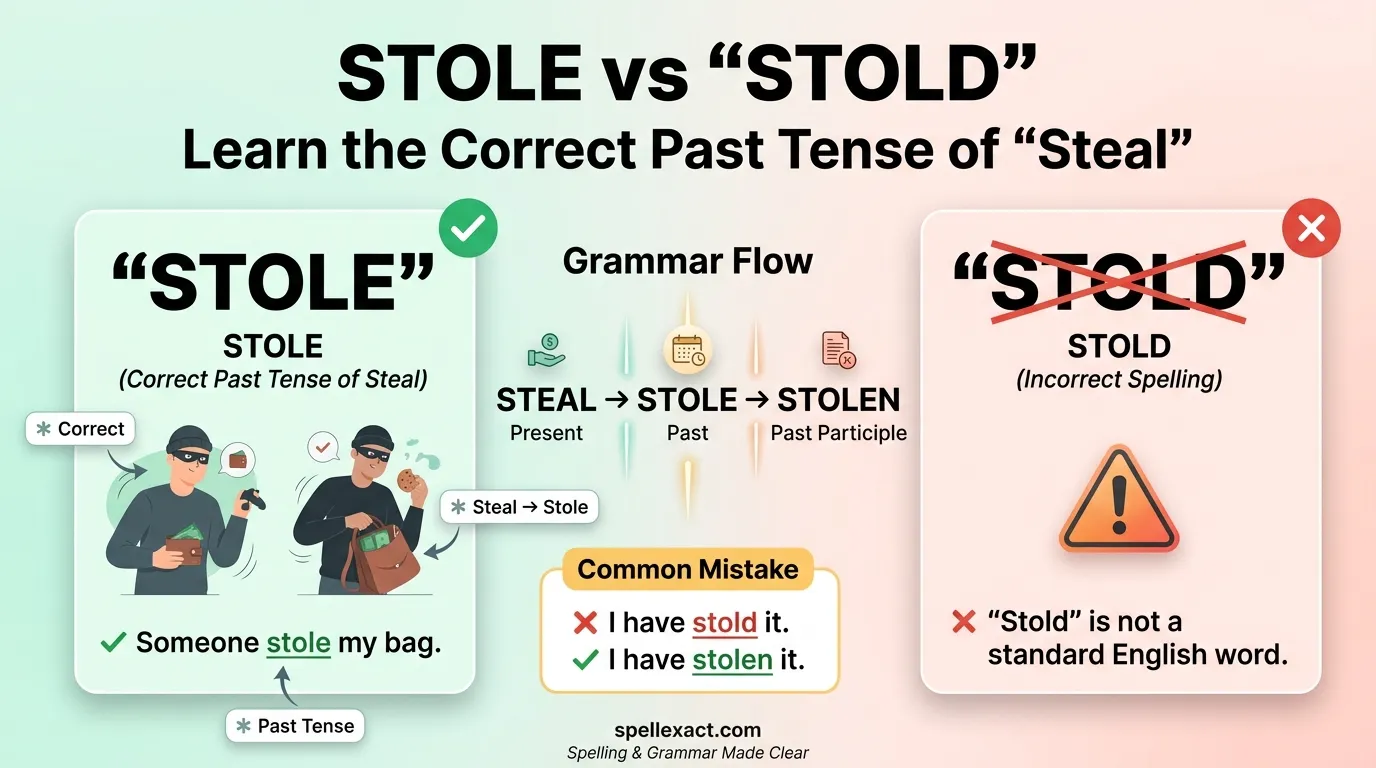
The simple answer is that stole is the correct past tense of steal, while stold is a misspelling and is not a standard English word. This guide explains the difference between stole and stold, shows how to use stole correctly, provides real-life examples, and helps you avoid one of the most common spelling and grammar mistakes related to the verb steal.
Quick Answer:
Stole is correct when referring to the simple past tense of steal.
Stold is incorrect in standard English.
- Present tense: steal
- Past tense: stole
- Past participle: stolen
- Incorrect form: stold
Correct: Someone stole my bicycle yesterday.
Incorrect: Someone stold my bicycle yesterday.
The verb steal is irregular, so it does not form its past tense by simply adding -ed.
Stole vs Stold Comparison Table
| Word | Correct? | Meaning | Example |
| Steal | Yes | To take something dishonestly | Someone may try to steal the phone. |
| Stole | Yes | Past tense of steal | Someone stole the phone yesterday. |
| Stolen | Yes | Past participle of steal | The phone was stolen. |
| Stold | No | Not a standard English word | Incorrect: Someone stold the phone. |
Remember this simple pattern:
Steal → Stole → Stolen
Learning the three forms together can make the correct spelling much easier to remember.
What Does Stole Mean?
Stole is the simple past tense of the verb steal. To steal means to take something that belongs to another person without permission, usually dishonestly or unlawfully.
When the action happened and was completed in the past, use stole.
Examples of Stole
- Someone stole my wallet at the station.
- The thief stole several valuable paintings.
- My brother stole a cookie from the kitchen.
- She stole a quick glance at the clock.
- The dog stole food from the table.
Notice that stole is not always used only for serious crimes. It can also appear in informal or figurative expressions.
For example:
- The comedian stole the show.
- He stole her heart.
- The child stole a glance at the surprise gift.
In these expressions, stole may describe taking attention, affection, or a brief look rather than physically taking an object.
Why Is “Stold” Incorrect?
The word stold is usually created by applying a regular verb pattern to an irregular verb.
Many English verbs follow this structure:
- walk → walked
- talk → talked
- call → called
- play → played
Because of these patterns, some writers may assume:
steal → stold
But this is not how the verb works. Steal has an irregular past tense, so its correct forms must be learned individually:
steal → stole → stolen
English contains many similar irregular verbs:
- speak → spoke → spoken
- break → broke → broken
- choose → chose → chosen
- freeze → froze → frozen
The pattern behind these verbs can sometimes help you remember that stole and stolen belong together.
How to Use Stole Correctly in a Sentence
Use stole when describing an action that happened at a specific or completed time in the past.
Examples with Specific Past Time
- Someone stole my car last night.
- The burglar stole the jewelry yesterday.
- They stole money from the office years ago.
- A stranger stole her bag on Monday.
Words such as yesterday, last night, last year, earlier, ago, and when I was young often signal that the simple past tense is needed.
Questions Using Stole
You can also use stole in questions about a past action:
- Who stole the keys?
- When did someone steal your phone?
- What did the thief steal?
Pay attention to the last two examples. After did, use the base form steal, not stole.
Correct: What did the thief steal?
Incorrect: What did the thief stole?
This is an important grammar rule because did already shows that the sentence is in the past.
Stole vs Stolen: Another Common Confusion
While stole vs stold is the main spelling question, many learners also confuse stole with stolen.
Both are correct, but they have different grammatical jobs.
Stole: Simple Past
Use stole as the main past-tense verb.
- Someone stole my laptop.
- The thief stole the documents.
Stolen: Past Participle
Use stolen with helping verbs such as has, have, had, was, or were.
- Someone has stolen my laptop.
- The thief had stolen the documents.
- My bicycle was stolen last week.
A helpful comparison is:
Yesterday, someone stole my bike.
My bike was stolen yesterday.
The first sentence uses the simple past tense. The second uses the past participle in a passive construction.
Common Mistakes With Stole and Stold
Mistake 1: Writing “Stold”
The most obvious error is using stold as the past tense of steal.
Incorrect: He stold my phone.
Correct: He stole my phone.
Mistake 2: Using “Stolen” Without a Helping Verb
Incorrect: He stolen my phone yesterday.
Correct: He stole my phone yesterday.
Also correct: He has stolen my phone.
The word stolen generally needs an auxiliary or helping verb unless it is being used as part of another grammatical structure.
Mistake 3: Using “Stole” After “Did”
Incorrect: Who did stole the money?
Correct: Who stole the money?
Or:
Correct: Who did they steal from?
When did is used, the main verb normally returns to its base form.
Mistake 4: Confusing “Stole” With “Steel”
This is another common spelling issue because stole and steel sound alike in many accents.
- stole = past tense of steal
- steel = a strong metal
Example: The thief stole a piece of steel.
Mistake 5: Forgetting That Steal Is an Irregular Verb
The temptation to write stealed or stold comes from expecting steal to follow a regular pattern.
However, neither is correct in standard English.
Correct forms: steal, stole, stolen.
Easy Ways to Remember Stole vs Stold
Here are a few practical memory tricks.
Remember the Three-Word Pattern
Say the verb forms together:
Steal – Stole – Stolen
Repeating irregular verb forms as a sequence is often more effective than trying to memorize each form separately.
Connect It With Similar Irregular Verbs
Think of:
- speak → spoke
- break → broke
- steal → stole
The vowel change is part of a familiar pattern found in several English irregular verbs.
Use a Simple Sentence
Try remembering:
“Yesterday, someone stole it.”
If the event happened yesterday, stole is the correct past-tense form.
Stole in Idioms and Figurative Expressions
The word stole appears in several natural English expressions. Understanding these can help you recognize that stole has broader uses than simply describing theft.
Stole the Show
To steal the show means to attract the most attention or give the best performance.
Example: The young singer stole the show.
Stole Someone’s Heart
To steal someone’s heart means to win that person’s love or affection.
Example: Her kindness stole his heart.
Stole a Glance
To steal a glance means to look quickly or secretly at something or someone.
Example: She stole a glance at the answer sheet.
These examples reinforce the same grammar rule: when the action happened in the past, the correct word is stole.
American vs British English: Is There Any Difference?
There is no spelling difference between American English and British English when it comes to these verb forms.
Both varieties use:
- steal
- stole
- stolen
For example:
American English: Someone stole my car.
British English: Someone stole my car.
Unlike words such as color/colour or traveling/travelling, the past tense of steal remains the same on both sides of the Atlantic.
So whether you are writing for a US, UK, Canadian, Australian, or international audience, stole is the correct standard form and stold should be avoided.
Is Stold Ever a Real Word?
In modern standard English, stold is not an accepted past-tense form of steal.
You may occasionally encounter stold as a typo, spelling error, nonstandard usage, or historical-looking form in unusual contexts. However, it should not be used when writing standard modern English.
For everyday writing, schoolwork, professional communication, SEO content, and formal documents, choose stole.
Frequently Asked Questions
Is “stold” a word?
No. Stold is not the standard English past tense or past participle of steal. The correct forms are stole and stolen.
What is the past tense of steal?
The past tense of steal is stole.
Example: Someone stole my bag yesterday.
What is the past participle of steal?
The past participle is stolen.
Example: My bag has been stolen.
Is it “someone stole my phone” or “someone stold my phone”?
The correct sentence is “Someone stole my phone.” The word stold is incorrect.
Is “stealed” correct?
No. Stealed is not the standard past tense of steal. Use stole for the simple past and stolen for the past participle.
Why is it “stole” instead of “stealed”?
Because steal is an irregular verb. Irregular verbs do not always form the past tense by adding -ed.
Can I say “I have stole”?
No. Use the past participle stolen after have or has.
Incorrect: I have stole it.
Correct: I have stolen it.
What is the difference between stole and stolen?
Stole is the simple past tense, while stolen is the past participle.
- He stole the money.
- He has stolen the money.
Summary:
The difference between stole vs stold is straightforward once you remember that steal is an irregular verb. Stole is correct as the simple past tense, while stold is an incorrect spelling in standard modern English. The complete verb pattern is steal → stole → stolen, and learning all three forms together can prevent future mistakes.
The most practical takeaway is to pause whenever you want to write stold and replace it with stole. Use stole for completed past actions, such as Someone stole my wallet yesterday, and use stolen with appropriate helping verbs, such as My wallet was stolen. Keep the pattern steal–stole–stolen in mind, and this common spelling confusion becomes much easier to avoid.
Actionable Takeaway
Before publishing or sending your writing, check for these forms:
- steal = present/base form
- stole = simple past
- stolen = past participle
- stold = incorrect
If you remember only one sentence, make it this: “Yesterday, someone stole it.”

Aaron Adam is the Administrator of SpellExact, dedicated to helping readers improve their spelling and writing accuracy. He oversees content quality, ensures reliable language resources, and works to make spelling guidance simple, practical, and accessible for everyone.