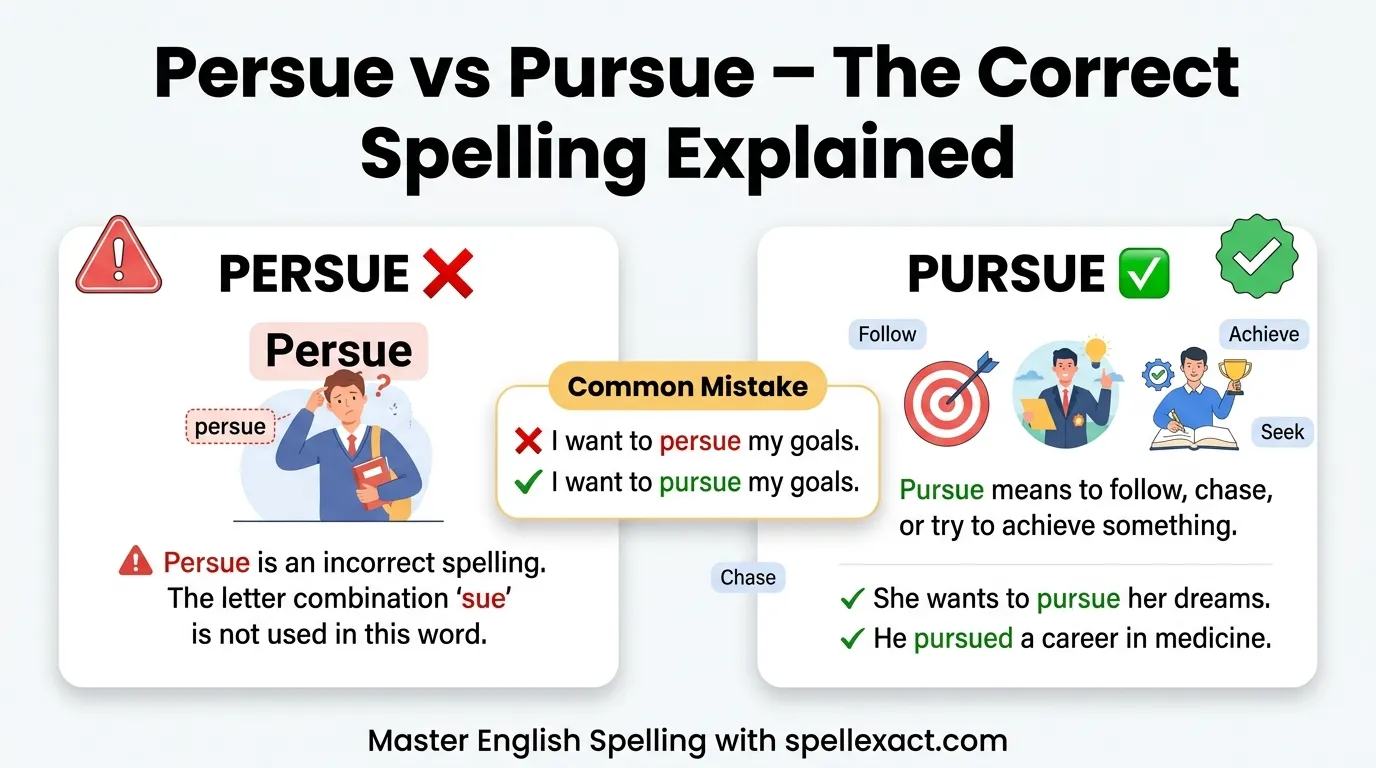
Have you ever searched “persue vs pursue“ because you were unsure which spelling is correct? You’re not alone. This is one of the most common English spelling mistakes, and many students, professionals, and English learners accidentally write persue when they actually mean pursue.
The good news is that the answer is simple: pursue is the correct spelling, while persue is incorrect. In this complete spelling guide, you’ll learn the pursue meaning, correct usage, pronunciation, examples, common mistakes, and a simple trick to remember the right spelling forever.
Quick Answer:
Pursue is the correct spelling.
Persue is an incorrect spelling and should not be used in standard English.
| Spelling | Correct? | Meaning |
| Pursue | ✅ Correct | To follow, chase, seek, or work toward something |
| Persue | ❌ Incorrect | A common spelling mistake of “pursue” |
Example:
✅ She wants to pursue her dream of becoming a doctor.
❌ She wants to persue her dream of becoming a doctor.
If you are asking “is it pursue or persue?”, always choose pursue.
What Does Pursue Mean?
The word pursue is a verb that means to follow, continue, seek, or try to achieve something.
The pursue definition can change slightly depending on the situation, but the main idea is always about actively following something.
Common meanings of pursue:
- To follow someone or something
- To chase after an objective
- To work toward a goal
- To continue an activity or plan
- To seek an opportunity
Examples of Pursue in a Sentence
Here are some natural pursue examples:
- She decided to pursue a career in technology.
- Many students pursue higher education to improve their skills.
- He wants to pursue his dreams despite challenges.
- The company plans to pursue new business opportunities.
- The police officer continued to pursue the suspect.
- They are determined to pursue success through hard work.
These examples show that pursue can be used in personal, professional, academic, and everyday situations.
Is Persue a Word?
A common question people search online is:
“Is persue a word?”
The answer is:
No, persue is not a correct English word.
Although many people write persue because it looks and sounds natural, dictionaries do not recognize it as standard English.
If you search for persue meaning, you will not find an official definition because it is simply a spelling error.
The correct word is:
✅ Pursue
Why Do People Confuse Persue vs Pursue?
The confusion between persue vs pursue happens because English spelling is not always predictable.
Here are the main reasons:
1. Pronunciation Creates Confusion
The pronunciation of pursue is:
per-SOO
/ pərˈsuː /
Because the first sound can resemble “per,” many people naturally type persue.
However, the spelling begins with:
✅ PUR
❌ PER
2. English Has Many Similar Patterns
Many English words start with “per”:
- Person
- Perfect
- Permission
- Perhaps
Because of these familiar patterns, writers sometimes assume persue follows the same rule.
3. Fast Typing Causes Mistakes
Many spelling errors happen because people type quickly and do not proofread their writing.
This is why persue spelling appears frequently online.
4. English Learners Depend on Sound
Many learners spell words based on pronunciation. However, English often contains silent letters, unusual patterns, and exceptions.
For example:
- Receive
- Definitely
- Separate
- Necessary
- Pursue
These are all examples of words that require memorization.
How to Spell Pursue Correctly
If you are wondering how to spell pursue, remember:
P-U-R-S-U-E
The important part is:
PUR
Not:
PER
Easy Memory Trick
Remember this sentence:
Pursue your purpose.
Both words begin with:
PUR
This simple connection helps you remember that the correct spelling is pursue, not persue.
Another way to remember:
You pursue something with a purpose.
Pursue vs Persue: Detailed Comparison
| Feature | Pursue | Persue |
| Correct spelling | ✅ Yes | ❌ No |
| Dictionary word | ✅ Yes | ❌ No |
| Part of speech | Verb | None |
| Meaning | Follow, seek, achieve | No official meaning |
| Used in formal writing | ✅ Yes | ❌ No |
| Used in academic writing | ✅ Yes | ❌ No |
| Used in professional communication | ✅ Yes | ❌ No |
| Accepted in American English | ✅ Yes | ❌ No |
| Accepted in British English | ✅ Yes | ❌ No |
When Should You Use Pursue?
You should use pursue whenever you talk about following or achieving something.
1. Pursue Your Dreams Meaning
The phrase pursue your dreams means to actively work toward your goals and ambitions.
Examples:
- Never stop trying to pursue your dreams.
- She moved abroad to pursue her dream career.
- Successful people continue to pursue their goals.
2. Pursue Career Meaning
When someone says they want to pursue a career, they mean they want to follow a specific professional path.
Examples:
- He wants to pursue a career in medicine.
- She decided to pursue a career in graphic design.
- Many people pursue careers based on their passions.
3. Pursue Education Meaning
Students often use this word when discussing academic goals.
Examples:
- I plan to pursue a master’s degree.
- She is pursuing higher education overseas.
- They want to pursue advanced research.
4. Pursuing Opportunities
Businesses and individuals often use pursue when discussing chances for growth.
Examples:
- The company will pursue new markets.
- He wants to pursue better opportunities.
- They are pursuing innovative solutions.
Should I Ever Use “Persue”?
No.
You should never use persue in professional writing, academic work, emails, articles, or exams.
If you see persue, treat it as a spelling mistake and replace it with:
✅ Pursue
Examples:
❌ I want to persue my goals.
✅ I want to pursue my goals.
❌ She will persue a new career path.
✅ She will pursue a new career path.
Using the correct spelling improves your credibility and shows strong English writing skills.
Origin and History of Pursue
Understanding word origins can make spelling easier.
The word pursue comes from Old French poursuivre, which means “to follow” or “continue after.”
It is also connected to the Latin word prosequi, meaning “to follow after.”
Over time, English adopted the modern spelling pursue, which is now used worldwide.
This history explains why the word does not follow the spelling pattern many people expect.
Common Mistakes Related to Pursue
Besides writing persue, people sometimes confuse:
❌ Pursu
❌ Pursuee
❌ Persu
❌ Pursueing
Correct forms:
✅ Pursue
✅ Pursued
✅ Pursuing
✅ Pursues
✅ Pursuit
Learning these forms helps improve your overall English vocabulary and spelling accuracy.
American vs British English: Is Pursue Spelled Differently?
A common question from English learners is whether there is any difference between pursue in American English and pursue in British English.
The answer is simple:
No, there is no spelling difference.
Both American and British English use:
✅ Pursue
The incorrect spelling persue is not accepted in either variety of English.
| English Type | Correct Spelling |
| American English | Pursue |
| British English | Pursue |
| Canadian English | Pursue |
| Australian English | Pursue |
Unlike words such as color/colour or center/centre, the word pursue has the same spelling everywhere.
Pursue Pronunciation
Many people confuse the spelling because of pronunciation.
The correct pursue pronunciation is:
/pərˈsuː/
Simple pronunciation:
per-SOO
The first sound may make people think the spelling starts with “per”, but the correct spelling starts with:
✅ PUR
Remember:
Pursue = PUR + SUE
Not:
❌ Per + Sue
Pursue Synonyms
Depending on the context, several words can replace pursue.
Common pursue synonyms include:
- Follow
- Chase
- Seek
- Strive for
- Aim for
- Work toward
- Go after
- Continue
- Attempt
- Explore
- Target
- Endeavor
Examples:
Original:
She wants to pursue success.
Similar meanings:
- She wants to seek success.
- She wants to achieve her goals.
- She wants to strive for excellence.
- She wants to work toward success.
Using synonyms helps improve your writing style and makes your English vocabulary stronger.
Common Phrases Using Pursue
The word pursue is commonly used with goals, ambitions, and opportunities.
Pursue Happiness
Example:
Everyone has the right to pursue happiness.
Meaning:
To actively seek a joyful and meaningful life.
Pursue Excellence
Example:
Great professionals always pursue excellence.
Meaning:
To continuously improve and achieve a higher standard.
Pursue Justice
Example:
The organization works to pursue justice for victims.
Meaning:
To seek fairness or a lawful result.
Pursue Knowledge
Example:
Students should pursue knowledge throughout life.
Meaning:
To continue learning and gaining information.
Pursue Opportunities
Example:
Successful people know when to pursue opportunities.
Meaning:
To actively seek useful chances for growth.
Related Words and Forms of Pursue
Understanding related forms helps you use the word correctly.
| Word | Meaning | Example |
| Pursue | Follow or seek something | I want to pursue my goals. |
| Pursues | Continues or follows | She pursues her dreams daily. |
| Pursued | Followed or attempted | They pursued the project. |
| Pursuing | Currently following | He is pursuing a degree. |
| Pursuit | The act of following something | The pursuit of success requires effort. |
| Pursuer | Someone who follows | The pursuer followed the suspect. |
Why Correct Spelling Matters in Writing
Using the correct spelling of words shows attention to detail.
Writing pursue correctly helps you:
- Improve professional communication
- Create trustworthy content
- Avoid grammar and spelling mistakes
- Build stronger English skills
- Improve academic writing
- Make your writing easier to understand
A single spelling mistake may seem small, but repeated errors can affect how readers view your work.
Whether you are writing a resume, blog article, school assignment, or business email, correct spelling matters.
Tips to Improve English Spelling
If you often struggle with words like pursue, these strategies can help.
1. Learn Commonly Confused Words
English has many confusing word pairs, such as:
- Their vs There
- Than vs Then
- Lose vs Loose
- Affect vs Effect
- Advice vs Advise
Studying these words improves your overall language skills.
2. Read More English Content
Reading regularly helps you recognize correct spelling naturally.
Books, articles, and quality websites expose you to proper word usage.
3. Practice Writing Sentences
Instead of memorizing words alone, use them in sentences.
Example:
I want to pursue my goals and improve my skills.
Repeated usage helps the spelling stay in your memory.
4. Use a Dictionary or Spell Checker
A dictionary confirms the correct spelling, while a spelling checker can identify mistakes.
However, always understand the correction instead of accepting suggestions blindly.
5. Proofread Your Work
Before submitting an article, email, or assignment:
- Read slowly.
- Check confusing words.
- Look for repeated mistakes.
- Verify unfamiliar spellings.
Good proofreading habits improve writing accuracy.
Frequently Asked Questions
1. Which is correct: persue or pursue?
The correct spelling is pursue.
Persue is an incorrect spelling and should not be used in English writing.
2. Is persue a real word?
No. Persue is not a recognized English word.
It is a common spelling mistake of pursue.
3. What does pursue mean?
Pursue means to follow, chase, seek, or work toward something.
Examples:
- Pursue a dream.
- Pursue a career.
- Pursue education.
- Pursue opportunities.
4. How do you spell pursue correctly?
The correct spelling is:
P-U-R-S-U-E
A simple memory trick:
Pursue your purpose.
5. Why do people spell pursue as persue?
People often write persue because:
- The pronunciation sounds similar.
- They confuse “pur” with “per.”
- They type quickly.
- English spelling patterns can be confusing.
6. Is pursue used in formal writing?
Yes.
Pursue is commonly used in:
- Academic writing
- Professional emails
- Business communication
- Legal writing
- Everyday English
7. Can pursue be used as a noun?
No. Pursue is a verb.
The noun form is:
Pursuit
Example:
The pursuit of knowledge leads to success.
8. Is pursue the same in American and British English?
Yes.
Both use the same spelling:
✅ Pursue
There is no difference between American and British usage.
Key Takeaways
- ✅ Pursue is the correct spelling.
- ❌ Persue is a spelling mistake.
- Pursue means to follow, seek, chase, or work toward something.
- It is used for goals, dreams, careers, education, and opportunities.
- American and British English use the same spelling.
- Remember: Pursue your purpose.
Final Summary
The confusion between persue vs pursue is common, but the solution is easy. The correct word is always pursue, while persue is simply a misspelling. If you are talking about pursuing a career, pursuing education, pursuing opportunities, or pursuing personal goals, the correct spelling remains the same.
Improving your spelling is not only about avoiding mistakes it is about becoming a clearer and more confident communicator. By understanding the meaning, pronunciation, examples, and memory trick behind pursue, you can easily avoid this common English spelling error.
Actionable Takeaway
Whenever you are unsure about persue vs pursue, remember:
You pursue something with a purpose.
Write PURsue, not PERsue.
Practice using the word in your daily writing, and this spelling mistake will become a thing of the past.

Maria Megan is a language enthusiast and content writer specializing in spelling, grammar, and English usage. She creates clear, practical articles that help readers identify common spelling mistakes, improve writing accuracy, and communicate with greater confidence.