If you have ever paused while writing “superseded vs superceded”, you are not alone. These two spellings look almost identical, and the extra “e” can easily cause confusion. If you are writing an email, report, academic paper, business document, or everyday message, choosing the correct form matters.
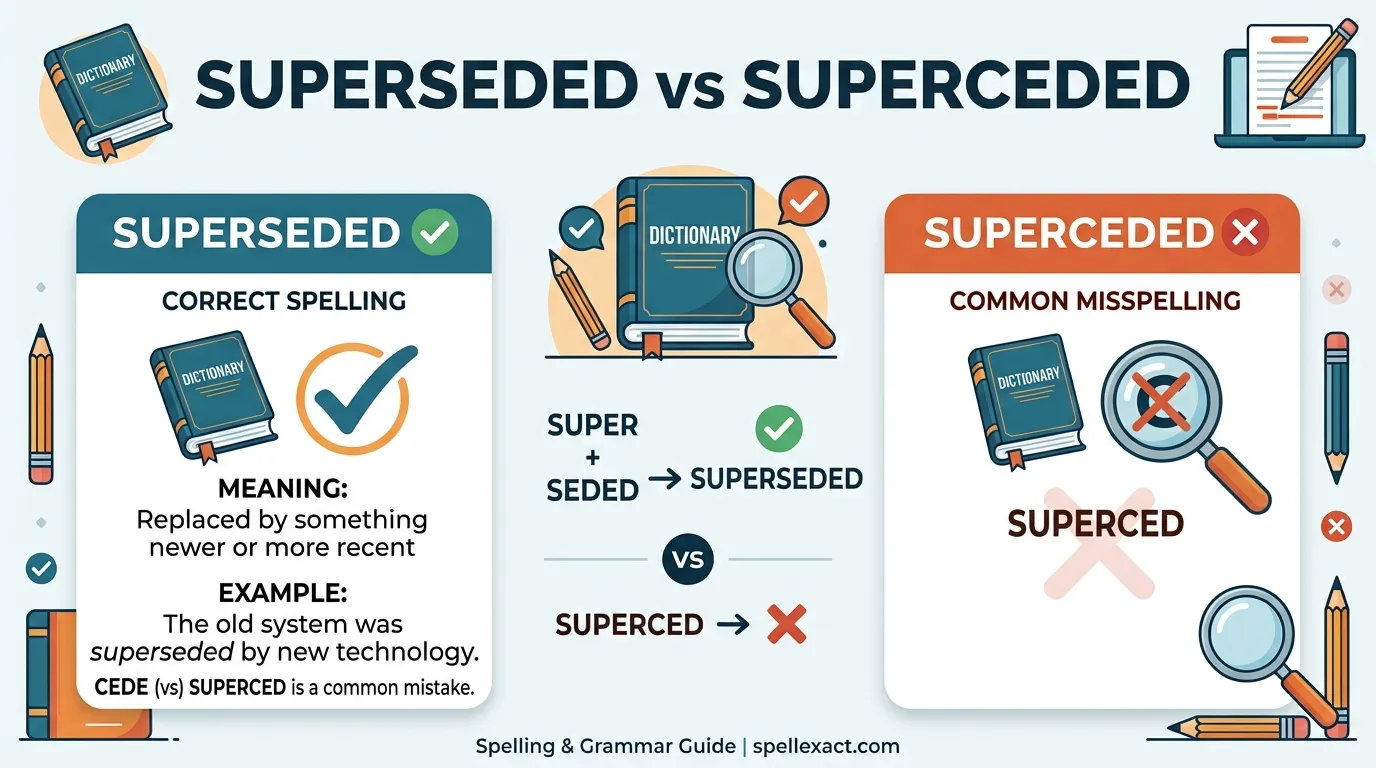
The good news is that the answer is straightforward: superseded is the correct spelling, while superceded is a common misspelling. Once you understand where the word comes from and how it is used, remembering the correct spelling becomes much easier.
Quick Answer:
Superseded is the correct spelling.
Superceded is incorrect and should generally be avoided in standard English.
- ✅ Superseded — correct
- ❌ Superceded — incorrect
- Supersede — correct base form
- Superseding — correct present participle
- Superseded — correct past tense and past participle
Example:
“The old policy was superseded by a new set of regulations.”
The confusion usually comes from the pronunciation and from the fact that many English words use -cede endings. However, the correct spelling of this particular word is supersede, with -sede, not supercede.
What Does Superseded Mean?
Superseded is the past tense and past participle of supersede. It means that something has been replaced by something newer, better, more current, or more effective.
In simple terms, when one thing supersedes another, it takes its place.
For example:
“The original software version was superseded by a newer release.”
This means the newer release replaced the original version.
The word can describe many things, including:
- Rules and regulations
- Policies
- Technology
- Documents
- Procedures
- Products
- Laws
- Agreements
- Methods
- Ideas
- Versions of software
Simple Meaning
You can think of superseded as meaning:
replaced, overtaken, made outdated, or rendered no longer current.
For example:
- “The old contract was superseded by a revised agreement.”
- “This model has been superseded by a newer version.”
- “The previous guidelines have been superseded.”
- “The updated procedure superseded the old process.”
What Does Superceded Mean?
Superceded is a common spelling mistake for superseded.
It is easy to see why people make this error. The incorrect form appears to follow a familiar spelling pattern, especially because English contains words such as precede, recede, and concede.
However, supercede is not the standard spelling of the verb.
Therefore:
- ❌ “The old policy was superceded.”
- ✅ “The old policy was superseded.”
If you are proofreading professional or academic writing, replace superceded with superseded.
Superseded vs Superceded: Side-by-Side Comparison
| Word | Correct? | Meaning | Example |
| Superseded | ✅ Yes | Replaced by something newer or more current | “The old version was superseded.” |
| Superceded | ❌ No | Common misspelling of superseded | Avoid this spelling. |
| Supersede | ✅ Yes | To replace or take the place of something | “The new rule will supersede the old rule.” |
| Superseding | ✅ Yes | Replacing something | “The superseding agreement was signed.” |
This distinction is especially useful when writing formal documents where spelling accuracy can affect credibility.
Why Is Superseded So Often Misspelled?
The spelling superceded is understandable because English has several verbs ending in -cede.
Consider words such as:
- Accede
- Concede
- Exceed
- Precede
- Recede
It is natural for writers to assume that supersede follows the same pattern.
But supersede is different. Its ending is -sede, not -cede.
The correct forms are:
supersede → superseded → superseding
A useful way to remember this is to focus on the base word first:
SUPERSEDE
Once you know that supersede is correct, the spelling superseded becomes much easier to reproduce.
How to Use Superseded in a Sentence
Understanding the meaning is only half the battle. Seeing the word in realistic sentences can make its usage clearer.
Example 1: Technology
“The company’s older smartphone model was superseded by a more advanced version.”
Here, the newer model replaced the older one.
Example 2: Business
“The previous pricing policy has been superseded by a new pricing structure.”
The new policy is now the current one.
Example 3: Government
“The regulation was superseded by updated legislation.”
The newer legislation replaced the earlier regulation.
Example 4: Documents
“Please disregard the previous document because it has been superseded by the attached version.”
This is a common use in professional communication.
Example 5: Procedures
“The old safety procedure was superseded after the company introduced new equipment.”
The newer procedure replaced the former one.
Example 6: Academic Writing
“This theory was later superseded by a more comprehensive explanation.”
Here, the newer explanation replaced the earlier theory as the preferred explanation.
Superseded vs Replaced: Are They the Same?
In many situations, superseded and replaced have very similar meanings, but there can be a slight difference in tone.
Replaced is a broad and everyday word. It simply means that one thing took the place of another.
Superseded is more formal and often suggests that the newer thing has become the accepted, current, or preferred alternative.
Compare:
- “The old computer was replaced by a new one.”
- “The old software standard was superseded by a newer standard.”
The second sentence sounds more formal and is particularly natural in technical, legal, administrative, and professional contexts.
Common Mistakes With Superseded
1. Writing Superceded
The most common mistake is adding c before the final -ed:
❌ Superceded
✅ Superseded
2. Misspelling the Base Form
The mistake can begin with the base verb:
❌ Supercede
✅ Supersede
If the base form is wrong, the other forms will usually be wrong as well.
3. Confusing It With Precede
Because precede is spelled with -cede, some writers assume supercede must also be correct.
But these are separate words:
- Precede = come before
- Supersede = replace or take the place of
4. Using Superseded When You Mean Preceded
These words have completely different meanings.
Preceded: came before something.
“The introduction was preceded by a short announcement.”
Superseded: was replaced by something else.
“The original agreement was superseded by a revised contract.”
Knowing this difference is particularly important in formal writing.
American vs British English: Is There a Difference?
There is no meaningful American-versus-British spelling difference for this word.
Both American English and British English use:
supersede
superseded
superseding
The misspelling superceded is not the standard British alternative or an accepted American alternative. It is simply a common error.
So whether you are writing for an American audience, a British audience, or an international audience, superseded is the spelling to use.
Supersede, Superseded, and Superseding
Understanding the different grammatical forms can prevent additional mistakes.
Supersede
This is the base form.
“The new policy will supersede the existing policy.”
Superseded
This is the past tense and past participle.
“The existing policy was superseded last year.”
Superseding
This is the present participle or gerund form.
“The company issued a superseding agreement.”
A simple pattern to remember is:
supersede → superseded → superseding
Notice that the base spelling retains sede.
A Simple Memory Trick
If you repeatedly confuse superseded and superceded, remember:
SUPER + SEDE = SUPERSEDE
The word contains SEDE, not CEDE.
Then add the appropriate ending:
SUPERSEDE → SUPERSEDED
Another useful association is:
Supersede = substitute
Both begin with the idea of something taking the place of something else.
This is not a linguistic rule, but it can serve as a practical spelling reminder when you are writing quickly.
When Should You Use Superseded?
Use superseded when something has been replaced or made obsolete by a newer or more current version.
It is particularly appropriate in formal contexts such as:
- Legal documents
- Business reports
- Technical manuals
- Government regulations
- Academic papers
- Software documentation
- Policies and procedures
- Contracts
- Product specifications
For casual writing, replaced may sound more natural.
For example:
Casual:
“My old phone was replaced by a new one.”
Formal:
“The previous device model was superseded by a newer model.”
Both can be correct, but the context determines which word sounds best.
Frequently Asked Questions
Is superseded the correct spelling?
Yes. Superseded is the standard and correct spelling. Superceded is a common misspelling.
Is superceded ever correct?
In standard modern English, superceded should not be used as the spelling of the past tense of supersede. Use superseded instead.
What is the correct spelling: supersede or supercede?
The correct base verb is supersede. It means to replace or take the place of something.
What does superseded mean?
Superseded means replaced by something newer, more current, or more suitable.
Is superseded British or American English?
Superseded is used in both British and American English. There is no standard regional spelling difference.
What is the difference between superseded and preceded?
Superseded means replaced, while preceded means came before.
For example, “The old rule was superseded” means the old rule was replaced. “The old rule preceded the new rule” means the old rule came earlier.
What is the opposite of superseded?
Depending on the context, possible opposites include current, active, retained, or maintained. The exact opposite depends on what is being described.
How can I remember the spelling of superseded?
Remember the base word supersede. It contains sede, not cede. Then form the past tense as superseded.
Final Summary
When choosing between superseded vs superceded, there is a clear winner: superseded is correct. The word comes from the verb supersede, meaning to replace, take the place of, or make something no longer current. Superceded is a common spelling error, often caused by confusion with words such as precede and recede.
If you are writing an email, business report, academic assignment, technical document, or formal policy, use superseded. There is no separate American or British spelling to remember, so the same form works for both varieties of English.
Actionable Takeaway
When you see superceded, correct it to superseded.
Remember:
✅ Superseded = correct
❌ Superceded = misspelling
✅ Supersede = correct base form
The easiest spelling trick is: SUPER + SEDE → SUPERSEDE → SUPERSEDED.

Aaron Adam is the Administrator of SpellExact, dedicated to helping readers improve their spelling and writing accuracy. He oversees content quality, ensures reliable language resources, and works to make spelling guidance simple, practical, and accessible for everyone.