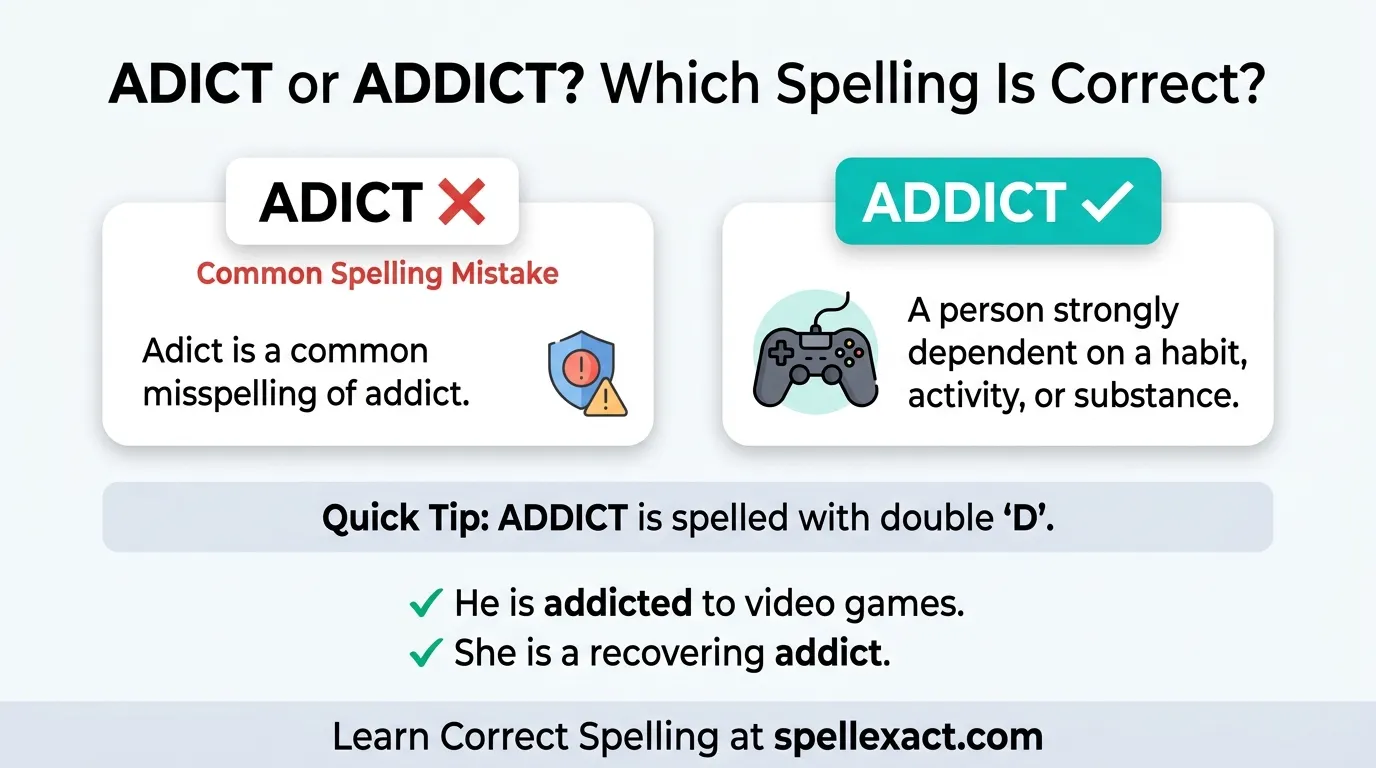
If you’ve ever typed “adict” and wondered whether it looks right, you’re not alone. This is a common spelling mistake because the word addict contains a double d, which can be easy to overlook when writing quickly.
The correct spelling is addict, not adict. Whether you’re writing about someone who is strongly dependent on a substance or someone who simply loves an activity, knowing the correct spelling helps your writing look polished and professional. Let’s explore the meaning, pronunciation, examples, and the easiest way to remember it.
Quick Answer:
Addict is the correct spelling.
❌ Adict — Incorrect spelling
✅ Addict — Correct spelling
The word addict has two d’s: a-d-d-i-c-t.
For example:
- She is addicted to coffee.
- He is a video game addict.
- Some people become addicted to certain substances.
- I’m a huge book addict.
Adict is simply a misspelling of addict and should be avoided in standard English.
What Does Addict Mean?
The word addict can be used as both a noun and, less commonly in modern English, a verb.
As a noun, an addict is a person who has an addiction or who is strongly dependent on something. The word is often associated with substance addiction, but it can also be used informally for someone who has a strong enthusiasm for an activity or thing.
For example:
He is a coffee addict.
Here, coffee addict means someone who is extremely fond of or dependent on coffee.
The word can also refer to more serious forms of addiction:
The treatment center helps people struggling with addiction.
In modern, respectful usage, it is often better to describe a person as “a person with an addiction” or “someone experiencing addiction” when discussing substance-use disorders. The term “addict” can sometimes sound labeling or stigmatizing depending on the context.
Addict Meaning in Simple English
In simple terms, addict means:
A person who is unable to easily stop using or doing something because they have developed a strong dependence or habit.
The meaning depends on context.
Examples of serious addiction
- a drug addict
- a gambling addict
- a person addicted to alcohol
- someone with a nicotine addiction
Examples of informal usage
- a fitness addict
- a movie addict
- a social media addict
- a coffee addict
- a book addict
In informal expressions, addict often means someone who really enjoys something rather than someone with a clinical addiction.
Why Is “Adict” Incorrect?
The spelling adict is incorrect because the standard English word is spelled with a double d:
A + D + D + I + C + T = ADDICT
One reason people misspell it is that the pronunciation does not make the double d especially obvious. When spoken quickly, the two consonants can sound like one.
This is similar to other English words where doubled letters are easy to forget.
A useful habit is to remember the word visually:
AD + DICT = ADDICT
Once you recognize the double d, the correct spelling becomes much easier to remember.
Addict vs. Adict: Comparison Table
| Feature | Adict | Addict |
| Correct spelling | ❌ No | ✅ Yes |
| Standard English | No | Yes |
| Number of “d” letters | 1 | 2 |
| Meaning | No standard meaning | A person with an addiction or strong dependence |
| Example | “He is an adict.” | “He is an addict.” |
| Recommended usage | Avoid | Use |
The key difference is simple: addict has two d’s.
Examples of Addict in Sentences
Seeing the word in context is one of the best ways to remember its spelling.
Addict as a noun
- He is a coffee addict who drinks several cups every morning.
- She has always been a book addict.
- The organization provides support for people affected by addiction.
- My brother is a fitness addict and rarely misses a workout.
- He was once a heavy smoker but has now quit.
Addict in informal expressions
- I’m a chocolate addict.
- She’s a travel addict who loves exploring new countries.
- He’s a movie addict and watches films every weekend.
- My friend is a photography addict.
- She calls herself a podcast addict.
These examples demonstrate that addict can appear in both serious and casual contexts.
Addict as a Verb
Addict can also function as a verb, although this use is less common in everyday modern English.
For example:
The substance can addict people quickly.
More commonly, English speakers use become addicted, get addicted, or develop an addiction.
Examples:
- He became addicted to gambling.
- She developed an addiction to nicotine.
- Some people can become addicted to certain medications.
- He was addicted to video games as a teenager.
The adjective addicted is particularly common:
She is addicted to social media.
Notice that addicted is spelled with the same double d:
A-D-D-I-C-T-E-D
Addict vs. Addicted
These words are related but they are not interchangeable.
Addict is generally a noun referring to a person, while addicted is an adjective describing a state of dependence.
Compare:
- He is an addict. — noun
- He is addicted to nicotine. — adjective
- She is a coffee addict. — noun
- She is addicted to coffee. — adjective
In sensitive contexts, however, “person with an addiction” may be preferable to labeling someone an “addict.”
Common Mistakes With Addict
The most common mistake is dropping one of the two d’s.
Mistake 1: Writing “adict”
❌ He is an adict.
This spelling is incorrect.
✅ He is an addict.
Mistake 2: Confusing addict and addicted
❌ He is addict to coffee.
The adjective requires -ed.
✅ He is addicted to coffee.
Mistake 3: Forgetting the double d in related words
The same spelling pattern appears in:
- addict
- addicted
- addiction
- addictive
Remembering the root addict can help you spell these related words correctly.
Is Addict the Same in American and British English?
Yes. Addict is spelled the same in both American English and British English.
There is no American-versus-British spelling difference such as color/colour or center/centre.
| English variety | Spelling |
| American English | addict |
| British English | addict |
| Canadian English | addict |
| Australian English | addict |
The spelling adict is not the standard spelling in either American or British English.
What can vary is the preferred wording around addiction, especially in professional, medical, or public-health contexts. More person-first language such as “person with an addiction” is often preferred because it focuses on the individual rather than defining them by a condition.
How to Remember the Correct Spelling
Here is an easy memory trick:
Remember: “Add” + “ict”
Think of the first part as add.
ADD + ICT = ADDICT
The word add already contains two d’s, so when you remember add + ict, you are less likely to write adict.
Another simple trick is:
Add another D to “adict” → ADDICT
If you’re unsure while writing, check whether your word contains two d’s.
A-D-D-I-C-T
Synonyms and Related Words
Depending on the context, several related terms can be used instead of addict.
For addiction or dependence
- person with an addiction
- dependent person
- person experiencing addiction
- substance-dependent person
- someone struggling with addiction
For informal enthusiasm
- enthusiast
- fan
- devotee
- aficionado
- passionate follower
For example, instead of:
She is a travel addict.
You could say:
She is a passionate traveler.
The best choice depends on whether you mean genuine addiction, strong dependence, or simply enthusiasm.
When Should You Use “Addict”?
Use addict when it accurately communicates the intended meaning and fits the context.
For casual writing, phrases such as “coffee addict” or “book addict” are commonly understood as humorous or informal descriptions of strong enthusiasm.
For serious discussions involving substance use or behavioral addiction, choose your wording thoughtfully. “A person with an addiction” is often more respectful and precise than defining someone solely as an “addict.”
Good writing is not just about spelling a word correctly; it is also about choosing language that communicates your meaning clearly and respectfully.
FAQs
1. Is it “adict” or “addict”?
Addict is the correct spelling. Adict is a misspelling. Always use two d’s: a-d-d-i-c-t.
2. What does addict mean?
An addict traditionally refers to a person who has an addiction or strong dependence on something. Informally, it can also describe someone who is extremely enthusiastic about an activity or thing.
3. Is “adict” a word?
No. Adict is not the standard English spelling of the word. The correct form is addict.
4. How do you spell addict?
The correct spelling is:
A-D-D-I-C-T
A useful memory trick is ADD + ICT = ADDICT.
5. Is addict the same in British and American English?
Yes. Addict is spelled exactly the same in both British and American English.
6. What is the difference between addict and addicted?
Addict is generally a noun referring to a person, while addicted is an adjective describing a person’s state of dependence.
Example:
- He is an addict.
- He is addicted to gambling.
7. What is the plural of addict?
The plural is addicts.
Example:
The program provides support for people affected by addiction.
8. How can I remember the spelling of addict?
Think of ADD + ICT. The word starts with add, which has two d’s. Therefore, addict also has two d’s.
Final Summary
If you are deciding between adict or addict, the answer is straightforward: addict is the correct spelling. Adict is a common spelling error caused by leaving out one of the two d’s. The correct spelling is A-D-D-I-C-T, and the same spelling is used in both American and British English.
The word addict can refer to someone experiencing an addiction, while informal expressions such as “coffee addict” or “book addict” can describe strong enthusiasm.
When discussing serious addiction, consider person-first language such as “a person with an addiction” for a more respectful and precise approach. If you remember ADD + ICT, you’ll have a simple way to avoid this spelling mistake in the future.
Actionable Takeaway
Whenever you wonder “adict or addict?”, remember:
❌ Adict
✅ Addict
Just add another D and you’ll have the correct spelling: ADDICT.

Caleb Carter is a passionate language enthusiast and content writer specializing in spelling mistakes, grammar, and vocabulary. He creates clear, practical guides that help readers improve their writing skills and communicate confidently every day.