If you’re wondering whether transferring or transfering is the correct spelling, the answer is straightforward: transferring is the only correct spelling in standard English. Transfering is a common misspelling that appears because many writers forget the English consonant-doubling rule.
This guide explains why “transferring” is correct, when to use it, how to remember the spelling, and the grammar rule behind it. You’ll also find pronunciation tips, real-life examples, common mistakes, comparison tables, and practical writing advice to help you avoid this error with confidence.
Quick Answer
✅ Correct: Transferring
❌ Incorrect: Transfering
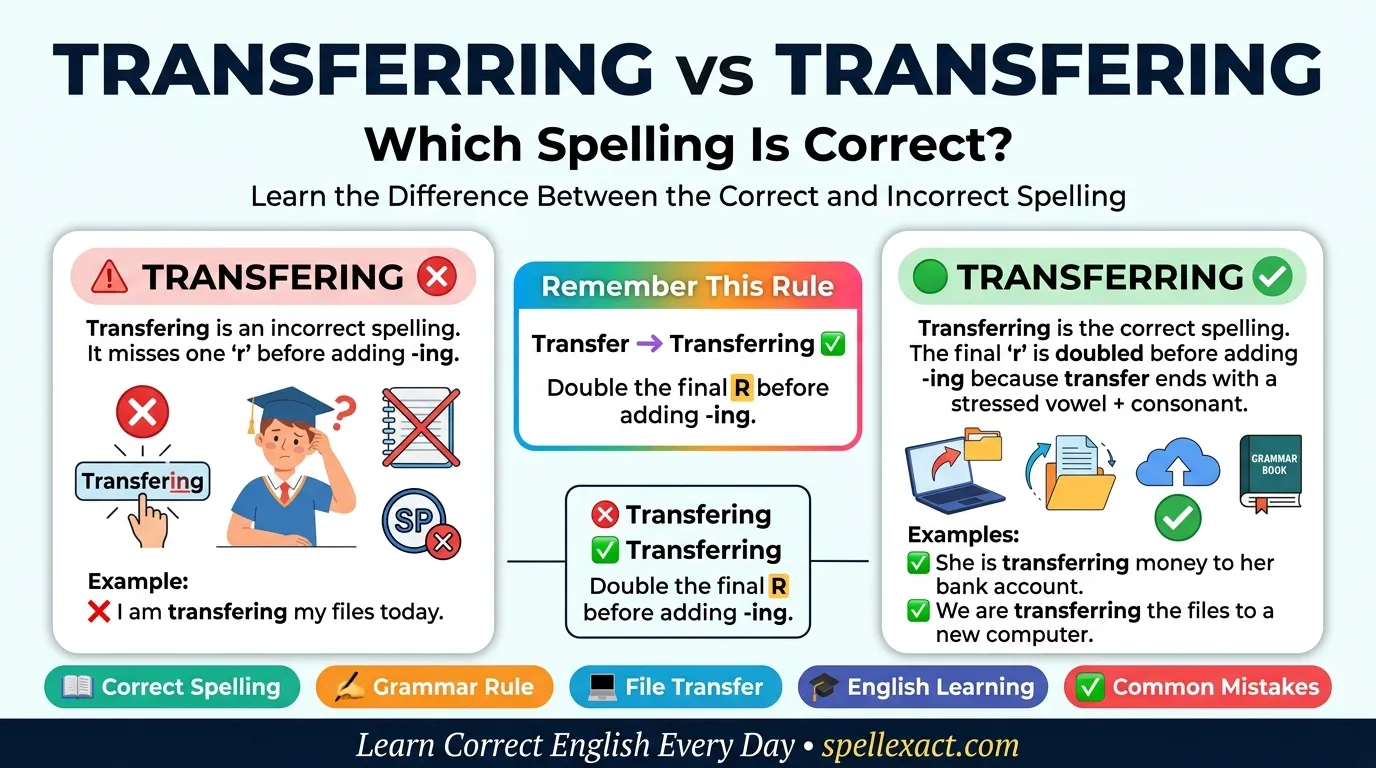
The word transferring is the correct present participle of the verb transfer. It requires a double “r” because transfer ends with a stressed syllable followed by a single vowel and a single consonant. According to standard English spelling rules, the final consonant must be doubled before adding -ing.
Example
- ✅ I am transferring my files to a new laptop.
- ❌ I am transfering my files to a new laptop.
Key takeaway: Whenever you add -ing to transfer, always write transferring with two “r”s.
At a Glance
| Question | Answer |
| Correct spelling | Transferring ✅ |
| InCorrect spelling | Transfering ❌ |
| Part of speech | Present participle / Gerund |
| Grammar rule | Double the final r before adding -ing |
| American English | Transferring |
| British English | Transferring |
What Does “Transferring” Mean?
The word transferring is the present participle (or gerund) of the verb transfer.
It means moving, sending, changing, shifting, or passing something from one place, person, account, device, or organization to another.
Depending on the context, transferring can refer to:
- Moving money between bank accounts
- Sending files from one device to another
- Changing schools or universities
- Moving employees to another office
- Transferring ownership of property
- Switching phone calls
- Moving data between systems
- Assigning responsibilities to another person
In everyday English, it simply describes the action of moving something from one location or owner to another.
How to Pronounce “Transferring”
Correct pronunciation can also help you remember the spelling.
American English (IPA):
/trænsˈfɝːrɪŋ/
British English (IPA):
/trænsˈfɜːrɪŋ/
Easy pronunciation:
trans-FER-ring
Notice that the stress falls on FER, which is one reason the final r is doubled in writing.
Why Is “Transfering” Incorrect?
Many people assume they can simply add -ing to the verb transfer.
That would produce:
Transfer + ing = Transfering ❌
However, English spelling doesn’t work that way in this case.
The correct spelling is:
Transfer + ing = Transferring ✅
The extra r isn’t optional—it’s required by a standard English spelling rule.
Because of this, transfering is considered a spelling mistake in professional, academic, and everyday writing.
Why Do People Misspell It?
One reason this mistake is so common is that many English words simply add -ing without changing the base word.
For example:
- Open → Opening
- Visit → Visiting
- Listen → Listening
Writers naturally expect transfer to follow the same pattern.
Instead, transfer follows the double-consonant rule, just like refer, prefer, and occur.
Fast typing, autocorrect errors, and unfamiliarity with English spelling rules also contribute to the widespread use of transfering, even though it is incorrect.
The Grammar Rule Explained
The spelling rule is easier than it looks.
When a verb:
- Ends with one vowel followed by one consonant
- Has the final syllable stressed
…the final consonant is doubled before adding -ing or -ed.
Let’s apply the rule.
Base verb:
Transfer
The stress falls on:
trans-FER
Since the final syllable is stressed and ends with a single r, English requires doubling the r.
Result:
Transfer → Transferring
The same rule creates:
- Refer → Referring
- Prefer → Preferring
- Occur → Occurring
- Commit → Committing
- Admit → Admitting
Understanding this one rule will help you spell dozens of similar words correctly.
Dictionary Confirmation
Major English dictionaries consistently recognize transferring as the correct spelling and list transfering as a misspelling or non-standard form.
Trusted references include:
- Oxford Learner’s Dictionaries
- Cambridge Dictionary
- Merriam-Webster Dictionary
- Collins English Dictionary
When writing for school, work, exams, or professional communication, always use transferring.
Transferring vs Transfering: Side-by-Side Comparison
| Feature | Transferring | Transfering |
| Correct spelling | ✅ Yes | ❌ No |
| Found in major dictionaries | ✅ Yes | ❌ No |
| Accepted in academic writing | ✅ Yes | ❌ No |
| Used in business writing | ✅ Yes | ❌ No |
| Grammar correct | ✅ Yes | ❌ No |
| Recommended for SEO writing | ✅ Yes | ❌ No |
| Professional communication | ✅ Yes | ❌ No |
| Standard English | ✅ Yes | ❌ No |
The comparison is simple:
Always choose “transferring.”
Real-Life Examples of “Transferring”
Banking
- I’m transferring money into my savings account.
- The bank is transferring the payment today.
Technology
- The software is transferring files to the cloud.
- We are transferring photos from the phone to the computer.
Education
- She is transferring to another university next semester.
- Hundreds of students are transferring every year.
Business
- The company is transferring employees to a new office.
- Our manager is transferring the project to another team.
Healthcare
- Doctors are transferring the patient to a larger hospital.
- The nurse is transferring medical records securely.
Everyday Life
- Dad is transferring the car ownership.
- She’s transferring her gym membership.
Common Mistakes to Avoid
Even experienced writers occasionally make this mistake. Here are the most common errors.
Mistake 1: Writing “Transfering”
❌ I am transfering the documents.
✅ I am transferring the documents.
Mistake 2: Forgetting the Double “R”
Many writers know the word but forget to double the final consonant.
Remember:
Transfer → Transferring
Not:
Transfer → Transfering
Mistake 3: Copying Incorrect Spellings Online
Some blogs, forums, or social media posts contain spelling errors. Always verify uncertain words using trusted dictionaries or grammar references rather than relying on random online examples.
Mistake 4: Assuming All Verbs Behave the Same
Words like opening, visiting, and listening simply add -ing, but transfer follows a different rule because its final syllable is stressed.
An Easy Memory Trick
Here’s a simple way to remember the correct spelling.
Think about these familiar words:
- Refer → Referring
- Prefer → Preferring
- Occur → Occurring
Now add:
- Transfer → Transferring
If you remember one, you’ll remember them all.
Memory Tip: If the stress falls on the last syllable and the verb ends with one vowel followed by one consonant, double the final consonant before adding -ing.
American vs British English
Unlike some English words that have different spellings in American and British English, transferring is spelled exactly the same everywhere.
| English Variant | Correct Spelling |
| American English | Transferring |
| British English | Transferring |
| Canadian English | Transferring |
| Australian English | Transferring |
Whether you’re writing for a U.S., U.K., Canadian, or Australian audience, transferring is always the correct choice.
Similar Words That Follow the Same Rule
Once you understand why transferring has two r’s, you’ll recognize the same pattern in many other English words.
| Base Verb | Correct Form | Incorrect Form |
| Transfer | Transferring | Transfering |
| Refer | Referring | Refering |
| Prefer | Preferring | Prefering |
| Occur | Occurring | Occuring |
| Commit | Committing | Commiting |
| Admit | Admitting | Admiting |
| Begin | Beginning | Begining |
| Forget | Forgetting | Forgeting |
Learning these examples together makes the spelling rule much easier to remember.
When Should You Use “Transferring”?
The word transferring appears in many real-life situations. Understanding these contexts helps you use it naturally and correctly.
Transferring Money
Banks and financial apps often use transferring when funds move between accounts.
Examples
- I’m transferring $250 to my savings account.
- The payment is transferring successfully.
- She finished transferring the funds online.
Transferring Files
In technology, transferring describes moving digital files between devices or cloud storage.
Examples
- The computer is transferring photos to an external drive.
- We’re transferring important documents to the cloud.
Transferring Schools
Students frequently use this word when changing educational institutions.
Examples
- He’s transferring to another college next semester.
- Several students are transferring this year.
Transferring Ownership
Legal and business documents often mention transferring ownership.
Examples
- They are transferring ownership of the property.
- The lawyer is transferring the business assets.
Transferring Employees
Businesses use the word when staff move between departments or offices.
Examples
- The company is transferring several employees overseas.
- Our manager is transferring the project to another department.
Transferring Calls
Customer service teams commonly use the word while redirecting phone calls.
Examples
- I’m transferring your call now.
- Please wait while I finish transferring you to technical support.
Why Correct Spelling Matters
A single spelling mistake may seem minor, but it can affect how readers perceive your writing.
Using the correct spelling helps you:
- Build trust with readers.
- Improve academic assignments.
- Write more professional emails.
- Strengthen resumes and job applications.
- Create polished business documents.
- Improve website credibility.
- Increase user confidence in your content.
If you’re a blogger, content writer, student, or professional, consistently using transferring instead of transfering demonstrates attention to detail and strong language skills.
Did You Know?
Many of the English language’s most commonly misspelled words follow the same consonant-doubling rule.
Examples include:
- Occurring
- Referring
- Preferring
- Committing
- Beginning
Learning the rule behind these words is more effective than memorizing each one individually.
People Also Ask
Why is transferring spelled with two “r”s?
Because transfer ends with a stressed syllable containing a single vowel followed by a single consonant. Standard English spelling rules require doubling the final consonant before adding -ing.
Is transfering a real English word?
No. Transfering is a common misspelling and is not accepted in standard English dictionaries or formal writing.
How do you spell transferring correctly?
The correct spelling is:
Transfer + ring = Transferring
Always remember the double r.
Is transferring correct in British English?
Yes. Both British and American English use transferring with two r’s.
Is transferred also spelled with two “r”s?
Yes. The correct past tense and past participle are transferred, not transfered.
FAQs
1. Which spelling is correct: transferring or transfering?
Transferring is correct. Transfering is an incorrect spelling because it doesn’t follow the English consonant-doubling rule.
2. Why do I keep writing “transfering”?
Many people instinctively add -ing to the base word. However, transfer requires doubling the final r before adding -ing, making transferring the correct form.
3. Is transferring used in both American and British English?
Yes. There is no spelling difference between American and British English. Both use transferring.
4. What part of speech is “transferring”?
It functions as the present participle of the verb transfer and can also act as a gerund depending on the sentence.
5. What is the past tense of transfer?
The correct past tense is transferred, with a double r.
6. Why do some verbs double the final consonant?
English spelling rules require doubling the final consonant when a verb ends in a stressed syllable with a single vowel followed by a single consonant before adding -ing or -ed.
7. Can using “transfering” affect professional writing?
Yes. Incorrect spelling can make emails, reports, resumes, and academic papers appear less polished. Using transferring helps maintain professionalism.
8. How can I remember the correct spelling easily?
Think of this pattern:
- Refer → Referring
- Prefer → Preferring
- Occur → Occurring
- Transfer → Transferring
The same spelling rule applies to all of them.
Key Takeaways
Before you go, remember these essential points:
- ✅ Transferring is the correct spelling.
- ❌ Transfering is always incorrect.
- Double the final r before adding -ing.
- The rule is the same in American and British English.
- The same pattern applies to referring, preferring, and occurring.
- Major dictionaries recognize only transferring as the standard spelling.
- Understanding the rule is better than memorizing individual words.
Final Thoughts
If you’ve ever been unsure about transferring vs transfering, you’re not alone. Many writers make this mistake because the consonant-doubling rule isn’t always obvious. The good news is that once you understand the pattern, the correct spelling becomes easy to remember. Transferring is the only accepted spelling in standard English and should be used in academic writing, business communication, professional documents, and everyday conversations.
Rather than memorizing a single word, focus on the grammar rule behind it. The same principle explains why we write referring, preferring, occurring, committing, and transferred with double consonants. Understanding this pattern will improve your spelling accuracy, strengthen your writing, and help you avoid similar mistakes in the future.
Actionable Takeaway
The next time you’re about to write transfering, pause for a moment and apply this simple rule:
Transfer → Transferring ✅
Ask yourself, “Does this verb end with a stressed syllable followed by a single vowel and a single consonant?” If the answer is yes, double the final consonant before adding -ing. This one habit will help you spell not only transferring correctly but also many other commonly confused English words with confidence.

Aaron Adam is the Administrator of SpellExact, dedicated to helping readers improve their spelling and writing accuracy. He oversees content quality, ensures reliable language resources, and works to make spelling guidance simple, practical, and accessible for everyone.