Have you ever typed storys only to see a red underline from your spell checker? If so, you’re not alone. Thousands of students, writers, bloggers, and English learners search for “storys or stories“ because they’re unsure which spelling is correct. Although the difference seems small, using the right plural form can make your writing look more professional and grammatically accurate.
The good news is that the rule is simple once you understand it. In this complete guide, you’ll learn whether storys or stories is correct, why English uses this spelling, common mistakes to avoid, real-life examples, and an easy trick to remember the rule forever. Whether you’re writing for school, work, social media, or your website, this guide will help you use the correct spelling with confidence.
Quick Answer
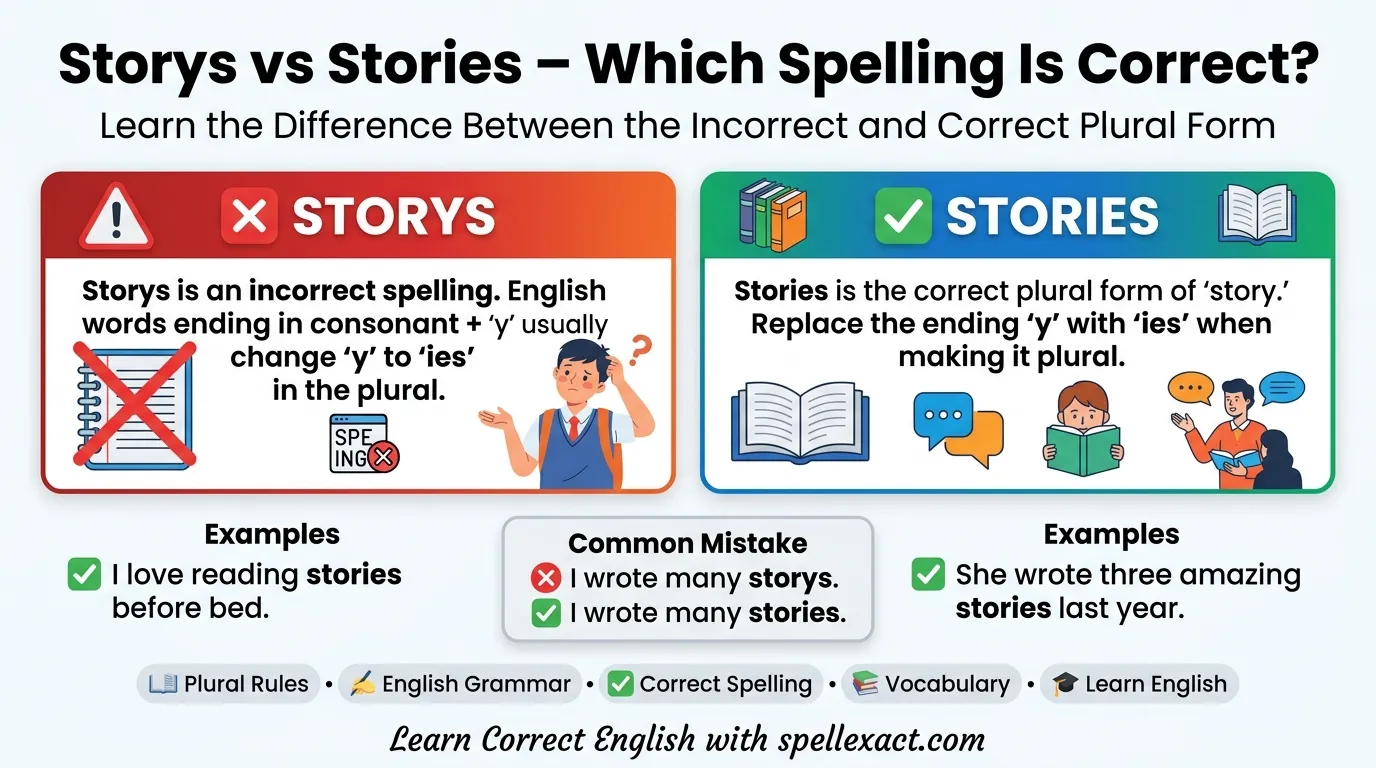
Stories is the correct spelling.
- ✅ Stories = Correct plural of story
- ❌ Storys = Incorrect spelling
The word story ends with a consonant (r) followed by y. According to standard English grammar, nouns ending in a consonant + y change y to ies when they become plural.
Example:
- ✅ I enjoy reading adventure stories.
- ❌ I enjoy reading adventure storys.
Featured Snippet Answer: The correct plural of story is stories. The spelling storys is incorrect because nouns ending in a consonant followed by y change y to ies in the plural form.
Storys or Stories: Which One Is Correct?
The correct spelling is stories.
The word storys is not accepted in standard English and should not be used in academic writing, professional communication, books, blogs, or everyday writing.
Many people accidentally write storys because most English nouns simply add -s to become plural.
For example:
- Book → Books
- Car → Cars
- Chair → Chairs
Since this pattern is so common, it’s easy to assume:
Story → Storys
However, story follows a different grammar rule because it ends with a consonant followed by the letter y.
Whenever you’re referring to more than one story, the only correct spelling is stories.
What Does “Story” Mean?
Before learning the spelling rule, it’s helpful to understand what the word means.
A story is:
- A written or spoken narrative
- A fictional tale
- A true account of events
- A news report
- A description of personal experiences
- A level or floor of a building (mainly in American English)
When talking about more than one, the plural becomes stories.
Examples
- My grandmother told wonderful stories.
- The magazine published inspiring stories.
- Children enjoy bedtime stories.
- The newspaper covered several local stories.
- She has written hundreds of short stories.
In every example above, stories is the correct plural.
Why Do People Write “Storys”?
This is one of the most common spelling mistakes among English learners.
People usually write storys because they apply the most common plural rule in English.
Most nouns simply add -s.
Examples:
- Dog → Dogs
- Cat → Cats
- Tree → Trees
- Phone → Phones
Because of this pattern, many people naturally assume:
Story → Storys
Unfortunately, English has several spelling rules, and words ending in a consonant + y follow a different one.
This mistake is especially common among:
- English learners (ESL students)
- School students
- Beginner writers
- Bloggers
- Social media users
- Anyone typing quickly without checking spelling
Understanding the rule once will help you avoid this mistake forever.
Why Is “Stories” Correct?
English grammar has a clear rule for nouns ending in y.
If a noun ends with:
Consonant + Y
You remove the y and add ies.
Story
↓
Remove y
↓
Add ies
↓
Stories
That’s why stories is correct and storys is incorrect.
The Grammar Rule Explained
There are two important plural rules involving words ending in y.
Rule 1: Consonant + Y → IES
When a noun ends with a consonant before y, replace y with ies.
Examples:
| Singular | Plural |
| Story | Stories |
| Baby | Babies |
| Country | Countries |
| Lady | Ladies |
| Family | Families |
| Library | Libraries |
| City | Cities |
| Cherry | Cherries |
Since story ends with r + y, this rule applies.
Rule 2: Vowel + Y → Add S
If a word ends with a vowel before y, simply add s.
Examples:
| Singular | Plural |
| Boy | Boys |
| Toy | Toys |
| Day | Days |
| Key | Keys |
| Journey | Journeys |
| Monkey | Monkeys |
| Donkey | Donkeys |
Notice the difference.
- Story → Stories ✅
- Boy → Boys ✅
The letter before y determines which rule you use.
Storys vs Stories Comparison Table
| Feature | Storys | Stories |
| Correct spelling | ❌ No | ✅ Yes |
| Accepted in dictionaries | ❌ No | ✅ Yes |
| Standard English | ❌ No | ✅ Yes |
| Academic writing | ❌ Incorrect | ✅ Correct |
| Professional writing | ❌ Incorrect | ✅ Correct |
| Exams and assignments | ❌ Incorrect | ✅ Correct |
| Everyday communication | ❌ Avoid | ✅ Always use |
The answer is always stories.
What Do Dictionaries Say?
Major English dictionaries recognize stories as the correct plural form of story.
The spelling storys does not appear as an accepted English word because it does not follow standard plural formation rules.
This means you should always use stories in:
- School assignments
- College essays
- Business documents
- Professional emails
- Books
- Articles
- Blog posts
- Social media captions
Following dictionary-approved spellings improves clarity and credibility.
Real-Life Examples of “Stories”
Learning through context makes grammar easier to remember.
School
The teacher asked every student to write two original stories about friendship.
Books
She enjoys reading historical stories before going to bed.
Family
My grandfather shared fascinating stories about his childhood.
News
The newspaper published several breaking stories this morning.
Business
Customer success stories help companies build trust with new clients.
Blogging
Adding personal stories makes blog posts more engaging and relatable.
Social Media
Many people share everyday stories through social media platforms to connect with friends and followers.
Story as a Building Floor
The word story has another meaning besides a narrative.
In American English, a story can also mean a level of a building.
Examples:
- The office is on the fourth story.
- The hotel has twenty stories.
- They rented an apartment on the second story.
Even in this meaning, the plural is still stories.
In British English, however, the word storey is commonly used for a building level, while story refers to a tale or narrative.
American vs British English
Many spelling questions have different answers depending on whether you’re using American or British English.
Fortunately, story is not one of them.
For narratives and written tales:
- 🇺🇸 American English: story → stories
- 🇬🇧 British English: story → stories
There is no spelling difference.
The only variation relates to buildings.
| Meaning | American English | British English |
| Narrative | Story | Story |
| Plural narrative | Stories | Stories |
| Building level | Story | Storey |
This distinction often confuses learners, but it doesn’t affect the plural form of story when referring to tales or narratives.
Remember This Rule
A quick memory trick can save you from making this mistake.
If a word ends with a consonant + y, replace y with ies.
Think of it like this:
Consonant + Y = Goodbye Y, Hello IES
Examples:
- Story → Stories
- Family → Families
- Country → Countries
- Library → Libraries
- Baby → Babies
Once you remember this pattern, you’ll automatically spell many English plural nouns correctly.
Common Mistakes to Avoid
Even though the rule is straightforward, many writers still make mistakes when using the plural form of story. Most errors happen because people automatically add -s to every noun without considering the spelling rule.
Here are some common mistakes and their corrections:
| ❌ Incorrect | ✅ Correct |
| Storys | Stories |
| Two storys | Two stories |
| Adventure storys | Adventure stories |
| Funny storys | Funny stories |
| Children’s storys | Children’s stories |
Whenever you’re writing about more than one story, always choose stories.
Similar Words That Follow the Same Rule
The plural rule used for story applies to many other English nouns ending in a consonant followed by y. Learning these words together makes the rule much easier to remember.
| Singular | Correct Plural |
| Story | Stories |
| Baby | Babies |
| Family | Families |
| Country | Countries |
| Library | Libraries |
| Lady | Ladies |
| City | Cities |
| Cherry | Cherries |
| Party | Parties |
| Puppy | Puppies |
If you know how to spell stories, you’ll also be able to spell these words correctly.
Words That Do Not Follow This Rule
Not every word ending in y changes to ies.
When the y comes after a vowel, simply add -s.
| Singular | Plural |
| Boy | Boys |
| Toy | Toys |
| Day | Days |
| Key | Keys |
| Journey | Journeys |
| Monkey | Monkeys |
| Donkey | Donkeys |
This is one of the easiest ways to remember which rule to use:
- Consonant + y → ies
- Vowel + y → s
Practice Sentences
Try reading these examples to reinforce the rule.
- My teacher recommended three interesting stories to read over the weekend.
- The author published several short stories this year.
- Children often enjoy imaginative bedtime stories.
- We shared funny travel stories during dinner.
- The website features inspiring customer success stories.
- Local newspapers covered the biggest stories of the week.
- Her mystery stories have become bestsellers.
- These historical stories help us understand the past.
Notice that stories sounds natural in every sentence, while storys would be incorrect.
Why Correct Spelling Matters
Correct spelling is more than following grammar rules. It also helps readers understand your message and builds trust in your writing.
Using the correct spelling:
- Makes your writing look professional.
- Improves academic performance.
- Creates a better impression in emails and job applications.
- Helps blog posts appear more credible.
- Supports better readability.
- Reduces confusion for readers.
For website owners and content creators, correct spelling also contributes to a better user experience, which is an important part of creating high-quality content.
Is “Storys” Ever Correct?
No. In modern English, storys is not considered a correct spelling.
Whether you’re writing:
- A school essay
- A business email
- A research paper
- A novel
- A blog post
- A social media caption
…the correct plural is always stories.
If your spelling checker marks storys as incorrect, it’s doing exactly what it should.
Tips to Remember the Correct Spelling
Here are a few simple ways to avoid this mistake in the future.
- Remember the rule: Consonant + y = ies.
- Read books and articles written in standard English.
- Pay attention to spell-check suggestions instead of ignoring them.
- Practice with similar words like families, countries, and babies.
- Say the word aloud. “Stories” sounds natural, while “storys” usually sounds awkward.
With a little practice, the correct spelling will become automatic.
Related Searches You May Find Helpful
If you’re learning English grammar, you might also be interested in these similar topics:
- Story plural form
- Singular and plural nouns
- Story meaning
- Story spelling
- Stories meaning
- Plural nouns ending in -y
- Common English spelling mistakes
- Grammar rules for plurals
- Difference between singular and plural nouns
- English writing tips
Learning related grammar rules strengthens your overall writing skills.
Frequently Asked Questions
1. Which is correct: storys or stories?
Stories is correct. Storys is an incorrect spelling because nouns ending in a consonant followed by y change y to ies in the plural.
2. Why does story become stories?
The word story ends with a consonant (r) followed by y. English grammar requires changing y to ies when forming the plural.
3. Is storys ever accepted in English?
No. Standard English dictionaries and grammar guides recognize stories as the only correct plural form.
4. What is the singular form of stories?
The singular form is story.
5. Does American English use stories?
Yes. American English uses stories when referring to more than one story.
6. Does British English spell it differently?
No. Both American and British English use stories for the plural of story. The only difference is that British English often uses storey instead of story when referring to a building level.
7. How can I remember the correct spelling?
Remember this simple rule:
Consonant + y = ies
So:
Story → Stories
Country → Countries
Family → Families
8. What other words follow the same rule?
Many common nouns follow this pattern, including babies, cities, libraries, ladies, families, countries, and parties.
Final Summary
When comparing storys or stories, the correct answer is always stories. The spelling storys does not follow English grammar rules and is not accepted in standard English. Because story ends with a consonant followed by y, the y changes to ies when forming the plural. This same pattern applies to many everyday words, including families, countries, libraries, cities, and babies.
Understanding this rule does more than help you spell one word correctly it improves your overall writing skills. If you’re writing essays, emails, blog posts, books, or social media content, using stories shows attention to detail and strengthens your credibility. The more you practice this grammar pattern, the more natural it becomes, making your English writing clearer, more accurate, and more professional.
Actionable Takeaway
The next time you’re unsure whether to write storys or stories, remember one simple rule: if a noun ends with a consonant followed by the letter y, replace the y with ies to make it plural. Keep this rule in mind whenever you write words like family, country, library, or city, and you’ll avoid one of the most common English spelling mistakes with confidence.

Aaron Adam is the Administrator of SpellExact, dedicated to helping readers improve their spelling and writing accuracy. He oversees content quality, ensures reliable language resources, and works to make spelling guidance simple, practical, and accessible for everyone.