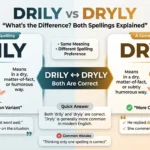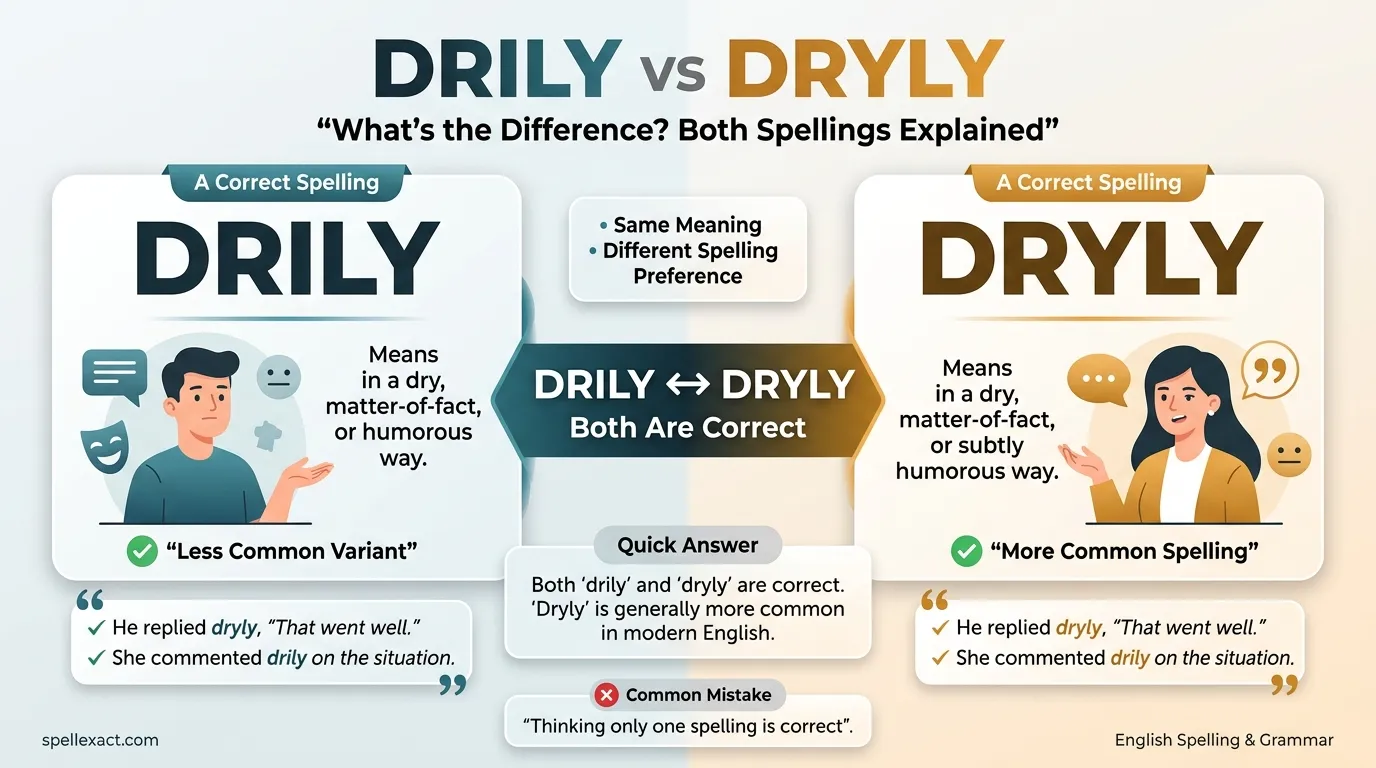
If you have ever paused while writing drily vs dryly, you are not alone. Both spellings are correct English words, and both can be used to describe something done in a dry, matter-of-fact, or humorously understated way. The difference is mainly a matter of spelling preference rather than meaning.
However, choosing between dryly and drily can still be confusing, especially because one spelling is much more common in modern English. This guide explains the meaning, usage, examples, spelling differences, common mistakes, and American vs British English preferences so you can confidently choose the right word in your writing.
Quick Answer
Both “drily” and “dryly” are correct spellings.
- Dryly is the more common spelling in modern English.
- Drily is also correct and is traditionally associated with British English usage.
- Both mean in a dry, matter-of-fact, or subtly humorous manner.
- In most everyday writing, dryly is the safer and more familiar choice.
Example:
“He dryly remarked that the meeting could have been an email.”
The same sentence can also be written as:
“He drily remarked that the meeting could have been an email.”
Drily vs Dryly: Comparison at a Glance
| Feature | Drily | Dryly |
| Correct spelling? | Yes | Yes |
| Meaning | In a dry or understated manner | In a dry or understated manner |
| More common today? | Less common | More common |
| American English | Used, but less frequently | Preferred and widely used |
| British English | Accepted and traditional | Also widely accepted |
| Best choice for general writing | Acceptable | Usually recommended |
The most important point is simple: there is no difference in meaning between drily and dryly.
What Does “Dryly” Mean?
The adverb dryly comes from the adjective dry. Depending on context, it can describe something that is literally dry or, more commonly in modern writing, something said in an understated, unemotional, ironic, or subtly humorous way.
For example:
- She dryly pointed out that nobody had read the instructions.
- “Well, that went perfectly,” he said dryly after the computer crashed.
- The professor dryly noted that the deadline had passed three weeks earlier.
In these examples, dryly suggests a restrained style of humor or a matter-of-fact tone. The speaker may be amused, sarcastic, or critical, but they are not expressing those emotions dramatically.
This type of expression is often called dry humor, deadpan humor, or understated humor.
What Does “Drily” Mean?
Drily has the same meaning as dryly. It can describe a person speaking with dry humor, irony, restraint, or a matter-of-fact tone.
Examples include:
- She drily observed that the plan had “a few minor problems.”
- He drily replied that waiting another six hours was not his idea of fun.
- The narrator drily described the disastrous event.
There is no meaningful distinction between these examples and versions using dryly.
For instance:
- She dryly observed that the plan had “a few minor problems.”
and:
- She drily observed that the plan had “a few minor problems.”
Both are grammatically correct.
Why Are There Two Correct Spellings?
The confusion surrounding drily vs dryly comes from English spelling patterns.
When many words ending in -y take the suffix -ly, the spelling changes slightly. For example:
- happy → happily
- easy → easily
- angry → angrily
Following that pattern, some writers naturally expect:
- dry → drily
However, English does not always follow one perfectly consistent spelling rule. The form dryly developed and became widely accepted, eventually becoming the more common spelling in modern usage.
As a result, dictionaries generally recognize both forms.
This is a useful reminder that English spelling often reflects history and established usage rather than a single mechanical rule.
Which Is More Common: Drily or Dryly?
In contemporary English, dryly is generally more common.
You are more likely to encounter dryly in:
- News articles
- Modern books
- Blogs
- Academic writing
- Business communication
- General online content
Drily remains a correct alternative, but it may look unusual to many readers, particularly in American English.
If your goal is maximum familiarity and readability, choose dryly.
For example, most readers will immediately recognize:
“That sounds like a wonderful idea,” she said dryly.
The spelling drily is not wrong, but dryly is more likely to feel natural to a broad modern audience.
Drily vs Dryly in American English
In American English, dryly is generally the preferred and more familiar spelling.
American writers commonly use phrases such as:
- dryly remarked
- dryly noted
- dryly observed
- dryly replied
- said dryly
Examples:
- “I can see that everything is under control,” she said dryly.
- The reporter dryly noted the obvious contradiction.
- He dryly remarked that the vacation had not started well.
Although drily is not incorrect in American English, it is less common. Therefore, dryly is usually the best choice for American audiences.
Drily vs Dryly in British English
In British English, both spellings are accepted.
Drily has a longer-established presence in British usage and may appear in traditional or formal writing. However, dryly is also common and widely understood.
This means British writers can generally choose either spelling, although consistency is important.
For example, if a publication follows a particular style guide, its editorial preference should take priority. A writer should avoid switching randomly between drily and dryly within the same article.
How to Use Dryly and Drily in a Sentence
The easiest way to understand these words is through realistic examples.
Examples of Dryly
- “Fantastic timing,” Maria said dryly as the rain began.
- He dryly remarked that the project was slightly behind schedule.
- The manager dryly noted that the problem had already been discussed.
- “Nothing could possibly go wrong,” she said dryly.
- The narrator dryly described the chaos that followed.
Examples of Drily
- “That was helpful,” he said drily.
- She drily observed that the instructions were missing.
- The detective drily remarked that this was not his first unusual case.
- “I suppose we could wait forever,” she replied drily.
- He drily noted that nobody had asked for his opinion.
Notice that the meaning remains unchanged when one spelling is replaced with the other.
Dryly as a Literal Adverb
Although dryly is often associated with humor or tone, it can also relate more literally to dryness in certain contexts.
For example:
- The article was dryly written and difficult to read.
Here, dryly does not necessarily mean the writer was being funny. Instead, it suggests that the writing was dull, unemotional, or lacking excitement.
Similarly:
- The report presented the facts dryly.
- The speaker explained the event dryly and without emotion.
Context determines whether dryly refers to humor, understatement, dullness, or an unemotional manner.
Common Phrases Used with Dryly
The word dryly frequently appears with verbs connected to speaking and writing.
Common combinations include:
- said dryly
- remarked dryly
- replied dryly
- noted dryly
- observed dryly
- commented dryly
- added dryly
Examples:
- “That should be easy,” he said dryly.
- She remarked dryly that the solution had been obvious.
- The editor noted dryly that several facts were missing.
- He replied dryly without looking up.
These combinations are useful for writers because they help communicate tone without explaining the joke or sarcasm directly.
Common Mistakes with Drily and Dryly
Mistake 1: Thinking One Spelling Is Incorrect
A common mistake is assuming that drily is a misspelling of dryly, or vice versa.
The truth is that both are correct.
The difference is primarily one of usage and preference.
Mistake 2: Using “Dry” When an Adverb Is Needed
Incorrect:
- He replied dry.
Correct:
- He replied dryly.
- He replied drily.
When describing how someone replied, you generally need an adverb.
Mistake 3: Confusing Dry Humor with Being Literally Dry
Consider:
- He spoke dryly.
This usually describes the speaker’s tone rather than physical dryness.
By contrast:
- The clothes dried quickly.
This refers to the removal of moisture.
Context is essential.
Mistake 4: Assuming Drily Is Always British and Dryly Is Always American
The distinction is not that strict.
Both spellings are recognized in English, and dryly appears in both American and British writing. The main difference is that dryly is generally more common overall, while drily may be more strongly associated with traditional British usage.
Mistake 5: Switching Spellings Without a Reason
If you choose dryly in one section of an article, do not suddenly use drily later unless you have a clear editorial reason.
Consistency improves professionalism and readability.
Is “Dryly” the Preferred Spelling?
For most writers, yes.
If you are writing for:
- A website
- A blog
- A school assignment
- A professional document
- An international audience
- American readers
Dryly is usually the safest choice.
It is familiar, widely accepted, and immediately recognizable.
However, if you prefer drily, especially because of a British English style preference or house style guide, it remains perfectly correct.
How to Remember the Difference
A simple memory tip is:
Dryly = the common modern choice.
Think of the original word dry and simply add -ly:
dry + ly = dryly
This is not a universal rule for every English word ending in -y, but it is an easy way to remember the most commonly used spelling in this specific case.
You can also remember:
Dryly is more common; drily is also correct.
That single rule will help you make the right choice in most situations.
Drily vs Dryly: Which Should You Use?
Choose dryly if you want the spelling that is:
- More common in modern English
- Especially familiar to American readers
- Clear to an international audience
- Suitable for general and professional writing
Choose drily if:
- Your style guide prefers it
- You are following a traditional British spelling convention
- You simply prefer that accepted variant
Neither choice changes the meaning of your sentence.
Frequently Asked Questions
Is drily a real word?
Yes. Drily is a real and correct English word. It is an alternative spelling of dryly and carries the same meaning.
Is dryly correct?
Yes. Dryly is correct and is the more common spelling in modern English.
Which spelling is more common, drily or dryly?
Dryly is generally more common, particularly in American English and modern general writing.
Does drily mean something different from dryly?
No. Drily and dryly have the same meaning. The difference is spelling preference and usage frequency.
Is drily British English?
Drily is often associated with British usage and traditional spelling preferences, but it is not exclusively British. Both British and American English recognize the word.
Should I use dryly or drily in American English?
Use dryly in most American English writing. It is the more familiar and widely used option.
Can I use drily in formal writing?
Yes. Drily is grammatically correct and can appear in formal writing. However, check any relevant editorial or organizational style guide.
What does “said dryly” mean?
“Said dryly” means someone spoke in an understated, matter-of-fact, ironic, sarcastic, or subtly humorous manner.
Summary:
When comparing drily vs dryly, the good news is that you do not need to worry about choosing between a correct and incorrect spelling. Both are correct, and both mean in a dry, understated, unemotional, ironic, or subtly humorous manner.
The main difference is usage. Dryly is the more common spelling in modern English and is usually the best choice for American and international audiences. Drily remains an accepted alternative and may be preferred in certain British or traditional editorial styles.
Actionable takeaway:
If you are unsure which spelling to use, choose dryly for everyday writing. If you are writing for a publication, school, or organization, follow its style guide and use the chosen spelling consistently throughout your work.

Maria Megan is a language enthusiast and content writer specializing in spelling, grammar, and English usage. She creates clear, practical articles that help readers identify common spelling mistakes, improve writing accuracy, and communicate with greater confidence.