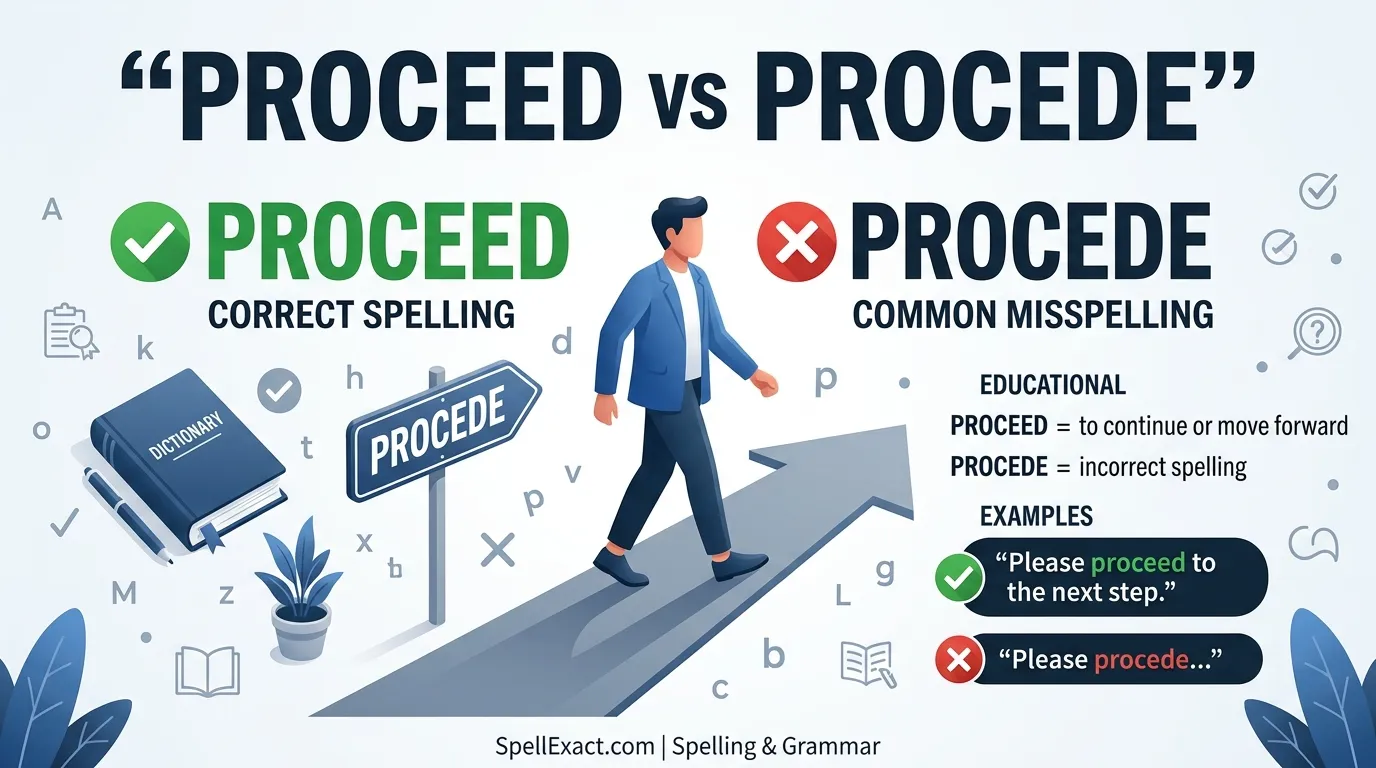
If you have ever hesitated between proceed vs procede, you are not alone. These two spellings look almost identical, but only one is a correct English word. The confusion usually happens because many English words end in “-cede,” “-ceed,” or similar-sounding patterns.
The correct spelling is proceed. It means to continue, move forward, or take the next step. Procede is not a standard English spelling and should not be used in normal writing. In this guide, you will learn the difference between proceed and procede, see practical examples, and discover a simple way to remember the correct spelling.
Quick Answer:
Proceed is the correct spelling.
Procede is a misspelling and is not accepted as the standard spelling of the English verb.
| Word | Correct? | Meaning | Example |
| Proceed | ✅ Yes | To continue or move forward | Please proceed with the application. |
| Procede | ❌ No | Incorrect spelling | Please procede with the application. |
So, if you are wondering whether to write “proceed with the plan” or “procede with the plan,” always choose “proceed with the plan.”
What Does Proceed Mean?
Proceed is a verb that means to continue doing something, move forward, or go to the next stage of an activity.
It can describe physical movement as well as progress in a process, discussion, project, or decision.
For example:
- Please proceed to the next room.
- We can proceed with the meeting.
- The company decided to proceed with the project.
- After receiving approval, construction will proceed.
- You may proceed when the traffic light turns green.
The word is common in everyday English, business writing, instructions, academic writing, legal documents, and formal communication.
Is Procede a Word?
No. Procede is generally considered a misspelling of proceed.
Although procede may look reasonable because of words such as precede, concede, and recede, it is not the standard spelling of the verb meaning “to continue” or “move forward.”
If you write:
We will procede with the project.
the correct version is:
We will proceed with the project.
This is an easy spelling mistake to make because the pronunciation and spelling pattern can be confusing. However, remembering the double e in proceed will help you avoid it.
Proceed Meaning in Simple English
In simple terms, proceed means “go ahead” or “continue.”
Think of it this way:
Proceed = Continue or move forward
For example:
- “You can proceed.” = “You can go ahead.”
- “Proceed with the work.” = “Continue the work.”
- “Proceed to checkout.” = “Go to checkout.”
- “The meeting proceeded normally.” = “The meeting continued normally.”
This simple connection makes the word much easier to understand and use correctly.
Proceed vs Procede: The Main Difference
The biggest difference is spelling rather than meaning.
Proceed is the correct English word. It can function as a verb and is used when someone continues an action or moves forward.
Procede is an incorrect spelling. It does not have a separate standard meaning that you should use in modern English.
Correct
Please proceed with your application.
Incorrect
Please procede with your application.
The mistake is only one letter, but it can make your writing look less polished, particularly in professional, academic, or formal communication.
Examples of Proceed in Sentences
Understanding the word through real examples is one of the best ways to remember its spelling.
Everyday Examples
- You may proceed when the road is clear.
- Please proceed to the front desk.
- We should proceed carefully.
- The children were told to proceed to the classroom.
- Once everyone is ready, we can proceed.
Business Examples
- The manager approved the proposal, so we can proceed.
- The team decided to proceed with the new strategy.
- We cannot proceed until the documents are signed.
- The company plans to proceed with the expansion.
- Please confirm that we can proceed with the order.
Academic and Formal Examples
- The researchers will proceed with the next stage of the study.
- After reviewing the evidence, the committee decided to proceed.
- Students should proceed to the final section of the examination.
- The court allowed the case to proceed.
- The experiment can now proceed under controlled conditions.
Common Phrases With Proceed
You will often see proceed in specific expressions. Learning these phrases can make the correct spelling easier to remember.
Proceed With
Proceed with means to continue or move forward with something.
Example:
We have received approval, so we can proceed with the project.
Proceed To
Proceed to can mean to move to a particular place or move to the next step.
Example:
Please proceed to the reception desk.
It can also be used for stages in a process:
After completing the first section, proceed to the next question.
Proceed Carefully
This phrase means to move forward with caution.
Example:
The engineers decided to proceed carefully because the weather conditions were uncertain.
Proceed as Planned
This means something will continue according to the original plan.
Example:
The event will proceed as planned despite the minor delay.
Why Do People Spell Proceed as Procede?
The proceed vs procede confusion is understandable because English spelling is not always predictable.
Several words have similar endings:
- precede
- concede
- recede
- succeed
- proceed
Some learners naturally assume that procede follows the same spelling pattern as precede. However, English contains many irregular spelling patterns, so pronunciation alone is not always enough to determine the spelling.
Another reason is that proceed is pronounced in a way that may make the second “e” easy to overlook when writing quickly.
The best approach is not to rely entirely on pronunciation. Instead, memorize the visual pattern:
pro + ceed = proceed
An Easy Trick to Remember Proceed
A useful memory trick is to connect proceed with “go ahead.”
Think:
Proceed = Go forward = Continue
Then remember that the correct spelling contains “ceed” at the end:
pro + ceed → proceed
You can also associate it with succeed, which has the same “ceed” ending:
- succeed
- proceed
This can help reinforce the spelling in your memory.
Proceed vs Precede: Don’t Confuse Them
Another common source of confusion is proceed and precede. Unlike procede, both proceed and precede are real English words, but they have different meanings.
Proceed means to continue or move forward.
We will proceed with the meeting.
Precede means to come before something in time, order, or position.
A short introduction will precede the presentation.
A simple way to remember the distinction is:
- Proceed = move forward or continue
- Precede = come before
This difference is particularly important in formal and academic writing.
American vs British English: Is the Spelling Different?
There is no significant American vs British English spelling difference for proceed.
Both American English and British English use:
proceed
The misspelling procede is not an accepted alternative spelling in standard American or British English.
Therefore, whether you are writing an email in the United States, preparing an academic assignment in the United Kingdom, or creating website content for an international audience, use proceed.
Common Mistakes to Avoid
When using proceed, watch out for these common errors:
1. Writing “Procede”
❌ Please procede with the payment.
✅ Please proceed with the payment.
2. Confusing Proceed With Precede
❌ The introduction will proceed the main presentation.
✅ The introduction will precede the main presentation.
3. Using the Wrong Form in Formal Writing
Because proceed is common in formal instructions, reports, and business communication, spelling it incorrectly can make an otherwise professional document appear careless.
Always check the spelling when using phrases such as:
- proceed with
- proceed to
- proceed further
- proceed accordingly
- proceed as planned
Synonyms for Proceed
Knowing synonyms can help you understand the word more clearly and avoid repetition.
Depending on the context, synonyms for proceed include:
- continue
- advance
- move forward
- go ahead
- progress
- carry on
- move onward
- advance further
For example:
We will proceed with the plan.
can also be expressed as:
We will move forward with the plan.
However, these words are not always interchangeable in every sentence. Proceed is especially useful when talking about moving to the next stage of a process or continuing with an approved action.
Frequently Asked Questions
Is proceed the correct spelling?
Yes. Proceed is the correct spelling of the English verb meaning to continue, move forward, or go ahead.
Is procede a correct English word?
No. Procede is generally a misspelling of proceed and should not be used in standard English writing.
What does proceed mean?
Proceed means to continue, move forward, or go to the next stage of something. For example, “Please proceed with the application” means “Please continue with the application.”
How do you spell proceed?
The correct spelling is P-R-O-C-E-E-D: proceed. Remember the ending “-ceed”.
Is it proceed or procede with the plan?
The correct phrase is “proceed with the plan.” The spelling “procede with the plan” is incorrect.
Is proceed American or British English?
Proceed is used in both American and British English. There is no standard regional spelling difference between the two.
What is the difference between proceed and precede?
Proceed means to continue or move forward, while precede means to come before something.
What is an easy way to remember proceed?
Remember: Proceed = Go forward. Also focus on the ending “ceed,” as in succeed and proceed.
Final Summary
When choosing between proceed vs procede, the answer is straightforward: proceed is correct, while procede is a misspelling. Proceed means to continue, move forward, or go ahead with an action. It is widely used in everyday conversations as well as business, academic, legal, and professional writing.
There is no American vs British spelling difference here, so you can confidently use proceed regardless of your audience. If you are unsure, remember the simple formula “pro + ceed = proceed.” Checking this small spelling detail can make your writing clearer, more accurate, and more professional.
Actionable Takeaway
Before you write procede, stop and remember:
✅ Proceed = Correct
❌ Procede = Incorrect
Use proceed whenever you mean continue, advance, move forward, or go ahead.

Aaron Adam is the Administrator of SpellExact, dedicated to helping readers improve their spelling and writing accuracy. He oversees content quality, ensures reliable language resources, and works to make spelling guidance simple, practical, and accessible for everyone.