If you have ever hesitated between recognization vs recognition, you are not alone. The two words look remarkably similar, and it is easy to assume that “recognization” is simply another spelling of the familiar word “recognition.” However, there is an important difference when it comes to standard English usage.
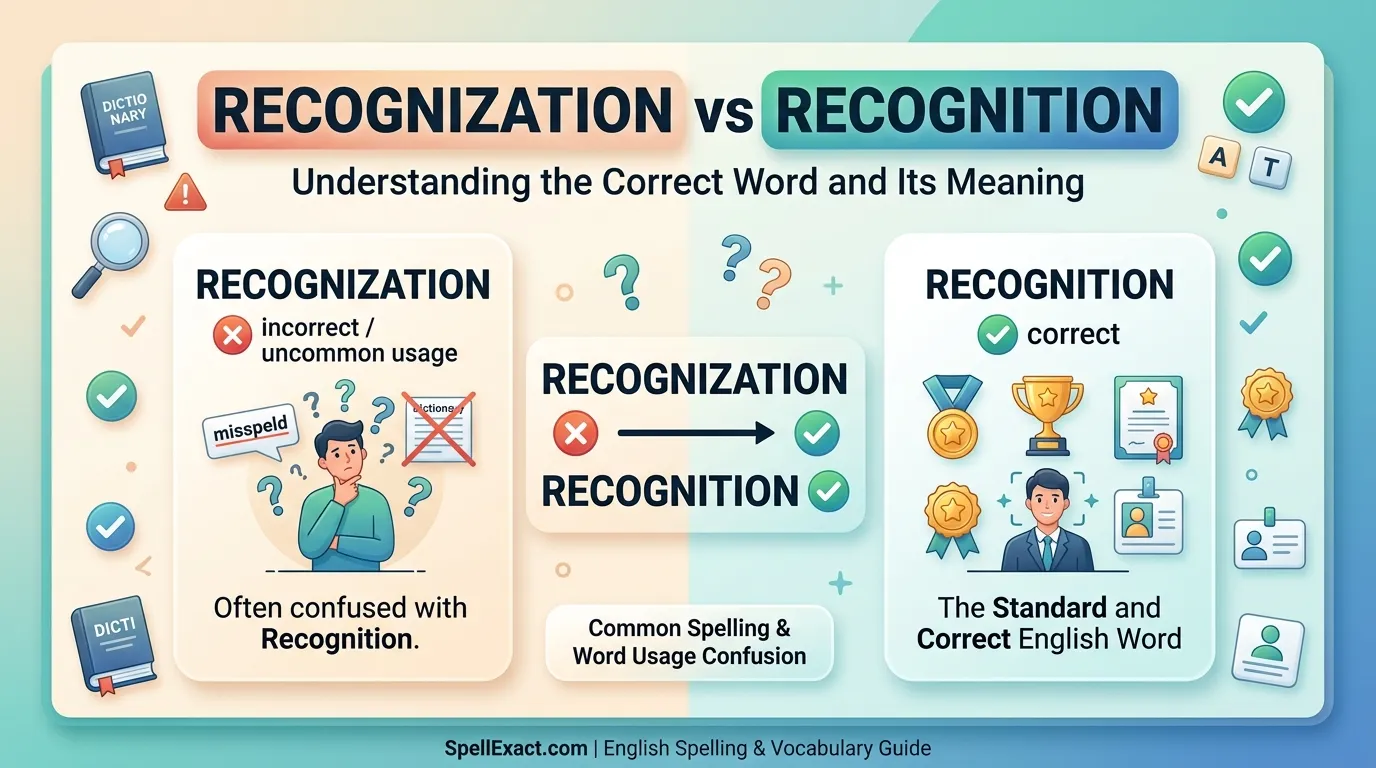
In modern English, recognition is the correct and widely accepted word for the act of identifying, acknowledging, noticing, or appreciating someone or something.
Recognization is generally considered a nonstandard or uncommon formation and should usually be avoided in formal writing. This guide explains the difference, gives practical examples, and shows you exactly which word to use.
Quick Answer:
Recognition is the correct and standard spelling in modern English.
Recognization is generally considered nonstandard and is rarely used in polished English. If you are writing an email, essay, article, academic paper, resume, business document, or website content, choose recognition.
- ✅ Recognition — standard and correct
- ❌ Recognization — generally nonstandard
- Verb: recognize
- Noun: recognition
- Adjective: recognizable
- Person who recognizes something: recognizer
Example:
The employee received recognition for her outstanding performance.
Not:
The employee received recognization for her outstanding performance.
What Does Recognition Mean?
Recognition is a noun derived from the verb recognize. It can describe several related ideas, including identifying something that you have seen before, acknowledging someone’s achievement, or showing appreciation for someone’s work.
For example:
I recognized the man from school.
Here, recognized means identified someone you already knew or had seen.
When we turn the idea into a noun, we use recognition:
I received recognition for my work.
In this sentence, recognition means acknowledgment or appreciation.
The word is common in everyday English as well as professional, academic, and formal writing.
Common meanings of recognition
1. Identifying someone or something
Facial recognition can identify a person from an image.
2. Acknowledging an achievement
She received recognition for her excellent performance.
3. Accepting or acknowledging something
The company finally gave recognition to the problem.
4. Appreciating someone’s contribution
The teacher gave recognition to the students who worked hard.
These meanings all use recognition, not “recognization.”
Why Is “Recognization” Often Considered Incorrect?
The confusion usually happens because English has many nouns ending in -ization.
For example:
- organize → organization
- realize → realization
- modernize → modernization
- recognize → recognition
Because of this pattern, it can seem logical to form “recognization” from “recognize.” However, English does not always create nouns by applying the same suffix to every verb.
Recognition is the established noun form of recognize.
This is an important point about English vocabulary: a word can look grammatically possible while still not being the conventional word used by native speakers and standard dictionaries.
So, even though recognization may appear occasionally, it is not the normal choice in standard contemporary English.
Recognition vs Recognization: Comparison Table
| Feature | Recognition | Recognization |
| Standard English | ✅ Yes | ❌ Generally no |
| Commonly used | ✅ Very common | ❌ Rare |
| Formal writing | ✅ Recommended | ❌ Avoid |
| Academic writing | ✅ Appropriate | ❌ Usually inappropriate |
| Business writing | ✅ Appropriate | ❌ Avoid |
| Meaning | Identification, acknowledgment, or appreciation | Usually intended to mean recognition |
| Recommended choice | ✅ Use this | ❌ Do not normally use this |
The safest rule is simple: when you mean acknowledgment, identification, or appreciation, use “recognition.”
Recognition Meaning With Simple Examples
Understanding the word in context makes the difference much easier to remember.
Example 1: Award or achievement
The athlete received recognition for her outstanding performance.
Here, recognition means public acknowledgment of an achievement.
Example 2: Identifying someone
His face was familiar, but I could not place him immediately. After a few seconds, I had recognition.
The word can relate to identifying something as familiar.
Example 3: Workplace appreciation
The company introduced an employee recognition program.
This means the company has a program designed to acknowledge employees for their contributions.
Example 4: Brand awareness
The new advertising campaign increased brand recognition.
Here, brand recognition means the ability of customers to identify or remember a brand.
Example 5: Formal acknowledgment
The organization deserves recognition for its environmental efforts.
In this sentence, recognition means praise or acknowledgment.
Recognize vs Recognition
One of the easiest ways to avoid this spelling mistake is to remember the relationship between the verb and noun.
Recognize is the verb.
I recognize that logo.
Recognition is the noun.
I have instant recognition of that logo.
More examples:
- Recognize: I recognized her voice.
- Recognition: Her voice was easy to recognize.
- Recognize: The manager recognized his efforts.
- Recognition: He received recognition for his efforts.
This pattern can help you remember that the noun is recognition, not “recognization.”
Common Mistakes With Recognition
Spelling mistakes often happen when writers try to apply a familiar word-building pattern to an irregular or established form.
Mistake 1: Writing “recognization”
❌ The employee received recognization.
Correct:
✅ The employee received recognition.
Mistake 2: Adding an unnecessary suffix
Some writers see recognize and automatically assume that adding -ation or -ization will produce the noun they need.
English vocabulary does not always work that way. Established forms should be learned as complete words.
Mistake 3: Confusing recognition with recognizable
These words are related but have different grammatical roles.
- Recognition = noun
- Recognize = verb
- Recognizable = adjective
Examples:
Her work received recognition.
I recognize her work.
Her style is instantly recognizable.
Using the correct form makes your sentence clearer and more natural.
American vs British English: Is There a Difference?
There is no major American vs British English spelling difference between recognition and recognization.
Both American and British English use recognition as the standard noun.
There is, however, a spelling difference in the related verb:
- American English: recognize
- British English: recognise is also widely used
The noun remains:
- American English: recognition
- British English: recognition
So changing from American recognize to British recognise does not mean you should change recognition into “recognisation” or “recognization.”
For example:
American English: The company recognized her achievement and gave her recognition.
British English: The company recognised her achievement and gave her recognition.
The noun recognition stays the same.
Recognition in Professional and Academic Writing
If you are writing professionally, choosing the standard word is especially important. Uncommon or nonstandard formations can make otherwise strong writing appear less polished.
Use recognition in:
- Resumes and CVs
- Cover letters
- Academic assignments
- Research papers
- Business reports
- Blog posts
- Website content
- Emails
- Presentations
- Formal applications
For example:
She received recognition for developing an innovative solution.
This sounds natural and professional.
A sentence using “recognization” may distract readers because the word is not the standard noun form.
How to Remember the Correct Spelling
A simple memory trick is to connect the word directly with recognize → recognition.
Think of this pair:
Recognize → Recognition
Not:
Recognize → Recognization
You can also remember a few common expressions:
- recognition award
- employee recognition
- facial recognition
- brand recognition
- public recognition
- recognition of achievement
- recognition for excellence
If you frequently use one of these phrases, the correct spelling becomes much easier to remember.
Is Recognization Ever Used?
You may encounter recognization in online writing, informal material, translated text, or other contexts. Its occasional appearance does not make it the preferred standard form.
When deciding which word to use in your own writing, frequency alone is not the only consideration. Standard usage, established vocabulary, dictionaries, and the expectations of your audience matter.
For clear and professional English, recognition is the better choice.
If you are proofreading content for publication, replacing “recognization” with recognition will generally make the sentence more natural and conventional.
Frequently Asked Questions
Is “recognization” a correct word?
“Recognization” is sometimes encountered, but it is generally considered nonstandard or uncommon in modern English. Recognition is the standard word and is the recommended choice.
Which is correct: recognization or recognition?
Recognition is correct and standard. Use it when referring to identification, acknowledgment, appreciation, or public praise.
What is the noun form of recognize?
The standard noun form is recognition.
For example:
The student received recognition for her achievement.
Is recognition spelled differently in British English?
No. Recognition is the standard noun in both American and British English. The related verb may be spelled recognize in American English and recognise in British English.
Why do people write recognization?
People may form “recognization” by analogy with words such as organization, realization, and modernization. However, the established noun associated with recognize is recognition.
What is the adjective form of recognition?
A common adjective is recognizable in American English and recognisable in British English.
Example:
Her voice was immediately recognizable.
Is “recognition” a noun or verb?
Recognition is a noun. The corresponding verb is recognize in American English and recognise in British English.
What is an example of recognition?
The teacher gave the student recognition for completing the project early.
Here, recognition means acknowledgment or appreciation of the student’s achievement.
Final Summary
When comparing recognization vs recognition, the answer is straightforward: recognition is the standard and widely accepted word. It can mean identifying someone or something, acknowledging an achievement, or showing appreciation for a person’s contribution. It is appropriate in casual conversations as well as professional, academic, and formal writing.
Although recognization may look logical because English contains many words ending in -ization, it is not the normal noun form of recognize. If you want your writing to sound natural, polished, and correct, choose recognition. Remember the simple pair recognize → recognition, and you will avoid this common spelling mistake.
Actionable Takeaway
Before publishing or submitting your writing, replace “recognization” with “recognition” whenever you mean acknowledgment, identification, or appreciation.
Correct: ✅ Recognition
Generally avoid: ❌ Recognization
The easiest rule to remember is: Recognize → Recognition.

Aaron Adam is the Administrator of SpellExact, dedicated to helping readers improve their spelling and writing accuracy. He oversees content quality, ensures reliable language resources, and works to make spelling guidance simple, practical, and accessible for everyone.