The difference between past away vs passed away is important when you want to describe someone who died clearly and correctly in standard English. The correct expression is passed away, while past away is incorrect. The expression passed away comes from the verb pass, with passed serving as its past-tense and past-tense form.
In this context, the word past cannot replace passed because it does not function as the required verb. For example, “Her grandfather passed away last year” is a natural sentence in English, while “Her grandfather past away last year” is not. This is one of the common English spelling mistakes caused by words that sound similar.
The main difference becomes easier to remember when you connect passed directly with the verb pass: pass → passed → passed away. Past, however, commonly refers to an earlier time or something beyond a point. From my experience explaining English usage, this confusion often comes from similar pronunciation rather than meaning.
When the meaning is that someone died, choose passed away as the correct expression. The important rule is simple: passed away is the natural English phrase, while past away should not be used for this meaning.
Quick Answer
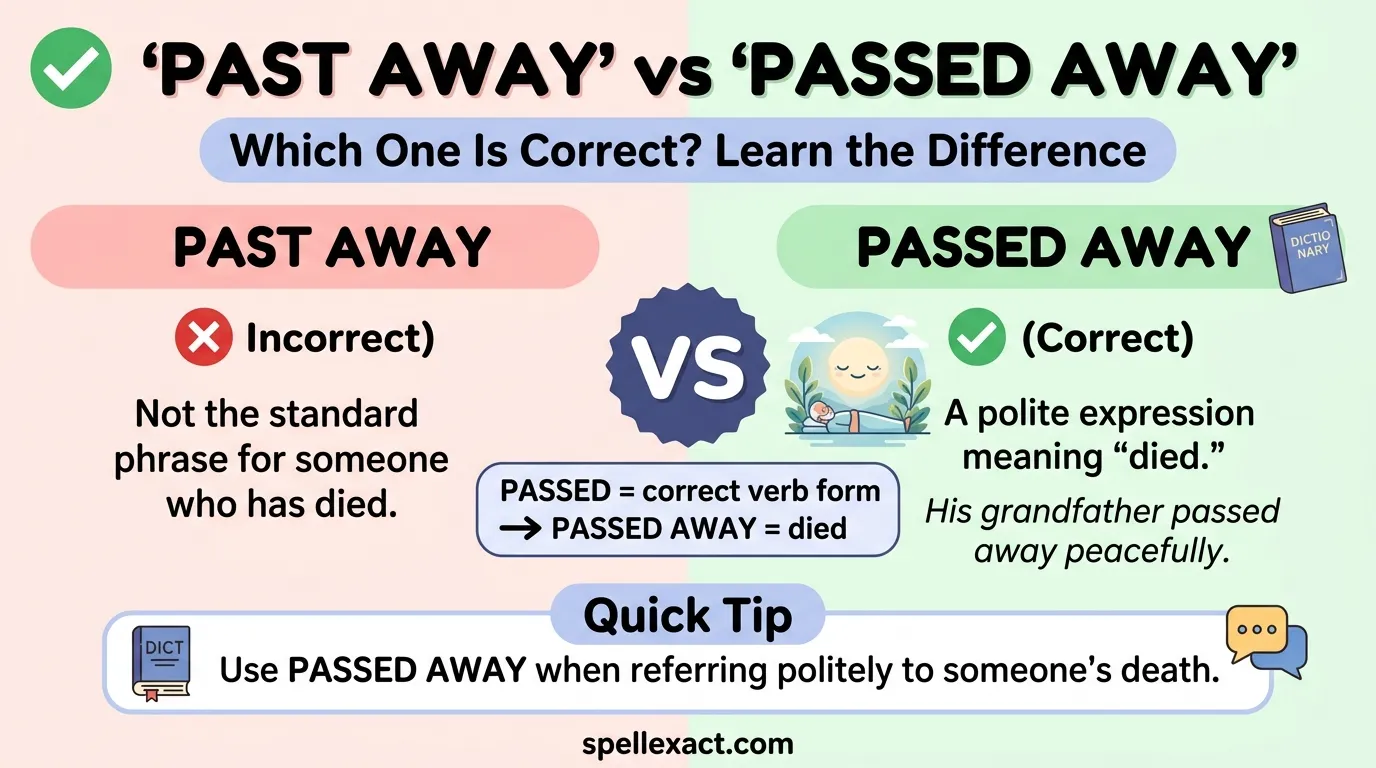
“Passed away” is correct, while “past away” is incorrect when referring to someone’s death. Passed away is a polite expression meaning “died.” The word passed is the past tense of pass. Past does not work in this expression because it is not the required verb.
Why Do People Confuse It?
People often confuse past away vs passed away because the two words sound almost identical.
- Passed = past tense of the verb pass
- Past = a word referring to an earlier time or something beyond a particular point
For example:
- She passed away peacefully.
- We walked past the house.
- He passed the exam.
- We talked about the past.
The pronunciation can make the mistake especially easy to make, but the spelling and grammatical function are different.
First Word: Past
Past refers to a time before now or something that has already happened. It can also describe movement beyond a particular point.
Examples:
- We should learn from the past.
- He walked past me.
- The train went past the station.
- She lived there in the past.
In “past away,” past does not function as the verb needed to express death. Therefore, past away is not the correct expression.
Second Word: Passed
Passed is the past tense and past participle of the verb pass.
It can have several meanings, including moving beyond something, completing something successfully, or experiencing the passage of time.
Examples:
- He passed the test.
- She passed the ball.
- The car passed us.
- Several years passed quickly.
The expression “passed away” uses passed as part of a polite phrase meaning died.
Past Away vs Passed Away: Comparison Table
| Phrase | Correct? | Meaning | Example |
| Past away | ❌ No | Not a correct expression for death | ❌ He past away last year. |
| Passed away | ✅ Yes | A polite way to say “died” | ✅ He passed away last year. |
| Past | ✅ Yes | Earlier time or beyond a point | We walked past the store. |
| Passed | ✅ Yes | Past tense of “pass” | She passed the exam. |
When Should You Use Each?
When to Use “Passed Away”
Use passed away when you want to refer to someone’s death in a gentle, respectful, or less direct way.
Examples:
- My grandfather passed away last winter.
- Her aunt passed away peacefully.
- The famous author passed away at the age of 82.
The phrase is common in conversations, obituaries, condolences, and other situations where a respectful expression is appropriate.
When to Use “Past”
Use past when referring to an earlier time or movement beyond something.
Examples:
- We need to move past this problem.
- He drove past my house.
- She often talks about her past.
- The deadline is past.
Do not use past away to mean that someone died.
10+ Examples of “Passed Away”
Here are examples showing how passed away is correctly used:
- My grandfather passed away last year.
- Her mother passed away peacefully.
- His uncle passed away after a long illness.
- The actor passed away at the age of 75.
- Their beloved teacher passed away recently.
- I was saddened to hear that she passed away.
- His grandmother passed away in her sleep.
- The writer passed away surrounded by his family.
- We still remember our friend who passed away.
- The musician passed away several years ago.
- Everyone was deeply saddened when their neighbor passed away.
- She spoke warmly about her father, who had passed away.
Common Mistakes
Mistake 1: Writing “Past Away”
❌ My uncle past away last month.
✅ My uncle passed away last month.
The verb required here is passed, not past.
Mistake 2: Thinking “Past” Is the Past Form of “Pass”
This is a very common misunderstanding.
Pass → passed
Not:
Pass → past
For example:
- I pass the shop every morning.
- I passed the shop yesterday.
Mistake 3: Using “Passed” and “Past” Interchangeably
Although they can sound similar, they are not interchangeable.
- We walked past the school.
- We passed the school.
Both can sometimes describe movement, but their grammatical structures differ.
For the expression referring to death, the correct form is specifically:
✅ passed away
Memory Trick
A simple way to remember the difference is:
Passed = an action
Past = an earlier time or beyond something
Think:
Pass → Passed → Passed away
If someone passed away, they passed from this life.
So remember:
✅ Passed away
❌ Past away
American vs British English
There is no standard American vs British spelling difference in the phrase passed away.
Both American and British English use:
passed away
For example:
- American English: “Her grandfather passed away.”
- British English: “Her grandfather passed away.”
The expression is widely understood in both varieties of English.
Similar Words
Several words and expressions are related to past, passed, or passed away, but they have different meanings.
Died
Died is the direct and grammatically simple term.
- His father died in 2018.
Passed Away
Passed away is a more indirect and often gentler expression for died.
- His father passed away in 2018.
Deceased
Deceased is a formal adjective or noun referring to someone who has died.
- The deceased person’s family was notified.
Pass Away
Pass away is the present or base form of the expression.
- Everyone eventually passes away.
Passed On
Passed on can sometimes be used as a euphemism for died, although it can have other meanings depending on context.
- She passed on peacefully.
Final Verdict
The correct phrase is “passed away,” not “past away,” when you are talking about someone’s death.
Passed is the past tense of pass, and passed away is a common polite expression meaning died. Past refers to an earlier time or something beyond a particular point, so it does not belong in this expression.
Remember the simple rule:
Pass → Passed → Passed away
Frequently Asked Questions
Is “past away” correct?
No. “Past away” is incorrect when you mean that someone died. The correct phrase is “passed away.”
Is it “passed away” or “past away”?
The correct expression is “passed away.” For example: “Her grandmother passed away last year.”
What does “passed away” mean?
Passed away is a polite expression meaning died. It is often used when speaking or writing about someone’s death respectfully.
Why is “passed away” correct?
Passed is the past tense of the verb pass. The established expression is pass away, so its past-tense form is passed away.
Can I say “past away” in a sentence?
No, not when referring to death. You should write “passed away.” For example, “His uncle passed away” is correct.
What is the difference between “past” and “passed”?
Past generally refers to an earlier time or movement beyond something. Passed is the past tense of pass.
Examples:
- We walked past the building.
- We passed the building.
Is “passed away” formal or informal?
Passed away is a widely used and polite expression. It can be used in everyday conversation as well as more formal contexts such as announcements and obituaries.
Is “passed away” the same as “died”?
Yes, passed away generally means died, but it is a more indirect and often gentler expression.
Remember This
Past = an earlier time or beyond something.
Passed = past tense of pass.
Passed away = died.
So, when referring to someone’s death:
✅ She passed away.
❌ She past away.
Conclusion
The difference between past away vs passed away is simple once you understand the roles of past and passed. Passed away is the correct expression for saying that someone died, while past away is an incorrect spelling in this context.
Whenever you need to describe someone’s death respectfully, use passed away. Remember that passed comes from the verb pass, while past refers to an earlier time or something beyond a point. Keeping this distinction in mind will help you avoid this common English mistake.

Andrew Anthony is a language enthusiast and content writer specializing in spelling mistakes, grammar, and English usage. He creates clear, practical, and well-researched guides that help readers improve their writing skills with confidence.