Have you ever wondered whether “sitted” or “seated” is the correct word when talking about someone sitting down? You’re not alone. “Sitted” may look like the natural past-tense form of sit, but standard English follows an irregular verb pattern here, making the correct form less obvious.
The good news is simple: “seated” is a correct English word, while “sitted” is generally considered incorrect in standard English. However, sat is usually the correct past tense of sit. Understanding the difference between sit, sat, and seated will help you avoid this common grammar mistake in everyday writing and speaking.
Quick Answer:
“Sitted” is not standard English. “Seated” is a correct word, but it does not always replace “sat.”
Here’s the easiest way to remember the difference:
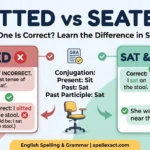
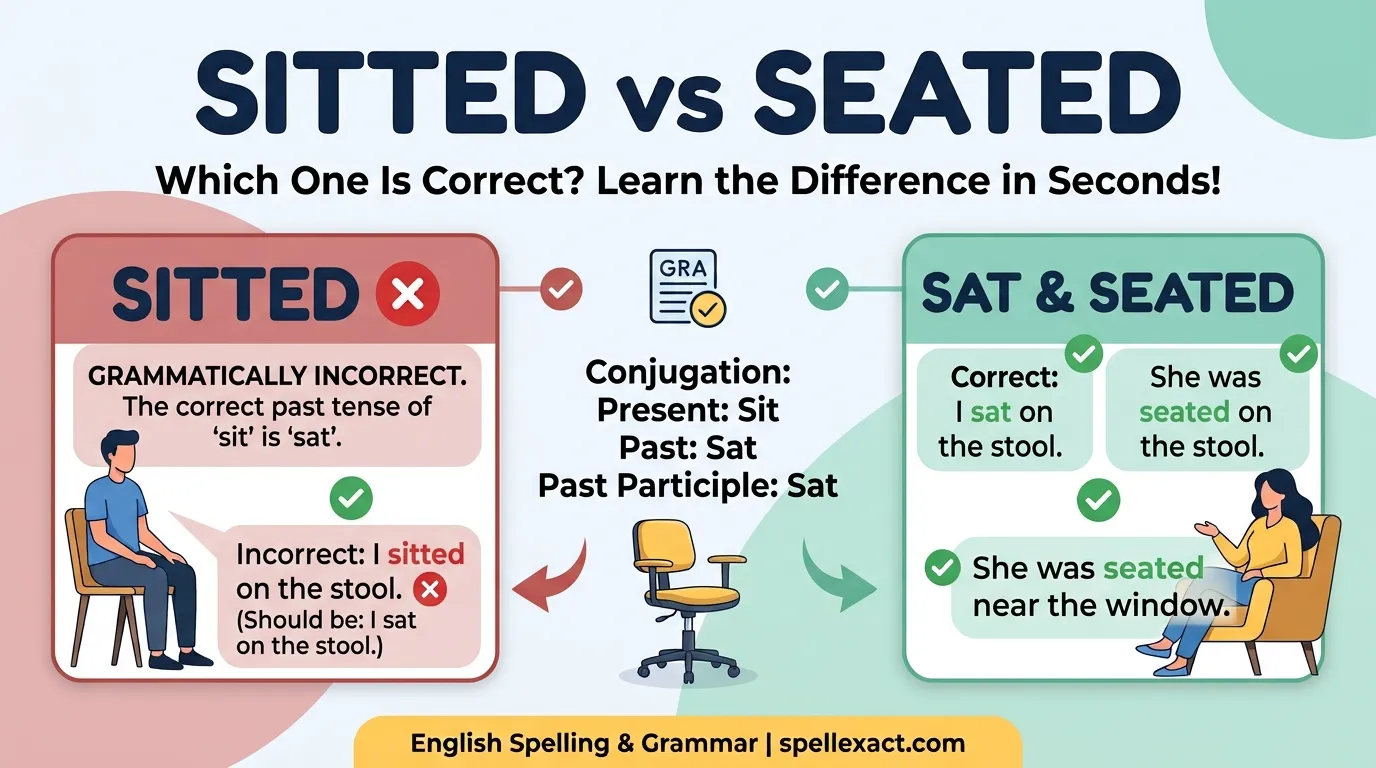
- Sit → present tense
- Sat → past tense of sit
- Sat → past participle of sit
- Seated → past tense/past participle of seat and also an adjective
- Sitted → generally incorrect in standard English
Examples
- Correct: I sat on the chair yesterday.
- Correct: Please sit here.
- Correct: She was seated near the window.
- Incorrect: I sitted on the chair yesterday.
So, if you mean the past tense of sit, use sat, not sitted.
What Does “Sit” Mean?
Sit is a verb that means to rest your body on a chair, seat, bench, floor, or another surface, usually with your weight supported underneath you.
It can also describe being in a sitting position.
Examples of “sit”
- Please sit on this chair.
- I usually sit near the front of the classroom.
- The children sit quietly during the lesson.
- Would you like to sit with us?
The verb sit is irregular, so its past forms do not follow the usual pattern of adding -ed.
Forms of “sit”
| Verb form | Word | Example |
| Base form | sit | I sit here every morning. |
| Past tense | sat | I sat here yesterday. |
| Past participle | sat | I have sat here before. |
| -ing form | sitting | She is sitting on the sofa. |
This irregular pattern is the main reason people sometimes incorrectly create the word “sitted.”
What Does “Seated” Mean?
Seated is the past tense and past participle of the verb seat. It can also function as an adjective.
The verb seat generally means to cause someone to sit down or to provide a place for someone to sit.
For example:
- The waiter seated us near the window.
- The usher seated the guests.
- We were seated at a large table.
- Please remain seated until the plane stops.
Notice an important difference: sit normally describes the person taking the sitting position, while seat often describes someone placing another person in a seat.
Sitted vs Seated: The Key Difference
The confusion becomes easier when you compare the verbs behind these words.
Sit is normally something a person does themselves:
I sat in the chair.
Seat can mean placing someone in a particular seat:
The hostess seated me near the window.
That means “sitted” cannot normally be used as the past tense of “sit.” The correct past form is “sat.”
Compare these sentences
- ❌ I sitted on the sofa.
- ✅ I sat on the sofa.
- ✅ I was seated on the sofa.
The first sentence uses an incorrect form. The second uses the ordinary past tense of sit. The third uses seated and changes the grammatical structure.
Sitted vs Sat vs Seated
This three-way comparison is especially useful because many learners confuse all three forms.
| Word | Correct? | Meaning | Example |
| Sit | Yes | To take or be in a sitting position | Please sit down. |
| Sat | Yes | Past tense/past participle of sit | I sat beside him. |
| Seated | Yes | Past form of seat; also adjective | We were seated near the entrance. |
| Sitted | No, in standard English | Incorrect attempt at the past form of sit | ❌ I sitted there. |
A useful rule is:
If you are using “sit” as the verb, its past form is “sat.” If you use “seat,” its past form is “seated.”
Why Is “Sitted” Incorrect?
English contains many regular verbs that form their past tense by adding -ed:
- walk → walked
- talk → talked
- clean → cleaned
- open → opened
Because of this pattern, it can seem logical to change sit into sitted. But sit is an irregular verb, so English does not form its past tense by simply adding -ed.
Instead:
sit → sat
The same irregular pattern appears in other common verbs:
- go → went
- come → came
- take → took
- write → wrote
- eat → ate
- sit → sat
Therefore, “I sitted” is not the standard form.
When Should You Use “Sat”?
Use sat when you are talking about someone being in a sitting position in the past.
Examples
- I sat on the bench for an hour.
- She sat beside her friend.
- We sat in the back row.
- He sat quietly during the meeting.
- They sat at the kitchen table.
- I sat down after work.
You can also use sat as a past participle:
- I have sat here many times.
- She had sat quietly for several minutes.
- We have sat together before.
When Should You Use “Seated”?
Use seated when you want to describe someone as being placed in a seat, being in a particular seated position, or being in a sitting position in a more formal context.
It is especially common in:
- Restaurants
- Theaters
- Weddings
- Formal events
- Air travel
- Official announcements
- Business settings
Examples
- The guests were seated before dinner.
- Please remain seated during the performance.
- We were seated at table six.
- The passengers were seated safely.
- The audience was seated before the show began.
“Seated” can sound more formal than “sitting” or “sat,” depending on the sentence.
Common Mistakes With Sitted and Seated
Understanding the most frequent mistakes can make this grammar point much easier.
Mistake 1: Using “sitted” as the past tense of “sit”
Incorrect: She sitted on the chair.
Correct: She sat on the chair.
Remember:
sit → sat, not sit → sitted.
Mistake 2: Assuming every verb takes “-ed”
Incorrect: I sitted beside my brother.
Correct: I sat beside my brother.
Irregular verbs must be learned according to their actual forms rather than applying the regular -ed pattern.
Mistake 3: Treating “sat” and “seated” as completely interchangeable
Although both can relate to sitting, they come from different verbs.
- Sat comes from sit.
- Seated comes from seat.
For example:
I sat near the door.
But:
The receptionist seated me near the door.
The first focuses on the person’s action or position. The second suggests that someone placed or directed the person to a seat.
Mistake 4: Using “seated” when “sat” is more natural
In everyday conversation, sat is often the natural choice.
Instead of:
Yesterday, I seated on the sofa.
Use:
Yesterday, I sat on the sofa.
However, this sentence is different:
Yesterday, the host seated me on the sofa.
Here, seated works because the host placed or directed the speaker to a seat.
American vs British English: Is There a Difference?
There is no major American vs British spelling difference between sat and seated. Both varieties of standard English use sit → sat and recognize seated as the past form of seat.
The main difference is often one of style and context, not correctness.
For example, both American and British English commonly use:
- “I sat down.”
- “She sat beside me.”
- “Please remain seated.”
- “We were seated near the front.”
Formal announcements such as “Please remain seated” are especially common in both varieties of English.
So if you are writing for an American or British audience, you should still avoid “sitted” in standard formal English.
How to Remember the Correct Form
A simple memory trick can help:
Sit has SAT.
Think of the pattern:
I sit today. I sat yesterday.
Then remember that seated belongs to seat:
The waiter seated me.
You can also use this quick test:
Did I personally sit somewhere? → Use “sat.”
Did someone place or arrange someone in a seat? → “Seated” may be appropriate.
For example:
- I sat at the table.
- The waiter seated me at the table.
More Examples in Everyday English
Here are several natural examples to reinforce the difference:
Using “sit”
- Please sit down.
- I want to sit outside.
- Where should I sit?
- Can you sit next to me?
Using “sat”
- I sat outside yesterday.
- She sat next to her mother.
- We sat together during lunch.
- He sat quietly and listened.
Using “seated”
- The guests were seated before the ceremony.
- We were seated near the stage.
- Please remain seated.
- The restaurant can seat 100 people.
Incorrect use of “sitted”
- ❌ I sitted on the floor.
- ❌ She sitted beside me.
- ❌ They sitted in the front row.
Correct versions:
- ✅ I sat on the floor.
- ✅ She sat beside me.
- ✅ They sat in the front row.
Frequently Asked Questions
Is “sitted” a correct English word?
No. “Sitted” is generally not accepted as the standard past tense of “sit.” The correct past tense is sat.
Is it “I sat” or “I sitted”?
The correct phrase is “I sat.” For example, “I sat on the chair for ten minutes.”
Is “seated” the past tense of “sit”?
No. Seated is the past tense and past participle of seat. The past tense of sit is sat.
Can I say “I was seated”?
Yes. “I was seated” is grammatically correct. It can mean that you were in a seat or that someone placed you in a seat, depending on context.
Is “sat” the past participle of “sit”?
Yes. The verb sit has sat as both its past tense and past participle.
For example:
- I sat there yesterday.
- I have sat here many times.
Why do people say “sitted”?
“Sitted” is usually created by applying the regular -ed pattern to sit. Because sit is an irregular verb, its past form is sat, not sitted.
Is “seated” more formal than “sat”?
Often, yes. Seated can sound more formal or professional, especially in phrases such as “Please remain seated” or “The guests were seated.” However, the words have different grammatical functions and meanings.
What is the correct phrase: “sitting,” “sat,” or “seated”?
It depends on the sentence:
- Sitting = present participle/gerund: “She is sitting here.”
- Sat = past tense/past participle: “She sat here yesterday.”
- Seated = form of seat: “She was seated near the entrance.”
Final Summary
The difference between sitted vs seated becomes much easier once you remember that sitted is not the standard past form of sit. If someone was in a sitting position in the past, the natural word is usually sat: “I sat on the chair.” The verb sit is irregular, so it does not become sitted by adding -ed.
Seated, meanwhile, is a legitimate word that comes from the verb seat. It is often used when someone is placed in a seat or when describing a person’s seated position, particularly in formal or professional situations. The simplest rule to remember is: sit → sat, while seat → seated.
Actionable Takeaway
Before using “sitted,” stop and ask yourself whether you mean the past tense of sit. If you do, replace it with “sat.” If someone placed or directed you into a seat, “seated” may be the better choice.
Remember:
Sit → Sat → Sat
Seat → Seated → Seated
Sitted → Avoid in standard English

Andrew Anthony is a language enthusiast and content writer specializing in spelling mistakes, grammar, and English usage. He creates clear, practical, and well-researched guides that help readers improve their writing skills with confidence.