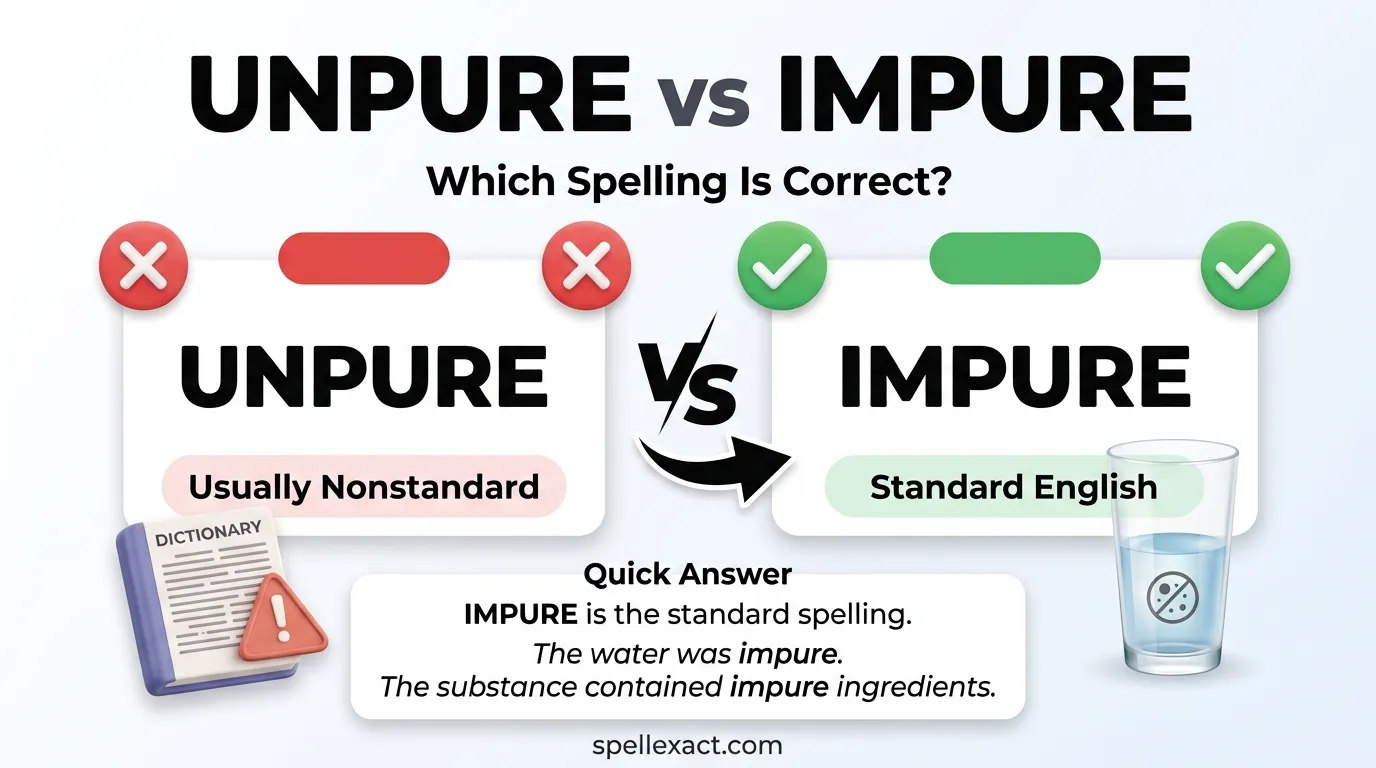
Have you ever wondered whether “unpure” or “impure” is the correct word? You are not alone. Both words appear understandable because the prefix un- commonly creates an opposite meaning, while im- is another common negative prefix in English. However, when you want to describe something that is not pure, there is an important difference between standard usage and a less common formation.
In this guide, we’ll explain unpure vs impure in simple terms. You’ll learn which spelling is preferred, what each word means, how to use it naturally in a sentence, common mistakes to avoid, and whether American and British English treat these words differently.
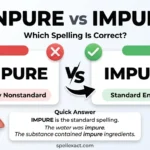
Quick Answer:
Impure is the standard and widely accepted word for something that is not pure, clean, unmixed, or morally pure.
Unpure is a possible English formation, but it is uncommon and generally sounds unnatural in modern standard English. In most situations, impure is the better choice.
- ✅ Impure — standard and commonly used
- ⚠️ Unpure — uncommon and usually best avoided
- ✅ Pure — the opposite of impure
Example:
“The laboratory test showed that the water was impure.”
If you are writing an essay, article, email, academic paper, or professional document, choose impure.
What Does “Impure” Mean?
Impure is an adjective meaning not pure. It can describe something that contains unwanted substances, has been mixed with another material, or is considered morally or spiritually unclean.
The word is formed with the prefix im-, which creates a negative meaning.
Common meanings of impure
1. Not clean or uncontaminated
When a substance contains unwanted material, it can be described as impure.
- The water was found to be impure.
- Scientists tested the impure sample.
- The metal became impure after being mixed with another substance.
2. Not completely or chemically pure
In chemistry and science, impure can describe a substance that contains other substances.
- The sample contained several impure compounds.
- The researcher removed the impurities from the impure solution.
3. Morally or ethically unclean
The word can also have a figurative meaning.
- The character was accused of having impure intentions.
- He questioned whether his motives were impure.
The exact meaning depends on context, but the central idea is that something lacks purity.
What Does “Unpure” Mean?
Unpure literally appears to mean “not pure,” and a reader can usually understand what the writer intends. However, it is not the normal modern choice when you need the adjective meaning “not pure.”
English does use un- to create many opposites:
- happy → unhappy
- fair → unfair
- clear → unclear
- certain → uncertain
Because of this pattern, it may seem logical to write unpure. However, English does not always form opposites simply by adding un-.
For pure, the conventional negative form is impure.
Is “unpure” a word?
You may encounter unpure in historical writing, literary contexts, or occasional modern usage. Its existence in some dictionaries or texts does not mean it is the preferred choice for ordinary contemporary English.
For standard writing, impure is the safer and more natural word.
Unpure vs Impure: Comparison Table
| Feature | Unpure | Impure |
| Meaning | Not pure | Not pure |
| Standard modern usage | Uncommon | Common |
| Natural in everyday English | Usually no | Yes |
| Suitable for formal writing | Generally avoid | Yes |
| Scientific usage | Rare | Standard |
| Common dictionary-style adjective | Less preferred | Preferred |
| Opposite of pure | Intended meaning | Standard form |
The biggest practical difference is usage frequency and acceptability. Although unpure can be understood, impure is the established word native speakers normally use.
Why Is “Impure” Correct?
The difference comes from how English uses negative prefixes.
The prefix im- is a form of in-, which often appears before words beginning with certain consonant sounds. For example:
- pure → impure
- possible → impossible
- patient → impatient
- mature → immature
This is one reason impure sounds natural to English speakers.
English vocabulary contains many words whose opposites cannot be created simply by attaching un-.
For example:
- incorrect, not uncorrect
- impossible, not unpossible
- illegal, not unlegal
- impure, not normally unpure
Learning the established word is therefore more useful than trying to predict every opposite from a prefix rule.
Examples of “Impure” in Sentences
Here are several examples showing how impure works in different contexts.
Science and chemistry
- The laboratory rejected the impure chemical sample.
- The scientist discovered that the substance was impure.
- The process removes impurities from impure water.
Food and beverages
- The inspector found that the product contained impure ingredients.
- The water source was considered impure and unsafe to consume.
Metals and materials
- The factory uses a process to refine impure metals.
- The impure material must be processed before it can be used.
Figurative meaning
- She suspected that his intentions were impure.
- The novel explores the idea of impure motives.
- He believed the decision was influenced by impure intentions.
These examples demonstrate why impure is useful in both literal and figurative contexts.
Unpure vs Impure Examples
Seeing the two forms side by side makes the difference easier to remember.
❌ The water was unpure.
✅ The water was impure.
❌ The scientist examined the unpure sample.
✅ The scientist examined the impure sample.
❌ The metal is unpure and needs refining.
✅ The metal is impure and needs refining.
❌ He was worried about his unpure motives.
✅ He was worried about his impure motives.
The first versions may be understandable, but the second versions use the standard adjective.
Common Mistakes With “Unpure” and “Impure”
Mistake 1: Assuming “un-” always means “not”
It is tempting to think that every adjective can form its opposite by adding un-. English does not work that way.
For example, we say:
- unknown
- unhappy
- unusual
But we also use other prefixes:
- impossible
- incorrect
- inactive
- impure
The correct form must usually be learned from established English usage.
Mistake 2: Using “unpure” in formal writing
Even when readers understand unpure, it can make formal writing sound awkward or nonstandard.
If you are writing:
- an academic assignment
- a business document
- a website article
- a scientific report
- a professional email
Impure is the better option.
Mistake 3: Confusing “impure” with “imperfect”
These words are related but not interchangeable.
Impure means something is not pure or contains unwanted elements.
Imperfect means something has flaws or does not meet a desired standard.
For example:
- “The sample is impure because it contains another substance.”
- “The design is imperfect because it has several flaws.”
American English vs British English
There is no major American vs British spelling difference between impure and unpure.
Both American English and British English use impure as the normal adjective meaning “not pure.”
For example:
American English:
“The water is impure.”
British English:
“The water is impure.”
The preference for impure is therefore not a regional spelling issue. If you are writing for either American or British readers, impure is the natural choice.
Synonyms for “Impure”
Depending on the context, several words can express a similar idea.
When talking about substances
- contaminated
- polluted
- tainted
- adulterated
- unclean
- mixed
For example:
“The water was contaminated.”
This may be more precise than impure when you specifically mean that harmful substances are present.
When talking about intentions or morality
- corrupt
- improper
- immoral
- tainted
- questionable
The best synonym depends on the exact meaning you want to communicate.
How to Remember “Impure”
A simple memory trick can help:
Pure → Impure
Think of “im-” as the negative prefix in words such as:
- possible → impossible
- patient → impatient
- mature → immature
- pure → impure
So when you mean “not pure,” remember:
I-M-P-U-R-E = IMPURE
If you’re unsure whether to use unpure, ask yourself whether the established opposite of pure is already available. It is: impure.
Is “Unpure” Ever Acceptable?
In ordinary modern English, unpure is best avoided.
There may be unusual contexts where writers deliberately use unpure for stylistic, historical, poetic, or creative reasons. A writer might choose an uncommon word to create a particular effect. That does not make it the normal choice for standard English.
For everyday communication, the answer is straightforward:
Use “impure.”
If you are proofreading someone else’s writing and see unpure, replacing it with impure will usually make the sentence more natural.
FAQs
Is “unpure” grammatically correct?
Unpure can be encountered as an English formation, but it is uncommon in modern standard usage. Impure is the established and preferred word.
Is “impure” the correct spelling?
Yes. Impure is the standard spelling when you mean “not pure.”
What is the opposite of pure?
The standard opposite of pure is impure.
Can I use “unpure” in an essay?
It is best to avoid unpure in an academic or formal essay. Use impure instead because it is more standard and natural.
Is “unpure” used in American English?
It can occasionally appear, but it is not the normal modern American English choice. Impure is preferred.
Is “unpure” used in British English?
You may encounter it occasionally, but impure is the standard choice in British English as well.
What is the noun form of impure?
The noun is impurity. For example: “The test detected several impurities in the sample.”
What is the adverb form of impure?
The adverb is impurely, although it is relatively uncommon. In many sentences, a more specific expression will sound more natural.
Final Summary
When comparing unpure vs impure, impure is the clear choice for modern standard English. It means not pure and can describe substances containing unwanted materials, materials that are not completely pure, or figurative ideas such as questionable or morally problematic intentions. Although unpure may appear occasionally, it is uncommon and generally sounds less natural.
You do not need to worry about an American-versus-British spelling difference here. Both varieties of English normally use impure. If you’re writing for school, work, a website, science, or everyday communication, choosing impure will make your sentence clearer, more conventional, and more polished.
Actionable Takeaway
Remember: Pure → Impure.
When you mean “not pure,” choose impure in standard English. If you see unpure in your writing, consider replacing it with impure unless you have a specific historical or creative reason for keeping it.

Aaron Adam is the Administrator of SpellExact, dedicated to helping readers improve their spelling and writing accuracy. He oversees content quality, ensures reliable language resources, and works to make spelling guidance simple, practical, and accessible for everyone.