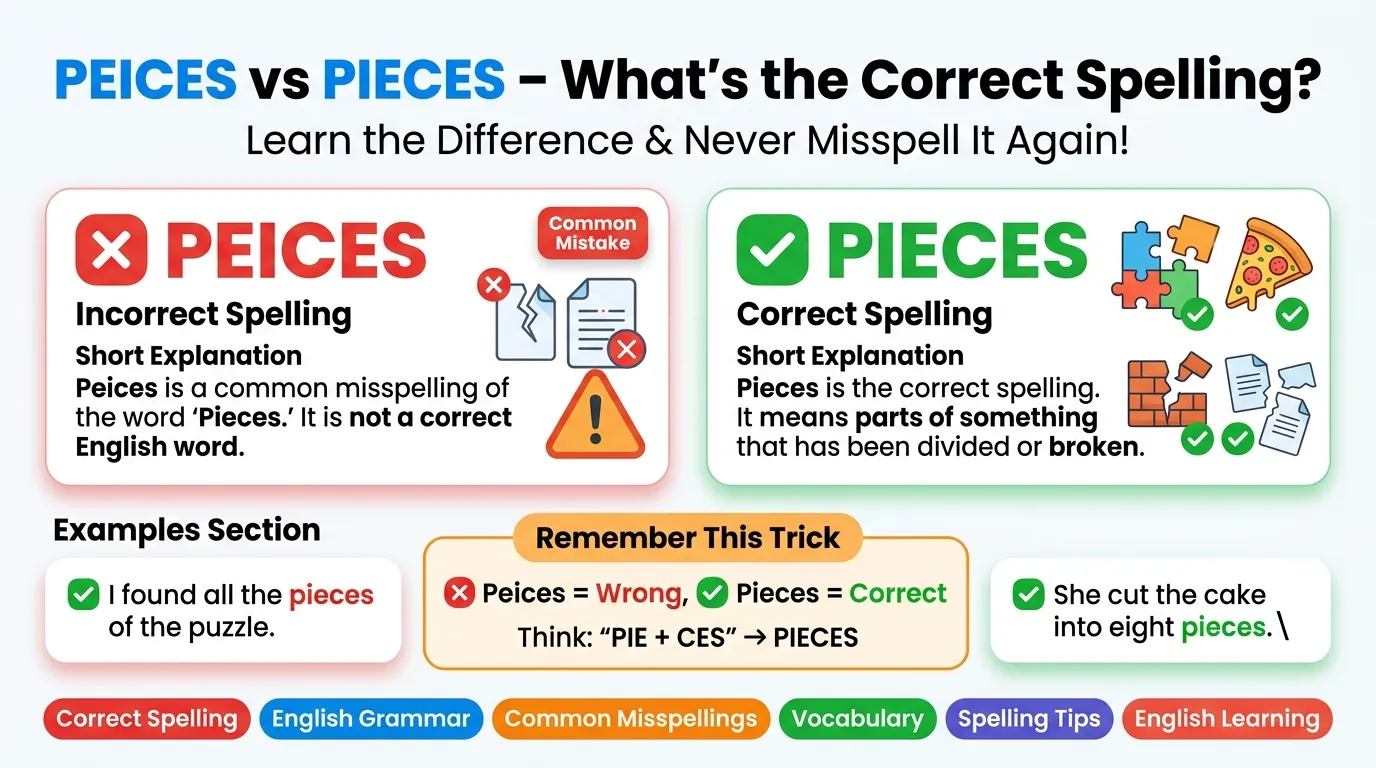
If you’re wondering “peices vs pieces which spelling is correct?”, here’s the quick answer: pieces is the correct spelling, while peices is a common misspelling caused by reversing the letters i and e. If you want to write confidently in English, always use pieces.
This spelling mistake is extremely common among students, professionals, bloggers, and English learners. Fortunately, it’s also one of the easiest to fix. In this guide, you’ll learn the correct spelling of pieces, why people accidentally write peices, how to remember the right spelling forever, and plenty of real-life examples to improve your English writing skills.
Quick Answer
| Word | Correct? | Meaning |
| Peices | ❌ Incorrect | A common spelling mistake |
| Pieces | ✅ Correct | The plural form of piece |
Example
✅ I cut the cake into six pieces.
❌ I cut the cake into six peices.
Bottom line: If you’re choosing between peices or pieces, always write pieces.
Featured Snippet Answer
Is it “Peices” or “Pieces”?
Pieces is the correct spelling. Peices is not a real English word it’s simply a typo caused by switching the positions of i and e. Whether you’re writing an essay, email, report, or social media post, always use pieces.
What Does “Pieces” Mean?
The word pieces is the plural form of piece. Understanding the pieces meaning helps you use it correctly in everyday communication.
A piece refers to:
- A part of something larger
- A portion of food
- A section of an object
- An individual item in a collection
- A work of art or music
- A unit of information or evidence
When there is more than one, the correct plural is pieces.
Pieces Examples
Here are some natural pieces examples:
- She bought three pieces of furniture.
- The mirror broke into tiny pieces.
- We finally found all the puzzle pieces.
- The museum displayed several ancient pieces of art.
- He wrote two beautiful piano pieces.
- Please hand me two pieces of paper.
- I saved the last two pieces of pizza.
- The report contains several important pieces of information.
Notice that every example uses pieces, never peices.
Is “Peices” a Real Word?
One of the most searched questions is:
“Is peices correct?”
The answer is no.
Another common question is:
“Is peices a real word?”
Again, no.
The word peices does not appear in standard English dictionaries because it is simply a common spelling mistake.
Major dictionaries and grammar tools recognize pieces as the correct spelling and flag peices as an error. This is why proofreading and using a spelling checker can help you catch the mistake before publishing or sending your writing.
Why Is “Peices” Wrong?
Many writers accidentally type peices because they reverse the letters i and e.
This happens because English contains many words with similar spelling patterns, making peices spelling one of the most common English spelling mistakes.
For example, people often confuse:
- Receive vs Recieve
- Believe vs Beleive
- Friend vs Freind
- Their vs There vs They’re
- Loose vs Lose
These are all examples of frequently misspelled words.
Although many people remember the rhyme:
“I before E, except after C.”
English contains many exceptions, so it’s safer to memorize the correct piece spelling instead of relying entirely on that rule.
Remember:
Piece → Pieces
Never:
Peice → Peices
Piece or Peice: Which Is Correct?
Another common search is:
Piece or Peice?
The answer is simple.
| Word | Correct? |
| Piece | ✅ Yes |
| Peice | ❌ No |
Examples:
✅ Every piece matters.
✅ That puzzle is missing one piece.
❌ Every peice matters.
❌ That puzzle is missing one peice.
Since the singular word is piece, the plural naturally becomes pieces.
How to Pronounce “Pieces”
Many English learners also ask how to pronounce the word correctly.
IPA Pronunciation
/ˈpiːsɪz/
It sounds like:
PEE-siz
Breaking it into two parts makes pronunciation easier:
PEE + siz
Practicing both the spelling and pronunciation helps improve your overall English vocabulary and writing accuracy.
Where Does the Word “Piece” Come From?
Understanding a word’s history can make it easier to remember.
The word piece comes from Old French, where piece referred to a portion or part of something. It later entered Middle English with a similar meaning and has remained largely unchanged over time.
Today, piece and pieces are standard spellings in all major varieties of English, including American, British, Canadian, and Australian English.
Peices vs Pieces: Comparison Table
| Feature | Peices | Pieces |
| Correct spelling | ❌ No | ✅ Yes |
| Dictionary word | ❌ No | ✅ Yes |
| Used in formal writing | ❌ Never | ✅ Always |
| Accepted in academic writing | ❌ No | ✅ Yes |
| Recognized by spell checkers | ❌ No | ✅ Yes |
| Recommended spelling | ❌ Never | ✅ Always |
The comparison clearly shows that pieces is the only correct spelling.
Pieces in a Sentence
Seeing pieces in a sentence is one of the best ways to remember the correct spelling.
Everyday Conversation
- Please cut the sandwich into four pieces.
- I found the missing pieces under the table.
- The toy broke into several pieces.
- She shared the chocolate in small pieces.
- We cleaned up the broken glass pieces carefully.
School Examples
- The teacher gave each student two pieces of paper.
- The science project had many moving pieces.
- Students analyzed famous literary pieces.
- The class completed the puzzle by joining all the pieces.
- The library displayed historical pieces from local artists.
Workplace Examples
- We received fifty pieces in today’s shipment.
- The machine contains several small metal pieces.
- The report includes three important pieces of evidence.
- Each package contains five pieces.
- The presentation combined several pieces of market research.
Common Spelling Mistakes to Avoid
If you’re learning correct English spelling, avoid these common errors.
| ❌ Incorrect | ✅ Correct |
| Peice | Piece |
| Peices | Pieces |
| Recieve | Receive |
| Beleive | Believe |
| Freind | Friend |
Here are more examples:
❌ Five peices of cake
✅ Five pieces of cake
❌ Puzzle peices
✅ Puzzle pieces
❌ Broken peices
✅ Broken pieces
❌ Important peices of information
✅ Important pieces of information
By recognizing these common typos, you’ll improve your English language learning, build stronger writing habits, and produce more accurate, professional content.
Easy Memory Trick to Remember the Correct Spelling
If you often forget how to remember pieces spelling, try this simple trick.
Think of the word pie.
The word piece begins with PIE.
PIE
↓
PIECE
↓
PIECES
Now imagine cutting a delicious pie into several pieces.
Since you already know how to spell pie, remembering piece and pieces becomes much easier.
Another quick memory aid is this:
There’s a PIE in PIECES.
Every time you’re unsure whether to write peices or pieces, picture a pie cut into pieces.
American vs British English
Many English learners wonder whether the spelling changes in different countries.
The good news is that it doesn’t.
| English Variant | Correct Spelling |
| American English | ✅ Pieces |
| British English | ✅ Pieces |
| Canadian English | ✅ Pieces |
| Australian English | ✅ Pieces |
Unlike words such as color/colour or center/centre, the spelling of pieces is identical in all major forms of English.
So whether you’re writing for readers in the United States, the United Kingdom, Canada, or Australia, always use pieces.
Grammar Tips for Using “Pieces”
Knowing the correct spelling is only part of writing accurately. Understanding how the word functions in a sentence improves your English usage and writing skills.
The word pieces is the plural form of piece, which is a countable noun.
Correct Examples
- Three pieces of cake
- Five pieces of chocolate
- Two pieces of furniture
- Four pieces of advice
- Several pieces of equipment
- Three pieces of information
Notice something important.
Words like advice, information, equipment, and furniture are uncountable nouns. Instead of saying:
❌ Advices
❌ Informations
English uses:
✅ Pieces of advice
✅ Pieces of information
Learning these patterns improves your grammar and spelling and helps you write naturally.
Commonly Confused Words
If you’ve searched for peices vs pieces, you may also struggle with other similar spelling mistakes.
Here are some commonly confused words:
| Incorrect | Correct |
| Peice | Piece |
| Peices | Pieces |
| Recieve | Receive |
| Beleive | Believe |
| Freind | Friend |
| Thier | Their |
| Occured | Occurred |
| Untill | Until |
Mastering these frequently misspelled words will strengthen your overall English vocabulary and reduce common writing errors.
Synonyms for “Pieces”
Depending on the sentence, you can replace pieces with several related words.
Common synonyms include:
- Parts
- Portions
- Sections
- Fragments
- Segments
- Components
- Elements
- Chunks
- Bits
- Units
Examples
Original
The mirror broke into many pieces.
Alternative
The mirror broke into many fragments.
Choosing the right synonym improves readability while expanding your vocabulary.
Why Correct Spelling Matters
Some people think spelling mistakes are minor, but they can influence how readers perceive your writing.
Using the correct word helps you:
- Build credibility.
- Improve communication.
- Create professional documents.
- Perform better in school and exams.
- Increase reader trust.
- Improve online readability.
- Strengthen your writing accuracy.
- Support better SEO for blog content.
Whether you’re writing an assignment, business email, article, or social media post, avoiding spelling errors like peices makes your work more polished and easier to understand.
Expert Tip
Professional editors, teachers, dictionaries, and grammar-checking tools consistently recognize pieces as the correct spelling. The form peices is treated as a misspelling rather than an accepted English variant.
Whenever you’re uncertain, checking a trusted dictionary or proofreading your work can help you catch this error before publishing.
Quick Quiz
Test yourself.
Which sentence is correct?
A.
I bought three peices of cake.
B.
I bought three pieces of cake.
✅ Correct Answer: B
Try another one.
Which spelling is correct?
A. Peices
B. Pieces
✅ Correct Answer: Pieces
If you answered both correctly, you’ve already mastered one of the most common English spelling mistakes.
Frequently Asked Questions
1. Which is correct: peices or pieces?
Pieces is the correct spelling. Peices is an incorrect spelling caused by reversing the letters i and e.
2. Is peices a real word?
No. If you’re asking “is peices a real word?”, the answer is no. It isn’t recognized by standard English dictionaries.
3. What is the correct spelling of pieces?
The correct spelling of pieces is simply:
Pieces
This is the only accepted spelling in English.
4. Why is peices wrong?
The spelling peices is wrong because the letters i and e are reversed. The correct singular word is piece, so the plural naturally becomes pieces.
5. How do you spell pieces correctly?
If you’re wondering how to spell pieces correctly, remember:
Piece → Pieces
Or think of the memory trick:
Pie → Piece → Pieces
6. What does pieces mean?
The pieces meaning refers to separate parts, portions, sections, fragments, or individual items that together form a whole.
7. Is pieces singular or plural?
Pieces is the plural form of piece.
- One piece
- Two pieces
8. Does spell check detect peices?
Yes. Nearly every modern spelling checker identifies peices as incorrect and recommends pieces instead.
Final Verdict:
There is no debate when it comes to peices vs pieces. The correct spelling is always pieces, while peices is simply a common typo. Although many people accidentally reverse the letters i and e, this mistake is easy to avoid once you understand the correct spelling pattern and practice it in your everyday writing.
If you’re writing an email, school assignment, blog post, business report, or social media caption, using pieces shows attention to detail and strong language skills. Remember the simple rule: there’s a “pie” in “piece.” That one memory trick can help you avoid this spelling mistake for life.
Actionable Takeaway
Before you click Send or Publish, take a few seconds to proofread your work. If you ever hesitate between peices or pieces, remember this simple formula:
❌ PEICES
↓
✅ PIECES
Think of a pie cut into pieces, and you’ll always choose the correct spelling. Small improvements like this make your writing clearer, more professional, and more trustworthy.

Liam Noah is a passionate language writer at SpellExact, specializing in spelling mistakes, grammar, word confusion, and American vs. British English. He creates clear, practical content that helps readers write and communicate with confidence.