If you’ve ever paused while writing and wondered whether “weeped” or “wept” is correct, you’re asking a common English grammar question.
Since many English verbs form the past tense by adding -ed, it’s understandable why some people assume weeped is right. However, English also has many irregular verbs that don’t follow this pattern.
Quick Answer:
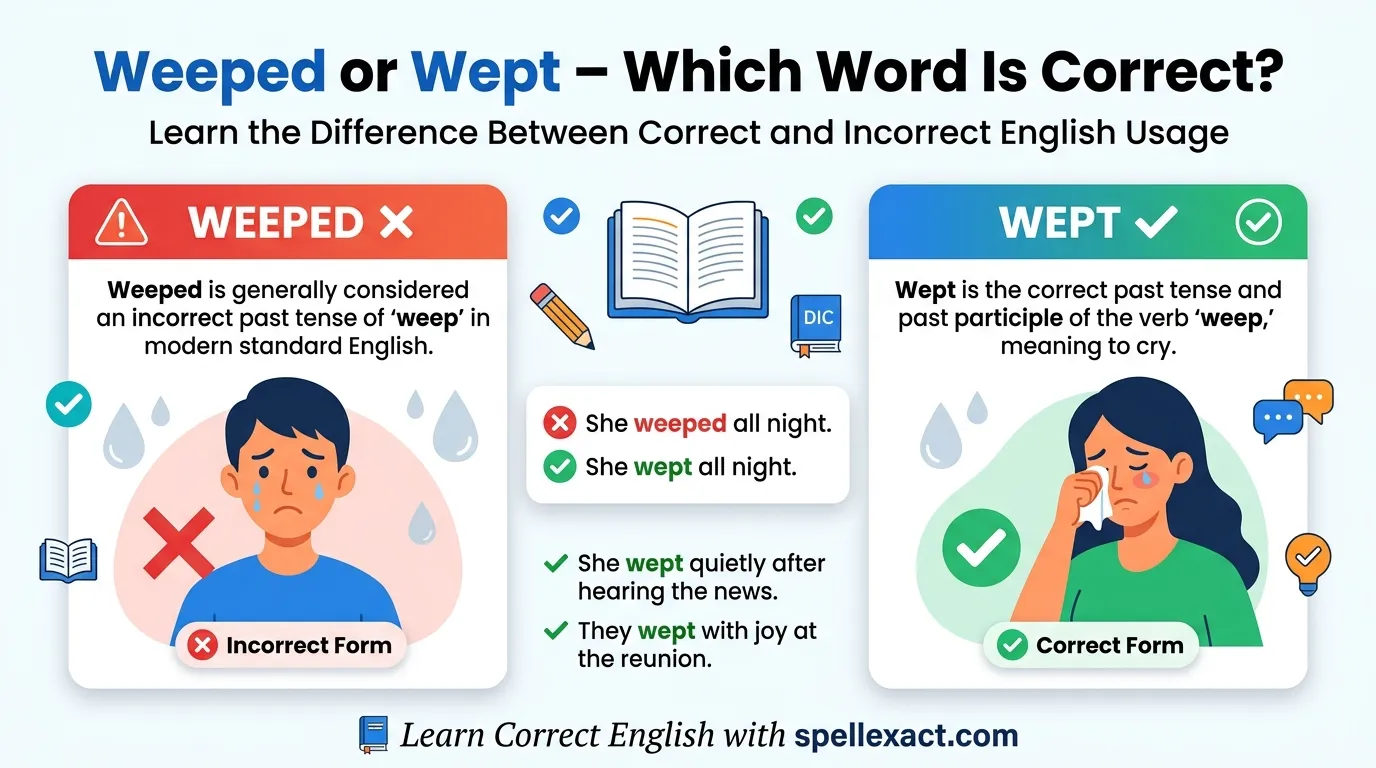
Wept is the correct past tense and past participle of weep. Weeped is not considered standard English and should be avoided in formal, academic, professional, and everyday writing.
Major English dictionaries, including Cambridge Dictionary, Merriam-Webster, and Oxford English Dictionary, recognize wept as the standard form. In this guide, you’ll learn why wept is correct, why weeped sounds logical but isn’t accepted, and how to remember the correct form with practical examples.
Quick Answer
If you’re looking for the shortest possible answer, here it is:
| Word | Correct? | Should You Use It? |
| Wept | ✅ Yes | Standard English |
| Weeped | ❌ No | Avoid in writing and speech |
Correct Example:
- She wept after hearing the heartbreaking news.
Incorrect Example:
- She weeped after hearing the heartbreaking news.
Whenever you’re talking about someone crying in the past, wept is the correct choice.
What Does “Weep” Mean?
The verb weep means to cry, shed tears, or express deep emotion, usually because of sadness, grief, disappointment, relief, or even overwhelming happiness.
Compared with the everyday verb cry, weep often carries a stronger emotional tone. It is commonly used in literature, formal writing, historical texts, speeches, religious writings, and emotional storytelling.
Examples
- The little girl began to weep when she couldn’t find her mother.
- Many people weep during emotional movies.
- He quietly wept after reading the letter.
- She was weeping with joy when her family surprised her.
Although cry is more common in everyday conversation, weep often suggests deeper emotion or prolonged crying.
How to Pronounce “Weep” and “Wept”
Correct pronunciation helps you recognize and use these words confidently.
| Word | Pronunciation |
| Weep | /wiːp/ |
| Wept | /wept/ |
Notice that the pronunciation changes along with the spelling because weep is an irregular verb.
Is It Weeped or Wept?
The correct form is wept.
This is because weep belongs to a group of irregular English verbs. Unlike regular verbs that simply add -ed, irregular verbs change their spelling when forming the past tense.
Verb Forms
| Verb Form | Correct Form |
| Base Verb | Weep |
| Present Simple | Weep / Weeps |
| Present Participle | Weeping |
| Past Tense | Wept |
| Past Participle | Wept |
Examples:
- Present: I weep whenever I hear that song.
- Past: I wept after watching the documentary.
- Present Perfect: I have wept before.
- Past Perfect: She had wept all night.
- Continuous: They are weeping quietly.
The form weeped does not follow standard English grammar and should be avoided.
Why Is “Weep” an Irregular Verb?
Many learners expect the past tense to be weeped because most English verbs follow this pattern:
- Walk → Walked
- Cook → Cooked
- Watch → Watched
However, English inherited many verbs from Old English, and some of them kept their unique historical forms. These are called irregular verbs.
The verb weep belongs to the same family as:
| Base Verb | Past Tense |
| Keep | Kept |
| Sleep | Slept |
| Sweep | Swept |
| Weep | Wept |
Instead of adding -ed, these verbs change part of their spelling.
Learning them together makes them much easier to remember.
Why Do People Write “Weeped”?
This mistake is surprisingly common, especially among English learners.
There are three main reasons:
1. Most English Verbs Are Regular
People naturally assume every verb forms the past tense by adding -ed.
For example:
- Help → Helped
- Paint → Painted
- Open → Opened
Following this pattern, weeped seems logical—but English doesn’t always follow simple rules.
2. Irregular Verbs Can Be Difficult
English contains hundreds of irregular verbs.
Some examples include:
- Go → Went
- Speak → Spoke
- Write → Wrote
- Sleep → Slept
- Weep → Wept
Because these forms must be memorized, mistakes happen frequently.
3. Spelling Pattern Confusion
Many people focus only on spelling instead of learning verb families.
Once you recognize the pattern:
- Keep → Kept
- Sleep → Slept
- Sweep → Swept
- Weep → Wept
the correct form becomes much easier to remember.
Is “Weeped” Ever Correct?
In modern standard English, no.
While you might occasionally find weeped in:
- very old texts,
- learner writing,
- internet forums,
- or typographical errors,
it is not accepted as the standard past tense by respected dictionaries or grammar guides.
If you’re writing:
- school assignments,
- blog articles,
- books,
- business emails,
- academic papers,
- or professional documents,
always use wept.
Using weeped may make your writing appear grammatically incorrect.
What Do Major Dictionaries Say?
Trusted dictionaries consistently list wept as the correct past tense and past participle of weep.
They recognize:
- Weep — base verb
- Wept — past tense
- Wept — past participle
- Weeping — present participle
You won’t find weeped listed as the standard past tense in respected modern dictionaries. This consistency across leading references reinforces that wept is the correct form in contemporary English.
Origin of the Word “Wept”
Understanding a word’s history often makes it easier to remember.
The verb weep comes from the Old English word wēpan, meaning to cry or lament.
Over hundreds of years, English pronunciation and spelling changed, but many common verbs kept their historical past-tense forms.
That’s why today we still say:
- Keep → Kept
- Sleep → Slept
- Sweep → Swept
- Weep → Wept
These inherited patterns are one reason English has irregular verbs.
Weep vs Cry: What’s the Difference?
Although both words involve shedding tears, they aren’t always used in the same situations.
| Feature | Weep | Cry |
| Meaning | Deep or emotional crying | General shedding of tears |
| Tone | Formal, literary, emotional | Everyday and conversational |
| Common in speech | Less common | Very common |
| Common in literature | Very common | Common |
| Emotional intensity | Usually stronger | Can vary |
Examples
Cry
- The baby cried because she was hungry.
- My son cried after falling off his bicycle.
Weep
- The family wept during the memorial service.
- She wept with happiness after hearing she had won the award.
- They wept as they said goodbye to their grandparents.
Both verbs are correct, but weep often emphasizes deeper, more heartfelt emotion.
Real-Life Examples of “Wept”
Seeing words in realistic situations makes them easier to remember.
At a Funeral
Everyone wept quietly as family members shared their memories.
During a Wedding
The bride wept tears of joy while reading her vows.
Watching a Movie
We wept at the emotional ending because the story reminded us of our own experiences.
Reading a Novel
Many readers wept when the main character sacrificed everything for her family.
Celebrating Good News
After years of waiting, they wept with happiness when they finally adopted their child.
These examples show that wept can describe tears caused by sadness, relief, gratitude, love, or overwhelming joy not just grief.
Common Mistakes to Avoid
Even advanced English learners occasionally misuse wept because it doesn’t follow the regular -ed pattern. Avoid these common mistakes to make your writing sound natural and grammatically correct.
Mistake 1: Using “Weeped” as the Past Tense
❌ Incorrect: She weeped after hearing the sad news.
✅ Correct: She wept after hearing the sad news.
Remember, weep is an irregular verb, so its past tense is wept, not weeped.
Mistake 2: Confusing “Wept” with “Weeping”
❌ Incorrect: They were wept all afternoon.
✅ Correct: They were weeping all afternoon.
- Wept = past tense or past participle
- Weeping = present participle (used in continuous tenses)
Mistake 3: Using “Wept” in the Present Tense
❌ Incorrect: Every time she watches that movie, she wept.
✅ Correct: Every time she watches that movie, she weeps.
Mistake 4: Forgetting the Past Participle
❌ Incorrect: She has weeped many times.
✅ Correct: She has wept many times.
American vs British English
Many spelling questions have different answers depending on whether you’re writing in American or British English. Fortunately, this isn’t one of them.
Both varieties use exactly the same verb forms.
| English Variety | Correct Form |
| American English | Wept |
| British English | Wept |
| Canadian English | Wept |
| Australian English | Wept |
No matter where your audience is located, wept is the accepted standard.
Similar Irregular Verbs
Learning related irregular verbs together makes them easier to remember.
| Base Verb | Past Tense | Past Participle |
| Keep | Kept | Kept |
| Sleep | Slept | Slept |
| Sweep | Swept | Swept |
| Feel | Felt | Felt |
| Leave | Left | Left |
| Weep | Wept | Wept |
Notice how several verbs ending in -eep change to -ept in the past tense.
Remember This
Quick Memory Trick
✔ Weep → Wept
✔ Keep → Kept
✔ Sleep → Slept
✔ Sweep → Swept
❌ Never write weeped in standard English.
If you can remember kept and slept, you’ll easily remember wept too.
Writer’s Tip
If you’re choosing between cried and wept, think about the tone of your writing.
- Use cried for everyday conversations and informal writing.
- Use wept when describing deep emotions, grief, relief, gratitude, or dramatic moments in stories, speeches, biographies, or formal writing.
For example:
- The toddler cried because he was tired.
- The mother wept with relief when her missing son returned home safely.
Choosing the right word helps your writing feel more natural and emotionally accurate.
Mini Grammar Quiz
Test your understanding before you leave.
1. Which sentence is correct?
A. She weeped yesterday.
B. She wept yesterday.
✅ Answer: B
2. Which is the correct past participle?
A. Weeped
B. Wept
✅ Answer: B
3. Complete the sentence:
“They had ______ before the ceremony started.”
A. Weeped
B. Wept
✅ Answer: B
4. Which sentence uses the present tense correctly?
A. He weeps whenever he hears that song.
B. He wept whenever he hears that song.
✅ Answer: A
If you answered all four correctly, you’ve mastered this grammar rule.
Frequently Asked Questions
Is “weeped” a real word?
Weeped may occasionally appear in informal writing, learner errors, or very old texts, but it is not the accepted past tense of weep in modern standard English. Use wept instead.
Which is correct: weeped or wept?
Wept is the correct past tense and past participle of weep.
Example:
- She wept after reading the emotional letter.
Why is “wept” correct instead of “weeped”?
Because weep is an irregular verb. Like keep → kept and sleep → slept, it changes form instead of adding -ed.
Is “wept” still used today?
Yes. Although cry is more common in everyday conversation, wept is still widely used in books, journalism, speeches, religious texts, and formal writing.
Can “wept” describe happy tears?
Absolutely. People can weep because of joy, relief, gratitude, pride, or overwhelming happiness—not only sadness.
Example:
- The grandparents wept with joy when they met their first grandchild.
What is the past participle of “weep”?
The past participle is wept.
Example:
- She has wept many times since the event.
Is “weep” a formal word?
Yes. Compared with cry, weep sounds more formal, literary, and emotionally expressive.
How can I remember the correct form?
Think of this pattern:
- Keep → Kept
- Sleep → Slept
- Sweep → Swept
- Weep → Wept
This simple pattern makes the correct form easy to remember.
Related Grammar Topics
If you’re learning English verb forms, you may also find these topics helpful:
- Irregular verb lists
- Past tense vs. past participle
- Regular and irregular verbs
- Common English grammar mistakes
- Cry vs. Weep
- Dreamed vs. Dreamt
- Spelled vs. Spelt
- Learned vs. Learnt
Exploring related grammar topics will strengthen your understanding of English and help you avoid similar mistakes in the future.
Summary
If you’ve been wondering whether weeped or wept is correct, the answer is clear: wept is the only standard past tense and past participle of weep. Although weeped may seem logical because many English verbs end in -ed, weep is an irregular verb that follows a historical pattern shared by verbs like keep, sleep, and sweep. Major dictionaries and grammar authorities consistently recognize wept as the correct form in both American and British English.
Using the correct verb form makes your writing more accurate, professional, and trustworthy. Whether you’re writing an essay, blog post, email, novel, or social media caption, choosing wept instead of weeped shows a solid understanding of English grammar. Practice using the examples in this guide, remember the keep → kept → weep → wept pattern, and you’ll avoid this common mistake with confidence.
Actionable Takeaway
Before you finish any piece of writing, take a moment to check irregular verbs. If you’re ever unsure about weeped or wept, remember this simple rule:
Weep → Wept → Wept
Save this guide for future reference, practice the example sentences, and continue learning related irregular verbs to improve your English writing naturally and confidently.

Caleb Carter is a passionate language enthusiast and content writer specializing in spelling mistakes, grammar, and vocabulary. He creates clear, practical guides that help readers improve their writing skills and communicate confidently every day.