If you have ever hesitated between reinforce vs reenforce, you are not alone. These two spellings look almost identical, and it is easy to wonder whether they have different meanings or whether both are accepted forms of the same word.
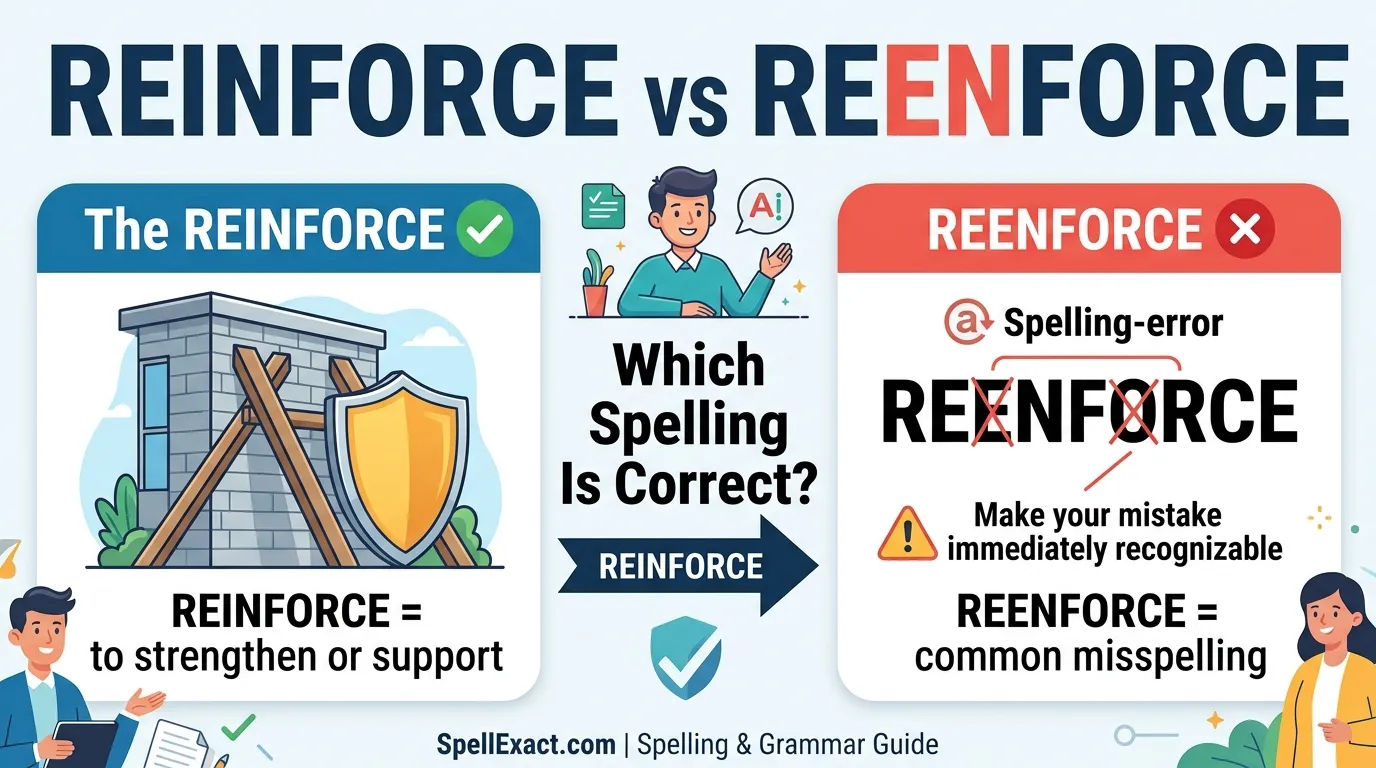
The good news is that the choice is much simpler than it first appears. Reinforce is the standard and correct spelling in modern English.
Reenforce is a less common variant that you may occasionally encounter, but it is generally not the preferred spelling in contemporary writing. Let’s break down the difference so you can confidently choose the right word every time.
Quick Answer
Reinforce is the standard spelling you should use in modern English.
Reenforce is an alternative spelling that exists in historical and dictionary records, but it is uncommon in current standard English.
- Correct/preferred: reinforce
- Less common variant: reenforce
- Meaning: to strengthen, support, make something stronger, or emphasize an idea
- Past tense: reinforced
- Present participle: reinforcing
Example:
“The steel beams were added to reinforce the building.”
Reinforce vs Reenforce: The Main Difference
The main difference between reinforce and reenforce is not their meaning but their spelling and modern usage.
Reinforce is the overwhelmingly preferred spelling. It can describe physically strengthening something, such as a wall or bridge, or figuratively strengthening an idea, belief, behavior, or argument.
Reenforce has been used as a variant spelling, but it is much less common. In most modern writing, especially academic, professional, business, educational, and online content, reinforce is the safer and more natural choice.
| Word | Status | Meaning | Modern Usage |
| reinforce | Standard/preferred | To strengthen or support | Very common |
| reenforce | Variant/less common | Same basic meaning | Rare |
| reinforced | Standard past tense | Made stronger | Very common |
| reinforcing | Standard -ing form | Making stronger | Very common |
If you are writing for a general audience, there is little reason to choose reenforce over reinforce.
What Does Reinforce Mean?
The verb reinforce means to make something stronger, more effective, or more firmly established.
The word can be used in both physical and abstract situations.
Physical meaning
When something is physically strengthened, it can be reinforced.
For example:
- Engineers reinforced the bridge before allowing heavy vehicles to cross.
- The workers reinforced the wall with steel bars.
- The wooden frame was reinforced to prevent further damage.
- Extra supports were added to reinforce the roof.
In these examples, reinforce means to strengthen a physical structure.
Figurative meaning
Reinforce can also describe strengthening an idea, belief, habit, message, or feeling.
For example:
- The teacher used examples to reinforce the lesson.
- The evidence reinforced her argument.
- Positive feedback reinforced his confidence.
- The results reinforced the researchers’ original conclusion.
Here, nothing is physically being strengthened. Instead, an idea, belief, argument, or behavior becomes stronger.
Reinforce Meaning in Simple English
If you want to remember the meaning quickly, think of reinforce as:
to make stronger or give additional support
This simple definition works in many situations.
For example, if a wall needs additional support, you reinforce the wall. If evidence makes an argument stronger, the evidence reinforces the argument.
That is why the word appears frequently in construction, education, psychology, business, writing, and everyday conversation.
What Does Reenforce Mean?
Reenforce is a recognized variant spelling of reinforce, but it is much less common in contemporary English.
In most situations, reenforce does not give you a different meaning. It generally refers to the same concept of strengthening or supporting something.
For example, you might occasionally see:
- “The evidence reenforced his opinion.”
However, modern readers will generally expect:
- “The evidence reinforced his opinion.”
Because reinforce is the established modern spelling, it is the better choice for almost all everyday and professional writing.
Why Is “Reinforce” More Common?
English spelling has developed through centuries of linguistic change, and some words have retained alternative spellings. Reenforce is one of those less-common variants.
The spelling reinforce is now firmly established in modern English. It is the form most readers expect to see in dictionaries, books, educational materials, professional documents, and online publications.
This matters because correct spelling is not only about whether a word can be found somewhere in a dictionary. Good writing also considers standard usage, clarity, reader expectations, and consistency.
If your goal is clear modern English, choose reinforce.
Reinforce Examples in Everyday Sentences
Here are several natural examples showing how reinforce works in different contexts.
Education
“The teacher repeated the main concept to reinforce the students’ understanding.”
Construction
“The contractor reinforced the foundation before expanding the building.”
Business
“The company introduced a training program to reinforce its customer-service standards.”
Psychology and behavior
“Rewards can reinforce positive behavior.”
Writing and communication
“The final paragraph reinforces the article’s central message.”
Evidence and arguments
“New evidence reinforced the scientist’s original theory.”
Relationships
“Her kind words reinforced his confidence during a difficult time.”
These examples demonstrate why reinforce is such a versatile word.
Common Mistakes With Reinforce vs Reenforce
One of the biggest mistakes is assuming that the two spellings are equally common simply because both can be found in written sources.
Mistake 1: Using “reenforce” in formal writing
Although reenforce may appear as a variant, it can look unusual or outdated to many modern readers.
Better:
“The results reinforced the conclusion.”
Mistake 2: Thinking “reinforce” means only physical strengthening
Reinforce can describe both physical and abstract strengthening.
Physical:
“The bridge was reinforced.”
Abstract:
“The evidence reinforced her belief.”
Mistake 3: Misspelling the past tense
The correct past-tense form is:
reinforced
Not:
- reinforceed
- reenforced, when following the preferred modern spelling
- re-inforced
Mistake 4: Confusing reinforce with repeat
To reinforce an idea can involve repeating it, but the two words are not exact synonyms.
Repeat means to say or do something again.
Reinforce means to make something stronger or more effective, sometimes by repetition, evidence, support, or encouragement.
Reinforce vs Strengthen
Reinforce and strengthen are closely related synonyms, but they can have slightly different nuances.
Strengthen is a broad term meaning to make something stronger.
Reinforce often suggests adding support to something that already exists.
Compare:
- “Exercise strengthens the muscles.”
- “Steel beams reinforce the structure.”
You can also use reinforce in abstract situations:
- “The experience strengthened her confidence.”
- “The positive feedback reinforced her confidence.”
Both can work, but reinforce often emphasizes additional support or confirmation.
Reinforce Synonyms
Depending on the context, useful synonyms for reinforce include:
- strengthen
- support
- bolster
- fortify
- encourage
- confirm
- emphasize
- intensify
- consolidate
- underpin
- enhance
Not every synonym works in every sentence, so choose one based on the intended meaning.
For example, fortify is particularly suitable for physical or defensive strengthening, while bolster often works well for confidence, arguments, or support.
American vs British English: Is There a Difference?
There is no major American vs British English difference in the preferred spelling of this word.
Both American English and British English commonly use reinforce.
For example:
American English:
“The evidence reinforced the conclusion.”
British English:
“The evidence reinforced the conclusion.”
The same spelling is standard in both varieties.
While reenforce may appear occasionally in historical, older, or variant usage, it is not a normal American-versus-British spelling distinction like color/colour or organize/organise.
Therefore, if you are writing for either American or British readers, reinforce is the safest choice.
How to Remember the Correct Spelling
A simple way to remember reinforce is to connect it with the idea of additional support.
Think:
reinforce = support + make stronger
You can also remember the spelling by noticing the “in” after “re”:
re + in + force = reinforce
This can help you avoid accidentally writing reenforce when you mean the standard modern spelling.
Reinforce in Different Word Forms
Knowing related forms can make the spelling easier to remember.
- Reinforce — base verb
- Reinforced — past tense
- Reinforcing — present participle
- Reinforcement — noun
- Reinforcer — something or someone that reinforces
Examples:
- “The walls need to be reinforced.”
- “The teacher is reinforcing the lesson.”
- “The company provided additional reinforcement.”
- “The feedback acted as a reinforcer of the behavior.”
Notice that these related forms consistently use the rein- spelling.
Is Reenforce a Misspelling?
Not exactly. Reenforce has existed as a variant spelling, so calling it simply a spelling error can be misleading.
However, there is an important practical distinction between being historically or technically attested and being the preferred spelling in modern standard English.
If you are writing an essay, website article, business email, school assignment, report, or professional document, use reinforce.
That choice is more familiar to modern readers and avoids unnecessary confusion.
Quick Comparison: Reinforce vs Reenforce
| Feature | Reinforce | Reenforce |
| Standard modern spelling | Yes | No, generally |
| Meaning | Strengthen/support | Same basic meaning |
| Common today | Yes | Rare |
| Suitable for formal writing | Yes | Usually avoid |
| American English | Common | Rare |
| British English | Common | Rare |
| Past tense | Reinforced | Reenforced, as a variant |
| Best choice | Yes | Usually no |
FAQs About Reinforce vs Reenforce
1. Is reinforce or reenforce correct?
Reinforce is the standard and preferred spelling in modern English. Reenforce exists as a less-common variant but is rarely the best choice today.
2. Does reinforce mean strengthen?
Yes. Reinforce commonly means to make something stronger by adding support, evidence, encouragement, or additional material.
3. Is reenforce a real word?
Yes, reenforce has been used as a variant spelling of reinforce. However, it is uncommon in modern standard English, so reinforce is normally preferable.
4. What is the past tense of reinforce?
The past tense is reinforced.
Example: “The workers reinforced the damaged wall.”
5. Is reinforce the same in American and British English?
Yes. Reinforce is the standard spelling in both American and British English.
6. What is the noun form of reinforce?
The noun is reinforcement.
Example: “The bridge requires additional reinforcement.”
7. Can reinforce be used for ideas?
Absolutely. You can reinforce an argument, belief, lesson, message, opinion, habit, or conclusion.
Example: “The research reinforced the importance of regular practice.”
8. Should I use reenforce in formal writing?
It is better to use reinforce. Although reenforce may be recognized as a variant, reinforce is much more familiar and widely accepted in contemporary formal writing.
Final Summary
When choosing between reinforce vs reenforce, the safest and most accurate answer is reinforce. It is the standard modern spelling and works for both physical and figurative meanings. You can reinforce a building, wall, bridge, argument, belief, lesson, habit, or message.
Reenforce is a less-common variant spelling rather than a word with a substantially different meaning. Since modern readers overwhelmingly expect reinforce, using the standard spelling will make your writing clearer, more natural, and more professional. Whether you are writing in American or British English, reinforce is the preferred choice.
Actionable Takeaway
Whenever you are unsure, remember:
Reinforce = the standard spelling.
If you are writing a sentence today, choose reinforce, reinforced, reinforcing, or reinforcement rather than the less-common reenforce forms.

Maria Megan is a language enthusiast and content writer specializing in spelling, grammar, and English usage. She creates clear, practical articles that help readers identify common spelling mistakes, improve writing accuracy, and communicate with greater confidence.