Have you ever typed “gummie” and wondered whether it should actually be “gummy”? You are not alone. This is a common spelling confusion, especially when writing about gummy candies, gummy bears, or something described as soft and sticky.
The good news is simple: “gummy” is the standard and correct English spelling, while “gummie” is generally considered a misspelling when you mean the ordinary English word. In this guide, we will explain the difference between gummy vs gummie, show you how to use the correct form, and give you practical examples so you can remember it easily.
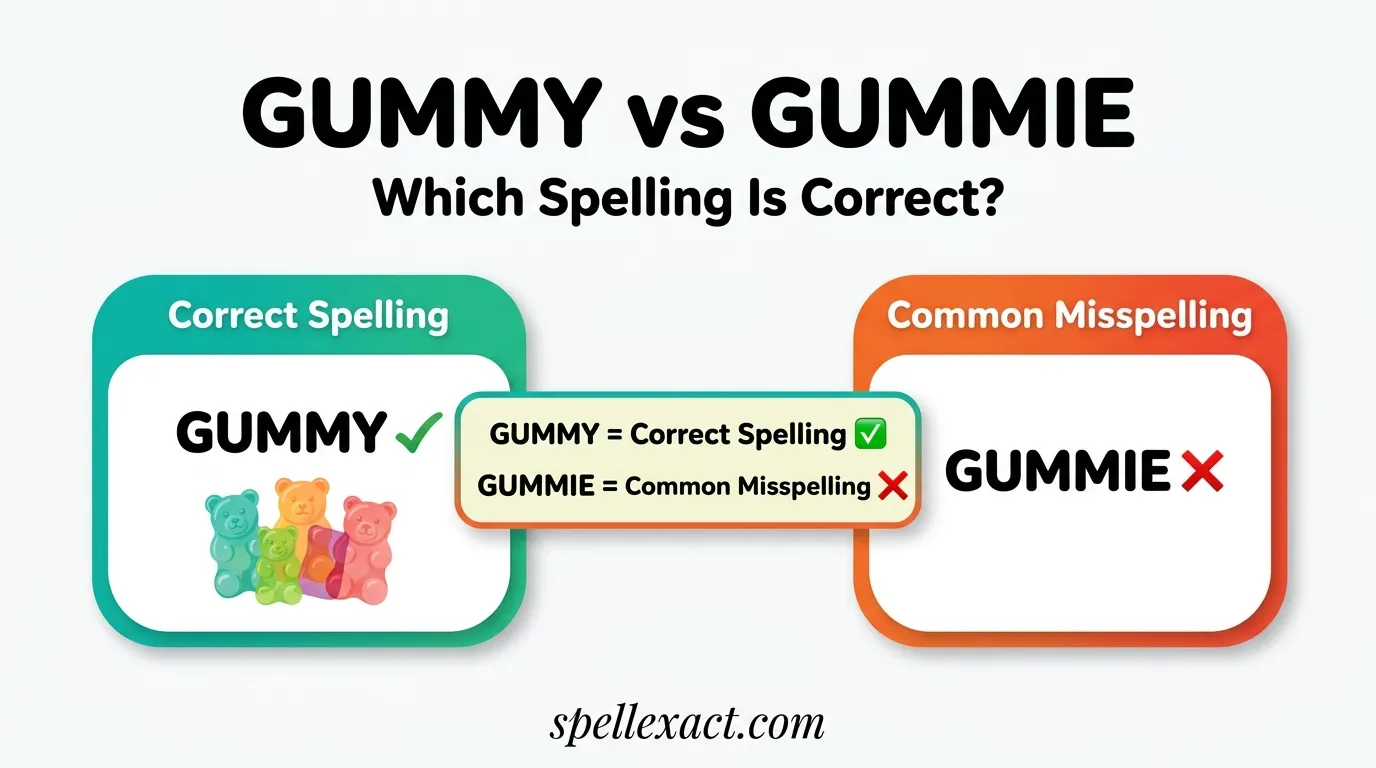
Quick Answer:
Gummy is the correct standard spelling in English.
Gummie is generally an incorrect spelling when you are trying to write the word gummy.
- ✅ Gummy — correct
- ❌ Gummie — usually incorrect
- ✅ Gummy bears
- ✅ Gummy candy
- ✅ Gummy texture
- ❌ Gummie bears
- ❌ Gummie candy
The spelling gummy is used in both American and British English. There is no standard American-versus-British spelling difference that changes gummy to gummie.
What Does “Gummy” Mean?
The word gummy is an adjective that describes something having a soft, sticky, or chewy texture similar to gum.
For example, you might describe candy as gummy because it is soft and chewy. You can also use the word in other contexts to describe something sticky or having a gum-like consistency.
Examples include:
- The children enjoyed eating gummy bears.
- This candy has a soft, gummy texture.
- The mixture became gummy after it cooled.
- I bought some gummy candy from the store.
- The substance felt sticky and gummy.
The word can also appear in expressions such as gummy smile and gummy candy, where it has a meaning related to gums or a gum-like quality depending on the context.
What Does “Gummie” Mean?
Gummie is not normally the standard spelling of the English word gummy.
People often write gummie because English spelling patterns can make the ending seem confusing. Since many English words change their spelling when forming plurals or related forms, it is understandable that someone might assume gummie is correct.
However, when you mean the adjective gummy, the standard spelling retains the -y:
gummy
not:
gummie
So if you are writing an article, school assignment, product description, email, or social media post, gummy is the safer and standard choice.
Gummy vs Gummie: Comparison Table
| Word | Correct? | Meaning | Example |
| Gummy | ✅ Yes | Soft, sticky, or chewy | I bought some gummy candy. |
| Gummie | ❌ Usually no | Common misspelling of gummy | I bought gummie candy. |
| Gummy bear | ✅ Yes | A type of chewy candy | She ate a gummy bear. |
| Gummy candy | ✅ Yes | Soft, chewy candy | These gummy candies are popular. |
| Gummie bear | ❌ No | Misspelling | Avoid this spelling in standard English. |
The important point is that gummy is the standard dictionary spelling for the ordinary English word.
Why Do People Spell It “Gummie”?
The confusion usually comes from the way English words change endings.
For example, some words ending in -y change to -ies when forming a plural:
- baby → babies
- city → cities
- story → stories
- party → parties
Because of these familiar patterns, it can be tempting to think that gummy should somehow become gummie.
But gummie is not the normal spelling of the singular adjective. The word remains:
gummy
For the plural noun referring to candies, you would normally write:
gummies
For example:
- I bought one gummy.
- I bought several gummies.
This distinction is important because gummies and gummie are not interchangeable.
Gummy or Gummies: Understanding the Difference
This is where the spelling can become especially confusing.
Gummy is the singular adjective or noun form.
Gummies is the plural form when referring to gummy candies or similar products.
Examples:
- This is a gummy candy.
- I ate one gummy.
- These are delicious gummies.
- She bought a bag of gummies.
Notice the spelling:
gummy → gummies
The final y changes to ie before the plural s.
That does not mean the singular word is spelled gummie.
Examples of “Gummy” in Sentences
Seeing the correct spelling in context is one of the easiest ways to remember it.
Example 1: Gummy Candy
I bought a packet of gummy candy for the party.
Here, gummy describes the type and texture of the candy.
Example 2: Gummy Bears
My favorite childhood snack was gummy bears.
The standard spelling is gummy bears, not gummie bears.
Example 3: Gummy Texture
The dough became too gummy after I added too much liquid.
Here, gummy describes the texture.
Example 4: Gummy Vitamins
Some children prefer gummy vitamins because they are easier to chew.
Again, gummy is the correct spelling.
Example 5: Gummy Smile
The dentist explained the possible causes of a gummy smile.
In this expression, gummy has a different meaning related to the gums, but the spelling remains the same.
Common Mistakes With Gummy and Gummie
The most common mistake is simply replacing the -y ending with -ie.
Incorrect
I bought some gummie bears.
Correct
I bought some gummy bears.
Another common mistake is confusing gummie with gummies.
Incorrect
She bought three gummie.
Correct
She bought three gummies.
Remember that gummie is not the standard singular spelling.
Another Common Mistake: Gummy vs Gummies
These two words serve different grammatical purposes:
- gummy — adjective or singular noun
- gummies — plural noun
For example:
This is a gummy bear.
But:
These are gummies.
American English vs British English: Is There a Difference?
If you are wondering whether Americans spell it gummy while British speakers spell it gummie, the answer is no.
The standard spelling gummy is used in both American English and British English.
For example:
American English:
I bought gummy bears.
British English:
I bought gummy bears.
The spelling does not normally change based on which variety of English you are using.
This makes gummy easier to remember than some other words that have genuine American and British spelling differences, such as color/colour or favorite/favourite.
Is “Gummie” Ever Used?
You may occasionally encounter gummie online, in usernames, brand names, informal writing, names, or other nonstandard contexts. A particular company, product, character, or nickname could also intentionally use an unusual spelling.
However, seeing gummie used somewhere does not make it the standard spelling of the ordinary English word.
If you are writing standard English and want to describe something soft, sticky, or chewy, use gummy.
This distinction is especially useful for writers, students, bloggers, editors, and anyone creating online content where correct spelling matters.
Easy Trick to Remember the Correct Spelling
Here is a simple memory trick:
Gum + my = gummy
Think of the word as:
gum + my → gummy
The ending is -y, not -ie.
When you need the plural form of the noun, however, the spelling changes:
gummy → gummies
You can remember it this way:
One gummy, two gummies.
This makes the difference much easier to remember.
Why Correct Spelling Matters
A single spelling mistake may seem unimportant, but correct spelling improves the clarity and credibility of your writing.
If you are writing a blog post, product description, educational article, school assignment, or business page, using gummy instead of gummie helps your content look polished and professional.
Correct spelling can also make your writing easier for readers to understand. When people search for information about gummy candy, gummy bears, or gummy vitamins, using the standard spelling naturally aligns your content with the language readers expect.
For SEO writers and website owners, the best approach is not to repeatedly insert a misspelling just to target it. Instead, explain the spelling difference naturally and focus on useful, reader-first content.
Final Verdict
When choosing between gummy vs gummie, the answer is straightforward: gummy is the correct standard spelling for the ordinary English word. It can describe something soft, sticky, or chewy and appears in familiar expressions such as gummy bears, gummy candy, and gummy vitamins.
Gummie is generally a misspelling and should be avoided in standard English. If you need the plural noun for gummy candies, use gummies, not gummie. And remember that the standard spelling is the same in both American and British English.
FAQs
1. Is gummy or gummie correct?
Gummy is the correct standard spelling. Gummie is generally considered a misspelling when referring to the ordinary English word.
2. Is “gummie” a word?
Gummie is not normally the standard spelling of gummy. It may appear as a name, brand, nickname, or intentional spelling in some contexts, but standard English uses gummy.
3. Is it gummy bears or gummie bears?
The correct spelling is gummy bears. The word gummy describes the soft, chewy candy.
4. What is the plural of gummy?
When gummy is used as a noun for a gummy candy, the plural is commonly gummies.
For example:
I ate one gummy.
I ate three gummies.
5. Do British people spell gummy as gummie?
No. Gummy is the standard spelling in both American and British English.
6. Why do people write gummie instead of gummy?
People may confuse the spelling because English words ending in -y sometimes change to -ies in their plural forms. For example, baby becomes babies. However, the standard singular spelling is gummy.
7. Is gummy candy correct?
Yes. Gummy candy is the standard spelling and is widely used to describe soft, chewy candy.
8. How can I remember gummy vs gummie?
Think of gum + my = gummy. When you need the plural noun, remember one gummy, two gummies.
Actionable Takeaway
If you are unsure whether to write gummy or gummie, choose gummy in standard English. Use it for phrases such as gummy bears, gummy candy, gummy texture, and gummy vitamins.
And if you are talking about more than one gummy candy, use gummies. Remember the simple rule: gummy is correct, gummie is usually incorrect, and gummies is the correct plural form.

Maria Megan is a language enthusiast and content writer specializing in spelling, grammar, and English usage. She creates clear, practical articles that help readers identify common spelling mistakes, improve writing accuracy, and communicate with greater confidence.