Have you ever typed “absense” when you meant “absence”? You’re not alone. This is a common spelling mistake because both versions look and sound very similar. If you’re unsure which spelling belongs in an email, school assignment, report, or professional document, the answer is straightforward.
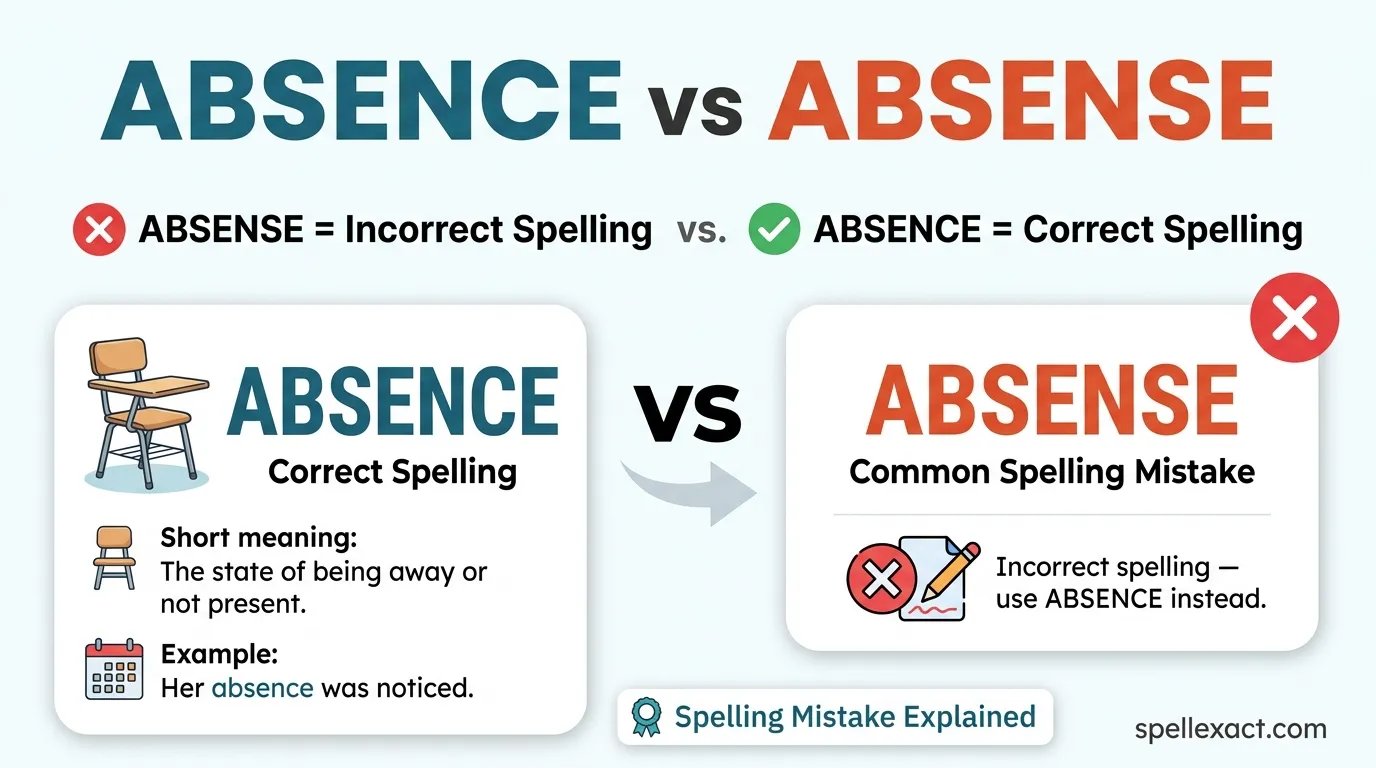
Absence is the correct spelling in standard English. Absense is a misspelling and should not be used in formal or edited writing. In this guide, you’ll learn the difference between absence vs absense, what each form means, how to use the correct word in sentences, and a few simple tricks to remember the spelling.
Quick Answer:
Absence is the correct spelling.
Absense is incorrect and is generally considered a spelling error.
| Word | Correct? | Meaning |
| Absence | ✅ Yes | The state of being away or not present |
| Absense | ❌ No | Misspelling of “absence” |
The correct word is: Absence
Example:
Her absence from the meeting was noticed by everyone.
Not:
Her absense from the meeting was noticed by everyone.
If you are writing a formal email, essay, application, report, or business document, always choose absence.
What Does Absence Mean?
Absence is a noun that refers to the state of not being present or the lack of something that is normally expected to be there.
It comes from the Latin word absentia, which is related to the idea of being away or absent.
You can use absence when talking about a person who is not somewhere, as well as when describing the lack of an object, quality, condition, or event.
For example:
- The teacher noticed his absence from class.
- Her absence was felt by the entire team.
- The report showed an absence of reliable evidence.
- We were concerned about his long absence from work.
The word can therefore describe both physical non-presence and the lack of something.
What Does Absense Mean?
Absense is not the standard spelling of an English word. It is a common misspelling of absence.
People often write “absense” because the pronunciation can make the spelling confusing. The ending -ence in absence may sound similar to “-ense” when spoken, especially in fast conversation.
If you have written absense, simply replace it with absence.
❌ Absense
✅ Absence
There is no standard American or British English situation in which absense becomes the preferred spelling.
Absence vs Absense: Key Difference
The main difference between absence vs absense is spelling and correctness.
Absence is the accepted English spelling. It is used in dictionaries, professional writing, academic work, workplace communication, and everyday English.
Absense, on the other hand, is a spelling error. Although readers can usually understand what the writer intended, it should be corrected.
The difference is only one letter, but that small difference matters when you want your writing to look accurate and professional.
Why Is “Absense” a Common Spelling Mistake?
The mistake usually happens because of pronunciation.
The word absence is commonly pronounced approximately as “AB-suhns.” The ending does not sound exactly like the way it looks in writing, which can lead people to guess the spelling as “absense.”
There is another reason: English contains many words ending in -ense, such as:
- expense
- defense
- sense
- suspense
This can make absense seem visually reasonable even though it is incorrect.
A useful approach is to remember that absence belongs to the same word family as absent.
Absent → Absence
Once you connect these two words, the spelling becomes easier to remember.
How to Use Absence in a Sentence
Here are several examples showing how absence works in everyday English.
Example 1: School
The student explained her absence from school.
Here, absence means that the student was not present at school.
Example 2: Work
Please inform your manager about your absence tomorrow.
This refers to being away from work.
Example 3: A Meeting
His absence from the meeting delayed the final decision.
The person was not present at the meeting.
Example 4: Lack of Something
The absence of clear instructions caused confusion.
Here, absence means a lack of clear instructions.
Example 5: Personal Relationships
Her absence was deeply felt by her family.
In this context, absence refers to someone not being present.
Example 6: Formal Writing
The committee rejected the proposal because of the absence of sufficient evidence.
This is a formal use where absence means a lack of something necessary.
Common Phrases With Absence
Learning common word combinations can make the correct spelling easier to remember.
Some useful phrases include:
- absence from work
- absence from school
- absence from class
- absence of evidence
- absence of information
- absence of proof
- long absence
- extended absence
- unexpected absence
- prolonged absence
- temporary absence
- unexplained absence
- in the absence of
For example:
In the absence of further information, we decided to wait.
The phrase “in the absence of” is especially common in formal and professional English.
Absence vs Absent
Although absence and absent are related, they have different grammatical roles.
Absent is usually an adjective. It describes someone or something that is not present.
Sarah was absent from class.
Absence is a noun. It refers to the state or condition of not being present.
Sarah’s absence from class was recorded.
Think of it this way:
Person or thing → absent
State of not being there → absence
This distinction can help you choose the correct word in a sentence.
Absence vs Absense: Comparison Table
| Feature | Absence | Absense |
| Spelling | Correct | Incorrect |
| Part of speech | Noun | — |
| Meaning | State of being away or lack of something | No standard meaning |
| Used in English | Yes | No |
| Suitable for formal writing | Yes | No |
| American English | Correct | Incorrect |
| British English | Correct | Incorrect |
| Example | His absence was unexpected. | His absense was unexpected. ❌ |
American vs British English: Is There a Difference?
There is no spelling difference between American and British English for this word.
Both varieties use:
absence
American English:
His absence was noted by the supervisor.
British English:
His absence was noted by the supervisor.
Absense is not the British spelling and is not an alternative American spelling. It is simply a misspelling.
This is worth remembering because some English words do have regional spelling differences, such as color/colour, center/centre, and organize/organise. However, absence does not change between American and British English.
Common Mistakes With Absence
1. Writing “Absense”
❌ Her absense was noticed.
✅ Her absence was noticed.
This is the most common spelling error involving the word.
2. Confusing Absence With Absent
❌ His absence from class means he was absent?
The words are related, but their grammatical roles are different.
Better:
✅ He was absent from class.
✅ His absence was recorded.
3. Using “Absence” When You Mean “Absent”
Because absence is a noun, it cannot always replace absent.
Incorrect:
❌ She was absence yesterday.
Correct:
✅ She was absent yesterday.
4. Forgetting the “c”
The correct spelling contains c:
a-b-s-e-n-c-e
A useful visual reminder is:
absence = absent + ce
While this is not a complete spelling rule for every related word, it can help you remember the correct form.
Easy Trick to Remember the Correct Spelling
Try this simple memory connection:
ABSENT → ABSENCE
Both words begin with ABSEN-.
Then remember that absence ends with -ence, not -ense.
You can also memorize this sentence:
The absence of the letter “t” from “absent” does not mean you should replace “c” with “s.”
An even simpler trick is to repeat:
“Absent has a C in absence.”
Writing the word correctly a few times can also reinforce the spelling.
When Should You Use Absence?
Use absence when you are talking about:
- Someone not being present
- Missing school or work
- Being away from an event
- A lack of evidence
- A lack of information
- The nonexistence of a particular quality or condition
For example:
The employee requested leave because of a personal matter.
The manager noticed his repeated absence from work.
The absence of supporting documents made the application incomplete.
The word is appropriate in casual, academic, professional, and formal contexts.
Why Correct Spelling Matters
A single spelling error usually does not prevent someone from understanding your message. However, repeated spelling mistakes can make writing appear less polished.
Correct spelling is particularly important in:
- Job applications
- Cover letters
- School assignments
- Academic papers
- Business emails
- Reports
- Websites and blog posts
- Official documents
Using absence instead of absense shows attention to detail and helps your writing look more credible.
Frequently Asked Questions
Is absence or absense correct?
Absence is correct. Absense is a misspelling and should be corrected.
What is the meaning of absence?
Absence means the state of being away or not present. It can also mean a lack or lack of something.
Is absense a word?
No. Absense is not the standard English spelling. It is a common misspelling of absence.
Is absence spelled differently in British English?
No. Absence is spelled the same way in both American and British English.
What is the difference between absent and absence?
Absent is generally an adjective describing someone or something that is not present. Absence is a noun referring to the state of not being present or the lack of something.
How do you remember the spelling of absence?
Connect it with absent and remember the ending -ence: absent → absence.
What is an example of absence?
A simple example is: “The teacher recorded the student’s absence from class.”
What is the opposite of absence?
The opposite of absence is generally presence, meaning the state of being present or existing.
Final Summary
When comparing absence vs absense, there is no real choice between two correct spellings. Absence is the correct English word, while absense is a common spelling mistake. Absence can describe someone being away or the lack of something, and it is widely used in everyday, academic, and professional English.
Remember the simple connection absent → absence. The correct spelling contains c before the final e: absence. If you use American or British English, the spelling remains the same. If you see “absense” in your writing, correct it to “absence” before publishing or submitting your work.
Actionable Takeaway
Before using the word, check these three points:
- ✅ Write absence
- ❌ Avoid absense
- 💡 Remember: absent → absence
Getting this one-letter difference right can make your writing clearer, more polished, and more professional.

Aaron Adam is the Administrator of SpellExact, dedicated to helping readers improve their spelling and writing accuracy. He oversees content quality, ensures reliable language resources, and works to make spelling guidance simple, practical, and accessible for everyone.