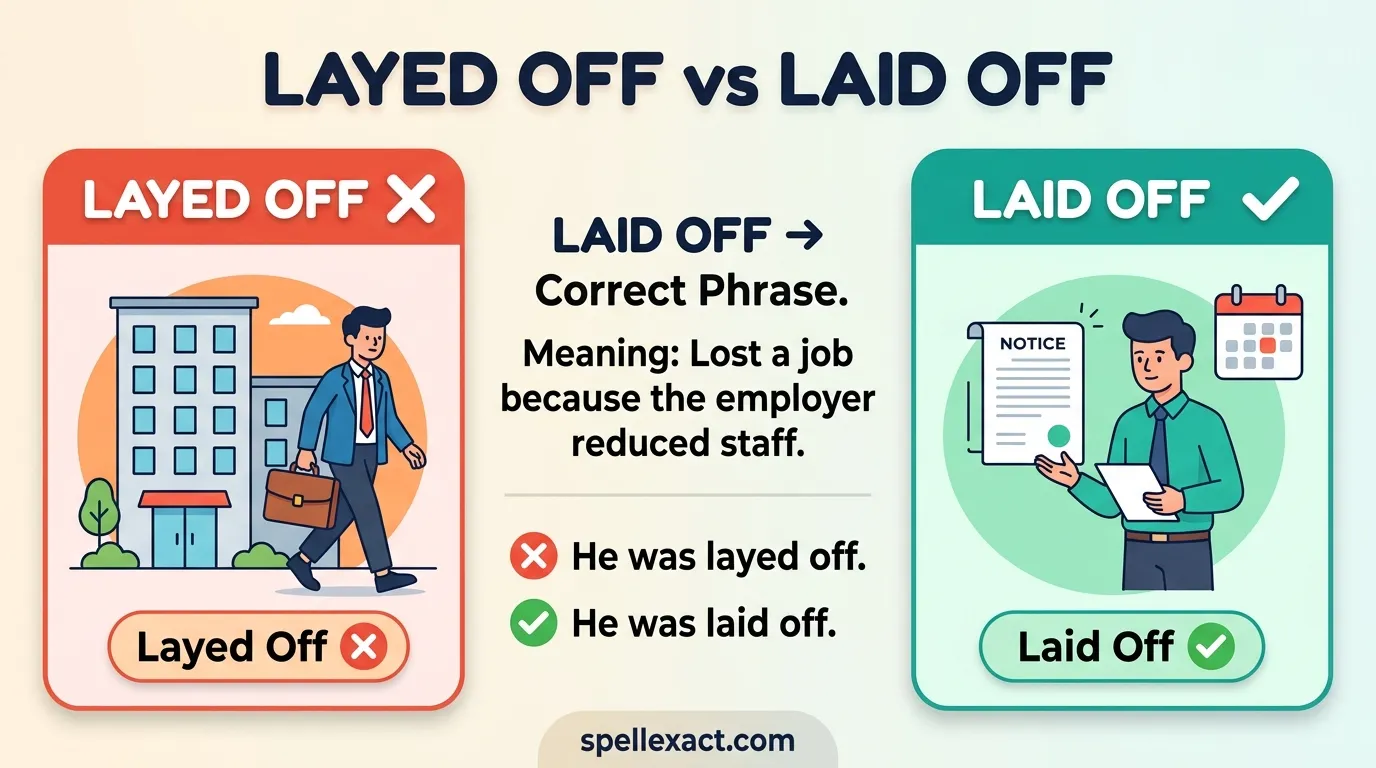
If you are unsure about layed off vs laid off, remember that standard English uses laid off when an employer ends a job because of business needs. In workplace English, layed off is incorrect, while laid off is the correct spelling.
The difference comes from the verb lay: its past tense and past participle are both laid. The phrase lay off is a phrasal verb that describes an employer stopped employing an employee, often because of business conditions or a lack of work. This grammatical form can feel confusing because the two expressions have a similar sound.
The meaning becomes easier to understand when you look at how these phrases work in real English. A company may lay off part of its workforce when business slows, which can result in job loss or a change in employment. For example, “The company laid off several employees because of difficult business conditions.”
When describing something that has already happened, laid off is the correct usage. For an action that may happen, use lay off, as in “The company may lay off workers.” This use of the terms makes the grammar much easier to understand and helps you write more naturally.
If you have ever wondered why layed off appears so often in written language, the sound of the phrase is partly responsible. People may write what they hear, but spelling, grammar, and the correct grammatical form still matter in professional work and the workplace.
A simple guide is to remember lay off → laid off. The words employing, lay, laid, and lie should also be kept separate because they are different terms with different uses. Once you understand these words and their relationship to employment, employee, and workforce, the distinction becomes much less confusing.
Quick Answer
“Laid off” is correct. “Layed off” is incorrect when referring to losing a job.
- ✅ Laid off — correct
- ❌ Layed off — incorrect
- Example: The company laid off several employees last month.
The phrase laid off is the standard expression used when an employer ends an employee’s job, usually because of economic conditions, restructuring, reduced demand, or other business reasons rather than because of the employee’s performance.
Layed Off vs Laid Off: What Is the Difference?
The main difference is grammatical rather than one of meaning.
Laid is the past tense and past participle of the verb lay. The expression “lay off” is a phrasal verb meaning to dismiss an employee, generally because the employer does not currently have enough work or needs to reduce costs.
Therefore, when you change “lay off” into the past tense, it becomes “laid off.”
“Layed” is not the standard past-tense form of “lay.” This is why “layed off” is considered a spelling and grammar error in standard English.
For example:
- Present: The company may lay off workers.
- Past: The company laid off workers.
- Present perfect: The company has laid off workers.
So if you are wondering whether to write layed off or laid off, choose laid off.
What Does “Laid Off” Mean?
Laid off means that an employee has lost their job because the employer has decided to eliminate the position or reduce its workforce.
Being laid off is often connected to business circumstances rather than an individual’s behavior or performance.
Common reasons for layoffs include:
- Company restructuring
- Budget reductions
- Economic difficulties
- A decrease in customer demand
- Business closure
- Department elimination
- Mergers or acquisitions
- Automation or technological changes
- A company reducing its workforce
For example:
The company laid off 200 employees after sales declined.
This sentence means the company dismissed those employees as part of a workforce reduction.
The word laid does not mean that the employees were physically placed somewhere. In laid off, the words work together as part of the phrasal verb lay off.
Why Is “Layed Off” Incorrect?
The confusion comes from the fact that English has several forms of “lay” and “lie,” and their past-tense forms can be difficult to remember.
The verb lay has these forms:
| Verb Form | Word |
| Present | lay |
| Past | laid |
| Past participle | laid |
| -ing form | laying |
So:
- I lay the book on the table.
- Yesterday, I laid the book on the table.
- I have laid the book on the table.
Because the past form is laid, the phrasal verb lay off becomes laid off in the past tense.
There is no standard English past-tense form layed for this verb.
That is why:
- ❌ The company layed off 50 employees.
- ✅ The company laid off 50 employees.
Examples of “Laid Off” in a Sentence
Seeing the correct expression in different situations can make the distinction easier to remember.
Example 1: Workplace Announcement
The company laid off several employees because of declining sales.
Here, “laid off” means the employees were dismissed as part of a workforce reduction.
Example 2: Talking About Yourself
I was laid off from my job last month.
This is a natural way to explain that your employer ended your employment.
Example 3: Economic Problems
Many workers were laid off during the economic downturn.
The phrase describes employees losing their jobs because of broader business or economic circumstances.
Example 4: Company Restructuring
The company laid off employees after restructuring several departments.
This suggests that organizational changes resulted in job losses.
Example 5: Future Possibility
The company may lay off more workers next year.
Notice that the present/base form lay off is used after “may.”
Example 6: Present Perfect
The business has laid off dozens of employees this year.
The past participle remains laid.
Laid Off vs Fired: Are They the Same?
Although laid off and fired can both mean that someone no longer has a job, they usually describe different circumstances.
Someone who is fired is generally dismissed because of something connected to their performance, conduct, attendance, or another employment-related issue.
Someone who is laid off is typically dismissed because the employer is reducing its workforce or eliminating a position.
For example:
- She was fired for repeatedly violating company rules.
- She was laid off when the company closed the department.
However, real-world employment situations can vary, and companies may use different terminology when communicating job losses.
Laid Off vs Made Redundant
You may also encounter “made redundant,” particularly in British English.
In American English, laid off is very common when an employer eliminates jobs or reduces its workforce.
In British English, made redundant is a common expression for losing a job because the position is no longer needed.
For example:
- American English: He was laid off last week.
- British English: He was made redundant last week.
The expressions can describe similar circumstances, although employment laws and the exact meaning of redundancy can differ between countries.
American vs British English
The spelling laid off is standard in both American and British English.
There is no British-English spelling where “layed off” becomes correct. “Layed off” remains incorrect in standard English.
The main difference is often the terminology used to describe job loss.
American English commonly uses:
- Laid off
- Layoffs
- Workforce reduction
- Job cuts
British English commonly uses:
- Made redundant
- Redundancy
- Redundancies
- Job losses
For international readers, this distinction is useful because you may see “redundant” much more frequently in British workplace writing.
Common Mistakes With “Layed Off”
The most common mistake is simply replacing laid with layed.
Incorrect:
The company layed off 100 employees.
Correct:
The company laid off 100 employees.
Another mistake occurs when people confuse the base form with the past form.
Present:
The company will lay off workers.
Past:
The company laid off workers.
Present perfect:
The company has laid off workers.
Remember that lay off is used for the base form, while laid off is used for past-tense and past-participle constructions.
How to Remember “Laid Off”
A simple memory trick can help.
Think of the phrase as:
lay → laid → laid
Just as you would say:
lay off → laid off
You can also remember a common sentence:
The company laid off its employees.
If you are describing a completed event in the past, laid is the word you need.
Another useful trick is to associate laid off with other familiar expressions containing “laid”:
- laid down
- laid out
- laid aside
- laid back
- laid off
This can help reinforce the correct spelling in your memory.
Is “Layed” Ever Correct?
In standard modern English, “layed” is generally not the correct past form of “lay.”
You may occasionally encounter “layed” in informal writing, historical texts, dialectal usage, or nonstandard contexts, but it should not be used as the past tense of lay in normal professional or academic writing.
If you are writing an email, résumé, article, report, application, or other formal text, use laid.
Laid Off vs Laid Out
It is also useful not to confuse laid off with other expressions beginning with “laid.”
Laid off means dismissed from employment.
Laid out can mean arranged, explained, or physically placed in a particular position.
For example:
- The company laid off 50 workers.
- She laid out the documents on the desk.
The additional word changes the meaning completely.
Frequently Asked Questions
Is “layed off” or “laid off” correct?
Laid off is correct. “Layed off” is a common spelling mistake when referring to employees losing their jobs.
Why is it “laid off” instead of “layed off”?
Because laid is the past tense and past participle of lay. The phrasal verb “lay off” therefore becomes “laid off” in past constructions.
Is “laid off” grammatically correct?
Yes. Laid off is grammatically correct and is the standard expression for an employee whose job has been terminated as part of a workforce reduction or similar business decision.
Can I say “I got laid off”?
Yes. “I got laid off” is common and natural in conversational English. For example: “I got laid off when the company reduced its workforce.”
Is “laid off” the same as “fired”?
Not necessarily. Fired often suggests that an employee was dismissed because of performance or conduct, while laid off generally refers to workforce reductions or business circumstances.
Do British people say “laid off”?
Yes, “laid off” is understood and used in British English. However, “made redundant” is also a very common British expression for losing a job because the position is no longer required.
Is “layoff” one word or two words?
As a noun, layoff is commonly written as one word: “The company announced a layoff.” As a verb, it is written as two words: lay off. The past form is laid off.
What is the easiest way to remember the correct spelling?
Remember the verb forms lay → laid → laid. Therefore, when talking about a completed job dismissal, write laid off, not “layed off.”
Final Summary
When comparing layed off vs laid off, there is a clear winner: laid off is the correct expression. It comes from the phrasal verb lay off, and its past-tense and past-participle form uses laid, not “layed.” You should use “laid off” when explaining that an employee lost their job because a company reduced its workforce, eliminated a position, or faced another business-related change.
Although being laid off can be an emotional and difficult experience, choosing the right terminology matters when communicating professionally. Whether you are writing about your own employment history, preparing a résumé, explaining a company announcement, or simply checking your spelling, remember the simple pattern lay → laid → laid. When in doubt, choose laid off.
Actionable Takeaway
Before publishing or submitting your writing, replace “layed off” with “laid off” whenever you mean that someone lost their job because of a workforce reduction. A quick memory rule is:
❌ Layed off → ✅ Laid off
Use the correct phrase confidently in professional emails, résumés, job applications, articles, and everyday conversations.

Andrew Anthony is a language enthusiast and content writer specializing in spelling mistakes, grammar, and English usage. He creates clear, practical, and well-researched guides that help readers improve their writing skills with confidence.