Have you ever typed occuring only to see your spell checker underline it in red? If so, you’re not alone. Every month, thousands of people search for occurring vs occuring, occurring or occuring, and how to spell occurring because this is one of the most common English spelling mistakes.
The confusion is understandable. The word occur changes slightly when -ing is added, causing many writers to wonder whether it should have one R or two.
In this complete grammar guide, you’ll learn the correct spelling of occurring, understand why occurring is spelled with two R’s, discover the grammar rule behind it, and see practical examples from everyday English, business, education, science, and technology.
Quick Answer
Looking for a quick answer?
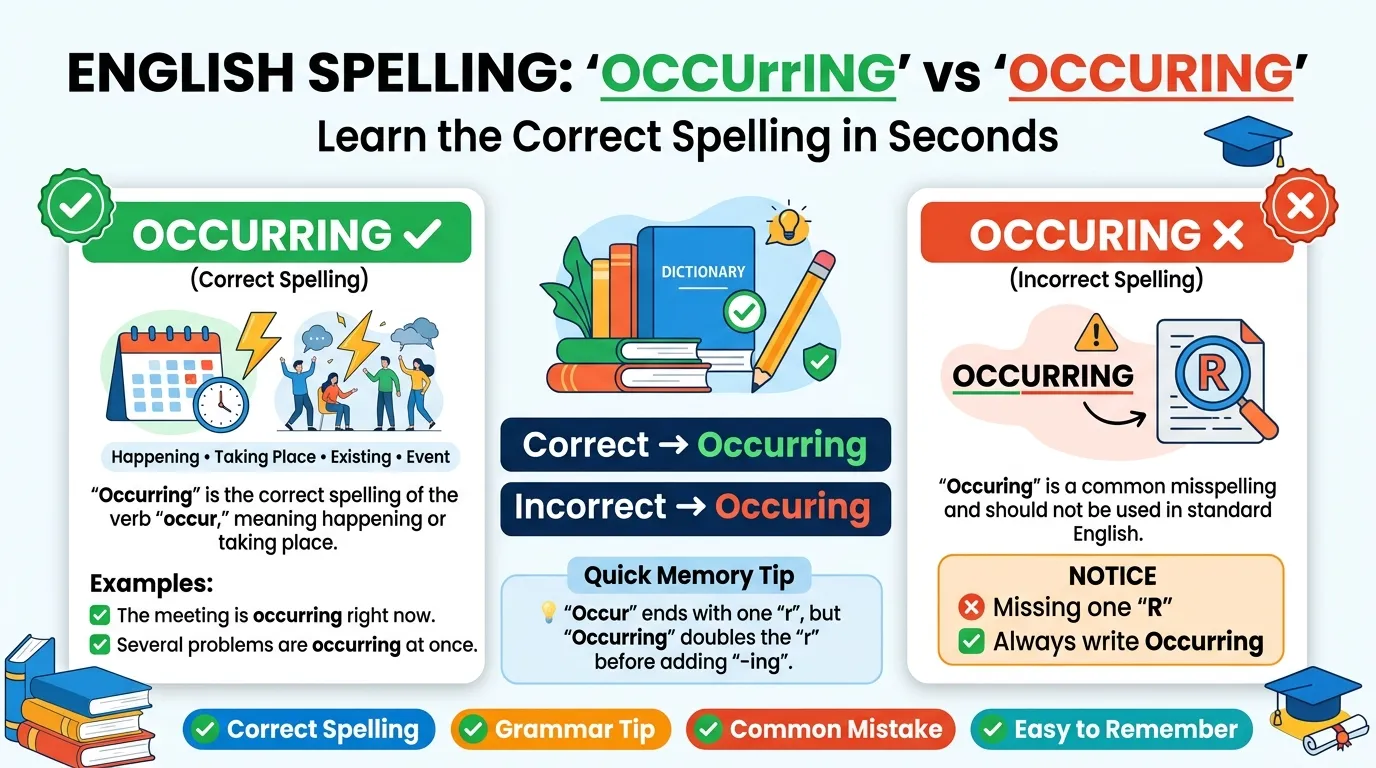
The correct spelling is occurring.
- ✅ Occurring = Correct
- ❌ Occuring = Incorrect
Occurring is the present participle of the verb occur. It is spelled with two R’s because English follows a double consonant spelling rule before adding -ing to certain verbs.
If you’re ever unsure about occurring vs occuring, always choose occurring.
Pronunciation
Occurring
IPA: /əˈkɜːr.ɪŋ/
Sounds like: uh-KUR-ing
Knowing the pronunciation can also make the spelling easier to remember because the stress falls on the final syllable of occur.
Dictionary Definition
Occurring (verb – present participle of occur)
Meaning:
To happen, take place, arise, or exist at a particular time.
Simple definition
When something is occurring, it is happening right now or taking place.
Synonyms
- Happening
- Taking place
- Coming about
- Arising
- Existing
- Developing
- Emerging
- Unfolding
These words are useful alternatives, although occurring remains the best choice in many formal and academic contexts.
Occurring vs Occuring: What’s the Difference?
Many people think both spellings are acceptable, but that’s not true.
| Feature | Occurring | Occuring |
| Correct spelling | ✅ Yes | ❌ No |
| Found in dictionaries | ✅ Yes | ❌ No |
| Accepted in academic writing | ✅ Yes | ❌ No |
| Suitable for professional writing | ✅ Yes | ❌ No |
| Grammatically correct | ✅ Yes | ❌ No |
| Recommended by spell checkers | ✅ Yes | ❌ No |
Although you may occasionally see occuring spelling online, it is simply a typo or misspelling. Standard dictionaries and grammar guides recognize only occurring as correct.
What Does “Occurring” Mean?
The occurring meaning is simple.
It describes something that is:
- Happening
- Taking place
- Existing
- Developing
- Coming about naturally
- Arising during a particular time
Because it refers to events or actions that are happening, occurring appears frequently in conversations, newspapers, scientific research, business reports, and academic writing.
Examples of Occurring in Everyday English
Understanding occurring in a sentence is one of the easiest ways to remember the correct spelling.
Everyday conversation
- Something unusual is occurring outside.
- The celebration is occurring this weekend.
- A lot of exciting events are occurring this summer.
Education
- The final examination is occurring next Monday.
- Classroom improvements are occurring throughout the school year.
Business
- Several organizational changes are occurring this quarter.
- Customer complaints are occurring less frequently after the update.
Technology
- The software error keeps occurring after installation.
- Automatic system updates are occurring overnight.
Medicine
- Mild side effects are occurring in only a few patients.
- Researchers are studying why certain symptoms are occurring more often.
Nature
- Naturally occurring minerals are found underground.
- Seasonal weather changes are occurring earlier than expected.
These examples show that occurring is used in both formal and informal writing.
Why Do People Spell “Occurring” as “Occuring”?
If you’ve searched is occuring a real word, you’re asking a question many English learners have.
The answer is no.
So why is this mistake so common?
1. The Double Consonant Rule Is Easy to Forget
Many writers remember the word occur, but forget to double the final R before adding -ing.
2. Fast Typing
When typing quickly, it’s easy to leave out one letter.
Instead of
Occurring
people accidentally write
Occuring
3. Pronunciation Doesn’t Make It Obvious
When spoken, both spellings sound almost identical.
Because English spelling doesn’t always match pronunciation perfectly, many people assume one R is enough.
4. English Learners Apply the Wrong Rule
Some words simply add -ing without changing the spelling.
Examples include:
- Play → Playing
- Read → Reading
- Watch → Watching
Learners often expect occur to behave the same way, but it follows a different grammar rule.
Why Is “Occurring” Spelled with Two R’s?
The answer lies in the double consonant spelling rule.
Double the final consonant before adding -ing when:
- the word ends with one vowel followed by one consonant, and
- the final syllable is stressed.
The word occur satisfies both conditions.
It ends with:
- vowel → u
- consonant → r
and the stress falls on the final syllable:
oc-CUR
Therefore:
Occur + ing = Occurring
Not
Occur + ing = Occuring
This same rule explains why we write:
- Refer → Referring
- Prefer → Preferring
- Admit → Admitting
- Begin → Beginning
- Forget → Forgetting
- Permit → Permitting
Learning this one grammar rule will help you avoid many common spelling mistakes in English.
Expert Grammar Tip
Expert Tip: If a verb ends with a single vowel followed by a single consonant and the last syllable is stressed, double the final consonant before adding -ing, -ed, or similar endings. This spelling rule applies to occurring, referring, preferring, admitting, and many other English verbs.
Easy Memory Trick
Remember this simple phrase:
Big events need two R’s before they’re occurring.
Or use this formula:
Occur → Occurring
One extra R makes the spelling correct.
Whenever you’re unsure between occurring or occuring, remember that the extra R is never optional.
Common Mistakes to Avoid
Incorrect:
❌ The meeting is occuring tomorrow.
Correct:
✅ The meeting is occurring tomorrow.
Incorrect:
❌ Several software errors are occuring after the update.
Correct:
✅ Several software errors are occurring after the update.
Incorrect:
❌ Unexpected changes are occuring across the company.
Correct:
✅ Unexpected changes are occurring across the company.
These examples reinforce the correct spelling and show how the word is used naturally in real-world writing.
American vs British English
One question people often ask is whether American English and British English spell this word differently.
The answer is no.
Both varieties of English use the same spelling:
- ✅ Occurring
- ❌ Occuring
Unlike words such as color/colour or organize/organise, there is no American vs British English difference for occurring. Whether you’re writing for readers in the United States, the United Kingdom, Canada, Australia, or anywhere else, occurring is always the correct spelling.
Word Origin (Etymology)
Knowing where a word comes from can make it easier to remember.
The verb occur comes from the Latin word occurrere, which means:
- to happen
- to come before
- to present itself
- to meet unexpectedly
Over time, the word entered English as occur, meaning to happen or to take place. The modern form occurring simply describes something that is currently happening.
Related Words You Should Know
If you’re learning the spelling of occurring, it’s helpful to recognize other forms of the same word.
| Word | Meaning |
| Occur | Base verb |
| Occurs | Happens |
| Occurred | Happened |
| Occurring | Happening now |
| Occurrence | An event or incident |
You may also come across similar words that people confuse:
- Occurrence vs Occurence
- Occurred vs Occured
- Recurring vs Reoccurring
- Occurrence vs Happening
Learning these related spellings will improve your vocabulary and help you avoid future mistakes.
Words That Follow the Same Spelling Rule
The double consonant spelling rule doesn’t apply only to occurring. Many common English words follow the same pattern.
| Base Word | Correct Form |
| Occur | Occurring |
| Refer | Referring |
| Prefer | Preferring |
| Admit | Admitting |
| Begin | Beginning |
| Forget | Forgetting |
| Permit | Permitting |
| Transfer | Transferring |
If you can remember this pattern, you’ll avoid many common spelling mistakes in English.
When Should You Use “Occurring”?
Use occurring whenever you’re describing something that is happening, taking place, or developing.
Here are a few situations where the word fits naturally:
Business
- Staff training is occurring every Friday.
- Major policy changes are occurring this year.
Education
- Parent-teacher meetings are occurring throughout the month.
- Classroom improvements are occurring across the district.
Healthcare
- Side effects are occurring less frequently with the new treatment.
- Doctors are investigating why symptoms are occurring earlier than expected.
Technology
- System updates are occurring automatically.
- Login errors are occurring because of outdated software.
Nature
- Naturally occurring plants grow throughout the region.
- Seasonal changes are occurring earlier than usual.
These practical examples show how the word is used across different industries and everyday situations.
Mini Quiz: Test Your Knowledge
Choose the correct sentence.
Question 1
A. The meeting is occuring tomorrow.
B. The meeting is occurring tomorrow.
✅ Correct Answer: B
Question 2
A. Software updates are occurring overnight.
B. Software updates are occuring overnight.
✅ Correct Answer: A
Question 3
Which spelling is accepted in professional writing?
- A. Occuring
- B. Occurring
✅ Correct Answer: B
If you answered all three correctly, you’ve mastered one of the most confusing English spelling rules.
Frequently Asked Questions
Is occurring or occuring correct?
Occurring is correct. Occuring is an incorrect spelling and should not be used in standard English.
Why is occurring spelled with two R’s?
The word follows the double consonant spelling rule. Since occur ends with a stressed vowel-consonant pattern, the final R is doubled before adding -ing.
Is occuring a real word?
No. Occuring is not recognized as a correct English word. Dictionaries list occurring as the proper spelling.
How do you spell occurring correctly?
The correct spelling is:
O-C-C-U-R-R-I-N-G
Remember that it contains two R’s.
What does occurring mean?
Occurring means happening, taking place, or coming about. It is the present participle of the verb occur.
Is occurring a verb?
Yes. Occurring is the present participle and -ing form of the verb occur.
Is occurring used in American and British English?
Yes. Both American English and British English use the same spelling: occurring.
How do I remember the spelling of occurring?
Use this memory trick:
Occur + one extra R + ing = Occurring
The extra R is what makes the spelling correct.
Common Writing Tips
To avoid spelling mistakes in the future:
- Learn the double consonant spelling rule instead of memorizing individual words.
- Proofread important emails, assignments, and reports.
- Read your writing aloud to catch unusual spellings.
- Practice with similar words like referring, beginning, and preferring.
- Use a trusted dictionary when you’re unsure.
These habits will improve your overall English writing skills and reduce common grammar errors.
Summary
The answer to occurring vs occuring is straightforward: occurring is the only correct spelling. The incorrect form occuring appears because many writers forget to double the final R before adding -ing. Understanding the double consonant spelling rule makes this word and many similar words much easier to spell correctly.
If you’re writing a school assignment, business email, research paper, or blog post, using occurring correctly makes your writing more accurate and professional. With the pronunciation, grammar rule, contextual examples, memory trick, and practice quiz from this guide, you can confidently choose the right spelling every time.
Actionable Takeaway
Whenever you pause and wonder whether to write occurring or occuring, remember this simple rule:
If the verb ends with one vowel, one consonant, and the final syllable is stressed, double the final consonant before adding -ing.
Think of it as:
Occur → Occurring
One extra R makes all the difference. Bookmark this guide, practice with similar words like referring and beginning, and you’ll avoid this common spelling mistake in both academic and professional writing.

Aaron Adam is the Administrator of SpellExact, dedicated to helping readers improve their spelling and writing accuracy. He oversees content quality, ensures reliable language resources, and works to make spelling guidance simple, practical, and accessible for everyone.