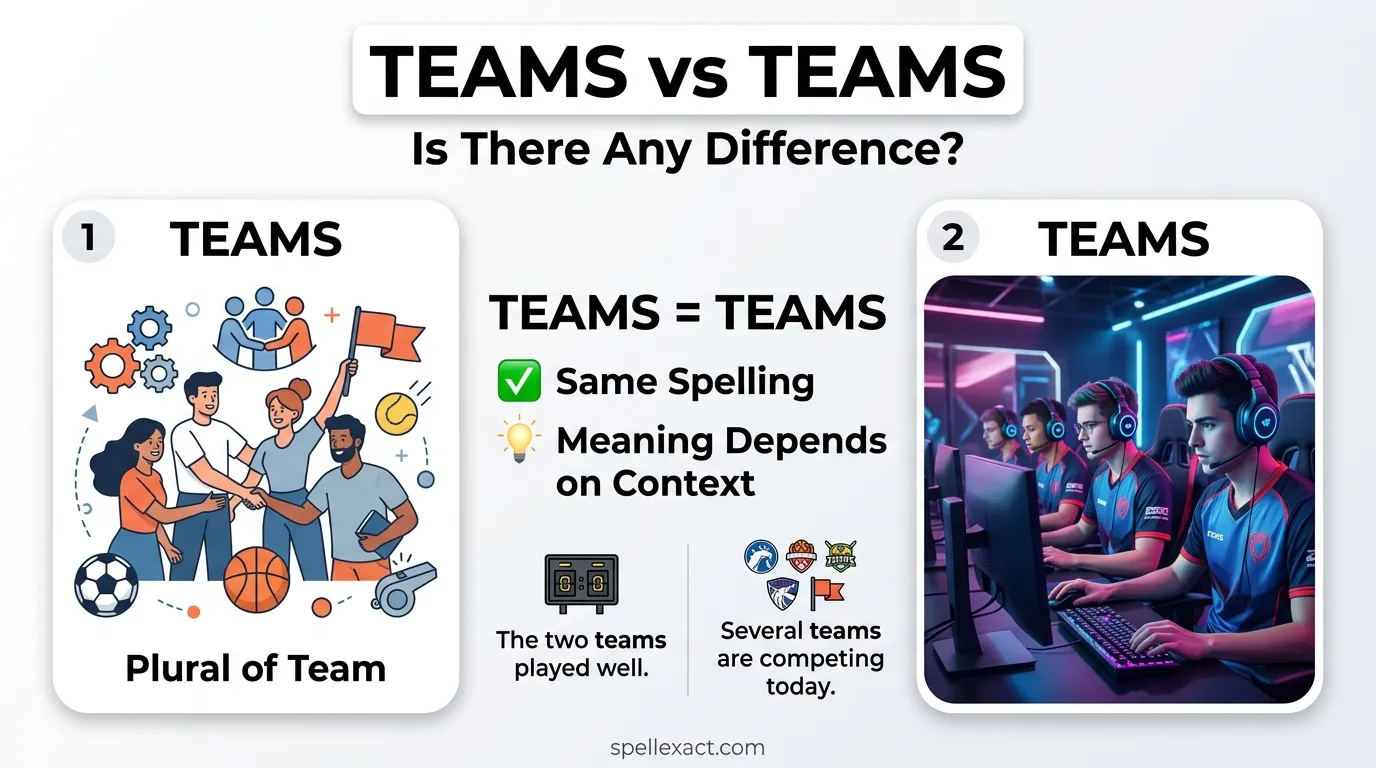
Have you ever searched for teams vs teams and wondered whether there is actually a difference between the two? At first glance, both words look exactly the same. The important point is that the difference, when there is one, usually comes from capitalization and context, not spelling.
In ordinary English, teams is simply the plural form of team. It can refer to groups of people working together, sports groups, or other organized groups. However, Teams with a capital T can refer to a specific name, such as Microsoft Teams.
Understanding this small distinction can help you choose the correct form in writing, especially in professional, academic, and digital contexts.
Quick Answer
Teams vs teams usually has no difference in spelling or pronunciation. The difference is generally related to capitalization and meaning.
- teams = plural of the common noun team
- Teams = may be a proper name, such as Microsoft Teams
- team = one group
- teams = more than one group
For example:
- Several teams competed in the tournament.
- We use Teams for our online meetings.
The first sentence uses teams as a regular common noun. The second uses Teams as part of a specific product name.
Teams vs Teams: The Basic Difference
The word team refers to a group of people or animals who work or act together toward a common purpose. Its plural form is teams. Dictionaries define a team as a group that works or acts together, including groups involved in sports and workplaces.
So, grammatically:
team → teams
There is no alternate spelling such as teames or another standard plural form.
When you see Teams with a capital T, however, capitalization may indicate that the word is being used as a proper name or brand name rather than as an ordinary plural noun.
Compare These Examples
Lowercase “teams”:
The two teams played an exciting final.
Here, teams simply means two groups of players.
Capitalized “Teams”:
We have a meeting on Teams at 10 a.m.
Here, Teams can refer to Microsoft Teams, the communication and collaboration platform.
The surrounding words and context tell you which meaning is intended.
What Does “Team” Mean?
A team is a group of people who cooperate to accomplish something. Teams are common in sports, workplaces, schools, businesses, research projects, and many other situations.
For example:
- a football team
- a basketball team
- a sales team
- a marketing team
- a research team
- a medical team
- a management team
- a project team
Cambridge Dictionary similarly describes a team as a group of people or animals acting together, and its Business English definition includes people working together on a particular activity or project.
The plural teams simply means there is more than one team.
Examples of “Team”
- Our team finished the project early.
- The basketball team practiced every morning.
- She joined the marketing team last month.
- The medical team examined the patient.
Examples of “Teams”
- Several teams entered the competition.
- The company has three sales teams.
- The football teams are preparing for the final.
- Different teams worked on different parts of the project.
When Should You Use “Teams”?
Use lowercase teams when you are talking about multiple groups in a general sense.
For example:
The two teams are ready to begin.
Here, teams is an ordinary plural noun.
You should also use lowercase teams when describing groups in general:
Successful teams communicate clearly.
The company created several new teams.
Both teams performed well.
In each case, there is no reason to capitalize the word.
When Should You Use “Teams” With a Capital T?
Capital Teams may be appropriate when the word is part of a specific proper name.
The most familiar modern example is Microsoft Teams. In that context, Teams is not simply being used as the plural of team. It is part of a product or service name.
For example:
Please send the document through Teams.
We discussed the project on Teams.
The meeting will take place on Teams.
However, capitalization should not be added simply because the word appears important. If you are talking about ordinary groups, use lowercase teams.
Teams vs Teams: Comparison Table
| Feature | teams | Teams |
| Basic spelling | teams | Teams |
| Pronunciation | Same | Same |
| Meaning | More than one team | Often a specific name, depending on context |
| Part of speech | Usually plural noun | Usually a proper name when referring to a product |
| Capitalization | Lowercase | Capitalized |
| Example | The teams arrived early. | We met on Teams. |
| General English | Correct | Usually unnecessary |
| Product name | Not applicable | May refer to Microsoft Teams |
The key takeaway is simple: the letters are identical; capitalization and context can change the intended meaning.
Is “Teams” a Different Word From “teams”?
Not necessarily.
Capitalization does not automatically create a completely different English word. In many cases, Teams is simply teams written with a capital letter because it is being used as part of a proper name.
Consider these examples:
The teams are meeting today.
The employees are meeting on Teams today.
The first sentence talks about groups of people. The second can refer to a communication platform.
This is why context matters more than the spelling itself.
Teams vs Teams in Workplace Writing
The distinction becomes especially useful in professional communication.
Imagine writing:
Our teams will review the report.
This means multiple groups of employees will review it.
Now compare:
Our teams will review the report on Teams.
Here, the first teams refers to employee groups, while Teams refers to the platform being used.
This produces a useful example of how capitalization can prevent confusion:
The project teams will meet on Teams.
The first word describes groups of people. The second identifies the communication platform.
Common Mistakes With “Teams”
Even though teams is a simple word, several capitalization and grammar mistakes are common.
1. Capitalizing Every Use of “Teams”
Our Teams worked together on the project.
If you mean ordinary groups, teams should normally be lowercase:
Our teams worked together on the project.
Capitalizing a common noun unnecessarily can make professional writing look inconsistent.
2. Using Lowercase for a Proper Name
If you are referring specifically to a branded service whose official name uses capitalization, writing the name inconsistently can be less professional.
For example:
Please join the meeting on Teams.
is appropriate when referring to Microsoft Teams.
3. Confusing “Team” and “Teams”
Remember the basic singular-plural rule:
- team = one group
- teams = two or more groups
Correct:
Our team is ready.
Correct:
Our teams are ready.
Incorrect:
Our teams is ready.
The plural subject teams normally takes the plural verb are.
Teams vs Team: A Quick Grammar Check
If you’re unsure whether to use team or teams, ask yourself how many groups you are talking about.
Use team for one:
The team won the match.
Use teams for more than one:
The teams won their matches.
This distinction is more important grammatically than the capitalization difference.
More Examples
Singular:
The research team completed the study.
Plural:
Several research teams completed separate studies.
Singular:
Our sales team meets every Monday.
Plural:
Our sales teams meet every Monday.
American vs British English: Is There a Difference?
There is no major spelling difference between American and British English for “team” or “teams.” Both varieties use team for the singular and teams for the plural.
For example:
American English:
The teams are ready.
British English:
The teams are ready.
The spelling remains the same.
There can be differences in vocabulary, punctuation, or how collective nouns are treated in particular contexts, but teams itself does not have a special American or British spelling.
Cambridge provides both American and British entries for team and uses the same basic spelling in both varieties.
Why Do People Search for “Teams vs Teams”?
A search such as teams vs teams can happen for several reasons.
Someone may be:
- Checking whether capitalization changes the meaning.
- Wondering whether Teams is a proper noun.
- Comparing ordinary teams with Microsoft Teams.
- Checking the correct plural form of team.
- Trying to decide whether a sentence should use uppercase or lowercase.
- Looking for a spelling or grammar correction.
If you encountered the two forms in different sentences, don’t automatically assume one is misspelled. Look at the context.
For example:
The teams competed against each other.
versus:
Join the meeting on Teams.
Both can be correct because they perform different functions.
Easy Memory Trick
Here’s a simple way to remember the difference:
teams = groups
Teams = a name, when referring to a specific branded product
So, if you can replace the word with groups, lowercase teams is probably what you need.
For example:
Three teams entered the contest.
You could say:
Three groups entered the contest.
But if you’re referring to a specific software platform:
We have a meeting on Teams.
You would not replace it with groups.
Frequently Asked Questions
Is “teams” the correct plural of “team”?
Yes. Teams is the standard plural form of team. One group is a team, while two or more groups are teams.
Is “Teams” grammatically correct?
Yes, but its capitalization depends on context. Teams can be correct when it is part of a proper name or when a style convention requires capitalization. For ordinary groups, use lowercase teams.
What is the difference between teams and Teams?
Usually, the difference is capitalization and context. Lowercase teams normally means multiple groups. Capitalized Teams can refer to a specific name, such as Microsoft Teams.
Is “Teams” a spelling mistake?
No. Teams is not a spelling mistake simply because it has a capital T. The correct form depends on what you are referring to.
Should I write “teams” or “Teams” in an essay?
Use teams when discussing groups in general. Use Teams only when referring to a specific proper name that is conventionally capitalized.
For example:
Several teams participated in the study.
But:
The interviews were conducted using Teams.
Is there an American spelling of “teams”?
No. Teams is spelled the same in American and British English.
Is “teams” singular or plural?
Teams is plural. The singular form is team.
For example:
The team is ready.
The teams are ready.
How do I remember when to capitalize “Teams”?
Think about whether you’re naming something. If Teams refers to a specific product or proper name, capitalization may be necessary. If you’re simply talking about groups, lowercase teams is normally correct.
Final Summary
The phrase teams vs teams is unusual because the two forms contain exactly the same letters. The meaningful difference usually comes from capitalization and context. Lowercase teams is the ordinary plural of team and refers to two or more groups working or competing together. Capitalized Teams can be used when the word forms part of a specific proper name, such as Microsoft Teams.
The easiest rule is to focus on what you mean rather than how the word looks. If you’re talking about groups of people, write teams. If you’re referring to a specific branded name, follow the capitalization used for that name. There is also no American-versus-British spelling difference to worry about: team and teams are standard in both varieties of English.
Actionable Takeaway
Before writing teams or Teams, ask yourself one simple question:
“Am I talking about groups, or am I naming something?”
- Talking about groups → teams
- Referring to a specific name → Teams, when the official name requires it
- One group → team
- More than one group → teams
When in doubt, check the surrounding sentence. Context is what tells you whether capitalization is meaningful.

Caleb Carter is a passionate language enthusiast and content writer specializing in spelling mistakes, grammar, and vocabulary. He creates clear, practical guides that help readers improve their writing skills and communicate confidently every day.