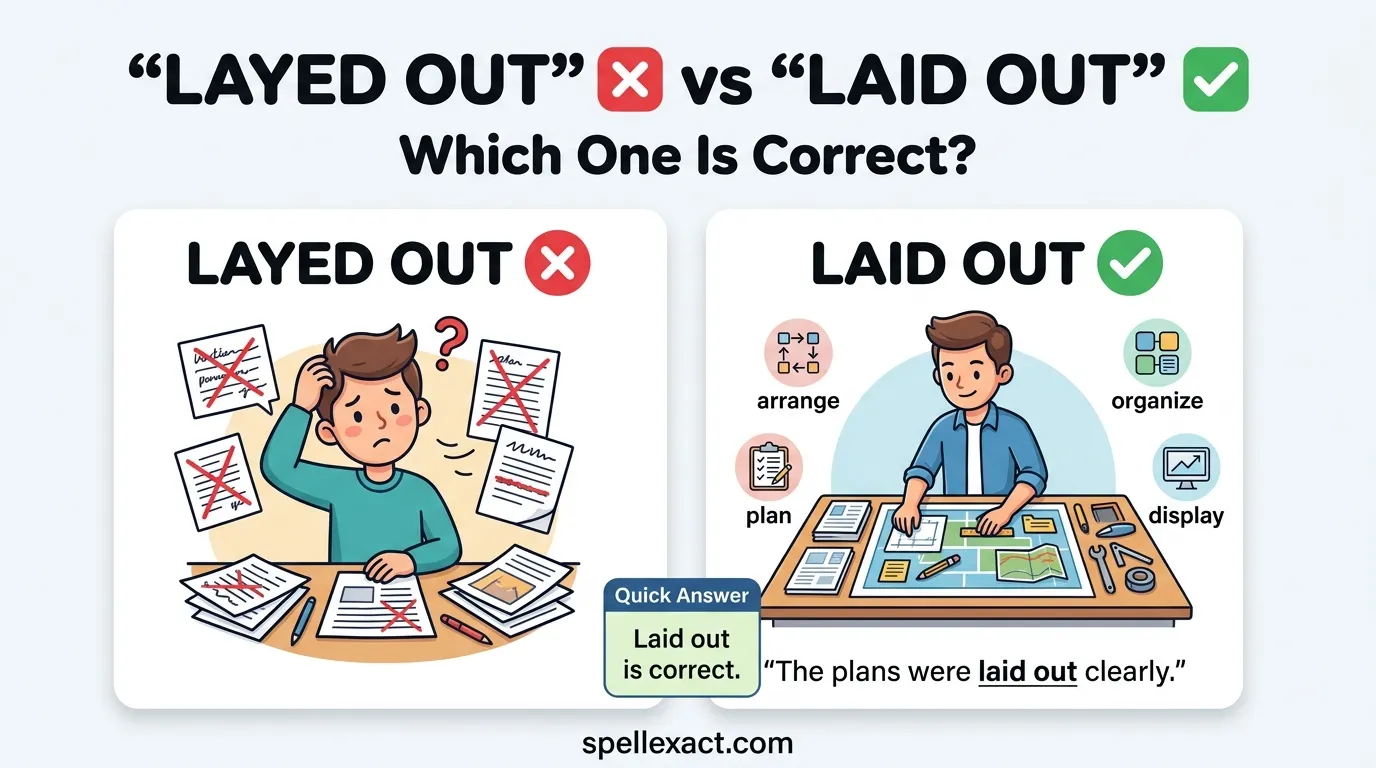
If you are unsure about layed out vs laid out, remember that laid out is the correct past tense form of the verb lay out in standard English. The verb lay is irregular, so its past tense is laid, not layed. Therefore, laid out is the correct form, while layed out is incorrect in standard written English.
The phrase laid out can mean to spread out, present, arrange, or organize something clearly. For example, a plan may be laid out step by step, while objects can be spread out across a table. These grammar rules are useful when using the phrase in professional content, and they help prevent common mistakes in everyday usage.
The difference becomes easier to understand when you remember that lay out is the base form, while laid out is its past tense and past participle form. Although layed out may appear informally, it is not the standard choice for polished writing.
The phrase can also have other meanings depending on the context: knock out can mean to defeat someone, while render unconscious means causing someone to lose consciousness. A Grammar Checker or checker can help you feel sure that you have selected the right form, while resources such as QuillBot may explain the past tense of lay and related common mistakes.
From an editing perspective, it is helpful to review the surrounding words in each sentence, especially when checking entities, semantically related terms, contextually relevant expressions, and NLP-related language patterns. In practical terms, if something was arranged, presented, or spread out, laid out is normally the correct choice.
Quick Answer:
Laid out is the correct and standard form.
- ✅ Laid out — correct
- ❌ Layed out — generally incorrect in standard English
The phrase laid out is the past tense and past participle form of the phrasal verb lay out.
Example:
The teacher laid out the instructions clearly.
Here, laid out means explained, presented, or arranged something clearly.
If you are writing an email, essay, report, website article, application, or professional document, choose laid out, not layed out.
What Does “Laid Out” Mean?
Laid out is the past tense and past participle of lay out. Its meaning depends on the context, but it commonly means to arrange, organize, present, explain, or spread something in a particular way.
For example:
- The designer laid out the page beautifully.
- She laid out all the documents on the table.
- The manager laid out the company’s plans.
- The information was laid out in an easy-to-understand format.
The expression can therefore describe both physical arrangement and the organization or presentation of ideas.
Physical arrangement
When objects are placed in a particular arrangement, laid out can mean placed or spread out.
The clothes were laid out on the bed.
Presenting information
When someone explains information, rules, plans, or ideas in an organized way, laid out can mean explained or presented clearly.
The lawyer laid out the facts during the meeting.
Designing or organizing something
The phrase is also common when discussing pages, websites, rooms, schedules, and designs.
The magazine was laid out in a clean and attractive format.
Why Is “Layed Out” Incorrect?
The confusion usually comes from assuming that the past tense of lay should be layed.
English does not work that way with this verb.
The basic forms are:
| Verb Form | Word |
| Base form | lay |
| Past tense | laid |
| Past participle | laid |
| Present participle | laying |
So:
lay → laid → laid
There is no standard modern-English past-tense form layed for the ordinary verb lay.
Because lay out is a phrasal verb built from lay, its past forms follow the same pattern:
lay out → laid out → laid out
That is why laid out is correct.
Layed Out vs Laid Out: Comparison Table
| Feature | Layed Out | Laid Out |
| Standard English | ❌ Generally incorrect | ✅ Correct |
| Base phrase | Lay out | Lay out |
| Past tense | ❌ Layed out | ✅ Laid out |
| Past participle | ❌ Layed out | ✅ Laid out |
| Used in formal writing | ❌ Avoid | ✅ Yes |
| Meaning | — | Arranged, presented, or explained |
The important point is simple: use “laid out” in standard English.
Examples of “Laid Out” in Sentences
Seeing the phrase in different situations can make the difference easier to remember.
Example 1: Explaining a plan
The manager laid out the company’s plans for the next year.
Here, laid out means explained or presented.
Example 2: Arranging objects
She laid out the plates before the guests arrived.
Here, the plates were arranged or placed.
Example 3: Presenting information
The report laid out the main reasons for the decision.
In this sentence, the report presented or explained the reasons.
Example 4: Website design
The designer laid out the website so that visitors could find information easily.
Here, laid out refers to organizing the visual structure.
Example 5: Instructions
The guide clearly laid out each step of the process.
This means the guide explained or presented each step.
Example 6: Physical objects
The children laid out their toys across the floor.
The toys were spread or arranged across the floor.
Common Mistakes With “Laid Out”
Even experienced English speakers can sometimes hesitate over lay, lie, laid, and lain. Here are some common mistakes to watch for.
Mistake 1: Writing “layed out”
❌ The teacher layed out the rules.
✅ The teacher laid out the rules.
The correct past form is laid, not layed.
Mistake 2: Confusing “lay” and “lie”
The verbs lay and lie are particularly confusing.
Lay normally takes an object:
She laid the book on the desk.
Lie means to recline or be in a resting position:
He lay on the sofa.
Their past forms are different, which is one reason English learners often find them difficult.
For the expression lay out, however, the answer is straightforward:
lay out → laid out
Mistake 3: Using “layed” because other verbs use “-ed”
Many regular verbs form the past tense by adding -ed:
- walk → walked
- clean → cleaned
- explain → explained
But lay is an irregular verb:
- lay → laid
Therefore, adding -ed to create layed is not correct for standard modern usage.
“Laid Out” vs “Laid” — Is There a Difference?
Yes. Laid out is a phrasal verb, while laid can be used by itself.
Laid:
She laid the book on the table.
Laid out:
She laid out the books on the table.
Adding out often gives the idea of arranging or spreading something in a particular way.
It can also change the meaning toward explaining or presenting information:
He laid out the facts for everyone to understand.
So, when you mean arranged, organized, displayed, or explained, laid out is often the appropriate phrase.
American vs. British English: Is “Laid Out” Different?
There is no meaningful American-versus-British spelling difference between laid out and layed out.
Both American English and British English use laid out as the standard form.
For example:
American English:
The facts were laid out clearly.
British English:
The facts were laid out clearly.
The spelling remains the same.
You may occasionally encounter layed in informal writing, historical texts, dialectal usage, or specialized contexts, but it should not be treated as the standard spelling of the ordinary past tense of lay out.
For modern professional and academic writing, laid out is the safe and correct choice.
How to Remember “Laid Out”
A simple way to remember the correct spelling is to memorize the verb pattern:
Lay → Laid → Laid
Then attach out:
Lay out → Laid out → Laid out
You can also remember this short rule:
If you mean arranged, organized, displayed, or explained, use “laid out.”
For example:
- The facts were laid out clearly.
- The furniture was laid out in the room.
- The plan was laid out in detail.
- The evidence was laid out before the jury.
When in doubt, choose laid out.
Frequently Asked Questions
Is “layed out” grammatically correct?
No, layed out is generally not correct in standard modern English. The correct expression is laid out.
Is it “laid out” or “layed out”?
The correct form is laid out. It is the past tense or past participle form of lay out.
What is the past tense of “lay out”?
The past tense of lay out is laid out.
For example:
She lays out the plan every Monday.
becomes:
She laid out the plan yesterday.
Can I use “laid out” in formal writing?
Yes. Laid out is completely acceptable in formal, academic, business, and professional writing when it fits the meaning of the sentence.
What does “laid out” mean?
Depending on the context, laid out can mean arranged, placed, spread, organized, presented, or explained.
For example:
The report laid out the evidence.
Here, it means the report presented or explained the evidence.
Why do people write “layed out”?
People often write layed out because they assume the past tense of lay is formed by adding -ed, as with regular verbs. However, lay is an irregular verb, so its past form is laid.
Is “layed” ever a word?
You may encounter layed in some historical, dialectal, or specialized uses, but it is not the standard past-tense form of the ordinary English verb lay. For everyday modern English, use laid.
Final Summary
When comparing layed out vs laid out, the correct choice for standard modern English is laid out. The phrase comes from the phrasal verb lay out, whose past tense and past participle use laid, not layed. If you are talking about arranging objects, organizing information, explaining a plan, or designing a page, laid out is the form you should use.
The confusion is understandable because English contains many regular verbs that form their past tense with -ed. However, lay is an irregular verb with the pattern lay → laid → laid. Remembering this small pattern will help you avoid the common mistake and make your writing sound polished and natural.
Actionable Takeaway
Whenever you are tempted to write “layed out,” stop and replace it with “laid out.”
Correct: The information was laid out clearly.
Incorrect: The information was layed out clearly.
Easy rule: Lay out → Laid out.

Aaron Adam is the Administrator of SpellExact, dedicated to helping readers improve their spelling and writing accuracy. He oversees content quality, ensures reliable language resources, and works to make spelling guidance simple, practical, and accessible for everyone.