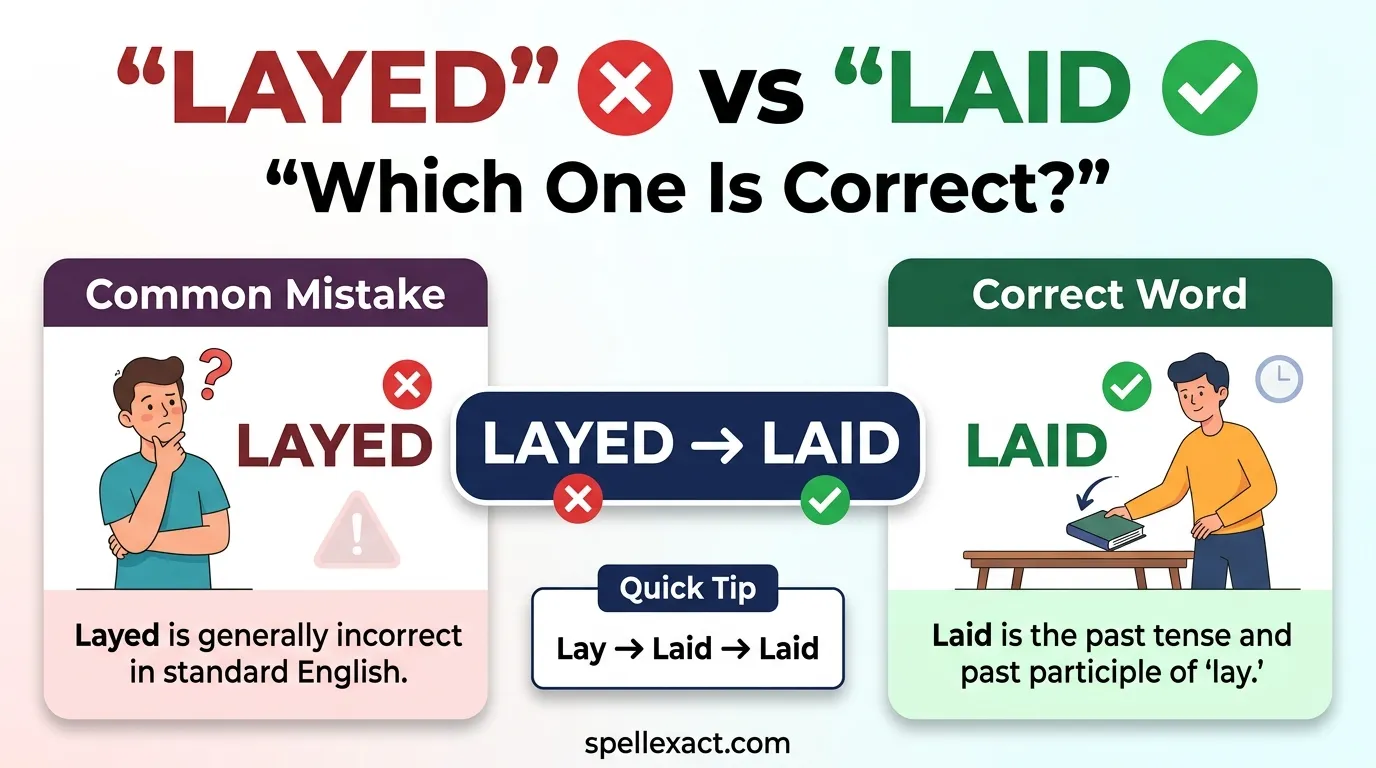
The layed vs laid difference is easy to understand once you know that lay is an irregular verb, not a regular verb. When checking spelling and grammar, remember that laid is the correct past tense of lay, meaning to put down.
Layed is a misspelling and comes from the common mistake of adding -ed to form the simple past. Unlike regular verbs, irregular verbs can change form instead of following the usual -ed pattern. For this reason, the simple past tense of lay is laid, not layed.
The pattern becomes clearer when you understand how verbs, tense, and verb forms work. With regular verbs, adding -ed often creates the past tense, but irregular verbs follow their own forms.
Using layed is therefore erroneously applying a regular pattern to an irregular verb. In everyday writing, choosing the correct form, laid, helps you avoid a frequent spelling and grammar error and makes the distinction much easier to remember.
Quick Answer:
Laid is the correct past tense and past participle of lay.
Layed is generally considered an incorrect spelling when you mean the past tense of “lay.”
- Present: lay
- Past: laid
- Past participle: laid
- Incorrect: layed
Example:
- Correct: She laid the book on the table.
- Incorrect: She layed the book on the table.
However, “layed” can occasionally appear in specialized or nonstandard contexts, so it is best to use laid when writing standard English.
What Does “Laid” Mean?
Laid is the past tense and past participle of the verb lay. The verb “lay” generally means to put, place, or set something down.
The important thing to remember is that lay normally takes an object. You lay something somewhere.
For example:
- I laid my keys on the counter.
- He laid the baby in the crib.
- They laid the documents on the desk.
- She laid the blanket on the bed.
In each sentence, something is being placed somewhere.
Forms of “Lay”
| Verb form | Example |
| Present | I lay the book here. |
| Past | I laid the book here yesterday. |
| Past participle | I have laid the book here before. |
| -ing form | I am laying the book here. |
This pattern is worth memorizing because “lay” does not follow the simple -ed pattern that many regular verbs use.
Is “Layed” a Word?
This is where things can become confusing.
In standard modern English, layed is not the normal past tense of lay. If you are writing an essay, email, article, school assignment, business document, or professional content, you should use laid.
The reason people sometimes write “layed” is understandable. Many English verbs form their past tense by adding -ed:
- play → played
- walk → walked
- call → called
- clean → cleaned
So it may seem logical to write:
- lay → layed
But English does not work that way here. The correct form is:
- lay → laid
Therefore, if you mean “placed something somewhere,” choose laid, not “layed.”
Laid vs Lay: What Is the Difference?
Another common source of confusion is deciding between lay and laid.
The simplest distinction is:
- Lay = present tense
- Laid = past tense and past participle
Examples of “Lay”
Use lay when talking about something happening now or as a general action.
- I usually lay my clothes on the chair.
- Please lay the papers on my desk.
- They lay the foundation carefully.
Examples of “Laid”
Use laid when the action happened in the past or when using a perfect tense.
- I laid my clothes on the chair yesterday.
- She laid the papers on the desk.
- They have laid the foundation.
Lay vs Lie: The Bigger Source of Confusion
If you are confused by layed vs laid, you may also be struggling with lay vs lie. These verbs are closely related but have different meanings.
Lay means to put or place something.
Lie means to recline or be in a resting position.
Compare:
- I lay the phone on the table.
- I lie on the sofa.
The past tense makes things even more confusing:
- lay → laid
- lie → lay
And the past participle of “lie” is:
- lie → lay → lain
A Simple Comparison
| Verb | Meaning | Present | Past | Past Participle |
| Lay | Put/place something | lay | laid | laid |
| Lie | Recline/rest | lie | lay | lain |
For example:
Present: I lie on the bed.
Past: I lay on the bed yesterday.
Present: I lay the book on the bed.
Past: I laid the book on the bed yesterday.
This is why English learners often find these verbs frustrating. The forms overlap, but the meanings are different.
Layed vs Laid Examples
Seeing the words in context can make the difference much easier to remember.
Correct Uses of “Laid”
- She laid the keys beside the door.
- He laid his jacket on the chair.
- We laid the papers on the conference table.
- The farmer laid the tools in the shed.
- They laid flowers beside the memorial.
- I have laid everything out for dinner.
- The workers laid new tiles across the floor.
- She carefully laid the baby in the crib.
Incorrect Uses of “Layed”
In standard English, these should use laid:
- ❌ She layed the book on the desk.
- ✅ She laid the book on the desk.
- ❌ He layed his coat on the sofa.
- ✅ He laid his coat on the sofa.
- ❌ They layed the papers on the table.
- ✅ They laid the papers on the table.
Common Mistakes With Layed and Laid
Mistake 1: Adding “-ed” to “Lay”
A common assumption is that every verb becomes past tense by adding “-ed.”
That works for regular verbs, but lay is irregular.
Remember:
lay → laid, not lay → layed
Mistake 2: Confusing “Laid” With “Lay”
Consider:
Yesterday, I laid the book on the table.
Not:
Yesterday, I lay the book on the table.
Because the action happened in the past, laid is required.
Mistake 3: Confusing “Lay” With “Lie”
If there is no object being placed, you may actually need lie rather than lay.
Compare:
- I lie on the couch when I am tired.
- I lay the blanket on the couch.
A useful question is:
What is being placed?
If you can identify an object, “lay” is often the correct verb.
A Simple Trick to Remember Laid
Here is an easy memory trick:
Lay = today.
Laid = yesterday.
For example:
- Today: I lay the book on the desk.
- Yesterday: I laid the book on the desk.
You can also remember:
Lay it down → laid it down.
The word laid is the form you need when describing something that was placed somewhere in the past.
American vs British English
There is no major American-versus-British difference in the standard past tense of “lay.”
Both American English and British English use:
lay → laid → laid
For example, both varieties consider this standard:
She laid the baby in the crib.
Similarly, layed is not the normal standard past tense in either variety.
Differences may sometimes appear in informal speech, regional dialects, historical writing, or specialized terminology, but these do not change the standard spelling used in formal English.
When Should You Use “Laid”?
Use laid when:
- You are describing something that was placed somewhere.
- You are using the past tense of “lay.”
- You are using the past participle with have, has, or had.
- You are writing formal or standard English.
Examples:
- He laid the foundation.
- She laid the clothes on the bed.
- They had laid the groundwork for the project.
- I have laid the documents on your desk.
When Should You Use “Layed”?
For ordinary standard English, do not use “layed” as the past tense of “lay.”
If you are checking a sentence and you have written “layed” to mean “placed,” replace it with laid.
For example:
❌ I layed my phone beside the laptop.
✅ I laid my phone beside the laptop.
This simple correction will make your sentence grammatically correct in standard English.
Layed vs Laid: Quick Comparison
| Feature | Layed | Laid |
| Standard past tense of “lay” | ❌ No | ✅ Yes |
| Standard past participle | ❌ No | ✅ Yes |
| Meaning “placed” | ❌ Incorrect in standard usage | ✅ Correct |
| Used in formal English | ❌ Avoid | ✅ Yes |
| American English | Not standard | Standard |
| British English | Not standard | Standard |
FAQs
Is “layed” grammatically correct?
Generally, no. If you mean the past tense or past participle of lay, the correct form is laid. “Layed” should normally be avoided in standard English.
Is “laid” the past tense of “lay”?
Yes. Laid is both the past tense and past participle of lay.
Example: She laid the book on the table.
What is the past tense of lay?
The past tense of lay is laid.
Lay → laid
Example: He laid his phone on the desk.
Is “layed” ever correct?
“Layed” may appear in unusual, specialized, dialectal, or historical contexts, but it is not the standard past tense of “lay.” For normal modern English writing, use laid.
What is the difference between lay and lie?
Lay means to put or place something, while lie means to recline or rest.
- Lay the book on the table.
- Lie on the sofa.
Is “laid” used in both American and British English?
Yes. Laid is the standard form in both American and British English.
Which is correct: “I layed down” or “I laid down”?
If you mean that you reclined yourself, the standard sentence is actually “I lay down” for the simple past of “lie.”
For example:
I lay down for an hour yesterday.
If you mean that you placed something down, use laid:
I laid the book down.
How can I remember laid vs layed?
Remember that the past tense of lay is irregular:
lay → laid → laid
Think: “I laid it down yesterday.”
Final Summary
The difference between layed vs laid is easier once you remember that laid is the standard past tense and past participle of lay. If you are talking about putting or placing something somewhere, use laid for a completed past action: She laid the keys on the table. “Layed” is generally an incorrect form in standard modern English.
Also keep lay vs lie separate in your mind. “Lay” takes an object and means to put or place something, while “lie” means to recline or rest. Once you learn the basic pattern—lay → laid → laid—you can avoid one of the most common English grammar and spelling mistakes with confidence.
Actionable Takeaway
Whenever you are tempted to write “layed,” stop and ask what you mean. If you mean “placed,” choose laid. If you mean “rested or reclined,” check whether lie, lay, or lain is the correct form.
Quick rule to remember:
👉 Lay it down today. Laid it down yesterday.

Aaron Adam is the Administrator of SpellExact, dedicated to helping readers improve their spelling and writing accuracy. He oversees content quality, ensures reliable language resources, and works to make spelling guidance simple, practical, and accessible for everyone.