If you have ever written “tieing” and wondered whether it looks right, you are not alone. The word can be confusing because many English verbs form their -ing version by simply adding -ing. However, tieing is not the standard spelling in modern English.
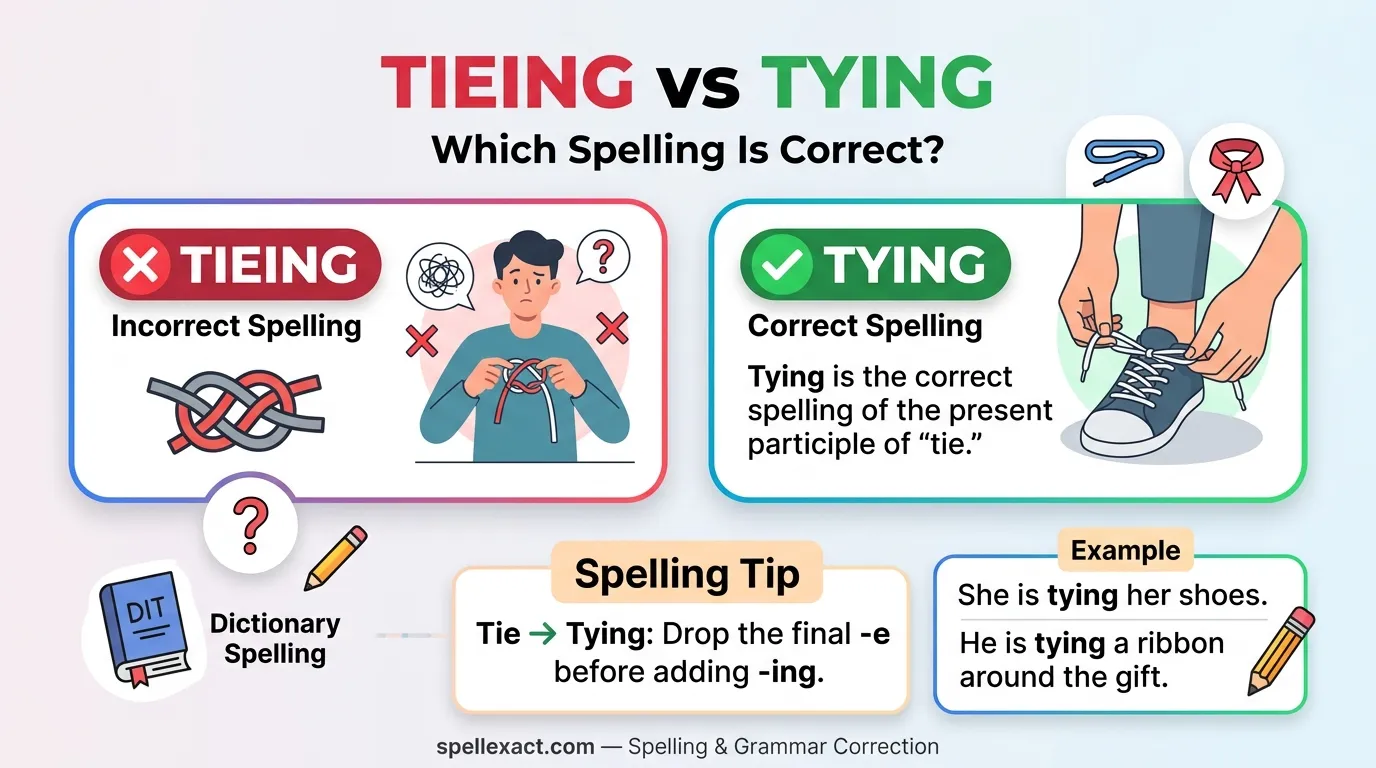
The correct spelling is tying. If you are talking about tying your shoes, tying a knot, tying a ribbon, or tying two things together, tying is the form you should use. Let’s look at why this spelling is correct, how the rule works, and how to avoid making the same mistake again.
Quick Answer:
Tying is the correct and standard spelling.
Tieing is generally considered a misspelling in modern standard English.
The confusion happens because the base verb is tie, and when -ing is added, the spelling changes slightly:
- Tie + ing = tying
- Not tie + ing = tieing
The final e is removed, and the y remains, giving us tying.
Correct:
She is tying her shoelaces.
Incorrect:
She is tieing her shoelaces.
If you are writing an email, essay, article, school assignment, professional document, or website content, choose tying.
What Does “Tying” Mean?
Tying is the present participle and gerund form of the verb tie.
The verb tie generally means to fasten, connect, secure, or hold something in place using a knot, string, rope, ribbon, cord, or another material.
For example:
- I am tying my shoes.
- She is tying a ribbon around the gift.
- He is tying the rope to the post.
- They are tying the boxes together.
- The child is learning how to tie a knot.
“Tying” can also be used in a figurative sense. For example, someone might say, “The two teams are tying for first place,” although in this context tying means reaching the same score or position.
Why Is “Tying” Correct?
The spelling becomes clearer when you understand what happens when tie takes the -ing ending.
The base verb is:
tie
When we add -ing, we normally remove the silent e at the end of a verb:
make → making
write → writing
dance → dancing
take → taking
The same basic spelling principle applies to tie. However, there is an additional change because the word ends in ie.
Instead of writing:
tie + ing = tieing
English changes the ending ie to y before adding -ing:
tie → tying
This is why the correct spelling contains a y:
TYING
rather than:
TIEING
Tieing vs Tying: Comparison Table
| Word | Correct? | Explanation | Example |
| Tying | ✅ Yes | Standard spelling of the -ing form of “tie” | She is tying her shoes. |
| Tieing | ❌ No | Common spelling mistake | She is tieing her shoes. |
| Tie | ✅ Yes | Base form of the verb | I need to tie this rope. |
| Tied | ✅ Yes | Past tense and past participle | He tied the knot. |
The key point is simple: use “tying” when you need the -ing form of “tie.”
Examples of Tying in Everyday English
Understanding the word in real sentences can make the spelling easier to remember.
Example 1: Shoes
I am tying my shoes before going outside.
Here, “tying” means fastening the shoelaces.
Example 2: A Present
Sarah is tying a colorful ribbon around the gift.
The ribbon is being fastened around the package.
Example 3: A Rope
The sailor is tying the rope securely to the boat.
“Tying” describes the action of securing the rope.
Example 4: Hair
She is tying her hair back before exercising.
Here, the word describes fastening the hair with a hair tie or similar item.
Example 5: A Knot
He spent several minutes tying a complicated knot.
The person is performing the action of making the knot.
Example 6: Figurative Meaning
The two candidates are tying in the latest poll.
In this sentence, “tying” means they have an equal result.
Common Mistakes With “Tieing”
The spelling tieing is easy to produce because it looks like a logical combination of the words tie + ing. However, English spelling does not always work by simply attaching a suffix.
One of the most common mistakes is writing:
I am tieing my shoes.
The correct version is:
I am tying my shoes.
Another mistake is assuming that every verb ending in e follows exactly the same spelling pattern. While removing the final e is common before -ing, verbs ending in ie have their own spelling pattern.
Remember:
- die → dying
- lie → lying
- tie → tying
Notice the pattern. The ending ie changes to y before -ing.
Tie, Tied, Tying: Don’t Mix Them Up
These three forms are related, but they are used differently.
Tie
Tie is the base form.
Please tie your shoes.
Tied
Tied is the past tense and past participle.
She tied her shoes before leaving.
Tying
Tying is the present participle or gerund.
She is tying her shoes now.
A quick way to remember them is:
Tie → Tied → Tying
This pattern is useful because it prevents you from accidentally writing tieing.
Why Do People Spell It “Tieing”?
The incorrect spelling tieing is understandable. When people hear the word, they may mentally combine the base word tie with the suffix -ing:
tie + ing
That produces tieing, which looks reasonable at first glance.
However, standard English spelling changes ie to y in this situation. The result is:
tie + ing → tying
This is one of those English spelling patterns that is easier to remember through examples than through a complicated rule.
If you frequently confuse these forms, remember the related words dying, lying, and tying. They all follow the same -ie → -y pattern before -ing.
Is “Tieing” Ever Correct?
For modern standard English, tieing should generally be treated as an incorrect spelling.
You may occasionally encounter unusual, historical, dialectal, or specialized spellings in older texts or nonstandard writing, but that does not make tieing the appropriate choice for normal modern English.
For everyday communication and professional writing, use:
tying
This applies to American English and British English.
American vs British English: Is There a Difference?
There is no meaningful American-versus-British spelling difference between tying and tieing.
Both American English and British English use:
tying
For example:
American English:
He is tying his shoes.
British English:
He is tying his shoes.
The spelling remains the same.
This is different from words such as color/colour, favorite/favourite, or organize/organise, where regional spelling conventions can differ. With tying, there is no standard US/UK distinction.
Easy Trick to Remember “Tying”
Here is a simple memory trick:
IE becomes Y before -ING.
Think of these three words together:
- die → dying
- lie → lying
- tie → tying
If you remember die, lie, tie, you can easily remember dying, lying, tying.
Another useful trick is to think:
Tie loses “ie” and gets “y.”
So:
TIE → TYING
Not:
TIE → TIEING
This small spelling pattern can save you from a very common typo.
Common Sentences With “Tying”
Here are more examples to help reinforce the correct spelling:
- I am tying my shoelaces.
- She is tying a bow on the present.
- He is tying the rope to the fence.
- They were tying the packages together.
- The children are tying balloons to the chairs.
- She was tying her hair before the workout.
- He is tying a knot in the string.
- We are tying everything down before the storm.
- The two teams are tying for second place.
- She learned tying techniques from her father.
Common Questions About Tieing vs Tying
Is “tieing” a correct spelling?
No. Tying is the standard modern English spelling. “Tieing” is generally considered a misspelling.
Why is “tying” spelled with a Y?
The ie ending in tie changes to y when the -ing suffix is added. Therefore, tie + ing becomes tying, not “tieing.”
Is “tying” correct in American English?
Yes. Tying is the standard spelling in American English.
Is “tying” correct in British English?
Yes. British English also uses tying. There is no standard British spelling “tieing” for ordinary modern usage.
What is the past tense of “tie”?
The past tense is tied.
For example:
She tied her shoes before the race.
What is the present participle of “tie”?
The present participle is tying.
For example:
She is tying her shoes.
What is the difference between tie and tying?
Tie is the base form of the verb, while tying is the -ing form.
For example:
I need to tie this rope.
I am tying this rope.
How can I remember the spelling of tying?
Remember the pattern:
die → dying
lie → lying
tie → tying
The ie changes to y before -ing.
Final Summary
When choosing between tieing vs tying, the correct spelling is tying. The word tieing is a common spelling mistake caused by adding -ing directly to the base word tie. In standard modern English, the ie changes to y, producing tying.
Whether you are writing about tying shoelaces, tying a knot, tying a ribbon, securing a rope, or two teams tying in a competition, use tying. The same spelling is accepted in both American and British English, so you do not need to worry about a regional variation.
Actionable Takeaway
When you are unsure, remember this simple pattern:
Tie → Tying ✅
Tie → Tieing ❌
Keep tying in mind alongside dying and lying, and this common spelling mistake becomes much easier to avoid. If you’re checking your writing for spelling accuracy, always replace tieing with tying.

Aaron Adam is the Administrator of SpellExact, dedicated to helping readers improve their spelling and writing accuracy. He oversees content quality, ensures reliable language resources, and works to make spelling guidance simple, practical, and accessible for everyone.